
SLIDE 1
= thing but which is often in reality, not true. Stereotyping can - - PowerPoint PPT Presentation
What is Stereotyping? Stereotyping is a fixed idea/image a person has of an individual, a group or = thing but which is often in reality, not true. Stereotyping can be harmful. For example if asked to think of a soldier, = a firefighter or a
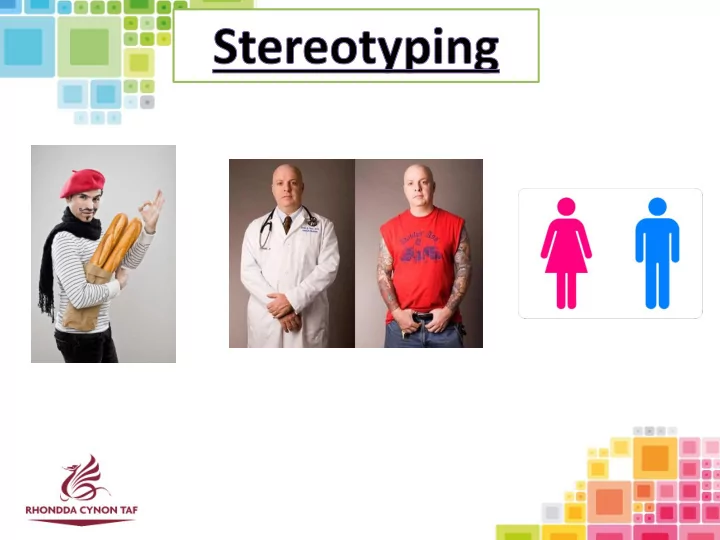
Stereotyping is a fixed idea/image a person has of an individual, a group or thing but which is often in reality, not true.
For example if asked to think of a soldier, a firefighter or a footballer; stereotypically this would be associated as a male. Stereotyping can be harmful.
Stereotypes are generalised because an individual or group assumes that the stereotype is true for each individual person who falls within these categories
People have their own stereotypes about things such as gender, race or religion. These may be influenced by various sources such as the media, culture, family and friends and even education.
We tend to “categorise” people to make it easier for us to understand. A stereotypical example of this may be associating careers for males in labouring/construction and for females in the caring professions. Although historically that statement has some truth, in our current climate roles are becoming less gender defined.
Childcare Worker Midwife Soldier Millionaire
Here are some of the examples that are usually associated with the
Although there has been wider progress towards gender equality, women still only make up 14.4% of all people working in STEM (Science, Technology, Engineering and Maths) in the UK, despite being about half
BBC (2020) In recent years there has been a big push on STEM based
populated and seen as “male” roles.
“Regardless of the positive trend of more women choosing STEM subjects the number of men choosing STEM subjects is rapidly increasing too … the percentage of women with STEM degrees has dropped from 25% to 24%” Built By Me (2019) There has been a “25% increase in the number of professional women engineers in a sector that grew 8.5%
working as professional engineers, more than double the number there were in 2013”, 7 years ago. Wise Campaign (2018)
We can form opinions of people when we meet them for the first time based just on appearance alone. However, these are not always true. It might be a case of us stereotyping and judging someone by their
appearance rather than getting to know the real them. These images will hopefully challenge the gender stereotypes associated with the roles