Theory, Mechanisms and Hierarchical Modelling of Climate Dynamics: - - PowerPoint PPT Presentation

theory mechanisms and hierarchical modelling of climate
SMART_READER_LITE
LIVE PREVIEW

Theory, Mechanisms and Hierarchical Modelling of Climate Dynamics: - - PowerPoint PPT Presentation

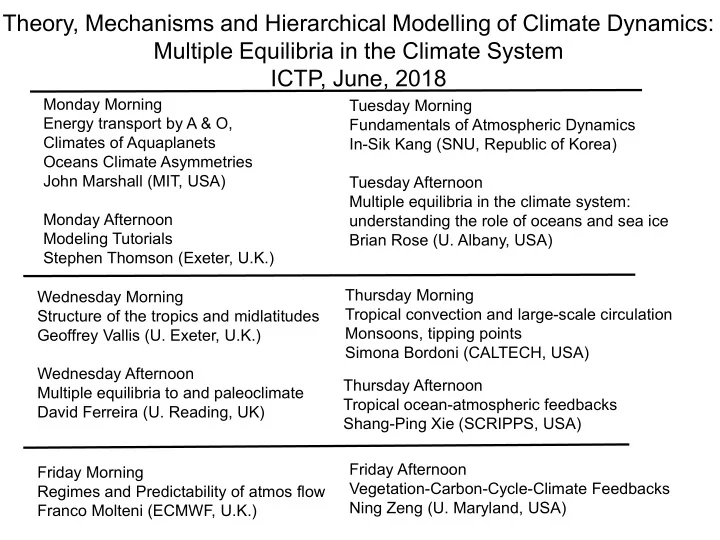
Theory, Mechanisms and Hierarchical Modelling of Climate Dynamics: Multiple Equilibria in the Climate System ICTP, June, 2018 Monday Morning Tuesday Morning Energy transport by A & O, Fundamentals of Atmospheric Dynamics Climates of


slide-1
SLIDE 1

Monday Morning Energy transport by A & O, Climates of Aquaplanets Oceans Climate Asymmetries John Marshall (MIT, USA) Monday Afternoon Modeling Tutorials Stephen Thomson (Exeter, U.K.) Tuesday Morning Fundamentals of Atmospheric Dynamics In-Sik Kang (SNU, Republic of Korea) Tuesday Afternoon Multiple equilibria in the climate system: understanding the role of oceans and sea ice Brian Rose (U. Albany, USA) Wednesday Morning Structure of the tropics and midlatitudes Geoffrey Vallis (U. Exeter, U.K.) Wednesday Afternoon Multiple equilibria to and paleoclimate David Ferreira (U. Reading, UK) Thursday Morning Tropical convection and large-scale circulation Monsoons, tipping points Simona Bordoni (CALTECH, USA) Thursday Afternoon Tropical ocean-atmospheric feedbacks Shang-Ping Xie (SCRIPPS, USA) Friday Morning Regimes and Predictability of atmos flow Franco Molteni (ECMWF, U.K.) Friday Afternoon Vegetation-Carbon-Cycle-Climate Feedbacks Ning Zeng (U. Maryland, USA)

Theory, Mechanisms and Hierarchical Modelling of Climate Dynamics: Multiple Equilibria in the Climate System ICTP, June, 2018

slide-2
SLIDE 2

Coupled Climate Dynamics: Energy transport by the Atmosphere and Ocean

John Marshall, MIT

  • 1. Energy transport by A & O

Observations Importance of hierarchical modeling

  • 2. Climate of an Aquaplanet
  • 3. Oceans and Climate asymmetries
slide-3
SLIDE 3
  • 1. Energy transport by A & O

Observations Importance of hierarchical modeling

Figs from Marshall and Plumb, 2008

slide-4
SLIDE 4

Earth’s Energy Balance

Two important consequences

  • 1. Warmer, and moister, in the tropics

than at higher latitudes

  • 2. Atmosphere, and ocean, must

transport, energy from low to high latitudes

Net top of the atmosphere

slide-5
SLIDE 5

Warm, and moist in the tropics

slide-6
SLIDE 6

Warm, and moist in the tropics

slide-7
SLIDE 7

Energy budget of the atmosphere and ocean

Total Northward Energy Transport Atmos + Ocean

PW 1015W

Note:

slide-8
SLIDE 8

Air-sea heat flux

In to ocean Out of ocean

slide-9
SLIDE 9

Ocean heat transport, basin by basin

Atlantic Indian

slide-10
SLIDE 10

Notes:

Trenberth and Caron, 2001

Northward Energy Transport by Atmosphere and Ocean

  • Atmosphere dominates over ocean in middle to high latitudes
  • Ocean transports substantial amounts of heat out of the tropics
  • Error bars are considerable
slide-11
SLIDE 11

Key climate questions

  • What determines the total meridional

energy transport and its partition between the atmosphere and ocean?

  • What sets the pole-equator

temperature gradient?

  • What determines the extent
  • f polar ice caps?
  • To what extent is the ocean ‘slaved’ to

the atmosphere?

  • Can more than one climate state exist

for the same external forcing?

Trenberth and Caron, 2001 See afternoon sessions by Brian Rose and by David Ferreira

slide-12
SLIDE 12

H B

Atmos Ocean Energy contrast Mass transport

Meridional energy transport is:

kg s1 J kg1

Framework for thinking about Energy Partition between A and O

Note: If we define a Sverdup (Sv) as 109 kg s1then

can readily compare the mass transports in each fluid.

Plot mass transport in energy space

slide-13
SLIDE 13

Ocean circulation

Abyssal ocean, ventilated by convection from poles Warm, salty lenses driven by the wind, floating on a well-mixed abyss.

HO vol cp

kg m3 m3s1

103 20 106 4000 15

  • B
  • 1.2 1015W

Co

  • Meridional energy transport

Example

slide-14
SLIDE 14

e

  • A

O 1 HA HO BA BO 1

e

  • convection

Atmos Ocean

moist

Held, 2001 Czaja and Marshall, 2006

BA CAT gz Lq

Note – in atmosphere need to consider moist static energy

Ratio of energy transports

Asymmetry of stratification of A and O in deep tropics

Ratio of mass transports Ratio of stratifications

slide-15
SLIDE 15

120Sv 30Sv

O

A

1 Sv 109 kg s1

Observational estimates

A & BA

from NCEP re-analyzed

BA CAT gz Lq

Moist static energy

Czaja and Marshall, JAS, 2006 Dominance of over is a consequence of

HA

HO A O

p p p

  • vz

vp g

How robust is this partition? Could it have been different in past, in future?

slide-16
SLIDE 16

Modeling hierarchies 2-box model Observed Climate ‘Sim-Earth’ Eq Pole

Modeling hierarchies

slide-17
SLIDE 17

Modeling hierarchies

slide-18
SLIDE 18

Modeling hierarchies

slide-19
SLIDE 19

Modeling hierarchies

slide-20
SLIDE 20

Modeling hierarchies

slide-21
SLIDE 21

Modeling hierarchies

slide-22
SLIDE 22

Modeling hierarchies

Ken Fallin

slide-23
SLIDE 23

‘Ken takes a sharp look, brandishes his steel quill, and traces in ink the essence of a living soul’ Ken Fallin

slide-24
SLIDE 24

Climate of a Water World

What would the climate of earth be like if there were no land?

Aqua Ridge Double Drake Drake

barrier Explore with a series of numerical simulations of highly idealized water worlds A, O, possibility of Ice, but no land

Coupled A, O, Ice model

slide-25
SLIDE 25

Coupled Climate Dynamics: Energy transport by the Atmosphere and Ocean

John Marshall, MIT

  • 1. Energy transport by A & O

Observations Importance of hierarchical modeling

  • 2. Climate of an Aquaplanet
  • 3. Oceans and Climate asymmetries
slide-26
SLIDE 26

Vorticity at ocean’s surface

Aqua-planet Project

Series of papers by John Marshall, Brian Rose, David Ferreira & collaborators Riccardo Farneti & Geoff Vallis

Aqua-planet Project

Thanks to: Martha Buckley J-M Campin Aaron Donohoe Daniel Enderton David Ferreira Brian Green Mukund Gupta Chris Hill David McGee Paul O’Gorman Brian Rose Sara Seager

Applied to: Understand present climate Paleo climate Multiple equilibria of climate Exoplanets

slide-27
SLIDE 27

Climate of an Aquaplanet

http://oceans.mit.edu/JohnMarshall/research/climate-dynamics/page-1/

What would the climate of earth be like if there were no land? How would it achieve the requisite meridional energy transports?

slide-28
SLIDE 28

MITgcm ‘SPEEDY’ Intermediate complexity ICE

Poles well represented

A & O

  • n same grid

Fully coupled: no adjustments Winton, 2000

2000 years in 1 week of CPU time

(synchronous)

J-M Campin and Chris Hill built the model David Ferreira helped drive forward the science Franco Molteni, 2003

Coupled Climate Model

slide-29
SLIDE 29

Aqua-planet

slide-30
SLIDE 30

Sea Surface Temperature & Sea Ice

Sea-ice thickness (m)

slide-31
SLIDE 31

Climate of aqua-planet

500mb T

ICE

A q S

Salinity

Specific humidity

Zonal jets in ocean

Equator

A O

U U

S

q

x

30N 60N

Marshall, Ferreira et al JAS, 2007

Circumpolar currents everywhere

Circumpolar currents everywhere

Aquaplanet solution discussed in

Winds, Currents and Temp Surface Winds

slide-32
SLIDE 32
  • Eu

res

  • Subtropical

Cells

A

O

Today’s climate

HA HO HA

HO

PW Aqua planet Eulerian view z or p

200 Sv

A

O

Mass transport streamfunction

45 Sv Residual view

energy

slide-33
SLIDE 33

A s

f AvhA

O s

f OvhO

Atmosphere Ocean

Dominates in extra-tropics Balance one-another in extra-tropics

Interpretation

s

In tropics

O A 1

O A OvhO AvhA

In extra-tropics

vh

v z

Ks

Now If isentropic slopes in the two fluids are comparable, then supposing that

KA 4 106 m2 s1 KO 103 m2 s1

O A OKO AKA 1 4 where K is an eddy diffusivity. bolus transport typical of turbulent diffusivities in A and O

slide-34
SLIDE 34

Why ice at the poles in aqua?

Poleward mass transport in the ocean all but vanishes at high latitudes Very small high latitude meridional energy flux

HO

A

O

Mass transport streamfunction energy

Pole freezes over

H B

slide-35
SLIDE 35

Conclusions

  • Energy flux partition can be rationalized by

Dominance of over is a consequence of

HA

HO

120Sv 30Sv

O

A

1 Sv 109 kg s1

A O

  • Partition of heat transport on aqua-planet

remarkably similar to present climate

  • Ocean energy transport on aqua-planet very small at high latitudes

Vanishing of residual flow at high latitudes Ice builds up over the poles Can interpret using zonal-average theory As we shall see, the aqua-planet supports multiple equilibria