The World The World Conservation Conservation Union Union - - PowerPoint PPT Presentation

the world the world conservation conservation union union
SMART_READER_LITE
LIVE PREVIEW

The World The World Conservation Conservation Union Union - - PowerPoint PPT Presentation

The World The World Conservation Conservation Union Union Linking policy and practice for sustainability The International Union for Conservation of Nature Agenda 1. Who we are 1. IUCN Programme Practical solutions for shaping a


slide-1
SLIDE 1

The International Union for Conservation of Nature
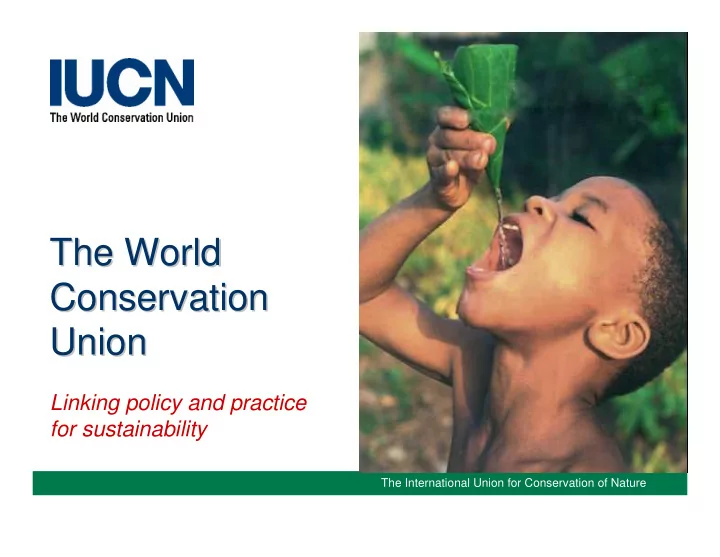
The World The World Conservation Conservation Union Union

Linking policy and practice for sustainability

slide-2
SLIDE 2

The International Union for Conservation of Nature

Agenda

1. Who we are

1. IUCN Programme

  • Practical solutions for shaping a sustainable future

2. IUCN Policy

  • Influencing decision-makers for a sustainable future

3. IUCN at the Bali Conference

  • Case-study on climate change policy and practice
slide-3
SLIDE 3

The International Union for Conservation of Nature

1. IUCN Programme: “Shaping a sustainable Future”

  • Framework for IUCN’s projects and activities around the world
  • Approved by members every 4 years at Congress
  • Current programme from 2005 to 2008
  • Planning for IUCN New Programme 2009-2012:

“Shaping a sustainable Future”

slide-4
SLIDE 4

The International Union for Conservation of Nature

Shaping a sustainable future

Reposition conservation to enhance its engagement with, and impact on, economic and social agendas Reinforcing the environmental pillar of sustainable development

slide-5
SLIDE 5

The International Union for Conservation of Nature

Addressing the causes

  • f biodiversity loss…
  • Natural resources use
  • Species introduction
  • Land use
  • Climate Change
  • Population dynamics
  • Global economy
  • Politics and institutions
  • Cultural values

… and the underlying threats to sustainability

Shaping a sustainable future

slide-6
SLIDE 6

The International Union for Conservation of Nature

Shaping a sustainable future

Biodiversity Biodiversity Climate change Climate change

Climate change will impact biodiversity Biodiversity can help mitigate and adapt to climate change

slide-7
SLIDE 7

The International Union for Conservation of Nature

Shaping a sustainable future

Biodiversity Biodiversity

Energy policies and infrastructures will impact biodiversity Biodiversity can play a role in generating new energy models

Energy Energy

slide-8
SLIDE 8

The International Union for Conservation of Nature

Shaping a sustainable future

Conserving biodiversity Climate Change Energy Poverty & Security Economy & Markets

Naturally energizing the future

I m p l e m e n t i n g e c

  • l
  • g

i c a l l y s u s t a i n a b l e , e q u i t a b l e a n d e f f i c i e n t e n e r g y s y s t e m s

Managing ecosystems for human well-being

Improving livelihoods, reducing poverty and vulnerability, and enhancing environmental and human security through sustainable ecosystem management

Greening the world economy

Integrating ecosystem conservation values in economic policy, finance and markets

Conserving the diversity of life

Ensuring sustainable and equitable management of biodiversity from local to global levels

slide-9
SLIDE 9

The International Union for Conservation of Nature

Conserving the diversity of life

Ensuring sustainable and equitable management of biodiversity from local to global levels

1.1 - Biodiversity-related policies and governance systems enable action towards the achievement of biodiversity conservation 1.2 - IUCN standards, tools and knowledge for sustainable natural resource management available and used for biodiversity conservation including effective management of global and regional common natural resources

slide-10
SLIDE 10

The International Union for Conservation of Nature

Changing the climate forecast

Integrating biodiversity considerations and

  • pportunities into climate

change policy and practice

2.1 - Climate change mitigation policies and practice include biodiversity concerns from local to global level. 2.2 - Natural resources management strategies to adapt to the impact of climate change are adopted and implemented

slide-11
SLIDE 11

The International Union for Conservation of Nature

Naturally energizing the future

Implementing ecologically sustainable, equitable and efficient energy systems

3.1 - Energy policies and strategies mitigate the impact of the growing energy demand on biodiversity. 3.2 - Ecosystem services that underpin sustainable and equitable energy, are incorporated in energy policies and strategies

slide-12
SLIDE 12

The International Union for Conservation of Nature

Managing ecosystems for human well-being

Improving livelihoods, reducing poverty and vulnerability, and enhancing environmental and human security through sustainable ecosystem management

4.1 - Development policies and strategies support vulnerable and poor stakeholders, especially women, to sustainably manage ecosystems for improved livelihoods. 4.2 - Sustainable environmental management reduces vulnerability to natural hazard and conflicts.

slide-13
SLIDE 13

The International Union for Conservation of Nature

Greening the world economy

Integrating ecosystem conservation values in economic policy, finance and markets

5.1 - Economic, trade and investment policies better integrate biodiversity values. 5.2 - Companies, industry associations and consumer groups incorporate ecosystem values into planning and action.

slide-14
SLIDE 14

The International Union for Conservation of Nature

Global results

Conserving the diversity of life Changing the climate forecast Naturally energizing the future Managing ecosystems for human well-being Greening the world economy

1.1 1.2 2.1 2.2 3.1 3.2 4.1 4.2 5.1 5.2

Component results Thematic priority areas

Regional Programme Global Thematic Programme Commission

Component Programme Plans

Regional Programme Global Thematic Programme Commission

Component Programme Plan

Each component programme has its own plan that fits within, and contribute to the IUCN Programme

slide-15
SLIDE 15

The International Union for Conservation of Nature

From practice to policy, from policy to practice

Empowerment Action Knowledge Influence

slide-16
SLIDE 16

The International Union for Conservation of Nature

  • 2. IUCN Policy:

Influencing decision-makers for a sustainable future

IUCN mission is to influence, encourage and assist societies throughout the world to to conserve biological diversity and ensure that use of biological resources is equitable and ecologically sustainable.

slide-17
SLIDE 17

The International Union for Conservation of Nature

IUCN « influences » societies

  • WHO DOES POLICY: Different roles of components of IUCN: policy

system

  • WHAT WE DO: Work of the Secretariat and Commissions in

implementing the Programme and the WCC policy – work at international level (conventions, agreements, processes); – work at national level (policies of ministries, PS, civil society); – issue statements to third parties

slide-18
SLIDE 18

The International Union for Conservation of Nature

WHO does policy in IUCN: Policy System

  • World Conservation Congress is only body entitled to define IUCN

general policy through Resolutions and Recommendations; WCC approves Programme

  • Members submit and vote motions at WCC, support IUCN’s objectives,

participate in Nat. and Reg. Committees

  • Council provides rulings and complementary guidance + submits WCC

motions

  • Directo Genneral implements IUCN Policy (WCC + Council); only DG can

issue Policy Statements

  • Commissions provide scientific input to policies
  • National and Regional Committees pursue their own policies and issue

statements on their name

slide-19
SLIDE 19

The International Union for Conservation of Nature

IUCN’s Secretariat work in international policies and agreements

  • UN Observer Status, and presence in New-York
  • Providing scientific and technical advice (WH, Ramsar, CITES)
  • Setting global standards (PAs categories)
  • Developing and advocating policy positions and supporting key

processes, especially inter-governmental (CBD, UNFCCC, WSSD, CCD, G8, WBCSD, regional agreements)

  • Providing a neutral forum or acting as a neutral facilitator
  • Supporting capacity building and implementation
slide-20
SLIDE 20

The International Union for Conservation of Nature

slide-21
SLIDE 21

The International Union for Conservation of Nature

IUCN’s comparative advantages

  • Governmental and NGO Membership – Convening

function

  • Scientific and technical input from Commissions and

RCOs’ projects

  • Bridge between policy and practice
  • Global-to-local coverage (offices in 42 countries),

resulting in interventions at these levels e.g. capacity building

  • Status of Observer to the UN General Assembly
  • Strategic presence in key capitals and at regional

level

slide-22
SLIDE 22

The International Union for Conservation of Nature

UN Observer Status

  • Granted in October 1999
  • Only conservation organization to have Observer

Status to the United Nations

  • Opportunity to:

Advance policy work of IUCN at highest level- UNGA and its commissions, ECOSOC, support NY missions’ work New voice for IUCN’s constituency through access to fora closed to non-members (WSSD) IGO status in CBD, UNFCCC, UNEP GC etc

slide-23
SLIDE 23

The International Union for Conservation of Nature

  • 3. IUCN at the Bali Conference

Case Study on climate change

slide-24
SLIDE 24

The International Union for Conservation of Nature

Climate change: What is at stake ?

  • Impacts of climate change (+0.6°

C) affecting ecosystems and poor communities

  • +2°

C will cause irreversible impacts: risk of extinction for 1/3 of species; uninhabitable low-lying islands; frequent and severe weather events; reduction in cereal productivity

  • Economic costs of climate change

(Stern review): 5 to 20% of GDP /year, cost of action = only 1%

  • Atmospheric concentration of 450

ppmCO2eq -> median probability of 50% of avoiding more than +2°C

  • It would require cuts in global

emissions by 50% by 2050 Source: UK Meteorological Office and the Climatic Research Unit of the University of East Anglia

Global T° C increase of 0.6°since pre-industrial levels

slide-25
SLIDE 25

The International Union for Conservation of Nature

What happened in Bali ?

  • 180 countries agreed on a Bali

Roadmap to reach agreement by 2009

  • No commitment on emission targets
  • Issue of North/South equity, technology

transfer and adaptation

  • Agreement on REDD (Reduced

Emissions from Deforestation in developing countries)

  • Agreement on Adaptation Fund (2% on

CDM, but would need 50 billion US $/year)

  • 4 additional inter-sessional meetings in

2008, March in Bangkok and June in Bonn

slide-26
SLIDE 26

The International Union for Conservation of Nature

IUCN key messages for the COP Role of biodiversity and livelihoods for climate Reach a post 2012 agreement Integrate Reduced Emissions from Deforestation and ecosystem Degradation (REDD) Use sustainable guidelines for biofuels Fund and support Adaptation Mainstream Gender into climate change policy

slide-27
SLIDE 27

The International Union for Conservation of Nature

Defining roles and responsibilities

  • Representation, high-

level meetings, media interviews

  • UN negotiations
  • Thematic leads
  • Congress
  • Communicaton, Media
  • Coordination, Support,

Logistics, Reporting

  • Julia (DG), Puri and Christine

(VP)

  • Martha, Elise
  • Stewart, Earl, Joshua, Jeff,

Lorena, David

  • François
  • John
  • Elise, David
slide-28
SLIDE 28

The International Union for Conservation of Nature

Getting prepared for the event

1 Nov: Thematic contributions for position paper 8 Nov: First draft of position paper and 4 Fact Sheets (REDD, Biofuels, Adaptation, Gender) 12 Nov: Final position paper for translation 14 Nov: 4th Delegation meeting 19 Nov: Final Fact Sheets and translated position paper, Shipping material/ Printing in Bali 29 Nov: 5th Delegation meeting

slide-29
SLIDE 29

The International Union for Conservation of Nature

IUCN participation in the event

3-14 Dec : IUCN exhibit, daily briefings 8 Dec: CIFOR Forest Day 11 Dec: Women Environment Ministers 11-13 Dec: Interviews with media, 1 to 1 meetings with decision-makers 13 Dec: IUCN side event on biofuels 14 Dec: DG speech in high-level segment 18 Dec: IUCN report

slide-30
SLIDE 30

The International Union for Conservation of Nature

Lessons learned

Positive outcomes ☺ ☺ ☺ ☺ + Excellent networking + Fund-raising opportunity + Successful coordination + Promotion of Congress + Key messages well received + Positive outcomes on REDD and Adaptation To improve

  • Plan well in advance
  • More linkages with our

members and Regions

  • Capacity-building of

delegates from developing countries

  • Prepare scientific data

and facts for the press

slide-31
SLIDE 31

The International Union for Conservation of Nature

More information: http://www.iucn.org/climate