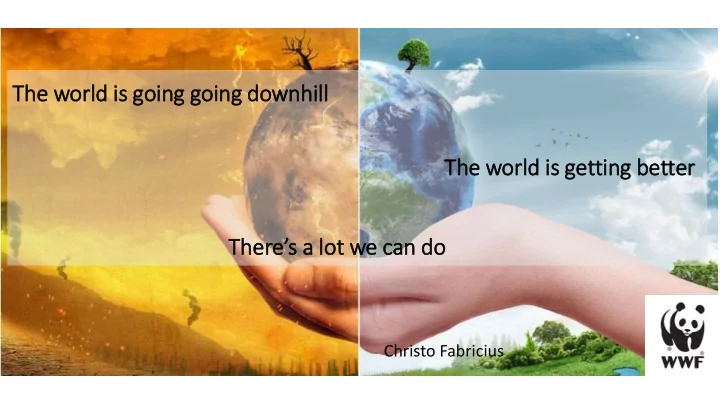
SLIDE 1 The world ld is is going going downhill ll The world ld is is getting better There’s a lot we can do
Christo Fabricius
SLIDE 2
The world is going downhill
SLIDE 3
There’s just too many of us..
SLIDE 4
The Great Acceleration: Socio-economic trends
SLIDE 5
The planet is FULL now
SLIDE 6
And we consume too much
SLIDE 7
The Global Living Planet Index 1970 to 2014
SLIDE 8
We are putting ourselves at risk
SLIDE 9
and people aren’t getting happier..
SLIDE 10
The world is getting better…
SLIDE 11
A rising Human Development Index
SLIDE 12
There are fewer people without education
SLIDE 13
Rate of population growth could slow down
SLIDE 14
Many diseases are under control
SLIDE 15
Healthy people on an unhealthy planet?
SLIDE 16
There’s a lot we can do
SLIDE 17 Every 0.5 degrees matters
- A a 1.5°C threshold
- Can avoid millions of premature deaths from heat
stress, malnutrition and air pollution
- 10 million fewer people exposed to sea-level rise
- 1.5 million additional tonnes of fish stocks
- 50% fewer people living with water scarcity
- At 2°C vs. 1.5
- Double the duration of heatwaves to 40 days
- Warm extremes increase 600%
- Number of dry days & rainfall extremes increase
- Average drought length last six months longer
- 5-million more people living with water scarcity at
2°C compared with 1.5°C
SLIDE 18
Transforming food systems
SLIDE 19 Renewable Energy
in South Africa cost nearly half the price of electricity generated from coal mines
- We could save R86 million
a year by 2050 if we use renewables
SLIDE 20 What progressive companies can do
- 1. Support decarbonization of
the energy sector. Invest in renewable energy
- 2. Get ahead of the curve: set
a science-based emission reduction target for your business
- 3. Make sure your voice is
heard
SLIDE 21 Invest in Nature
- Burning & clearing of tropical forests:
16 percent of global carbon dioxide (CO2 ) emissions
- more than all the world’s cars, trucks,
airplanes and ships combined
- Unsustainable agriculture: 14% of CO2
emissions.
- Halting emissions from forests and
sustainable agriculture, conserving natural ecosystems, is essential to resolve the climate challenge.
Agriculture: 21% Forests; 65% Grasslands; 0,0; 0% Wetlands 14% Agriculture Forests Grasslands Wetlands
Potential for cost-effective reduction and absorption of CO2
SLIDE 22 Investing a nature: a business opportunity?
- Save on disaster management costs
- Create jobs
- Leverage funds from corporations setting
science-based targets
- Water security
- Energy saving
- Food security
- Innovation
GET AHEAD OF THE CURVE TO BEND THE CURVE