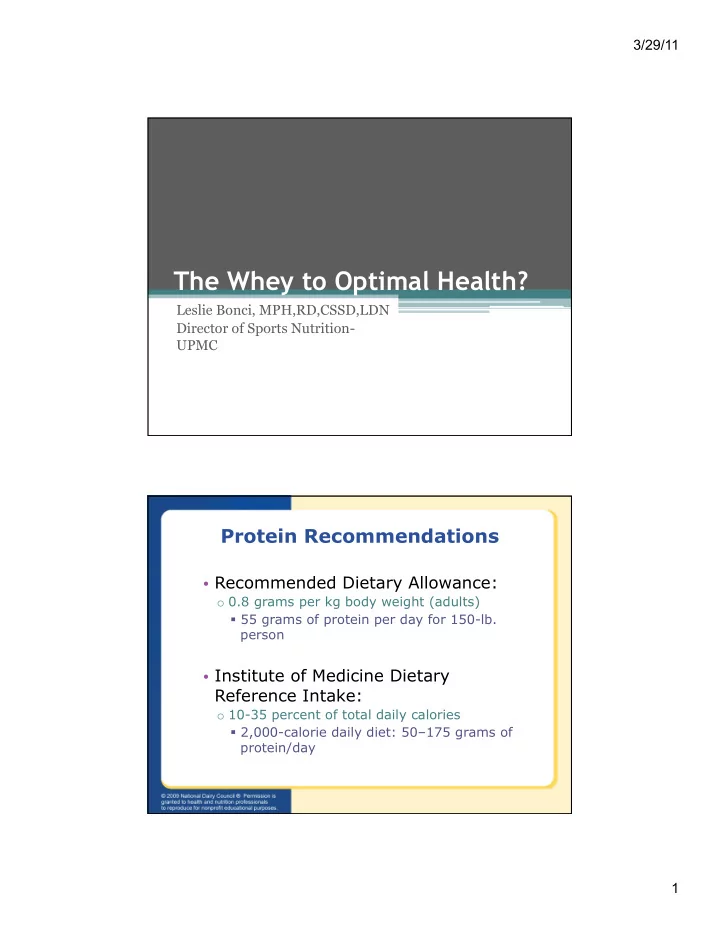
The Whey to Optimal Health? Leslie Bonci, MPH,RD,CSSD,LDN Director - - PDF document

the whey to optimal health
SMART_READER_LITE
LIVE PREVIEW

The Whey to Optimal Health? Leslie Bonci, MPH,RD,CSSD,LDN Director - - PDF document

3/29/11 The Whey to Optimal Health? Leslie Bonci, MPH,RD,CSSD,LDN Director of Sports Nutrition- UPMC Protein Recommendations Recommended Dietary Allowance: o 0.8 grams per kg body weight (adults) 55 grams of protein per day for


slide-1
SLIDE 1

3/29/11 1

The Whey to Optimal Health?

Leslie Bonci, MPH,RD,CSSD,LDN Director of Sports Nutrition- UPMC

  • Recommended Dietary Allowance:
  • 0.8 grams per kg body weight (adults)

§ 55 grams of protein per day for 150-lb. person

  • Institute of Medicine Dietary

Reference Intake:

  • 10-35 percent of total daily calories

§ 2,000-calorie daily diet: 50–175 grams of protein/day

Protein Recommendations

slide-2
SLIDE 2

3/29/11 2

How Much Protein?

  • The AMDR for protein is 10-35% of your daily

calorie intake

  • To estimate recommended protein intake, multiply your

weight (in lbs.) by the number below that matches your activity level or goals: ▫ Recreational exercise: 0.5-0.7 grams ▫ Endurance athlete: 0.5-0.8 grams ▫ Muscle building: 0.5-0.8 grams ▫ Weight loss with exercise and calorie restriction: 0.8-0.9 grams

IOM, 2005; Rodriguez, Am Coll Sports Med, ADA, Dieticians of Canada, 2009; Clark, Sport Nutrition Guidebook, 2008

RECOMMENDATIONS FOR CHILDREN

  • AGE
  • 1-3
  • 4-8
  • 9-10
  • Gms protein/kg BW
  • 1.1
  • 0.95
  • 0.95
slide-3
SLIDE 3

3/29/11 3

Muscle Protein Balance

Net Protein Balance difference between rates of protein synthesis (PS) and protein breakdown (PB) Positive Net Balance PS > PB = é lean body mass Negative Net Balance PB > PS = ê lean body mass

  • +
  • +

Phillips SM et al., J Am Col Nutr, 2005

Protein Balance During Feeding and Fasting

slide-4
SLIDE 4

3/29/11 4

Protein and Muscle Synthesis

  • Dietary protein is critical to build and

maintain muscle

  • Quality of dietary protein matters
  • Essential amino acids

▫ necessary to build protein ▫ stimulate muscle protein synthesis ▫ play a unique role in muscle metabolism (BCAAS)

BENEFITS OF WHEY

  • More BCAAs:

– Leucine – Isoleucine – Valine

  • Absorbed/utilized by skeletal muscle to promote

muscle protein synthesis and/or provide fuel for muscles for endurance-type activities

slide-5
SLIDE 5

3/29/11 5

Muscle Mass and Health

  • Weight management
  • Improved response to exercise
  • Better response to injury
  • Reduced muscle wasting and increased

vitality in elderly

  • Improved bone health and reduced risk
  • f osteoporosis

Wolfe, RR. AJCN, 2006

Protein Quality Ratings

Protein Type PDCAAS Biological Value Net Protein Utilization Protein Efficiency Ratio Whey Protein 1.00 104 92 3.2 Milk 1.00 91 82 2.5 Casein 1.00 77 76 2.5 Egg 1.00 100 94 3.9 Soy Protein 1.00 74 61 2.2 Beef 0.92 80 73 2.9 Black Beans 0.75 Peanuts 0.52 1.8 Wheat Gluten 0.25 64 92 0.8

Journal of Sports Science and Medicine, 2004

slide-6
SLIDE 6

3/29/11 6

SOY PROTEIN

Only complete vegetable protein May help to decrease cholesterol Can also help weight loss Whole soy is a source of fiber in addition to being a source Of protein

BCAA Content of Foods

LEUCINE ISOLEUCINE VALINE 1 scoop (36g) whey protein isolate 3.2 g 1.8g 1.7g 1 scoop (36g) soy protein isolate 2.4 g 1.5g 1.5g 4 oz. sirloin steak 2.0 g 1.1g 1.3g 4 oz. chicken breast 2.0 g 1.4g 1.4g 1 cup low-fat yogurt 1.1 g 0.6g 0.9g 1 cup skim milk 0.8 g 0.4g 0.4g 1 egg 0.5 g 0.3g 0.4g 2 T peanut butter 0.5 g 0.2g 0.2g 1 slice wheat bread 0.1 g 0.05g 0.07g

Sources: USDA National Nutrient Database for Standard Reference, Release 20. and GNC WPI 28

slide-7
SLIDE 7

3/29/11 7

Resistance Exercise Protein gains Balance Meal Meal Meal Protein loss Balance Protein gains Protein loss Rest Fasted Rest Fed Exercise Fasted Exercise Fed

{

Exercise

Resistance Exercise and Protein Work Together to Promote Muscle Gain

Phillips SM., Nutrition, 2004 Moore et al., AJCN, 2009

  • 20 grams =

maximum protein synthesis stimulation

Protein Dose to Maximize Muscle Protein Synthesis

slide-8
SLIDE 8

3/29/11 8

PROTEIN VS PROTEIN/CARB FOR MUSCLE SYNTHESIS POST EXERCISE

  • Whey protein : 25 gms or 25 gms + 50 gms

carbohydrate post exercise

  • Same effect on muscle protein synthesis post

exercise

  • Implication: fewer calories consumed with whey

protein alone than protein+ carb

▫ Med Sci Sports Exerc Dec 2010 Higher Protein Diets May Help Maintain a Healthy Weight

  • Eating a higher protein diet has been shown to increase a

feeling of fullness, which may contribute to people consuming fewer calories, which can help maintain or lose weight.

  • As part of a reduced calorie diet, higher protein diets may

improve the quality of weight loss by helping people lose more fat and/or maintain more lean muscle. ▫ Lean muscle helps to promote a healthy metabolism and burn more calories.

Weigle et al, AJCN,2005; Layman et al, JNut, 2009; Leidy et al, Obesity, 2007; Skov et al, IJO,1999, Gordon et al, JNut Healthy Aging, 2008, Halton et al, JACN, 2004

slide-9
SLIDE 9

3/29/11 9

CHANGES IN BODY FAT PERCENTAGE WITH VARYING PROTEIN INTAKES

  • Increases in protein intake resulted in small but

significant decrease in body fat percentage in a 3 month study of protein supplemented vs control group of 24, 20-42 yo M/F where calories were controlled

  • 1.1% decrease in body fat
  • 1.2 # decrease in body fat

▫ Physiology and Behavior 2010;101:635-638

Protein Can Increase Satiety

  • Consuming more protein, such as whey

protein, may help people feel fuller longer than carbohydrates or fat.

  • IOM Dietary Reference Intakes for

Macronutrients:

▫ “A number of short term studies indicate that protein intake exerts a more powerful effect on satiety than either carbohydrate or fat”

Institute of Medicine 2005, Halton et al, JACN,2005

slide-10
SLIDE 10

3/29/11 10

Higher Protein Meals: Increase Fullness and Reduce Desire to Eat

Leidy et al, Obesity, 2007 30% Protein 18% Protein 30% Protein 18% Protein Smeets et al., J Nutr, 2008

Higher Protein Meals: Increase Fullness and Reduce Desire to Eat

10% Protein 25% Protein Rating of satiety

slide-11
SLIDE 11

3/29/11 11

Weigle et al., AJCN, 2005

A High Protein Diet Decreased Ad Libitum Caloric Intake & Body Weight

Body Weight Caloric Intake

Higher Protein Diets: Preserve Lean Body Mass

CHO

p<0.10

Layman D. J Nutr, 2005

High Protein

slide-12
SLIDE 12

3/29/11 12

Higher Protein Diets: Increase Body Weight Loss and Fat Loss

p<0.05

  • 21.6
  • 14.8
  • 12.3
  • 19.4

p<0.05

Layman D. J Nutr, 2005

CHO High Protein CHO High Protein

Sarcopenia: A Public Health Concern

  • Average loss of muscle mass ~0.5-1%/yr

beginning at ~ age 40*

  • Estimated to affect 30% of people over 60

years and > 50% of people over 80 years

  • Census Bureau data: by 2025 elderly

population in U.S. is expected to be ~80% greater than number in 2000

*The Journals of Gerontology Series A: Biological Sciences and Medical Sciences 55:M716-M724 (2000)

slide-13
SLIDE 13

3/29/11 13

Protein Requirement in Older Adults

RDA – offset deficiency Absence of deficiency does not imply

  • ptimal level

Quality of protein consumed declines Muscle Mass Declines With Age

Janssen, JAP, 2000

slide-14
SLIDE 14

3/29/11 14

Protein Intake Declines With Age

Fulgoni, AJCN, 2008

Current Science: Protein and Older Adults

  • Protein timing and type are

important to short term increases in protein synthesis

  • Acute protein feedings stimulate

protein synthesis

  • Available data mixed regarding

long-term benefit

Dangin et al., J Phys, 2003

slide-15
SLIDE 15

3/29/11 15

Higher Protein Intakes: Less Lean Body Mass Lost in Elderly

Low Protein intake High

Houston et al., AJCN, 2008

The Importance of Adequate Protein Throughout the Day for Older Adults

Paddon-Jones, Curr Op in Clin Met Care, 2009

slide-16
SLIDE 16

3/29/11 16

Timing of Protein Intake Impacts Muscle Growth in Older Adults

Esmarck et al., J Physiol, 2001

Protein

Protein and Bone Health

  • Along with calcium and vitamin D, protein is an

essential nutrient for bone health and the prevention

  • f osteoporosis.
  • Higher protein diets are associated with greater bone

mass and fewer fractures when calcium intake is also adequate.

  • It is well established that a diet with moderate protein

intakes (1.0-1.5 g/kg) is associated with a well- balanced calcium homeostasis and likely no alterations of bone turnover.

Heaney, AJCN,2008; Bonjour, AJCN 2005; Isaia, J Endocrinol Invest. 2007

slide-17
SLIDE 17

3/29/11 17

DIABETES

  • 1-1.2 g pro/kg BW
  • Carbohydrate AND protein at each eating

episode

  • 25% protein as part of meals

PRODUCTS WITH WHEY

  • BiPro- whey protein isolate
  • Starbucks Vivanno smoothie: 15-18 gms whey

protein, 260-280 calories

  • Better Whey of Life Protein yogurt: 15-17 gms

protein, 135-140 calories

  • Detour Bars:15-30 gms whey protein
  • Mix1: Protein shake: 15 gms whey protein isolate

and Hi-Antioxidant Fiber Drink: 9 gms whey protein isolate

slide-18
SLIDE 18

3/29/11 18

PRODUCTS WITH WHEY

  • Designer Whey Protein Water: 12 gms whey

protein isolate, 60 calories

  • Quaker Weight Control oatmeal: 7 gms protein,

6 gms fiber, 2 gms whole grains

  • Kellogg’s Special K protein shake: 180-190

calories,10 gms protein

  • Bolthouse Farms coffee drinks:160-199 calories,

10-40 gms protein/8 oz

PRODUCTS WITH WHEY

  • XAPP carbonated protein drink: 170 calories, 40

gms whey protein isolate, 5.2 gms leucine, 2 gms carbohydrate

  • Gatorade G Series 03 Recover Drink: 15 gms

whey protein , 14 gms carbohydrate/8 oz

slide-19
SLIDE 19

3/29/11 19

PRODUCTS WITH WHEY

  • Tera’swhey protein powders: 20 gms whey

protein, 5 gms carbohydrate

  • Zing bars: 10-13 gms whey protein, gluten,

wheat and soy protein free- created and owned by RDs

  • Bolthouse Farms Parfait Smoothie: 25 grams

whey+soy protein blend, 3 gms fiber, 180 calories

BOTTOM LINE

  • Protein remains an important nutrient

throughout the lifecycle

  • Quality of protein remains constant
  • Quantity may vary depending upon age/activity
  • Food is an excellent way to meet protein needs

and protein supplements can augment an inadequate protein intake

slide-20
SLIDE 20

3/29/11 20

CONTACT INFORMATION

  • Leslie Bonci, MPH,RD,CSSD,LDN
  • 412-432-3674
  • boncilj@upmc.edu