The Wars of the Roses 1455-1487 The Houses of York and Lancaster - - PDF document

the wars of the roses
SMART_READER_LITE
LIVE PREVIEW

The Wars of the Roses 1455-1487 The Houses of York and Lancaster - - PDF document

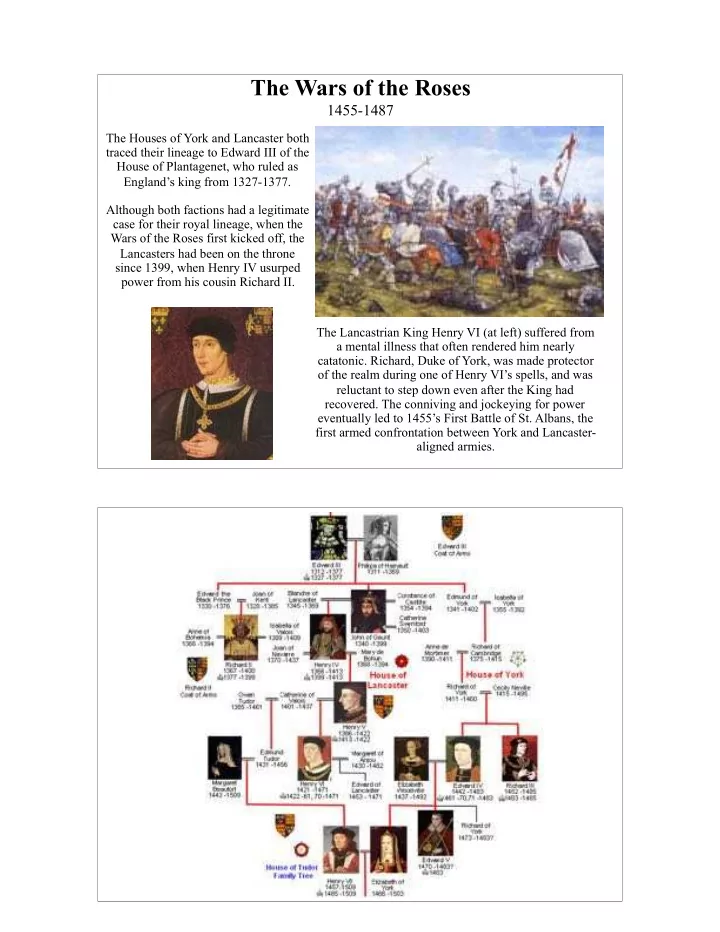
The Wars of the Roses 1455-1487 The Houses of York and Lancaster both traced their lineage to Edward III of the House of Plantagenet, who ruled as Englands king from 1327-1377. Although both factions had a legitimate case for their royal


slide-1
SLIDE 1

The Houses of York and Lancaster both traced their lineage to Edward III of the House of Plantagenet, who ruled as England’s king from 1327-1377. Although both factions had a legitimate case for their royal lineage, when the Wars of the Roses first kicked off, the Lancasters had been on the throne since 1399, when Henry IV usurped power from his cousin Richard II.

The Wars of the Roses

1455-1487

The Lancastrian King Henry VI (at left) suffered from a mental illness that often rendered him nearly

  • catatonic. Richard, Duke of York, was made protector
  • f the realm during one of Henry VI’s spells, and was

reluctant to step down even after the King had

  • recovered. The conniving and jockeying for power

eventually led to 1455’s First Battle of St. Albans, the first armed confrontation between York and Lancaster- aligned armies.

slide-2
SLIDE 2

The White Rose of York

Families in the North of England who descended from the House

  • f York were members of the

Yorkist faction, led by Richard, Duke of York, and his son Edward. When Richard died in 1460, his son Edward became the leader of the York forces. Edward became King Edward IV in 1461 when Henry VI left the country for nine years following a serious mental breakdown. In 1464 Edward secretly married Elizabeth Woodville. The marriage infuriated Richard Neville, Earl of Warwick. In alliance with Margaret of Anjou, Warwick forced Edward to flee England.

The House of York The House of Lancaster

The Red Rose of Lancaster

Henry VI’s descendants and their supporters were the Lancastrian faction. The Lancaster faction was led by Queen Margaret of Anjou, the wife of the King of England, Henry VI. Henry VI returned in 1470 with an army and briefly regained the throne, but Edward IV raised a large army in the Netherlands and wrestled power away from Henry VI again, defeating the Yorkist forces and killing the Earl of Warwick. Edward IV ruled England without challenge from 1471 to his death in 1483. Upon Edward IV’s death, his brother Richard was named Lord Protector of the realm for Edward’s son and successor, the 12-year-old King Edward V. Before the young king could be crowned, however, his father’s marriage to his mother Elizabeth Woodville was declared invalid, making their children illegitimate and ineligible for the throne.

Princes in the Tower

Richard then declared himself King Richard III as the next Yorkist in line for the throne. However, while he had strong support in the northern regions of England, many southerners were outraged by the (presumed) murders of the young princes in the tower. Richard III then began his reign. The young princes were not seen in public again, and accusations circulated that the boys had been murdered on Richard's orders.

slide-3
SLIDE 3

The new leader of the Lancastrian forces, Henry Tudor, an obscure Welsh prince, led the house of Lancaster as it continued its warfare against Richard III. The Tudors had blood-ties to the House of Lancaster, and Henry Tudor had a strong claim to the throne (especially since most of the major Lancastrian and Yorkist candidates had killed each other during the previous thirty years of warfare!).

Battle of Bosworth Field

1485

King Richard III v. Henry Tudor The struggle ended at the Battle of Bosworth Field in 1485 when the Lancastrian faction won a decisive victory. Richard was slain during the battle by with a blow to the head from major Welsh landowner Rhys ap Thomas. The Yorkist army melted away after Richard was killed.

The Tudor Dynasty Begins

Henry Tudor declared himself King Henry VII, King of England.

The Tudor Rose combined the Red Rose of Lancaster and the White Rose of York.

In the first few years of his reign, Henry VII eliminated all his rivals and married Edward IV's daughter Elizabeth to strengthen his descendant's claim to the throne. The marriage was a brilliant move politically; Elizabeth carried matrilineally the Yorkist claim to the throne, and Henry carried patrilineally the Lancastrian claim to the throne: Henry VII's children would have both Yorkist and Lancastrian blood. Their son became Henry VIII, and he in turn fathered Queen Elizabeth I, the illustrious monarch who ruled during Shakespeare's early career. The House of Tudor ruled England and Wales until 1603.

slide-4
SLIDE 4

Monarchs from the House of Tudor ruled England for 118 years from 1485 until 1603. Henry Tudor gained power and became Henry VII in the wake of the Wars of the Roses, was followed by his son, Henry VIII, (1509-47), famous for having six wives and bringing about the Reformation in England. Three of his children inherited the throne: Edward VI (1547-53), Mary I (1553-58), and Elizabeth I (1558-1603), who emerged as the greatest of her house. The Tudor dynasty became extinct on the death of Elizabeth without a direct heir in 1603. The crown of England then passed to Henry VII's great-grandson, James VI of Scotland, who became James I of England.