Herodotus and the Persian Wars Herodotus and the Persian Wars - - PowerPoint PPT Presentation

herodotus and the persian wars herodotus and the persian
SMART_READER_LITE
LIVE PREVIEW

Herodotus and the Persian Wars Herodotus and the Persian Wars - - PowerPoint PPT Presentation

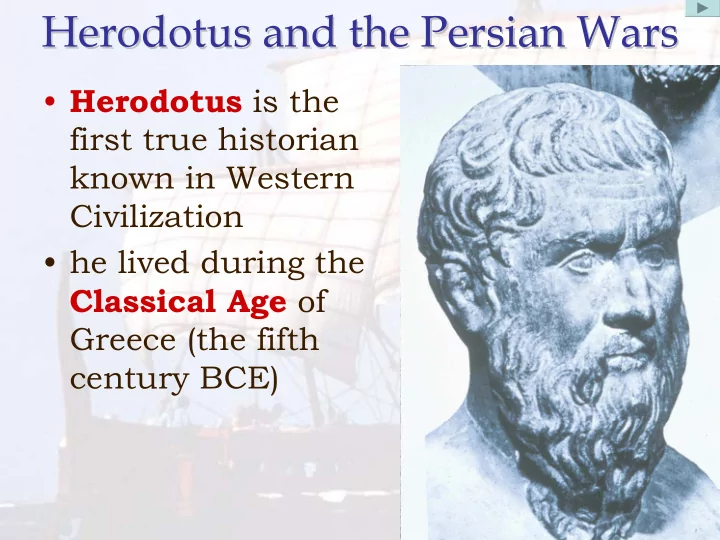
Herodotus and the Persian Wars Herodotus and the Persian Wars Herodotus is the first true historian known in Western Civilization he lived during the Classical Age of Greece (the fifth century BCE) Herodotus and the Persian Wars


slide-1
SLIDE 1

Herodotus and the Persian Wars Herodotus and the Persian Wars

  • Herodotus is the

first true historian known in Western Civilization

  • he lived during the

Classical Age of Greece (the fifth century BCE)

slide-2
SLIDE 2

Herodotus and the Persian Wars Herodotus and the Persian Wars

  • he is the earliest

Western author known to have written a systematic investigation of the past

slide-3
SLIDE 3

Herodotus and the Persian Wars Herodotus and the Persian Wars

  • he wrote The

Histories which are now divided into nine “Books”

  • historia in Greek

means “inquiry, investigation”

– of the Persians Wars

slide-4
SLIDE 4

Herodotus and the Persian Wars Herodotus and the Persian Wars

  • Herodotus’ life

– born ca. 485 BCE at Halicarnassus (Ionia) – was a merchant and traveler – spent some time in Athens – died ca. 425 BCE at the Athenian colony

  • f Thurii
slide-5
SLIDE 5

Herodotus and the Persian Wars Herodotus and the Persian Wars

  • the nature of his

Histories

– a jumble of fact and fable – like a parent telling bedtime stories

  • modern historians

(in the Victorian period) dubbed him the “Father of History and Lies”

slide-6
SLIDE 6

Herodotus and the Persian Wars Herodotus and the Persian Wars

  • Herodotus’ methodology

– he was an “oral historian”

  • he talked to people about what they

remembered in the past

  • or what their elders had told them

– then he collected the stories

  • often uncritical of conflicting accounts
  • little attempt to sift fact from fiction

– only clear theme: the Delphic oracle is always right — in the long run!

slide-7
SLIDE 7

Herodotus and the Persian Wars Herodotus and the Persian Wars

  • the organization of Herodotus’

Histories is discursive

– main thrust: to tell the story of the Persians Wars (490 & 481-479 BCE) – but Books 1-4 about deep background: Lydia, Egypt, etc. – only in Book 5 does Herodotus finally get to the Persian Wars

  • cf. starting a history of the Vietnam

War with Napoleon!

slide-8
SLIDE 8

Herodotus and the Persian Wars Herodotus and the Persian Wars

  • the reason for the discursions is

clear: they’re entertaining!

– how to build a pyramid – tour of ancient Babylon – the people who live “beyond the Massagetae” and smoke marijuana – and the first story in Herodotus’ Histories: Gyges and Candaules

slide-9
SLIDE 9

Herodotus and the Persian Wars Herodotus and the Persian Wars

Gyges and Candaules

Herodotus, Book 1.8-13

slide-10
SLIDE 10

Herodotus and the Persian Wars Herodotus and the Persian Wars

  • The Persian Empire

– the Persians were originally a tribe from the highlands of Iran – Assyrians > Babylonians > Medes – Cyrus (II) the Great (ca. 550 BCE)

  • conquered and assimilated the Medes

– the Greeks confused Persians/Medes

  • conquered Babylon; freed the Hebrews
  • then, conquered Lydia and Ionia
slide-11
SLIDE 11

Herodotus and the Persian Wars Herodotus and the Persian Wars

  • The Persian Empire

– Cyrus was succeeded by his son Cambyses (II) in 530 BCE – Cambyses conquered Egypt

  • but he was crazy and vicious
  • this negative picture may be the result

Herodotus’ Persian sources who disliked Cambyses

– he was assassinated in 522 BCE

slide-12
SLIDE 12

Herodotus and the Persian Wars Herodotus and the Persian Wars

  • The Persian Empire

– Cambyses’ brother-in-law Darius took the throne – consolidated Persia – created satrapies, run by satraps – built the Royal Road

“Neither snow nor rain nor heat nor gloom of night stays these couriers from the swift completion of their appointed rounds.”

(General Post Office, New York City, 8th Avenue and 33rd Street)

slide-13
SLIDE 13

Herodotus and the Persian Wars Herodotus and the Persian Wars

  • The Persian Empire

– Darius increased Persian wealth, prestige and bureaucracy

  • Herodotus:

“Cyrus was a father, Cambyses was a master, and Darius was a shopkeeper.”

slide-14
SLIDE 14

Herodotus and the Persian Wars Herodotus and the Persian Wars

  • The Persian Empire

– Darius endorses Zoroastrianism

  • religion featuring a battle between light

and dark, i.e. good vs. evil

  • popularizes this sort of “dualism”

– influences other religions, cf. Satan

slide-15
SLIDE 15

Herodotus and the Persian Wars Herodotus and the Persian Wars

  • The Ionian Revolution

– in the mid-sixth century BCE, a new sort of thinking arises in Ionia

  • the Ionian philosophers

– search for origins and basic elements: water, air, earth, fire

  • Pythagoreans: numbers

– earliest attested non-religious explanation of the natural world

slide-16
SLIDE 16

Herodotus and the Persian Wars Herodotus and the Persian Wars

  • The Ionian Revolution

– philosophical revolution leads to political revolution – Aristagoras of Miletus: enlightened tyrant who forces the expulsion of

  • ther Ionian tyrants in 499 BCE

– forms Ionian League of free states

  • having just expelled their tyrant,

Athens (Athenians) join this league and send five ships from Attica

slide-17
SLIDE 17

Herodotus and the Persian Wars Herodotus and the Persian Wars

  • The Ionian Revolution

– the forces of the Ionian League march against Sardis (capital of Lydia) and “liberate” it – but in the ensuing celebration, the Ionians burn the city down – the Lydians call in Darius and the Persians to oust the Ionian League – to even the score, the Persians burn down Miletus in Ionia (493 BCE)

slide-18
SLIDE 18

Herodotus and the Persian Wars Herodotus and the Persian Wars

  • The Ionian Revolution

– the results of the Ionian Revolution

  • it did not produce any new democracy

– democratia: “mob-rule”

  • the new thinkers (philosophers) fled

Ionia for the west (Greece and Italy)

  • it gave Darius an excuse to attack

Athens for sending ships

– Darius needed to have a military victory to add to his institutional and economic achievements as king

slide-19
SLIDE 19

Herodotus and the Persian Wars Herodotus and the Persian Wars

  • The First Persian War (490 BCE)

– Darius’ naval expedition across the Aegean Sea – The Battle of Marathon

  • Greece and the Greeks defeat the

Persians

– but at the cost of many lives

  • Phidippides: “We won!”

– hence, the race called the Marathon

slide-20
SLIDE 20

Herodotus and the Persian Wars Herodotus and the Persian Wars

  • The 480’s: Between the Wars

– in Greece, the rise of Themistocles

  • (ab)uses ostracism
  • ostraca (“wastepaper”)

– in Persia, Darius > Xerxes (r. 486- 465 BCE)

  • revolt in Egypt suppressed (483 BCE)
  • plans to attack Greece and avenge his

father Darius

  • the Persian expeditionary force

numbers over five million people

slide-21
SLIDE 21

Herodotus and the Persian Wars Herodotus and the Persian Wars

  • The 480’s: Between the Wars

– back in Greece, the Athenians discover a huge vein of silver in the Laurian mines (SE of Athens) – Themistocles convinces the Athenian assembly to build a fleet of triremes (“three [decks of] oars”)

slide-22
SLIDE 22

Herodotus and the Persian Wars Herodotus and the Persian Wars

slide-23
SLIDE 23

Herodotus and the Persian Wars Herodotus and the Persian Wars

  • The Second Persian War (481-

479 BCE)

– Xerxes attacks by land and sea – crosses the Hellespont by building a boat-bridge

  • the first one is destroyed by

strong winds and currents

  • Xerxes has the Hellespont

cursed and whipped

– northern Greeks let him pass

slide-24
SLIDE 24

Herodotus and the Persian Wars Herodotus and the Persian Wars

  • The Second Persian War (481-

479 BCE)

– Xerxes drives his forces south – The Battle of Thermopylae (480 BCE): Leonidas and 300 Spartans hold off the whole Persian army – Thebes “medizes” – Xerxes captures and burns Athens

  • in particular, the wooden temple of

Athena on the Acropolis

slide-25
SLIDE 25

Herodotus and the Persian Wars Herodotus and the Persian Wars

  • The Second Persian War (481-

479 BCE)

– The Battle of Salamis (480 BCE)

  • in the narrows between the island of

Salamis and the mainland

  • Persian battle-cruisers cannot

maneuver but smaller triremes can

  • Xerxes panics and flees back to

Persepolis

  • leaves his general Mardonius to finish
  • ff the Greeks
slide-26
SLIDE 26

Herodotus and the Persian Wars Herodotus and the Persian Wars

  • The Second Persian War (481-

479 BCE)

– Mardonius and a large Persian army winters in Thebes – The Battle of Plataea (Spring, 479 BCE)

  • after a long and hard-fought battle, the

Greeks win and Mardonius is killed

– with that, the Persian threat is over

slide-27
SLIDE 27

Herodotus and the Persian Wars Herodotus and the Persian Wars

  • Conclusion on Herodotus

– a thrilling story, but how much of it is history? – nevertheless, he is surely reporting what his sources told him – and surely at least some of those sources believed in the accuracy of their accounts – even when they claimed that a god appeared in the midst of a battle!!

slide-28
SLIDE 28

Herodotus and the Persian Wars Herodotus and the Persian Wars

  • Conclusion on Herodotus

– and what if Thermopylae didn’t happened the way he says? – Herodotus’ story of the Spartans’ bravery tells a truth greater than any literal reality!

  • their patriotism and love of liberty

– even if Herodotus cannot be verified, these are important psychological elements in what-really-happened