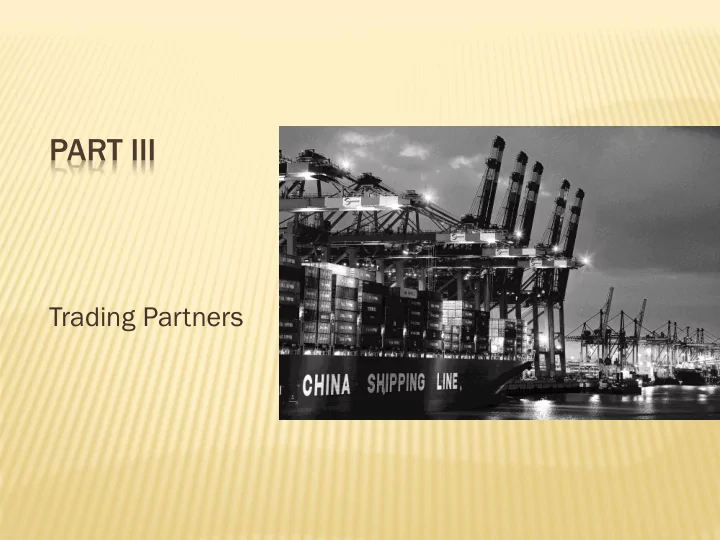
PART III Trading Partners The Americas and the Caribbean Basin - - PowerPoint PPT Presentation
PART III Trading Partners The Americas and the Caribbean Basin CHAPTER 10 THE US AND WARS List of wars involving the United States http://en.wikipedia.org/wiki/List_of_wars_invol ving_the_United_States Americas wars: U.S.
CHAPTER 10
The Americas and the Caribbean Basin
THE US AND WARS
List of wars involving the United States
http://en.wikipedia.org/wiki/List_of_wars_invol ving_the_United_States
America’s wars: U.S. Casualities and Veterans
http://www.infoplease.com/ipa/A0004615.html
3
THE US DEFENSE BUDGET
Too much on defense budget?
http://www.slate.com/articles/technology/ameri can_prosperity_consensus/2013/10/american_ prosperity_consensus_is_excessive_defense_spe nding_the_most_important.html
Safely cut our defense budget?
http://www.usnews.com/opinion/blogs/economi c-intelligence/2012/06/21/how-to-safely-cut-us- defense-spending
4
WHY DO WE GO TO WAR?
World Peace Intervention in a conflict Should we continue to be involved?
5
ARMS INDUSTRY & WAR BUSINESS
Worlds’ largest defense budget – do you think
we really need to put this money into defense budget?
6
ARM EXPORTERS & IMPORTERS
7
OBJECTIVES
Examine the evolution of economic and political
- rganization in the Americas
Examine the roles of producing and consuming countries,
areas of expertise, and specialization
Explore industrial development and trade regulations in
the different sectors
Discuss major participating countries in the textile and
apparel business
8
INTRODUCTION
North, Central, and South America span the globe vertically, from north to south The technology for spinning and weaving machines developed in Europe migrated to
the early colonies through industrial espionage
The influences of European, Asian and African cultures are reflected in different
sectors throughout the Americas and in the textiles and apparel found here
9
POLITICAL AND ECONOMIC OVERVIEW
10
The terms America and the Americas, as used in this text, refer to the combination of North, Middle, and South America Western Hemisphere = North America, Central America, West Indies, and South America
EFFORTS TO UNIFY THE AMERICAS
Pa
Pan-Ameri American can Unio Union n created in 1910 with the purpose of closer economic, cultural, and political relations
Forty years later, the ninth
Pan-American Conference created the Org rganiz anization tion of Ame meric rican an St States es (O (OAS) S)
11
EFFORTS TO UNIFY THE AMERICAS
A Free
ee Trade ade Ar Area ea of th the e Am Amer ericas icas (F (FTAA) AA) was the most comprehensive free trade agreement ever proposed for this region
North Americans see FTAA as an extension of
NAFTA, and South Americans see FTAA as an extension of Me Mercos cosur ur (S (Southern
- uthern South
uth Ame merican rican Common mmon Ma Mark rket) t)
12
CULTURAL DIVERSITY IN THE AMERICAS
The OAS has four official languages:
English, Spanish, Portuguese, and French
Roots of ideas, customs, and skills
are based in sources of these languages
Cultural values cannot be judged as
right or wrong, only as different
North America is often described as
progressive while Latin America is seen as traditional
15
ECONOMIC AND INDUSTRIAL STANDING OF SELECTED AMERICAN COUNTRIES
Canada has largest geographic size;
the United States has the largest population
Economic and industrial dominance
- f the United States carries both an
advantage and a responsibility
Only the U.S. and Canada are
considered developed countries; most countries in region are considered developing countries
Inflation rates range from -0.7
percent, in United States, to 8.6 percent, in Jamaica
16
TRENDS IN TEXTILE AND APPAREL TRADE IN THE AMERICAS
Dominance of the United States, Canada, and
Mexico in the textile and apparel trade in the Americas
Many U.S. apparel brands sold around the world;
few garments actually produced in the United States
The force of China is likely to have decreased
Caribbean Basin apparel exports since 2008
18