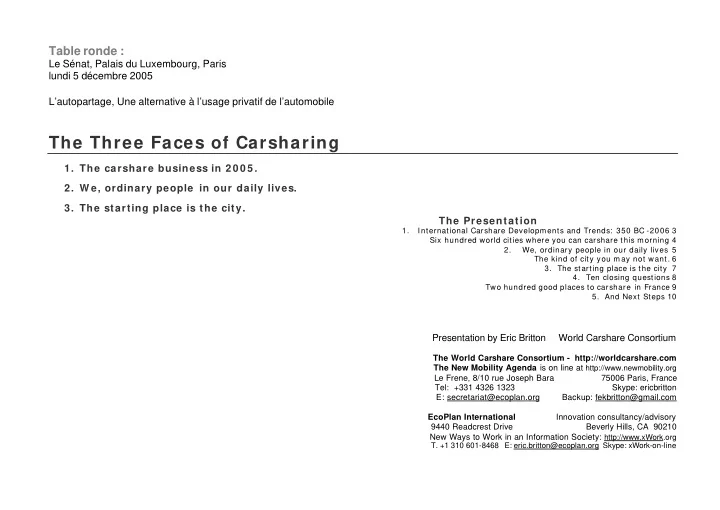
SLIDE 8 The Three Faces of Carsharing
Eric Britton, World Carshare, speaking notes of 12/6/2005
- p. 7 of 14
- 3. The starting place is the city ( And the politics of transportation)
- 1. To make carsharing work in your city you definitely need a strategy -- and that strategy has to be not only a matter of technical and business expertise on the
part of the operator, but also requires the development of a broad based partnership of organizations and interests in the host city, led ideally by local government and supported by many institutions -- and (especially important) win/win strategies in the transport sector and other.
- 2. It does not make much sense for a city to support carsharing per se, unless it is already in the process of developing a global policy for sustainable mobility. It
can be done, and almost always has been the case up to now -- but it is our firm recommendation that the two proceed in parallel.
- 3. Carshare operators traditionally claim that the biggest problems for them are, in order, (a) local legislation, (b) insurance, and (c) parking. And subsidies. This
may be true from their perspective, but is only part of the strategic challenge as a whole.
- 4. As to subsidies, it is our view that it is not going to be very easy to get the right subsidies, unless the city is able to see how this new service is going to work
with and interact with everything else that is in place.
- 5. Once a reasonably good framework for the overall sustainable mobility system is in place, the process that needs to be engaged to prepare a detailed city
strategy and support program can be carried out with proper organization and support in less than a year.
- 6. Today there is no real difficulty in finding first rate sources of consultancy help, as well as prospective operators and partners. (Annex A below provides you
with a good starting place, and more information and guidance is available from World Carshare and its extensions.)
- 7. We often say that all the necessary studies and the RFP (Request for Proposals) can be carried out for “less than the prices of a single city bus”.
- 8. We suggest you send out your RFPs to at least 3 qualified eventual supplier/partners – and moreover that you pay them fairly for their work. This is important
for 2 reasons. We need to have economically solid enterprises in the field, and the best way to ensure that is to pay them for their work. Moreover, it is likely that your final implementation plan is going to draw from more than one, possibly all of those who respond to the RFP – so it is only fair that they be compensated for their expertise and time
- 9. Keep an eye on the cultural awarenesses of your supplier choice. Ideas and procedures that work well in one kind of cultural and legal environment may not
make it in your city. So careful.
- 10. Bear in mind that in time there may be more than one carshare operator working in your city, so make sure that you provide each of them with a level playing
- field. It is healthy to assume this from the start rather than getting into two special a relationship with your supplier.
- 11. At the end of the day, the development of a strong carsharing operation from the vantage of the city is a test for your leadership and governance skills.
- 12. And in France now that the sector is maturing, it may be a good time for all the key players to join in a wide open national carshare organization, to exchange
experience and provide a basis for collaboration and creative synergies, with real possibilities for creative cost-sharing.
- 13. Remember: carsharing does not have to be imposed. It is a response to what people want and need, opening up new choices and savings --not an obligation
forced on them, It is thus an example of 21st century democracy in action.
2 0 0 6 bottom line 3 : “W e know how to m ake it happen