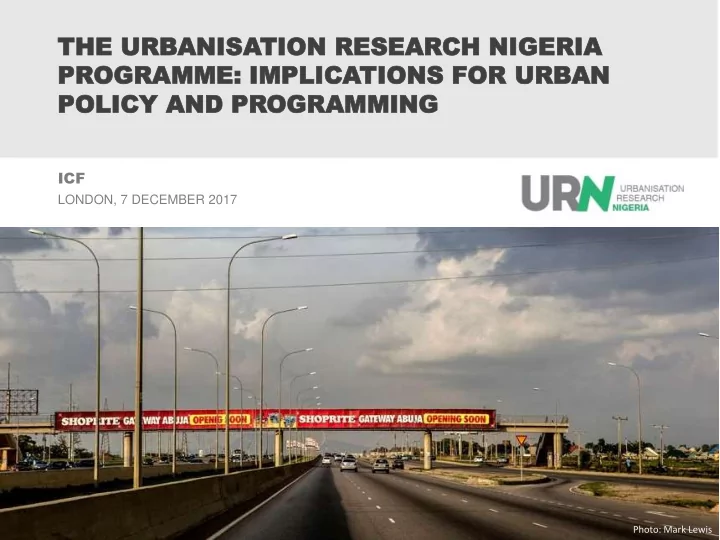
SLIDE 1 THE THE UR URBANISA ANISATION TION RESE RESEAR ARCH CH NIGERI NIGERIA A PR PROG OGRA RAMM MME: E: IMPLICA IMPLICATION TIONS FOR URB S FOR URBAN AN POLICY POLICY AND AND PR PROG OGRA RAMM MMIN ING
Photo: Mark Lewis
LONDON, 7 DECEMBER 2017
ICF
SLIDE 2
THE URN PROGRAMME
▪
Urbanisation Research Nigeria (URN) is a five year (2013-18) research programme, funded by the United Kingdom’s Department for International Development (DFID).
▪
URN also supplied evaluation services directly to DFID on the Nigeria Infrastructure Advisory Facility (NIAF) programme, a £98 million technical assistance (TA) programme to the Nigerian government to support more effective infrastructure investment.
▪
URN is implemented by a consortium led by the International Development division of ICF, which specialises in carrying out urban sector and governance projects in sub-Saharan Africa and Asia.
▪
Two conjunctures covered: Boom: economic growth through 2015; Crash: recession 2016 onwards
SLIDE 3
▪
The research programme is “theoretically-informed, empirically- grounded and policy relevant” in addressing the key social, economic and political concerns in the urban sector in Nigeria.
▪
Findings are also intended to contribute to the knowledge and evidence base for better urbanisation strategy, urban policy, and urban programming and management in Nigeria.
▪
Nigeria has a long-run and formerly world-renowned tradition of urban sector research. But resource constraints, both human and financial, have meant a diminishment in research capacity – just as urban challenges have become of greater significance for society, polity and citizenry.
▪
The building of research capacity thus emerged as an important ancillary goal of the programme.
POINT OF DEPARTURE
SLIDE 4 ▪ Rural-Urban Linkages within the Benue Basin ▪ Urban Change in a Northern Nigerian City – Kaduna 1967-2014 ▪ Agriculture, Markets and the Urban System in Katsina State ▪ Spatial Expansion and the Periphery in Nigerian Cities: the New Nigerian Suburbs ▪ Agglomeration, Industrial Development and Business-Civic Leadership: A Case Study
Harcourt ▪ A Framework for Informing Industrial Development Programming in the South- East of Nigeria ▪ Design of a City Infrastructure Quality Index (CIQI) ▪ Economic Knowledge and the Urban Informal Economy in Zaria ▪ Transport, Poverty and Well-being in Urban Nigeria ▪ Pathways Out of Urban Water Poverty ▪ Urban Infrastructure Projects and Displacement: How Do the Poor Mobilise Around their Interests? ▪ Urban Crime in Nigeria: Trends, Costs and Policy Implications ▪ Planning and Governance of Informal Urban Developments ▪ Adaptation of Urban Infrastructure to Enhance Climate Resilience in Nigeria ▪ Delivering Municipal Services through Effective Procurement
▪ Examining the Potential for Metropolitan Governance in Nigeria ▪ Municipal Infrastructure and Services, Institutional Frameworks and Financing Arrangements in Nigerian Cities
URBAN CHANGE PROCESSES
Developing a better understanding of the urbanisation process.
URBAN ECONOMIC DEVELOPMENT
Examining Nigeria’s diverse urban economies and the
- pportunities they provide.
WELL-BEING OF URBAN CITIZENS
Exploring the material, relational and subjective dimensions of well-being.
URBAN LAND, PLANNING, AND GOVERNANCE
Uncovering the process of urban development based
- n land resources and their
management.
4
SLIDE 5 URN COLLABORATORS
▪
Ahmadu Bello University (ABU), Zaria
▪
Benue State University (BSU), Makurdi
▪
Federal University of Technology (FUT), Minna
▪
University of Calabar
▪
University of Ibadan
▪
University of Lagos
▪
University of Nigeria, Nsukka
▪
The Foundation for Development and Environmental Initiatives (FDI), Ibadan
▪
CLEEN Foundation, Abuja
▪
University of Pretoria
▪
Wits University, Johannesburg
▪
The Development Planning Unit (DPU) at University College London
▪
University of the West of England (UWE), Bristol
▪
The Max Lock Centre at the University
▪
University of Bristol
▪
University of Sheffield
▪
University of Lincoln
▪
ETH Zurich
▪
Polytechnic University, Valencia
We worked with urban studies researchers in the UK and Nigeria, and with institutions in government, the community and business that are directly involved in urban development, as well as other international researchers:
SLIDE 6 RESEARCH UPTAKE AND DISSEMINATION
We engaged urban studies researchers and reached audiences in Nigeria and internationally. Examples
- f relevant activities included:
▪
Published academic papers
▪
Submission of abstracts for inclusion in academic peer reviewed journals and edited collections.
▪
Organisation of technical workshops organised around the research themes and projects.
▪
Presentations at academic and professional conferences and meetings where decision-makers are present.
▪
High level End-of-Programme Conference focused on URN research results and their urbanisation policy and strategy implications scheduled for March
- 2018. The conference is organised
with the support of the Federal Ministry of Power, Works and Housing.
SLIDE 7 ENGAGEMENT WITH THE WORLD BANK
Building on findings from the URN programme, we supported the World Bank:
▪
To prepare the Nigeria Urbanization Review (“From Oil to Cities: Nigeria's Next Transformation,” 2016), which identifies key urban policy reforms.
▪
To research and formulate a Development Framework for Northern Nigeria and a report on Spatial Development Strategies and Economic Corridors (2015- 17).
▪
To conduct a Deep-Dive Analysis
Competitiveness of the Lagos- Ibadan Economic Corridor (2016-17), which included value chain analysis of key sectors, and identified appropriate spatial development strategies that could increase competitiveness and
- productivity. The deep-dive
informs the design of a prospective World Bank Transport Connectivity and Trade Competitiveness operation (planned for FY2018).
SLIDE 8 ENGAGEMENT WITH FCO
Building on findings from the URN programme, we also supported the Foreign and Commonwealth Office (FCO):
▪
To design a multi-year global Prosperity Fund Global Future Cities Programme (planned to commence in 2018), which will provide technical assistance covering transport, urban planning and resilience interventions in key target countries, including Nigeria.
▪
To carry out Scoping Studies of cities in six states in Nigeria (Lagos, Ogun, Oyo, Anambra, FCT, and Kaduna) to identify
- pportunities to better plan and
manage cities in order to improve city level growth and prosperity, reduce poverty, and decrease barriers to UK trade and
- investment. The purpose was to
provide an evidence base that identifies city-level interventions in cities in Nigeria for the FCO’s Prosperity Fund Future Cities Programme.
SLIDE 9
NIGERIA: GEO-POLITICAL ZONES, STATES AND CAPITALS
SLIDE 10
URBANISATION
▪
We define “urbanisation” technically, as an increase in the proportion of a country or region’s population residing in urban settlements (defined as 20,000 and above in Nigeria).
▪
Urbanisation is occurring rapidly in Nigeria and on a massive scale. Today slightly fewer than half of Nigeria’s population of 190-200 million live in cities – this is double the amount at the turn of this century, and estimated to rise to 67 percent by 2050.
▪
Nigeria’s urban population is growing rapidly in absolute terms – and will continue to increase as a relative share of the national population.
SLIDE 11
URBANISATION
▪
The underlying cause of rapid urbanisation (and urban expansion) in Nigeria is rapid population growth driven by declining mortality and persistently high fertility in both rural and urban areas.
▪
The resulting population boom has driven urbanisation (and expansion) directly through (a) natural population increase in existing urban centres, and (b) densification in rural areas, resulting in the reclassification of settlements from rural to urban.
▪
Rural-urban migration does contribute, and varies across Nigeria’s regions
▪
But the significance of natural increase and reclassification have been widely underappreciated, and the role of rural-urban migration has likely been overstated in Nigeria, and indeed in sub-Saharan Africa more generally.
SLIDE 12
URBAN EXPANSION
▪
The growth of Nigeria’s urban population in absolute and relative terms has been accompanied by the massive expansion of existing built-up areas (with land conversion and profit-making on former peripheries) –
▪
This has led to the emergence of new, identifiably ‘urban’ settlements.
▪
There is a widely held perception that Lagos is an over-bearing megacity within the urban system
▪
But Nigeria’s urban population is spread fairly evenly across four large urban fields/conurbations – as urbanised regions characterised by one or more metropolitan centres connected to secondary cities and towns, and interspersed with ‘rural’ settlements and activities.
SLIDE 13
▪
The following can be identified:
– Northern, centred around Kano and encompassing Kaduna in the south and Katsina in the north; – Central, running from Abuja in the southwest to Jos in the northeast; – Southwestern, stretching from Lagos in the south to Ilorin in the north; – South-eastern, within a roughly square zone encompassing Benin City, Port Harcourt, Calabar and Enugu.
▪
A variety of settlement types exist within these regionally-scaled agglomerations: city/metropolitan regions, corridors, small-city networks and clusters – and, not least, massive suburbanisation which co-exists with informalities of various kinds
▪
The precepts of contemporary urbanism are not followed, notwithstanding significant but varying levels of density across the urbanised terrain
URBAN EXPANSION
SLIDE 14
VAST URBANISED REGIONS
SLIDE 15 URB URBAN AND AN AND REG REGION IONAL AL ECO ECONO NOMIC MIC DEVE DEVELOP OPME MENT NT
▪
Nigeria’s economy is at a crossroads. For decades, it has relied mainly on
- il extraction to drive growth and revenue. Tradable sectors have not been
developed sufficiently, leading to weak structural transformation and limited employment opportunities.
▪ The positive effects of urbanisation are not widely evident in Nigeria;
instead, its relatively rapid urban population growth has occurred without structural transformation and thus without adequate job creation, infrastructure provision, affordable housing, or access to basic services.
▪ Nigeria appears to be underprepared for the managing the challenges of
urbanisation – and for maximising its beneficial effects.
SLIDE 16
AGGLOMERATION AND GROWTH CENTERS
▪
Analysis of the contemporary spatial economy demonstrates industrial concentration in spatially-extensive growth centers which cut across city and state boundaries.
▪
Three main zones where economic activity is concentrated can be identified.
▪
The first is in the South West, centred around Lagos and the surrounding cities and the corridor to Ibadan. This zone is specialized in ICT, Professional & Scientific Services, Financial Services and Manufacturing. .
▪
The second zone is an industrial corridor running from Abuja to Kano in the north of the country, and including Kaduna and Jos. Kano is the second largest city and historically a manufacturing hub, while Abuja is an emerging industrial centre, with very little known about the nature of manufacturing in the city.
▪
The final zone is in the South East, primarily the cities of Port Harcourt, Onitsha and Aba. These latter three cities between them account for a significant percentage of manufacturing activity in the area.
SLIDE 17
A HISTORICAL OVERVIEW OF REGIONAL DEVELOPMENT
▪
Following independence in 1960, the spatial economy evolved in response to import substitution industrialization.
▪
Three industrial zones emerged: Kano-Zaria- Kaduna-Jos; Enugu- Ontsha-Aba-Port Harcourt-Calabar; and Ibadan-Abeokuta-Ikeja- Lagos.
SLIDE 18
LOCATION OF MANUFACTURING MSMES AT THE STATE LEVEL, 2010
Source: NBS National MSME Collaborative Survey (2010).
SLIDE 19
NUMBER OF MANUFACTURING BUSINESSES BY CITY, 2010
Source: Combined Nigeria Business Directory / URN
SLIDE 20
URBAN INDUSTRIAL STRUCTURES AND INTRA-REGIONAL INDUSTRIAL CONCENTRATIONS Manufacturing firms by LGA in Lagos
SLIDE 21
URBAN INDUSTRIAL STRUCTURES AND INTRA-REGIONAL INDUSTRIAL CONCENTRATIONS Manufacturing firms by LGA in Port Harcourt
SLIDE 22
URBAN INDUSTRIAL STRUCTURES AND INTRA-REGIONAL INDUSTRIAL CONCENTRATIONS Manufacturing firms by LGA in Kano
SLIDE 23
URBAN INDUSTRIAL STRUCTURES AND INTRA-REGIONAL INDUSTRIAL CONCENTRATIONS Tradable services firms by LGA in Lagos
SLIDE 24
URBAN INDUSTRIAL STRUCTURES AND INTRA-REGIONAL INDUSTRIAL CONCENTRATIONS Tradable services firms by LGA in Port Harcourt
SLIDE 25
BUSINESS-CIVIC ORGANISATION
Cross-cutting themes by order of importance as perceived by business leaders: Urban Context
▪
Access to reliable utilities (electricity, water and sanitation)
▪
Access to serviced land
▪
Urban connective infrastructure
▪
Multiplicity of taxes National Context
▪
Access to business finance
▪
Counterfeiting, standards and border protection
▪
Access to foreign exchange
▪
National connective infrastructure
▪
Government support & policy consistency
SLIDE 26
BUSINESS-CIVIC ORGANISATION
Findings
▪ The political attention of business leaders is almost exclusively
focused on efficiency-related aspects of the business and investment climate.
▪ This, while understandable, overlooks crucial aspects of the urban
context essential for developing agglomeration economies and ‘productivity-enhancing’ firm-level characteristics.
▪ Such a ‘narrow’ perspective on ‘efficiency-related’ aspects of the
business and investment climate risks confining Nigeria’s economic structure to a ‘low-productivity’ trap, long after it has broken out of its current long-standing ‘inefficiency-trap’.
SLIDE 27
EXAM EXAMINING INING TH THE PO E POTE TENT NTIAL IAL FOR M FOR MET ETROP OPOLIT OLITAN AN GO GOVE VERN RNAN ANCE CE IN N IN NIGE IGERIA RIA
▪
Exploring the opportunities for transformational change in the metropolitan governance of Nigeria’s cities, and the institutional and deeper political economy challenges that need to be overcome to achieve this.
▪
Understanding the relationships between the changing scales of urban challenges and the fit of scales of governance and planning in Nigeria, with a focus on urban and regional economic development and growth.
▪ Within urban fields urban-regional city systems are emerging such as
corridors and clusters: what forms of governance are best for realising economic potential at different scales?
▪ These new forms of governance are particularly needed to deliver strategic
infrastructure needs – how can urban planning and urban infrastructure and service delivery be best managed across the emerging metropolitan areas/city regions?
SLIDE 28
MAIN TRANSPORTATION ROUTES AND URBAN REGIONS
SLIDE 29
EXAMINING THE POTENTIAL FOR METROPOLITAN GOVERNANCE IN NIGERIA
SLIDE 30
LAGOS
SLIDE 31
ABUJA
SLIDE 32
▪
The need to create more productive and livable cities through the regeneration of existing industrial zone infrastructure, support to existing businesses, and improved public transport, housing and basic services.
▪
An imperative to support development of high potential value chains and manufacturing clusters.
▪
The requirement to enhance the local business environment through improvements to regulatory instruments and enforcement of appropriate legislation/by-laws.
▪
The need to better determine and allocate institutional responsibilities, establish cooperative forums and, if required, new governance institutions (e.g., at metropolitan-scale). Governance and capacity in these institutions needs to be strengthened so that they can deliver enhanced urban and regional development interventions.
PO POLICY CONS LICY CONSIDERA IDERATION TIONS
SLIDE 33
URBAN-REGIONAL POLITICS
▪
Nigeria’s Federal system has always and indeed increasingly privileges 36 State Governments and their powerful Governors as the fulcrum of urban politics
▪
Urban planning, the financing of infrastructure and services and the facilitation of economic development are key derivative functions.
▪
City governments as such do not exist, and 774 Local Government Areas (LGAs) are functionally-limited and depend on Federal and State Governments for revenue
▪
The Federal government role in urban development is limited, but the Ministry of Works, Power and Housing has policymaking and convening roles.
▪
National politics pervades urban politics, with Governor.
SLIDE 34
URBAN-REGIONAL POLITICS
▪
A typically bleak conventional view requires challenging here: space for experimentation and reform can exist at state government level, particularly if the opportunity for creating “Internally Generated Revenue” (IGR) is taken by administrations (Lagos State as the best example, also Kaduna, Edo, Ogun states, amongst others)
▪
The regional dimension is re-emerging, as are debates around ‘restructuring’ and new regionally-scaled (up-scaled) institutions: DAWN Commission, Southeast Region Economic Development Company (SEREDEC).
▪
Plans are increasingly cognisant of the scale and pace of urbanisation and urban expansion, and incorporate economic development priorities.
▪
Urban politics and plans are thus becoming more regionalised.
SLIDE 35
▪
More specifically, a new discourse and practice (or paradigm) is emerging for spatial/economic planning in Nigeria (as elsewhere),
▪
This is premised on improving urban-regional productivity through infrastructural investment (energy, transportation), spatial planning, and regulatory reform, often framed in a corridor conceptualisation (at different scales).
▪
Understanding and reckoning with the new scale/s of politics, and with the new forms of planning and investment that construct them, is critical to any meaningful engagement with the political process, and for policy and programming.
URBAN-REGIONAL POLITICS
SLIDE 36
SLIDE 37
SLIDE 38
SLIDE 39
SLIDE 40 THANK YOU
We welcome your feedback and suggestions on the Urbanisation Research Nigeria (URN) programme. Please contact Dr Robin Bloch, Team Leader, at robin.bloch@icf.com or Nikolaos Papachristodoulou, Research Manager, at nikolaos.papachristodoulou@icfi.com
This programme has been funded by UK aid from the UK government; however the views expressed do not necessarily reflect the UK government’s official policies.
Visit our Urbanisation Research Nigeria (URN) website at: urn.icfwebservices.com