The Business of Walking: The Relationship between Pedestrian - - PowerPoint PPT Presentation

the business of walking the relationship between
SMART_READER_LITE
LIVE PREVIEW

The Business of Walking: The Relationship between Pedestrian - - PowerPoint PPT Presentation

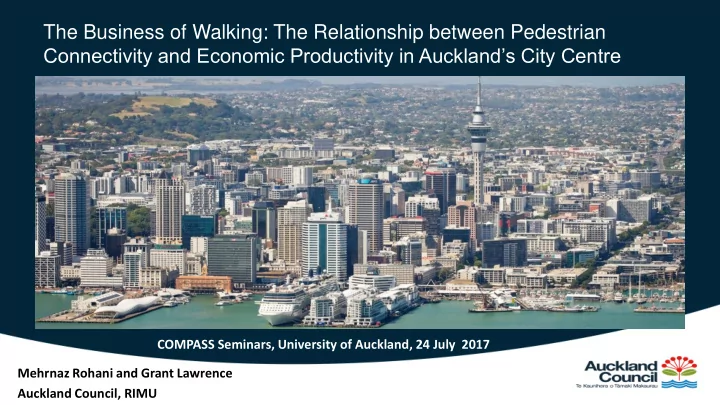
The Business of Walking: The Relationship between Pedestrian Connectivity and Economic Productivity in Aucklands City Centre COMPASS Seminars, University of Auckland, 24 July 2017 Mehrnaz Rohani and Grant Lawrence Auckland Council, RIMU


slide-1
SLIDE 1

The Business of Walking: The Relationship between Pedestrian Connectivity and Economic Productivity in Auckland’s City Centre

Mehrnaz Rohani and Grant Lawrence Auckland Council, RIMU COMPASS Seminars, University of Auckland, 24 July 2017

slide-2
SLIDE 2

Contents

slide-3
SLIDE 3

Why this research was carried out?

  • The city centre the economic heart of the Auckland region
  • One of the several work streams to quantify the economic benefits of

walking by Auckland Design Office

  • To replicate, SGS (2014) methodology

Strategic directors:

  • The Auckland Plan (2012)
  • The City Centre Master Plan (2012)
slide-4
SLIDE 4

Theory

slide-5
SLIDE 5

𝐹𝐾𝐸𝑗 = 𝐹𝑗 𝐵𝑗 𝜌

⍺ + 𝐹 𝑘

𝑒𝑗𝑘

⍺ 𝑘

EJDi = the effective job density of jobs in location i Ei = employment in location i (origin) Ej = employment in location j (destinations) Ai = the land area of area i 𝐵𝑗 𝜌 = an estimate of the average distance between jobs within area i dij = walking distance between location i and location j (minutes) ⍺ = distance decay = 1 in this analysis

Measure of Agglomeration Economies

slide-6
SLIDE 6

6. Examining association between pedestrian connectivity and labour productivity

Analysis Steps

1. Defining the city centre, study area and other travel zones 2. Filling the data gaps

  • Developing a pedestrian network
  • Carrying out a census of businesses

3. Creating pedestrian travel time matrices 5. Estimating labour productivity 4. Measuring agglomeration effects: Effective Job Density (EJD)

slide-7
SLIDE 7

City Centre, Study Area and Travel Zones

Employment Density

Auckland Domain Victoria Park Ports Wynyard Qtr

slide-8
SLIDE 8

Knowledge Hub

0.00% 5.00% 10.00% 15.00% 20.00% 25.00% 30.00% Professional, Scientific… Financial and Insurance… Administrative and… Accommodation and… Retail Trade Rental, Hiring and Real… Transport, Postal and… Public Administration and… Information Media and… Arts and Recreation… Health Care and Social… Wholesale Trade Other Services Education and Training Construction Manufacturing Mining Agriculture, Forestry and… Electricity, Gas, Water…

Share of employment in the study area

0.00% 10.00% 20.00% 30.00% 40.00% 50.00% 60.00% 70.00% 80.00% 90.00% 100.00% Professional, Scientific… Financial and Insurance… Administrative and… Accommodation and Food… Retail Trade Rental, Hiring and Real… Transport, Postal and… Public Administration and… Information Media and… Arts and Recreation… Health Care and Social… Wholesale Trade Other Services Education and Training Construction Manufacturing Mining Agriculture, Forestry and… Electricity, Gas, Water and… Total

Proportion of the city centre's employment in the study area

slide-9
SLIDE 9

Item Average Speed (Km/h) Footpath 5 Footway 4 Lane 4 Arcade 4 Steps 2 Shared 4 Lane 4 Controlled Crossings

  • Short

3

  • Medium

2

  • Long

1 Uncontrolled Crossings

  • Designated raised platforms

3

  • Designated refuge islands

3

  • Zebra crossings

3

  • Designated straight crossings

3

  • Uncontrolled intersections

3

Pedestrian Network

slide-10
SLIDE 10

Origins and Destinations

  • 304 Buildings
  • 408 Building entrances
  • 259 Meshblocks centroids
slide-11
SLIDE 11

Travel Time

Displayed in seconds

1 2

slide-12
SLIDE 12

Building Building 1 Building 2 Building 3… Building 1 9.8 0.7 3.7 Building 2 0.0 10.4 7.7 Building 3 10.4 0.0 4.2 Building 4… 7.7 4.2 0.0 MB 411700 411900 412000… Building 1 28.6 27.4 24.4 Building 2 19.7 18.5 15.5 Building 3 28.8 27.7 24.7 Building 4… 25.2 24.0 21.0

Travel Time Matrices Displayed in seconds

slide-13
SLIDE 13

Business Census

slide-14
SLIDE 14

Distribution of Industries

Albert Park Albert Park Aotea Sq Aotea Sq

slide-15
SLIDE 15

𝐹𝐾𝐸𝑗 = 𝐹𝑗 𝐵𝑗 𝜌

⍺ + 𝐹 𝑘

𝑒𝑗𝑘

⍺ 𝑘

EJDi = the effective job density of jobs in location i Ei = employment in location i (origin) Ej = employment in location j (destinations) Ai = the land area of area i 𝐵𝑗 𝜌 = an estimate of the average distance between jobs within area I dij = walking distance between location i and location j (minutes) ⍺ = distance decay = 1 in this analysis

Measure of Agglomeration Economies

slide-16
SLIDE 16

Walking Effective Job Density

Relatively higher EJD:

  • Along Queen Street
  • The eastern part of the area
slide-17
SLIDE 17

Employment Density Walking Connectivity

slide-18
SLIDE 18

Labour Productivity

  • Mean wage per worker

by industry

  • Adjusted for industry

premium in the city centre

slide-19
SLIDE 19

y = 0.5302x + 5.8027 R² = 0.1487 10.20 10.40 10.60 10.80 11.00 11.20 11.40 11.60 11.80 9.20 9.40 9.60 9.80 10.00 10.20 10.40 10.60 10.80

Ln Labour Productivity Ln Effective Job Density

P-Value= 0.0000

Walking Effective Job Density and Productivity

slide-20
SLIDE 20

Employment by Industry, Auckland’s City Centre and Melbourne CBD

10,000 20,000 30,000 40,000 50,000

Professional, Scientific and Technical Services Financial and Insurance Services Accommodation and Food Services Administrative and Support Services Education and Training Information Media and Telecommunications Public Administration and Safety Transport, Postal and Warehousing Retail Trade Rental, Hiring and Real Estate Services Wholesale Trade Health Care and Social Assistance Arts and Recreation Services Other Services Manufacturing Construction Agriculture, Forestry and Fishing Electricity, Gas, Water and Waste Services Mining

Auckland's City Centre Melbourne CBD

slide-21
SLIDE 21

Walking Accessibility of the study area’s fringe

slide-22
SLIDE 22

Walking Effective Job Density in the Broader Travel Zones

EJD

Job Density Walking Connectivity

slide-23
SLIDE 23
  • Improved pedestrian connectivity = Improved city centre’s economy
  • Additional outcomes:

Pedestrian network business profile datasets

  • The next phase : scenario testing
  • Available on: Knowledge Auckland Website

Conclusions and Next steps