
SLIDE 1
Shadow Walking
An Unencumbered Locomotion Technique for Systems with Under-floor Projection David J. Zielinski, Ryan P. McMahan, Rachael B. Brady
Shadow Walking An Unencumbered Locomotion Technique for Systems - - PowerPoint PPT Presentation
Shadow Walking An Unencumbered Locomotion Technique for Systems with Under-floor Projection David J. Zielinski, Ryan P. McMahan, Rachael B. Brady Motivation: Walking in Place An alternative to real-walking locomotion Overcomes the requirement
An Unencumbered Locomotion Technique for Systems with Under-floor Projection David J. Zielinski, Ryan P. McMahan, Rachael B. Brady
An alternative to real-walking locomotion Overcomes the requirement for a large physical space Uses same muscles as real walking (increased presence)
Slater, M., Usoh, M., and Steed, A., 1995. Analyze head position with a neural net Templeman et al, "Gaiter" 1999. Feasel, Whitton, and Wendt. 2008
Trackers on knees, sensors in insoles
Swapp, Williams, Steed. "Wizdish" 2010 User walks in a dish with low friction shoes Various device based systems Treadmills, Bicycles, ...
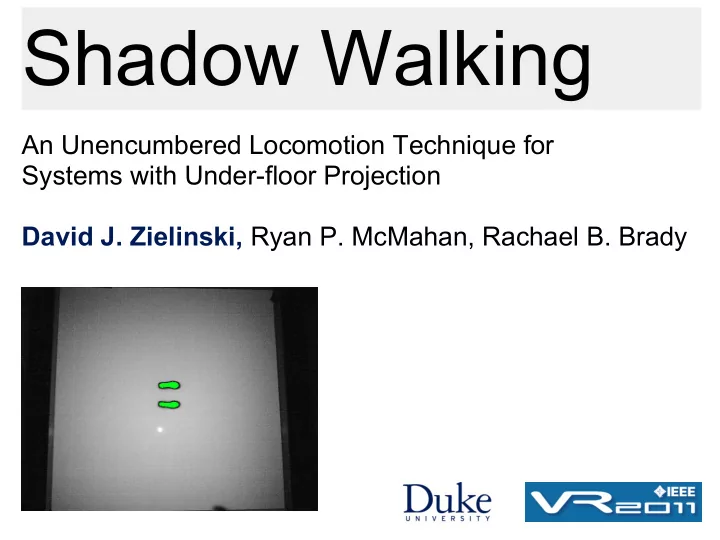
Track the shadows cast by the user's feet to calculate ground-plane location, orientation, and step events.
6-sided cube. 3m x 3m x 3m. PS3 Eye Webcam 640x480 @ 30 fps
Blur (radius=2) Threshold (val<30) Original
Center of Mass Furthest Point Orientation
1-Foot State if Cluster2 / Cluster1 < 50% then state 1 2-Foot State if Cluster2 / Cluster1 > 75% then state 2
Cluster1 Cluster2
if state transitions, then send step event to the VE
Easy and natural to use Range of walking speeds Can we compare our technique to the IS-900 head tracker? Walking in place with turning. mean yaw error = 7.3° (σ = 5.0°) Walking around mean pos error = 13.4 cm (σ = 3.2 cm)
Unencumbered Low Cost: $40 Camera (+ $1M VR System) No per user calibration
Need to have a system that was built for underfloor projection Dependence on scene for illumination (our testing was done with an idealized scene) Need to walk with a flat footed step to detect orientation. No Droopy Pants
Eliminate dependency on scene Low illumination Non-uniform floor illumination. Can we increase position and
User study Ideas: How well does our technique integrate into existing VR applications ? Does our technique work across a range of foot sizes?
Additional extended gestures Collaborative walking Artistic purposes: sound generation collaborate with dancers
David J. Zielinski Software Engineer for the Visualization Technology Group
Rachael B. Brady Director of the Visualization Technology Group Ryan P. McMahan Ph.D. Candidate
http://www.duke.edu/~djzielin/
if only one step event in the queue completion_time = 0.5 else completion_time = step time stamp - next step time stamp speed = 0.5 / completion_time //in ft per second do travel if time spent on this step > completion_time pop step off the queue at each frame