
SLIDE 1
W E N D Y E D W A R D S , S C H O O L C O U N S E L O R A N D N O R M K E N N E D Y , P R I N C I P A L T . M A R S H A L L E L E M E N T A R Y S C H O O L
The Social Thinking Project
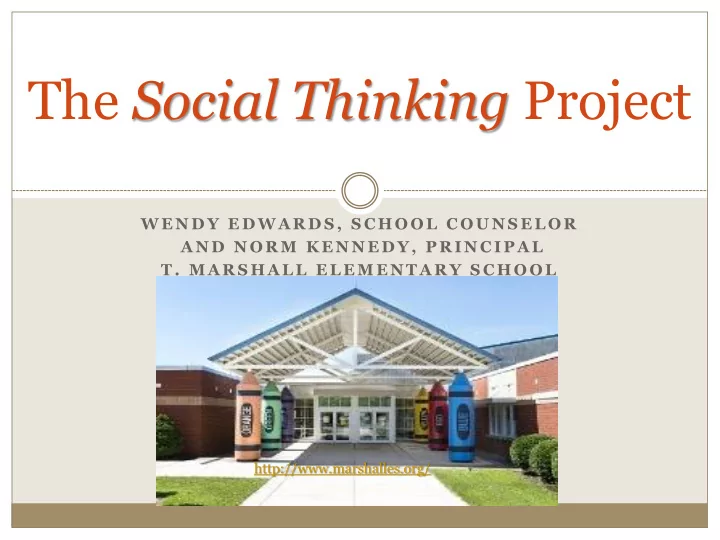
http://www.marshalles.org/
The Social Thinking Project W E N D Y E D W A R D S , S C H O O L - - PowerPoint PPT Presentation
The Social Thinking Project W E N D Y E D W A R D S , S C H O O L C O U N S E L O R A N D N O R M K E N N E D Y , P R I N C I P A L T . M A R S H A L L E L E M E N T A R Y S C H O O L http://www.marshalles.org/ What is Social Thinking?
W E N D Y E D W A R D S , S C H O O L C O U N S E L O R A N D N O R M K E N N E D Y , P R I N C I P A L T . M A R S H A L L E L E M E N T A R Y S C H O O L
http://www.marshalles.org/
A program that teaches
students to understand the concepts of social interaction so that they may learn social skills in a context that is meaningful for them.
Moving beyond spoken
interactions
Following unwritten
social rules of the environment
Sharing space with
Thinking about others Regulating your behavior
to others expectations or
2005)
The Launching
Thinking at Marshall…
1.
Professional Development during 2011-2012 school year.
2.
Leadership
3.
Needs Assessment
4.
Identify Staff
1.
Professional Development
Passion for Social thinking Philosophy Desire to integrate Social Thinking
Philosophy school wide.
Recognized a need to solidify a
Behavioral RTI process.
Needed a consistent approach for
discipline interventions.
3.
Therapist completed training
immediate need.
November 2012.
School-wide language and philosophy provided.
Expected and Unexpected Behavior Think with your eyes Being a “Thinking of you” kid versus a “Just Me” Comfortable/ Uncomfortable thoughts Your behavior affects my thoughts and feelings Size of the problem: Matching reaction to the size
Problem Solving Strategies Self-monitoring behavior
Established school wide expectations for problem solving
(Reinforced in August 2013 during a professional development)
Problem reflection visual and
problem scale were asked to be put up in classroom in a “thinking area”
Anger and anxiety thermometer
were sent out to teachers
The problem wheel was offered to teacher
to use in addition to PBS think sheets.
Integrated social thinking vocabulary and
concepts during parent and teacher consults/meetings.
The Size of the Problem
Students can understand expected responses to different types of problems. Utilized for individual, group, and classroom behavior interventions.
The Problem Reflection
Teachers utilize to help students identify the problem and their view
Teachers were given these visuals to support individual and classroom problem- solving strategies and interventions. The School Counselor integrated the problem wheel with the Second Step Program lessons including music and curriculum for social- emotional learning.
A N G E R & A N X I E T Y T H E R M O M E T E R S
M E R G I N G S O C I A L T H I N K I N G C O N C E P T S S C H O O L W I D E
Social Thinking Groups Process
Identify Students
Students with known social skills deficits Teacher Recommendations Individual Assessment Parent Letter and consent
Provide Parent Consultation Provide Teacher resources and consultation as needed K-2 Superflex Lessons 3-5 Think Socially Lessons
35% 23% 18% 12% 12%
8 Social Thinking Groups
K-1 2nd 3rd 4th 5th
Shaping School-wide Behaviors
Behavior Planning Behavior Interventions Behavior Management Problem Solving
Behavior intervention staff are using social
thinking components to help shape student behavior
Expected/Unexpected Language Model and Encourage Self-
regulation strategies
Providing safe environment for de-
escalation
Providing positive consequences for
expected behaviors (“Blue Room” and calming corners)
Providing sensory tools to self-manage
negative emotions.
Processing behavioral choices with
the Problem Wheel
year.
strategies to use in the home setting.
resource for parents.
The Future of Social Thinking @
Elementary School
Identify and support school wide positive behaviors with social thinking tools and concepts.
Future Endeavors
Identify and implement a School-wide
Screener to assist with identifying student social-emotional issues school-wide.
Train Special Education Staff (teachers,
aides, etc.)
planning.
“Train the trainer” (in-house consultants);
2 staff members
support social thinking concepts.
basic concepts and vocabulary.
R E S O U R C E S T O G E T Y O U S T A R T E D : W W W . M A R S H A L L E S . O R G
B u r o n , K a r i D u n n a n d C u r t i s , M i t z i ; T h e I n c r e d i b l e F i v e P o i n t S c a l e : A u t i s m A s p e r g e r P u b l i s h i n g C o . , 2 0 0 4 . C o n c o u v a n i s , J u d i t h : S u p e r S k i l l s : A S o c i a l S k i l l s G r o u p P r o g r a m f o r C h i l d r e n w i t h A s p e r g e r S y n d r o m e , H i g h F u n c t i o n i n g A u t i s m a n d R e l a t e d C h a l l e n g e s : A u t i s m A s p e r g e r P u b l i s h i n g C o m p a n y , 2 0 0 5 . W i n n e r , M i c h e l l e G a r c i a ; T h i n k S o c i a l ! A S o c i a l T h i n k i n g C u r r i c u l u m f o r S c h o o l - a g e C h i l d r e n ; C a l i f o r n i a , T h i n k S o c i a l P u b l i s h i n g I n c . , 2 0 0 5 . W i n n e r , M i c h e l l e G a r c i a a n d C r o o k e , P a m e l a ; Y o u a r e a S o c i a l D e t e c t i v e ! E x p l a i n i n g S o c i a l T h i n k i n g t o K i d s ; C a l i f o r n i a , T h i n k S o c i a l P u b l i s h i n g I n c . , 2 0 0 8 . W i n n e r , M i c h e l l e G a r c i a a n d M a d r i g a l , S t e p h a n i e ; S u p e r f l e x … A S u p e r h e r o S o c i a l T h i n k i n g C u r r i c u l u m P a c k a g e ; C a l i f o r n i a , T h i n k S o c i a l P u b l i s h i n g I n c . , 2 0 0 8 .