
SLIDE 1
Design Thinking Slides1.notebook 1 November 29, 2017
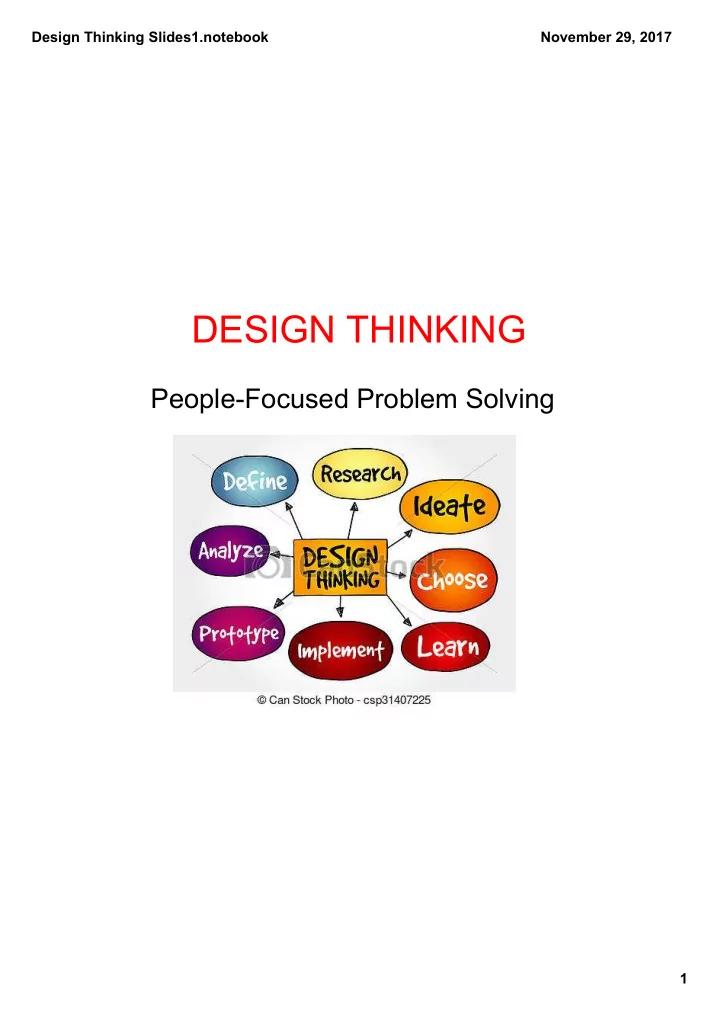
DESIGN THINKING
PeopleFocused Problem Solving
DESIGN THINKING PeopleFocused Problem Solving 1 Design Thinking - - PDF document
Design Thinking Slides1.notebook November 29, 2017 DESIGN THINKING PeopleFocused Problem Solving 1 Design Thinking Slides1.notebook November 29, 2017 STEP 1 IMMERSION Jump into the problem: Get on the dance floor! Gather as much
Design Thinking Slides1.notebook 1 November 29, 2017
PeopleFocused Problem Solving
Design Thinking Slides1.notebook 2 November 29, 2017
STEP 1
Jump into the problem: Get on the dance floor! Gather as much information as you can What are people, DOING, SAYING, THINKING, and FEELING? Find out "why" by observing and asking open ended questions Be a traveler/alien Immerse at the extremes
Design Thinking Slides1.notebook 3 November 29, 2017
neat messy busy decorated unique colorful fun stuffed dirty unorganized
trashy blue pretty full pink empty clean simple half empty, half full small sporty lots of papers lots of water bottles careless
Design Thinking Slides1.notebook 4 November 29, 2017
What did I see? What did I think?
Design Thinking Slides1.notebook 5 November 29, 2017
a lot of objects Different sections disorganized messed up a lot of blue neat fine useful a bit messy neat and organized you could put another shelf on top artistic doesn't use the hooks it's not very decorative many books and looseleaf papers with no where to go functional creative bright crayon box
Design Thinking Slides1.notebook 6 November 29, 2017
Not influenced by personal feelings
Based on or influenced by personal feelings or opinions
Design Thinking Slides1.notebook 7 November 29, 2017
The ability to understand and share feelings of another
Design Thinking Slides1.notebook 8 November 29, 2017
How did empathy play an important role in the design of the MRI machine? Why do you think empathy is part of the design problem solving process? 1) 2)
Design Thinking Slides1.notebook 9 November 29, 2017
STEP 2
Move from "the dance floor" to "the balcony" Gain some perspective Frame your challenge as an opportunity "How Might We...?"
Design Thinking Slides1.notebook 10 November 29, 2017
Shopping Cart Challenge?
Design Thinking Slides1.notebook 11 November 29, 2017
MRI Machine Challenge
Design Thinking Slides1.notebook 12 November 29, 2017
STEP 3
Generate LOTS of solutions to our challenge Get creative and resourceful Don't edit! Cluster and label related ideas Take something off the table and ask many "What if....?" questions Play with constraints: "What if we had 1 million dollars?"
"Enlighten trial and error, succeeds over the planning of the lone genius."
Design Thinking Slides1.notebook 13 November 29, 2017
STEP 4
Build, Test, Learn! Just do it! Pick an idea you are passionate about Show, don't tell! Create a rapid prototype: anything that helps experience the experience you imagined Share prototypes and talk to the people in your community. This is a continuous process!
Design Thinking Slides1.notebook 14 November 29, 2017
Design Thinking Slides1.notebook 15 November 29, 2017
THE RULES:
Build the Tallest Freestanding Structure: The winning team is the one that has the tallest structure measured from the table top surface to the top of the marshmallow. That means the structure cannot be suspended from a higher structure, like a chair, ceiling or chandelier. The Entire Marshmallow must be on top: The entire marshmallow needs to be on the top of the structure. Cutting or eating part of the marshmallow disqualifies the team. Use as Much or as Little of the Kit: The team can use as many or as few of the 20 spaghetti sticks, as much or as little of the string or tape. The team cannot use the paper bag as part of their structure. Break up the Spaghetti, String or Tape: Teams are free to break the spaghetti, cut up the tape and string to create new structures. The Challenge Lasts 18 minutes: Teams cannot hold on to the structure when the time runs out. Those touching or supporting the structure at the end of the exercise will be disqualified.
1) 2) 3) 4) 5)
Design Thinking Slides1.notebook 16 November 29, 2017
TIME FOR REFLECTION: What was it like working in a group? Was there a leader in the group that directed? What were the strategies used? What happened when there was failure?
Design Thinking Slides1.notebook 17 November 29, 2017
LESSONS LEARNED: Prototyping Matters! Find all Hidden Assumptions!
Design Thinking Slides1.notebook 18 November 29, 2017
School Veteran’s Day Professional Development, November 2016