
SLIDE 1
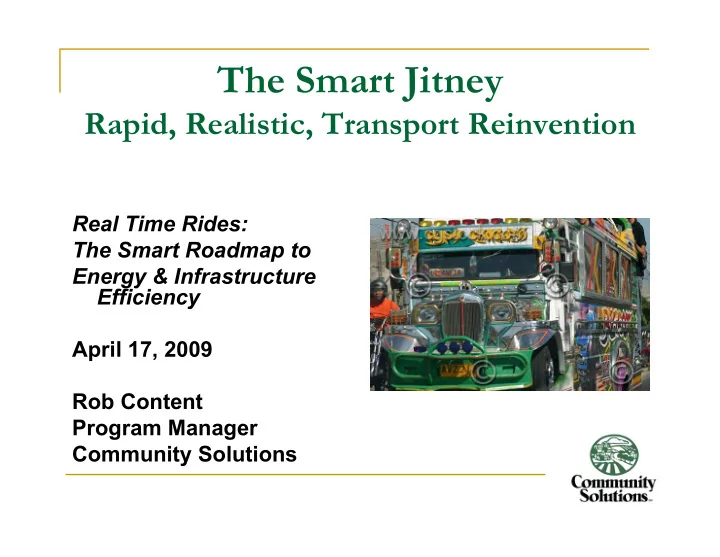
The Smart Jitney Rapid, Realistic, Transport Reinvention Real Time - - PowerPoint PPT Presentation
The Smart Jitney Rapid, Realistic, Transport Reinvention Real Time Rides: The Smart Roadmap to Energy & Infrastructure Efficiency April 17, 2009 Rob Content Program Manager Community Solutions Community Solutions Vision &
Vision – To reduce energy consumption everywhere in every way through community and personal action
Mission – To provide knowledge and practices to support low energy lifestyles in the household economic sector (food, housing, transportation)
Key Assumptions
Peak Oil and Climate Change are interrelated
Must become “sustainable” – watchword of our times
“Sustainability” can be, and must be, measured
Running low on oil
Petroleum Geologists (ASPO) All fossil fuels finite Predictions began in 1970s
Running low on atmosphere
Climate scientists (NOAA) Carbon absorption finite Predictions began in 1970s
2006
5 10 15 20 25
US Russia Germany Japan UK Iran Mexico Thailand China Turkey Brazil Cuba Indonesia Egypt Nigeria Vietnam Phillipines India Pakistan Ethiopia Bangladesh
Sustainability defined – ~ 1 ton/CO2 per person per year
20 of ~200 nations with 70% of population
Sustainable ~1 ton/person
Western Industrial “life style” is threatening life itself
China & India (2.5 billion people) have chosen industrialism
Consumerism replaced socialism/communism
Ecological deterioration is accelerating
“What kind of world will we leave our children, grandchildren and great grandchildren? What will they say of us? Will our great grand children say, "What kind of monsters must they have been?“ – US Representative Roscoe Bartlett (Rep) ASPO 2006
Three options – Plan A, Plan B, Plan C
Plan A – Business as usual (new fuels). Same lifestyle Plan B – Replace fossil fuels with wind/solar. Same lifestyle Plan C – The party’s over. Change lifestyle. Cut back fuels
Plan A – Denial – Fuel Cell, Nuclear Fusion, Carbon Capture
The record is bleak. Big potential for war.
Plan B – Substitution – Wind, solar, biofuels
Wind & solar still about 1%. Agri-fuels (food of the poor)
Plan C – Redesign – Curtailment and Community
Use “intermediate” technologies Reduce consumption – change life style Focus on household sector – food, house, car
U.S. has 250 million cars/SUVs/pickups
30% of the 700+ million cars in use worldwide
75 million new cars and trucks are built each year worldwide
Net addition to world car population – 55 million yearly World growth in terms of auto fuel – 8%
U.S. cars/trucks generate 45% of auto CO2 in world
Average American buys 13 cars in his/her lifetime
U.S. fleet mileage – 21 mpg, Europe 42 mpg, Japan 47 mpg
Low mileage cars still being made – with a 15-20 year life
Hirsch concludes we can’t change the fleet $.25 trillion 22 8,500 Aircraft $1.5 trillion 28 7 Million Heavy Trucks, Buses $1 trillion 16 80 Million Light trucks SUVS, etc. $1.3 trillion 17 130 Million Automobiles Cost to replace half the fleet (2003 $) Median Life (years) Size Fleet
Passengers per trip
US Transportation Energy Book, 2007
1,200,000 deaths yearly
38,848,000 injuries yearly
Enormous suffering
Massive property losses
More casualties in 3rd world
Poor road infrastructure
Much new car research hasn’t worked well
Fuel Cell EV PNGV
Very successful hybrid Prius model
About 1.5 million out of 250 million in 10 years
PHEV is a coal car
Density determines success of mass transit
Historically residences laid out in dense corridors
Many walkable small towns along the rail line
Between corridors, there was open space and farms
Suburban growth filled in the corridors
Filled in area (suburbs) are car dependent
A true mass transit system for U.S. today might be impossible
Our sprawl has no precedent in history
Mass transit typically just supplements cars
Paris, London, Toronto, New York – high car populations
Mass transit overrated (BTU per passenger mile)
Private Car – 3,496
SUV – 4,329
Bus Transit – 4,318
Airplane – 3,959
Amtrak Train – 2,760
Rail transit – 2,569
Vanpool – 1.294
How much and how long for a mass transit system?
Can it even be done in places like Los Angeles?
Heavily subsidized car-based transport through:
publicly funded loans, grants, road building cheap fuel, health care, policing & courts
Encourages people to make as many car trips as possible
Encourages the largest possible cars
Ensures that cars are rarely delayed by even a couple minutes
Makes buses and trains generally unpleasant experiences
Makes walking & cycling as inconvenient & dangerous as possible
Ignores the health, aesthetics, ethical & cost advantages of walking/cycling
A small bus that carries passengers
schedule
An unlicensed taxicab
Essence of the Jitney
Mass transit with cars, not buses
Common in 85% of world
Like any jitney, it’s for a small number of people
Not mass transit – anyone, with a good record, can drive
Made possible by basic communications/GPS technology
A software problem – not a hardware problem
Will provide anywhere/anytime/anyplace pickup and drop off
Not limited to tracks/lines/schedules
Will provide a high level of security and safety
“Smart” enough to cut transport energy use 75%
Climate people say 80% cut in CO2 is needed
A vehicle
New or old, small or large Includes a “wired in” Smart Jitney cell phone Includes an Auto Event Recorder (speed, etc.) May have a speed governor – a social question
A cell phone for each rider/passenger
Includes GPS Includes emergency call button for security
A reservation and tracking computer system
All hardware is in existence
Passenger requests a ride via cell phone
Enters Pickup/Destination Location, Pickup/Arrival Time Selects Kind of Service
Smart Jitney computer assigns rider to vehicle
Evaluates all seats in transit Determines optimum pick up and drop-off path Monitors pickup and drop-off process Monitors for emergency warning
Pick up and drop off made
Rider submits evaluation entered by cell phone Smart Jitney computer summarizes ride evaluations
E Bay methodology
Competition is a top cultural value
Basis of our economic system Cooperation is viewed as weakness 2005 had the highest income inequity since records began
Our neighborhoods are organized by income level
School funding via taxes supports social separation Perpetuates inequity through generations Competition between children
How could we ride with just anybody?
Easy for most cultures in the world Very hard for us
New technology fuel cell – 30 years and counting
Electrical cars (EVs and PHEVs) fueled by coal power plants
Risk of runaway climate change
New liquid fuels – high risk, decades away, low EROEI
Oil shale, coal to liquids, gas to liquids, biofuels The Hirsch Option – designed to perpetuate large cars
Efficiency vision won’t do it – Jevon’s paradox
The more efficient the car the more energy will be consumed