The Six Pillars of Fundraising Success Jay Frost Principal Frost - - PDF document

the six pillars of fundraising success
SMART_READER_LITE
LIVE PREVIEW

The Six Pillars of Fundraising Success Jay Frost Principal Frost - - PDF document

6/12/2019 The Six Pillars of Fundraising Success Jay Frost Principal Frost On Fundraising The New Hampshire & Vermont Council of Charitable Gift Planners June 2019 The House We Built Source: Henry Huey, Flickr 1 Donor Research


slide-1
SLIDE 1

6/12/2019 1

The Six Pillars

  • f Fundraising Success

Jay Frost Principal Frost On Fundraising The New Hampshire & Vermont Council of Charitable Gift Planners June 2019

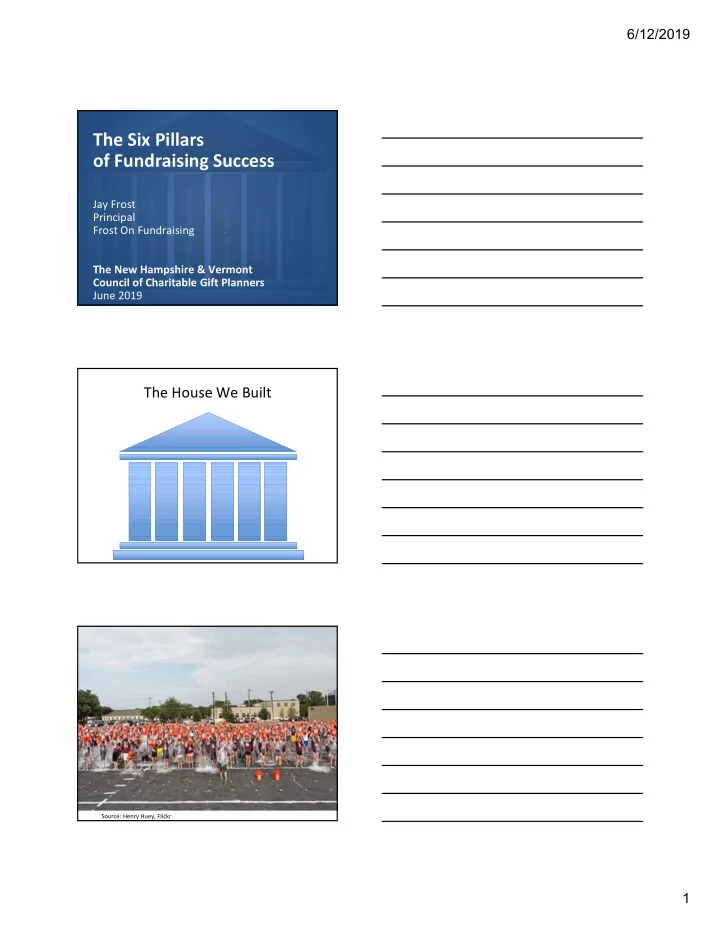
The House We Built

Source: Henry Huey, Flickr

slide-2
SLIDE 2

6/12/2019 2

The Circle of Giving

Identify Qualify Cultivate Solicit Steward

Six Pillars Six Pillars

  • f Fundraising

Donor Research Relationship Building Volunteer Involvement Securing the Gift Leadership and Management Ethics, Accountability, and Professionalism

slide-3
SLIDE 3

6/12/2019 3

Six Pillars Six Pillars

  • f Fundraising

Donor Research

Relationship Building Volunteer Involvement Securing the Gift Leadership and Management Ethics, Accountability, and Professionalism

Donor Research

Communicate and validate relevant donor information with key organizational stakeholders to establish a plan of action for engagement, cultivation, solicitation, and stewardship. Rate current and prospective donors on linkage, ability, and interest to priorities and plan cultivation and solicitation.

Collect and analyze current and prospective donor information including demographics, psycho-graphics, interests, values, motivations, culture, ability, giving and volunteer history, relationships, and linkages to select potential donors for particular projects and fundraising programs. Implement and utilize a secure data management system to ensure data privacy, store information on current and prospective donors, and enable segmented retrieval and analysis. Develop a list of prospective donors by identifying individuals, groups and entities, such as foundations, corporations, and government agencies, with the linkage, ability, and interest to give in order to qualify prospective donors for further research and cultivation.

The Chairs

Source: TeachingEconomics.org

slide-4
SLIDE 4

6/12/2019 4 What does your donor look like?

Six Markers of Philanthropy Study

DonorSearch 2017 $685 Million 1 Million 400 in Giving Individuals Organizations

(no outliers)

  • 1. Giving To

Your Organization

  • RFM

– Recency – Frequency – Money

slide-5
SLIDE 5

6/12/2019 5

2. Giving to Other Organizations

  • 3. Board/Trustee

Position

Who’s at the Top?

slide-6
SLIDE 6

6/12/2019 6

  • 4. Political Giving

A single lifetime political gift of $250 puts your constituent in the top 6% of the US population A single gift of $1,000 puts your constituent in the top 1/10th of 1% Virtually every donor with lifetime political giving of $15,000 has made a 4,5,6, or 7 figure charitable gift somewhere

  • 5. Value Of Real

Estate

  • Often the only asset

data available

  • Giftable
  • Individuals owning $2+

million worth of real estate are in the top 3.5% of your donor pool and give nearly 1/3 of your donation dollars.

  • Individuals owning$1

million + in real estate comprise 9.3% of your donor pool and are responsible for 40% of your revenue.

6. Public and Private Business Affiliations

slide-7
SLIDE 7

6/12/2019 7

D&B / Hoovers for Private Company Details

CNBC for Snapshots of Public Company Ownership

EDGAR for Detailed Public Company Info

slide-8
SLIDE 8

6/12/2019 8 Screenings

Peer Data Overlay Assets Modeling Social

  • BWF Insight (US)
  • DonorSearch (US)
  • Factary (UK)
  • FR&C (Australia)
  • Global-Z (Europe)
  • Gnosis (Asia)
  • GG&A Donorscape ()US)
  • Iwave (US)
  • Mosaic from Experian

(Global)

  • Prospecting for Gold (UK)
  • Sherlock (Global)
  • Target Analytics (US)
  • WealthEngine (US)
  • WealthX (Global)

Six Pillars Six Pillars

  • f Fundraising

Donor Research

Relationship Building

Volunteer Involvement Securing the Gift Leadership and Management Ethics, Accountability, and Professionalism

Relationship Building

Initiate and strengthen Initiate and strengthen relationships w/ constituents via systematic cultivation and stewardship plans designed to build trust in, and long term commitment to, the organization Develop and implement Develop and implement a comprehensive communications plan to inform constituents about the

  • rganization’s

mission, vision, and values, financial and ethical practices, fundin g priorities, and gift

  • pportunities

Promote Promote a culture of philanthropy by broadening constituents’ understanding

  • f the value of

giving Acknowledge and recognize Acknowledge and recognize donor gifts and engagement in ways that are meaningful to donors and appropriate to the mission and values of the

  • rganization

Communicate and validate Communicate and validate relevant donor information with key stakeholders to establish a plan of action for engagement, cultivation, solicitation, and stewardship.

slide-9
SLIDE 9

6/12/2019 9

Relationship Building: It’s All About Sustained Engagement & Gratitude

Does This Look Like Your Organization?

  • Very few organizations are calling their

$1,000+ donors

  • The majority of organizations are

sending communication from the name

  • f the organization, rather than from a

real person

  • One-third of organizations aren’t calling

their donors by name

  • Most organizations don’t say “thank

you” nearly enough

  • The size of your organization does not

determine your ability to communicate effectively

Tim Kachuriak, Founder and Chief Innovation and Optimization Officer for NextAfter

Engage in conversation

slide-10
SLIDE 10

6/12/2019 10

Top “TO DO’s” on LinkedIn

  • Make sure you have a

profile!

  • Mention your

affiliation prominently

  • Mention your
  • rganization in status

when attending meetings

  • Talk about your
  • rganization in groups
  • Identify and profile

potential board members, major donors or volunteers

Top “To Dos” for Facebook

  • On Your Page(s)
  • Post about your

meetings with photos and videos, tagging individuals and

  • rganizations for reach
  • Share content
  • On Organizational

Page

  • Like posts
  • Engage in conversation
  • Tag photos

Top “To Dos”

  • n Twitter
  • Browse the lists
  • Conduct keyword searches
  • Watch hashtags
  • Monitor mentions
  • Use the currency of the

network: RTs, Tys, Shrunken URLs, and other forms of acknowledgement

slide-11
SLIDE 11

6/12/2019 11

Manage your social life

Introducing Moves Management™

  • A system for building

deep, life-long affinity and commitment with probably donors.

  • These relationships

reliably lead to major gifts.

  • This is true no matter

how you define a major gift.

What is a “Move”

  • A “Move” is an opportunity to:

– Further cultivate a relationship – Increase awareness of important

  • pportunities

– Acquire vital information

  • Moves cover the whole range of the

major gift process.

  • Moves can be made by personal visit,

phone call, letter or social media

  • There should be at least 1 per month

per probable donor.

  • All moves have a specific, desired
  • utcome that leads naturally to a

planned next step.

slide-12
SLIDE 12

6/12/2019 12

Who Does What

  • Each major gift probable donor is

assigned to a Moves Manager.

  • This person makes certain the

donor is properly cultivated, solicited & thanked for his or her generosity.

  • The Moves Manager relies on

help from Natural Partners. These can be friends, relatives, business associates, and social acquaintances of the probably

  • donor. Natural Partners can also

be representatives from the

  • rganization.
  • The Natural Partners help create

and implement a strategy for securing a major gift. They also participate in the cultivation, solicitation and acknowledgement of the donor.

  • The Moves Manager also

identifies a Primary Player—the Natural Partner to whom the probable donor would have the most difficulty saying “no.” This person asks for the gift.

Setting Cultivation Objectives

  • Too general
  • Unrealistic
  • Fundraiser-driven

Traps to Avoid

  • Best possible outcome
  • Minimum acceptable
  • utcome

Prior to Each Call, Determine…

How Much Can You Manage?

An executive director with administrative help can personally cultivate/solicit 20 donors. A Director of Development with management, marketing, content creation and administrative duties can personally cultivate/solicit 50 donors. If your

  • rganization is

lucky enough to have a full time development

  • fficer, he or

she can personally manage 100 to 125 donors. A board member, with help from staff, can manage 5 to 10 donors. Source: “Fundraising Benchmarks for Small Nonprofits ($2M and under)” by Joanna Joslyn

slide-13
SLIDE 13

6/12/2019 13

Get a Move On!

Select 10 to 25

  • f your best
  • pportunities

1

Collect easy-to- access research

  • n each

2

Identify Natural Partners

3 Get Set

Plan

Plan next seven moves for each

Develop

Develop a strategy for each opportunity & establish preliminary gift objective

Select

Select a Primary Player for each probable donor

Consult

Consult confidentially with Natural Partners

Go

Implement Moves Review/Record what transpires in each and every contact Refine strategy/gift

  • bjectives as

appropriate Fine tune the planning for next move

slide-14
SLIDE 14

6/12/2019 14

Keep the destination in mind

  • Periodically review the status of each

and every prospective donor

  • Refine strategies and objectives and

plan the next seven moves for each

  • Add and delete opportunities from

your portfolio as appropriate

Setting a Higher Standard

Six Pillars Six Pillars

  • f Fundraising

Donor Research Relationship Building

Volunteer Involvement

Securing the Gift Leadership and Management Ethics, Accountability, and Professionalism

slide-15
SLIDE 15

6/12/2019 15

Volunteer Involvement

Identify

  • Identify organizational readiness and opportunities to

engage volunteers. Create

  • Create structured processes for the identification,

recruitment, orientation, training, evaluation, recognition, retention and succession of volunteers. Develop

  • Develop specific role descriptions and terms of

commitment to empower and support volunteers and enhance their effectiveness. Engage

  • Engage various types of volunteers (for example, board,

program, campaign) in the fundraising process to increase organizational capacity. Participate in

  • Participate in recruiting experienced and diverse

leadership on boards and/or committees to ensure these groups are representative of, and responsive to, the communities served.

Source: The Value of Volunteer Time / State and Historical Data, Independent Sector, April 2018

  • There are 63 million volunteers in the US
  • Despite major economic and political changes since 2012,

the contributions of volunteers has grown with each year.

  • The estimated value of volunteer time is $24.69 per hour

nationally and ranges from a low of $19.81 in Mississippi to a high of $31.17 in Massachusetts

Volunteer Engagement

  • The level of volunteer engagement in

fundraising is low.

  • NPOs should seek meaningful ways to

engage volunteers in the processes of donor cultivation, solicitation and stewardship.

  • Volunteer participation is critical for

instilling trust and confidence among potential donors.

slide-16
SLIDE 16

6/12/2019 16

Longer and Happier Lives

  • Volunteering frequently to help others is

associated with delayed mortality among older adults.

  • A study of elders in assisted living indicated

that volunteer activities improved mental health by creating “positive attitudes toward aging, a sense of connectedness, and improvements in feelings of control and life satisfaction,” as well as decreased depression.

Sources: Studies at University of California, Berkeley and the University of Michigan

Happier and More Productive Staff

  • 71% of employees who volunteer feel better

about their employers. This is believed to contribute to improved recruitment and retention.

Answer These Questions

  • Where is the volunteer portal on your website?
  • How many volunteers do you have today?
  • How do you match volunteer skills and interests to current

and emerging needs?

  • How are you tracking volunteer data in your CRM?
  • Are you offering a peer-to-peer fundraising tool for your

donors?

slide-17
SLIDE 17

6/12/2019 17 Social Works!

The Example of Giving Blue Day

Rachel’s wish

Six Pillars Six Pillars

  • f Fundraising

Donor Research Relationship Building Volunteer Involvement

Securing the Gift

Leadership and Management Ethics, Accountability, and Professionalism

slide-18
SLIDE 18

6/12/2019 18

Securing the Gift

Develop a case for support by involving stakeholders in order to communicate the rationale for supporting the

  • rganization’s mission.

Develop

Identify solicitation strategies and techniques appropriate to current and prospective donor groups.

Identify

Develop and implement specific solicitation plans for the involvement of individual donors, donor groups, and/or entities.

Develop and implement

Prepare donor-focused solicitation communications in order to facilitate informed gift decisions.

Prepare

Ask for and secure gifts from current and prospective donors in order to generate financial support for the

  • rganization’s mission.

Ask

The Golden Circle

Source: Simon Sinek, How Great Leaders Inspire Action, TED Talk

Going Up?

slide-19
SLIDE 19

6/12/2019 19

Your Case For Support

What is it? When and how do we use it? Who is the audience?

Your Case for Support

  • Every organization needs a basic document that sets

forth its nature, purpose, and principal objectives in a powerful, personal, and compelling way.

  • The case is not for the purpose of praising the
  • institution. It is not a resume. Or a list of projects. Or

merely a list of naming opportunities.

  • A really powerful case will be more concerned with

the cause that the institution represents and the problem it seeks to resolve— than with the institution itself.

  • The case explains how together you will change lives
  • r save lives.
  • Statistics tells. Stories sell. Make it real.

Now What?

If the case is focused on a capital project, it can facilitate a study to uncover your lead donors up to 60% or more of a major goal It allows you to set appointments with individuals and institutions with demonstrated capacity and affinity and to focus your discussion The Case is your tool for measuring the interest of donors in your work

slide-20
SLIDE 20

6/12/2019 20

Ask

Setting up the visit

  • Send a letter in advance
  • Select the time of day and place the call
  • Prepare and practice
  • Review your calendar in advance and

keep it handy

  • Stand
  • Put yourself in their shoes
  • Keep it brief
  • Be upfront about the purpose
  • Talk about the amount of time involved
  • Be patient, firm, and positive
  • Set the date while you are on the phone
  • Send written confirmation
  • Remember: Don’t make the case or solicit

now! Your only objective is to set the meeting

The meeting

  • Establish rapport &

common ground

  • You both care
  • You are dedicated to

mission

  • Probe/Ask open

questions

  • LISTEN THE GIFT!
slide-21
SLIDE 21

6/12/2019 21

Present the

  • pportunity

Give testimony “I’d like you to consider…” Don’t fill in the silence Objections are your best friends

Handling Objections

Indifference Misunderstanding Skepticism Negative feelings

When it doesn’t work…

  • You didn’t call for the

visit

  • Inadequate

preparation

  • No strategy
  • Too many

assumptions

  • Failure to probe
  • Poor listening
  • Failure to stress

benefits

  • You didn’t ask!
slide-22
SLIDE 22

6/12/2019 22

Six Pillars Six Pillars

  • f Fundraising

Donor Research Relationship Building Volunteer Involvement Securing the Gift

Leadership and Management

Ethics, Accountability, and Professionalism

Leadership and Management

Demonstrate leadership that advances fundraising practice.

Demonstrate

Advocate for and support a culture of philanthropy and the advancement of fundraising across the organization and its constituencies.

Advocate

Ensure that sound administrative and management policies and procedures are in place to support fundraising functions.

Ensure

Participate in the organization’s strategic planning process to ensure the integration of fundraising and philanthropy.

Participate in

Design and implement short-and long- term fundraising plans and budgets to support the organization’s strategic goals.

Design and implement

Leadership and Management

Utilize

Utilize external services as needed to optimize the efforts of the fundraising function.

Recruit, train, and support

Recruit, train, and support staff by providing professional development opportunities and applying human resource principles to foster professionalism and a productive, team-oriented work environment.

Conduct

Conduct ongoing performance measurement analysis of fundraising program using accepted and appropriate standards and metrics in order to identify opportunities, resolve problems, and inform future planning.

Employ

Employ marketing and public relations principles and tools to support and grow fundraising programs.

slide-23
SLIDE 23

6/12/2019 23

The Complete Development Program

Research Engagement Sustaining Support Major & Planned Gifts Institutional Support Events Operations

Six Pillars Six Pillars

  • f Fundraising

Donor Research Relationship Building Volunteer Involvement Securing the Gift Leadership and Management

Ethics, Accountability, and Professionalism

Ethics, Accountability, and Professionalism

Ensure that all fundraising activities and policies comply with ethical principles and legal standards and reflect the values of the organization and the community.

Ensure

Communicate principles of ethical fundraising to stakeholders to promote ethical practices and strengthen a culture of philanthropy.

Communicate

Promote ethical fundraising as a crucial component of philanthropy to strengthen the non-profit sector and support the sector’s role as a pillar of civil society.

Promote

Clarify, implement, monitor, and honor donors’ intent and instructions regarding the use of gifts.

Clarify, implement, monitor, and honor

Ensure that allocations of donations are accurately documented in the organization’s records.

Ensure

Report to constituents the sources, uses, impact, and management of donations to demonstrate transparency and enhance public trust in the organization.

Report

Participate as an active and contributing member of the fundraising profession through activities such as mentoring, continuing education, research, and membership in professional associations.

Participate
slide-24
SLIDE 24

6/12/2019 24

Tales from the Crypt

Horror Stories of Fundraising

Accuracy

  • Howling Good Time
  • Life on the Farm
  • You, Your Wife and Your Other Wife

Relevance

Black out Tales

slide-25
SLIDE 25

6/12/2019 25

Responsibility

  • No Boundaries
  • Can You Help Me With

My Book?

  • Just the fax, Ma’am
  • How Much do You Guys

Make?

Conflict of Interest

  • Take my Clients,

Please!

  • Sharing the Wealth
  • We’re All Part of the

Same Institution, Aren’t We?

Generally Hair Raising Fundraising Practices!

  • Just a Few Final Pledges
  • Remembering the Really Important Donors
  • Redhead Executives
slide-26
SLIDE 26

6/12/2019 26

Confidentiality

  • The Stalker
  • Shredder Stories
  • The Not-So-Anonymous Donor
  • Here’s Your Bio!

“Ethics is knowing the difference between what you have a right to do and what is right to do.” – Justice Potter Stewart

Six Pillars Six Pillars

  • f Fundraising

Donor Research Relationship Building Volunteer Involvement Securing the Gift Leadership and Management Ethics, Accountability, and Professionalism

slide-27
SLIDE 27

6/12/2019 27

Source: Crystalinks.com

Reach Out to Me Anytime!

  • Email:

jay@frostonfundraising.co m

  • Phone: 571-426-6214
  • LinkedIn: Jay Frost
  • Twitter: @gordonjayfrost
  • Facebook:

FrostOnFundraising