Boaz & Jachin - The Pillars of the Porch We encounter the - - PDF document

boaz amp jachin the pillars of the porch we encounter the
SMART_READER_LITE
LIVE PREVIEW

Boaz & Jachin - The Pillars of the Porch We encounter the - - PDF document

U.M.W. St. Johns Grand Lodge of Louisiana A.F.&A.M. Boaz & Jachin - The Pillars of the Porch We encounter the two great pillars Boaz and Jachin twice in Freemasonry. We encounter them physically, as brothers who had been


slide-1
SLIDE 1
  • Boaz & Jachin - The Pillars of the Porch

We encounter the two great pillars Boaz and Jachin twice in Freemasonry. We encounter them physically, as brothers who had been regularly initiated and seeking more light by being passed to the degree of fellow craft. This of course happens as we prepare to make the ascent up the the winding stairs to the middle chamber to receive our wages

  • f a fellow craft, which are corn, wine and oil, emblematic of peace, unity and plenty.

This place being The Holy of Holies or Sanctum Santorum. We also encounter them in the historical sense as we examine them biblically on the porch of King Solomon’s

  • Temple. While easily recognizable to any studied Mason... The representation of the

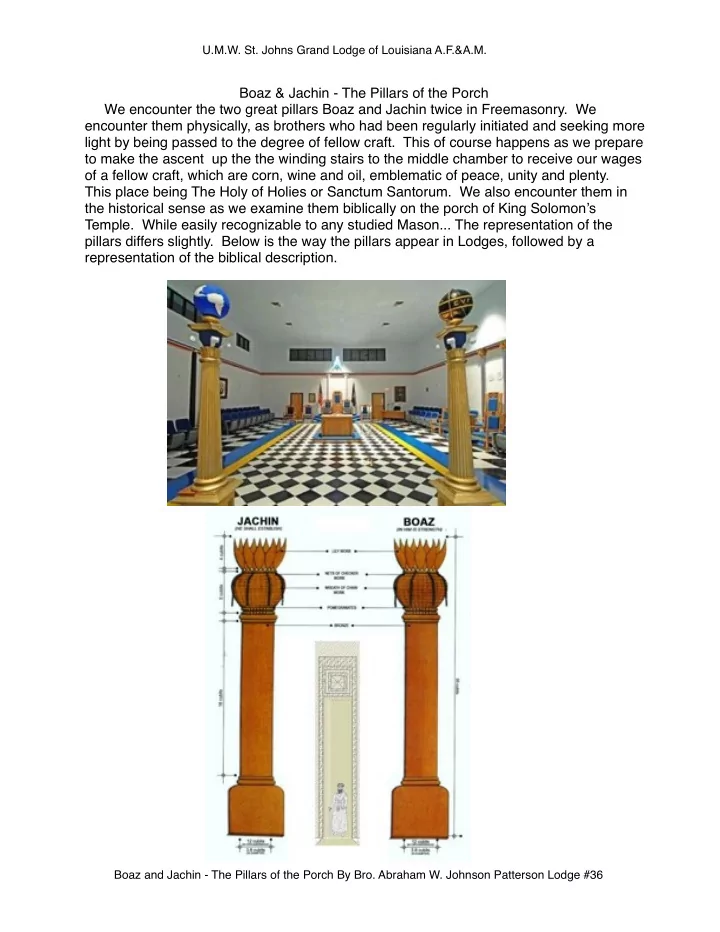
pillars differs slightly. Below is the way the pillars appear in Lodges, followed by a representation of the biblical description.

U.M.W. St. Johns Grand Lodge of Louisiana A.F.&A.M. Boaz and Jachin - The Pillars of the Porch By Bro. Abraham W. Johnson Patterson Lodge #36

slide-2
SLIDE 2

The names of the pillars... Boaz and Jachin are given to us in the Bible. 1 Kings 7:21 reads: ‘And he set up the pillars in the porch of the temple: and he set up the right pillar, and called the name thereof Jachin: and he set up the left pillar, and called the name thereof Boaz’. In the original Hebrew, “Boaz” means strength, “Jachin” meaning to establish. Collectively alluding to God’s promise to David to establish his kingdom in strength. As we examine the physical characteristics, first we start with the most obvious trait of the pillars, and that is the fact that there are two. The number 2 is significant of witness. In both the Old and New Testaments, the testimony of 2 was required. Deuteronomy 17:6 ‘At the mouth of two witnesses, or three witnesses, shall he that is worthy of death be put to death; but at the mouth of one witness he shall not be put to death.’ and 2 Corinthians 13:1 ‘This is the third time I am coming to you. In the mouth of two or three witnesses shall every word be established.’ The Pillars Both representations of the pillars start with the shaft of the pillar. Lester’s tells us “These pillars were cast in the clay grounds on the banks of Jordan, between Succoth and Zarthan, where all the vessels of King Solomon’s Temple were cast by Hiram Abiff. They were cast hollow the better to serve as a safe deposit for the archives of Masonry against all conflagrations and inundations. Conflagration means an extensive fire that destroys a great deal of land or property, and inundation means flooding. The thickness

  • f the pillars was a hand or four fingers. We find this in Jeremiah 52:20-21.

The pillars were made of bright or scoured brass... we find this in 1 Kings 7:45 ‘And the pots, and the shovels, and the basons: and all these vessels, which Hiram made to King Solomon for the house of the LORD, were of bright brass.’ As well as 1 Chronicles 18:8 ‘Likewise from Tibhath, and from Chun, cities of Hadarezer, brought David very much brass, wherewith Solomon made the brasen sea, and the pillars, and the vessels of brass.’ In the bible, brass is found to be symbolic of judgment against sin, and against

  • self. The Holy Spirit is titled “The Spirit of Judgement and the spirit of Burning” (Isaiah 4:4)

Scouring speaks of the suffering and chastisement that believers experience as the Lord deals with sin and selfishness. (Hebrews 12:11) Lester’s says “They were each thirty-five cubits in height, and were adorned with chapiters of five cubits, making in all forty cubits in height. This is confirmed in the bible in 2 Chronicles 3: 15 ‘Also he made in front of the house two pillars of thirty and five cubits high, and the capital that was on the top of each of them was five cubits.’ This description is more detailed in 1 Kings 7:15 says ‘For he cast two pillars of brass, of eighteen cubits high apiece: and a line of twelve cubits did compass either of them about.’ 18 is a multiple of 9, nine being the number of Divine completeness and finality. It is also the number of the holy spirit. There are 9 fruits of the spirit, 9 gifts of the spirit, and 9 beatitudes (or commandments of blessedness). This means the pillars speak of that which is completed, that which is final as to the outer court ministry, or how we have lived according to how He wants us to live, the final step before entering the Lord’s house. The line of 12 cubits surrounding it is the circumference, indicating that it is 12 cubits, or 18

U.M.W. St. Johns Grand Lodge of Louisiana A.F.&A.M. Boaz and Jachin - The Pillars of the Porch By Bro. Abraham W. Johnson Patterson Lodge #36

slide-3
SLIDE 3

feet around. The number 12 is the number of Divine government. Twelve is the number

  • f God’s government being seen in the city of God, the new Jerusalem(Revelation 21-22).

In this place everything is according to God’s Order, God’s law, and His government. When dealing with the height and circumference we see the unit of measurement called cubits. This historically has never been an exact measurement. It is understood to be a physical measurement of about 1.5 feet or 18 inches. Or in those days, the length from ones elbow to finger tips. Using this measurement we can assume that the pillars, from base to Lily work were approximately 60 feet. The column itself being roughly 52.5 feet tall. The Chapiters This brings us to the chapiters. The pillars had chapiters or crowns or caps on them. The crown speaks of that which is kingly. Christ is crowned with honor and glory. The saints receive their crowns when their earthly ministry is completed. We find this in Hebrews 2:9 and 1 Peter 5:4. We are given the physical description in 1 Kings 7:16 ‘And he made two chapiters of molten brass, to set upon the tops of the pillars: the height

  • f the one chapiter was five cubits, and the height of the other chapiter was five cubits.’

We get a varying size in 2 Kings 25:17 which says it measures 3 cubits. This is most likely because the chapiter itself was 3 cubits in size, but the bowls which they were set in made up the other 2 cubits, being considered 1 ornament. The bowls or Pommels which are referred to in 2 Chronicles 4:12 and 1 Kings 7:41-42 are simply round bowls to hold the chapiters. 5 is the number of God’s grace, the number of life and atonement. Lester’s tells us that the chapiters were adorned with lily-work, network and

  • pomegranates. The network is broken down into two parts... Nets of Checker Work, and

Wreaths of Chain work. Nets of Checker Work Network, or as it is referred to as checker work is mentioned 6 times in the bible. These references often relate to the weaving of clothing. Lester’s says The intimate connections

  • f its parts denotes unity. As we know from 1 of the first scriptures we learn in Masonry.

Psalms 133... ‘Behold, how good and how pleasant it is for brethren to dwell together in unity!’ Because that is how we should work, with an interwoven unified purpose. We see checker works in the bible relating to the pillars in: 1 Kings 7:17 ‘And nets of checker work, and wreaths of chain work, for the chapiters which were upon the top of the pillars; seven for the one chapiter, and seven for the other chapiter.’ The two bowl-like chapiters were set and then these nets of checker work were

  • n top of these bowls. In the scriptures the net reminds us of Christ’s call to His disciples

to become fishers of men and catch men in the Gospel net (Matthew 4:19; Mark 1:17; Matthew 13:47-50, Ezekiel 47:10-14). We know that Christ is the master fisherman and that He knows the right bait to catch fish out of the sea of humanity. The parable of the kingdom shows the Gospel net bringing in all kinds of fish, or people. Jeremiah 16:16 ‘Behold, I will send for many fishers, saith the LORD, and they shall fish them; and after

U.M.W. St. Johns Grand Lodge of Louisiana A.F.&A.M. Boaz and Jachin - The Pillars of the Porch By Bro. Abraham W. Johnson Patterson Lodge #36

slide-4
SLIDE 4

will I send for many hunters, and they shall hunt them from every mountain, and from every hill, and out of the holes of the rocks.’ Wreaths of Chain Work Wreathed chain work is generally used as the symbol of exaltation. Exaltation is defined as the action of elevating someone in rank, power, or character. As in “the resurrection and exaltation of Christ” Chains of course are made of numerous links. We see in the bible both Joseph and Daniel adorned in exaltation with chains of gold and set next to the king (Genesis 41:42; Daniel 5:29). The high priest had chains of gold on his breastplate of judgement (Exodus 28) and The holy oracle in the Temple had golden chains across its door (2 Chronicles 3:16). The pillars have woven chains of brass representing the fact that justice and judgement are exalted before the Lord. There were 7 of these chains... 7 is the number of perfection or completeness. The Pomegranates on the Chains 2 Chronicles 3:16 ‘And he made chains, as in the inner sanctuary, and put them on the tops of the pillars; and made a hundred pomegranates, and put them on the chains.’ When we pair this scripture with 1 Kings 7:18-20, 42 and 2 Chronicles 4:12-13 we find several things. That the pomegranates on the chain work were entwined with the network

  • n the top of the pillars and the wreathed chains. The scriptures also show us that there

were a total of 400, 200 on each pillar, in two rows of 100 spanning the circumference. But why is the pomegranate important? The pomegranate was a fruit of the promised

  • land. The pomegranate speaks of fruitfulness, the fruit of the Spirit on the two pillars

( Numbers 13:23; Deuteronomy 8:8). 400 is the number of affliction and suffering. The fruit of the Spirit is often born out of affliction and suffering, it is the manifestation of the life of the tree (John 15:1-16) We learn in Lester’s that the pomegranate represents

  • plenty. This is because of their many seeds as well as their ability to grow prosperously in

many types of climates. The Lily or Lilywork The Lily is mentioned 15 times in the bible. Luke 12:27 says ‘Consider the lilies, how they grow: they neither toil(don’t work at all) nor spin; but I tell you, not even Solomon in all his glory clothed himself like one of these. They are a beautiful, large white flower, it is sweet and fragrant with a strong scent.’ The Hebrew meaning of “lily” is “whiteness”; also a trumpet, for its tubular shape. So Christ is absolute whiteness with perfect purity within and without. His saints should be lily white also. They also lift their voices like a trumpet and warn people (Isaiah 58:1; Ezekiel 33). It represents purity... And we know that He is the purist to walk the earth. Jesus is called the Lilly of the Valley. Song 2:1 Jesus says “I am the Rose of Sharon, and the Lily of the Valleys. We learn in Masonry that the Lily, by its purity, and the retired situation in which it grows, denotes peace. Peace is a noble attribute we should strive for in our spiritual relationship with God and as Masons, we should promote peace between all men. In Isaiah 9:6, Jesus is called The Prince of

  • Peace. The measurement of the Lilly on the pillars are 4 cubits or 6 feet.

U.M.W. St. Johns Grand Lodge of Louisiana A.F.&A.M. Boaz and Jachin - The Pillars of the Porch By Bro. Abraham W. Johnson Patterson Lodge #36

slide-5
SLIDE 5

The Terrestrial and Celestial Globes The first thing we notice when examining the representation of the pillars in Lodge versus the biblical representation is the globes atop Boaz and Jachin. Why is this? It’s hard to believe that they were simply forgotten. Or is it that Masonry simply added them. We know that the pillars collectively allude to God’s promise to David to establish his kingdom in strength. So we wonder what this has to do with the globes. First we must understand what the globes denote. We learn in Lester’s that “The globes are two artificial spherical bodies, on the convex surface of which are represented the countries, seas and various parts of the earth, the face of the heavens, the planetary revolutions and

  • ther particulars. The sphere with the parts of the earth delineated on its surface is called

the terrestrial globe, and that with the constellations and other heavenly bodies the celestial globe. Contemplating these bodies, we are inspired with due reverence for the Deity and His works. This concept is given to us in the very first book and verse of the Bible... Genesis 1:1 ‘In the beginning God created the heavens and the earth.’ Thus the terrestrial and celestial globes are Masonic visual representations of such. In the time of the building of King Solomon’s temple which was completed in 964 B.C. globes did not

  • exist. In fact the first globe did not come into existence until 1492 and was created by

Martin Behaim, not Hiram Abiff or any of the Grand Masters or there predecessors. The bible shows the significance of pillars. A pillar speaks of stability, uprightness and solidarity in the work of the Lord, in the position which God sets it. A pillar speaks of faithfulness, as well as speaking to the many divine attributes we have discovered and identified while breaking down its parts. As the pillars stood on the porch of King Solomon’s temple, so should we stand as Masons, servants of God.

U.M.W. St. Johns Grand Lodge of Louisiana A.F.&A.M. Boaz and Jachin - The Pillars of the Porch By Bro. Abraham W. Johnson Patterson Lodge #36

slide-6
SLIDE 6

Much of the above material comes from three sources: The Holy Bible Lester’s Look To The East (revised) The Temple of Solomon by Kevin J. Conner.

U.M.W. St. Johns Grand Lodge of Louisiana A.F.&A.M. Boaz and Jachin - The Pillars of the Porch By Bro. Abraham W. Johnson Patterson Lodge #36