SLIDE 1
SLIDE 2
An in-depth study of KST would consume many days Instead, lets us focus on one of the most outstanding
features of the temple
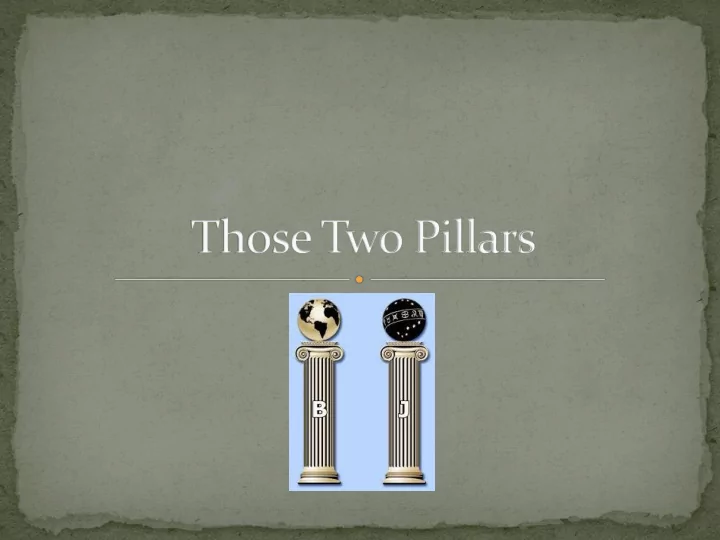
The two pillars. Boaz and Jachin, which guarded the
entrance to the Temple
SLIDE 3
Few things in Masonry are less understood
than the two pillars in the porch of King Solomon’s Temple
We talk about them a lot but the DETAILS
are not well known
SLIDE 4 The first thing that attracts our attention is two
columns or pillars, representing those which were placed on the porch of King Solomon’s Temple, one on the right hand and one on the left. The one on the left hand was named BOAZ and denoted strength; the one
- n the right hand was named JACHIN and denoted
- establishment. Collectively they allude to a passage of
scripture wherein God hath said, “In strength, shall this mine house be established.”
SLIDE 5
These two pillars are basically the same in every
lodge in the Masonic world, representing the same message (or are they?)
In US lodges, the earliest description (from the
1700’s) show both Wardens seated in the West, facing the Master.
The two pillars were generally near them, next to
the inner door, forming a portal and all candidates pass between them for each degree.
SLIDE 6
However, location is not uniform in the US
jurisdictions
The majority of lodges place them as we do But, in my travels, I have observed that the
two pillars might be located anywhere in lodge room
SLIDE 7 In George Washington Lodge Number 22
AF&AM in Alexandria, VA
The two pillars are found on one side of the
Junior Warden’s station in the south
Perhaps to add strength to our Masonic
thoughts that it was their first JW who
SLIDE 8
In England, and in many other countries
abroad, the two pillars are usually displayed in front of the Master’s chair, and some place the pillars in the center of the lodge.
In some portions of the world, they are not
represented at all.
SLIDE 9
SLIDE 10
SLIDE 11
SLIDE 12
SLIDE 13
SLIDE 14
From our ritual we learn that:
“Those columns were eighteen cubits in height, twelve in circumference and four in diameter, and were adorned with two chapiters, one on each, five cubits in height…”
Lets examine the dimensions and geometry
SLIDE 15
For a circle with radius = r Area = π r2 Circumference = 2 π r And d = 2 r So if C = 12, we solve for d 2 π r = 12 2 r = 12/ π D= 3.8197 (not 4, so math is off!)
r
SLIDE 16
We know that D= 3.8197 And height = 18
4
SLIDE 17
What is a cubit? Cubit = approx 20 inches Therefore columns were
18 x 20/12 = 30 feet high 5.3 feet in diameter
SLIDE 18
These two pillars are discussed in the Masonic Bible
that we provide to new masons
Interesting to note that there is no image of these
pillars in our masonic bible
SLIDE 19
Many different images of what those pillars looked like Why?
SLIDE 20
SLIDE 21
SLIDE 22
SLIDE 23
SLIDE 24
SLIDE 25
Present design is an interpretation of the columns Composite Hollow Globes
SLIDE 26
SLIDE 27
SLIDE 28
SLIDE 29
SLIDE 30
SLIDE 31
SLIDE 32
SLIDE 33
SLIDE 34
SLIDE 35
SLIDE 36
SLIDE 37
SLIDE 38
SLIDE 39
It is believed that the pillars were cast in the clayey
grounds in the banks of the river Jordan between Succoth and Zurudathal
Where is this?
SLIDE 40
SLIDE 41
SLIDE 42
SLIDE 43
Those columns were of molten or cast brass. They
were cast by Hiram, the widow’s son, in the clayey grounds on the banks of the river Jordan, between Succoth and Zurudathal where King Solomon ordered these and all the holy vessels of the temple to be cast.
They were a hands breadth, or four inches in
thickness, and were cast hollow to preserve, from inundations and conflagrations, the rolls and records contained within them, which were supposed to be the archives of Masonry.
SLIDE 44
It is believed that the pillars were cast hollow and
were a handbreadth, or four inches in thickness
Commonly conceived that the two pillars were cast
in one piece
From a foundry viewpoint, hard to believe Single brass casting would weigh 27 tons Need to move about 50 miles from origin to
destination
SLIDE 45
Some images show
columns in sections
Stone pillars were
made like this
Maybe our ancient
brethren used this technique?
SLIDE 46
Casting bronze was not an easy task If we break the column down into smaller sections, say
10, each one would be about 3 feet high and weight about 2.7 tons. More believable, but…
Archelogists have stated disbelief that people of the
Bronze Age could make a casting weighing over a ton.
SLIDE 47
SLIDE 48
X
SLIDE 49
SLIDE 50
Metallic ores (copper, tin, lead, antimony, arsenic) Fuel (wood, charcoal, seeds, dry dung, brush) Blast Air (bellows, wind human breath) Tools (for handling molten metal, for sculpting molds) Furnace (to melt the ores, mix ready to pour)
Pure copper melts at 1,083 °C [ 1,981 °F]
Molds (constructed to required shape)
SLIDE 51
Many more questions beg answers
Where did they get the large quantity of ore? Where did they get the HUGE quantity of fuel needed? How did they smelt it? How did they make the molds? How did they get the molten metal into molds? How did they get the finished product to the site? How did they erect the pillars?
Archeologists have found nothing near the supposed
sight to indicate that bronze was smelted there
You will have to decide for yourself.
SLIDE 52
…these were ornamented with three rows of work-
network, lily work, and pomegranates.
The network, from the closeness of its connections,
denoted unity;
the lily work, from its whiteness and purity, denoted
peace;
and the pomegranate, from the exuberance of its seed,
denoted plenty.
SLIDE 53
They were further adorned with two globes, or
spherical bodies, on the surfaces of which were represented the countries, the seas and the various parts of the earth, the face of the heavens, the planetary orbits and other important particulars.
They were thus extensive to denote the universality of
Masonry and to teach us that a Masons charity should be equally extensive.
SLIDE 54
A modern addition The ancient world believed the world to be flat
SLIDE 55
The actual details of the pillars is not
important
This is just an interesting history and
engineering lesson
What they represent to all masons is what is
important to remember
SLIDE 56
Never forget, my brother, the lessons of these two
pillars
They guard the entrance to our lodge room Stop and ponder a while next time you are in their
presence at all they represent
Let your mind become subjective and captive to all
they represent
SLIDE 57
SLIDE 58
Solomen’s Temple, by WB Harvey Lovewell The Pillars of the Porch, by Bro. William B. Bragdon Those Mysterious Pillars: Boaz and Jachin, by WB
William M Larson
The Two Pillars, by John Schroeder, GL VA Two Pillars, MSA Short Talk