
SLIDE 1
Depth & Complexity Framework - Understanding the pieces
J Taylor Education, 2016
ELP Depth and Complexity Resource Page: https://www.jtayloreducation.com/tagtelp/
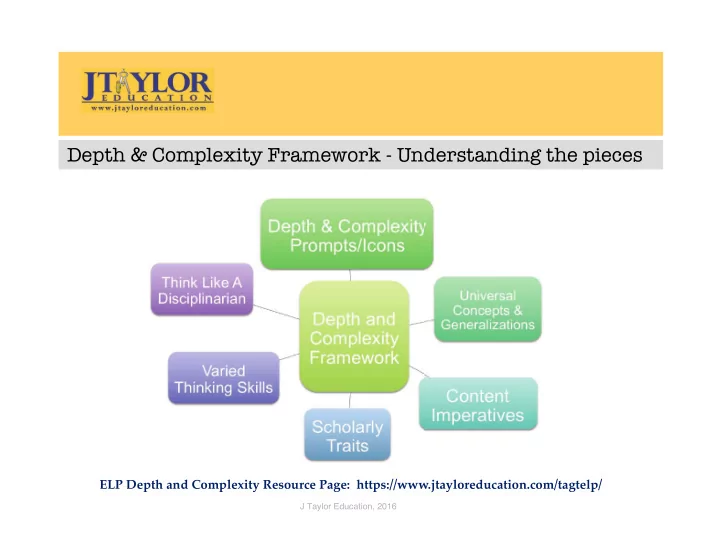
Depth & Complexity Framework - Understanding the pieces ELP - - PowerPoint PPT Presentation
Depth & Complexity Framework - Understanding the pieces ELP Depth and Complexity Resource Page: https://www.jtayloreducation.com/tagtelp/ J Taylor Education, 2016 Depth & Complexity Framework Understanding the parts Think Like A
Depth & Complexity Framework - Understanding the pieces
J Taylor Education, 2016
ELP Depth and Complexity Resource Page: https://www.jtayloreducation.com/tagtelp/
Think Like A…
!
Universal Concepts & Generalizations
!
J Taylor Education, 2016
Depth&&& Complexity&
&
&
& &
&
Assessment&Forms&
& & & & & &
& &
&
Depth & Complexity
up on classroom walls).
align with the icons).
used.
standards.
(smooth-flowing; not forced).
“Think Like Disciplinarians….” are being used during instruction.
Teacher: Date: Content Area: Grade:
Depth & Complexity Teacher Assessment
To occur before classroom observations Please check any of the following that apply to your teaching at this time. Describe your best experience using the Depth & Complexity Framework______
Introduction of some Depth/Complexity dimensions (icons) Introduction of Depth/Complexity icons
lessons/classroom environment
instruction
Collaborating with colleagues related to Depth/Complexity
Experiences/Goals/Questions:
___________________________________________________ ___________________________________________________ ___________________________________________________
Teacher: _____________________________________________ her: _____________________________________________ Date: _______________________ Content Area: _______________________ Grade: _____________
Teacher/ Follow-Up
Together, select from the option below as to what you think needs to be a “next step.” This may be for several or many teachers at a similar level.
differentiation - universal themes or concepts, content imperatives, independent study)
J Taylor trainers
collaborate)
________________________________________________________ ________________________________________________________ ________________________________________________________ Teacher: _____________________________________________ her: _____________________________________________ Date: _______________________ Content Area: _______________________ Grade: _____________ Lesson: ___________________________________________________ Lesson: ___________________________________________________ Standard: __________________
Name: ..................................................Teacher/Student Thinking “Progression”
To be submitted and recorded once every 2-3 months
Students that use Depth & Complexity will develop critical, creative, and abstract thinking skills. They will ask broad, deep, though-providing questions that often times have several solutions, or none at all. Students will progress through their acquisition of these thinking skills as listed below:
Teacher organizes and directs all instruction Curiosity and independent inquiry/ownership but still needs teacher help at ties Independent thinker that1 2 3 4
* Understands thinking required to complete tasks.
1 2 3 4
* Selects relevant and/or appropriate D/C thinking tools.
1 2 3 4
* Uses one or more components of the D/C framework on regular basis.
1 2 3 4
* Exhibits understanding and command of at least some of D/C tools
1 2 3 4
* Reflects on deep and complex thinking with insight.
1 2 3 4
* Independently looks to improve thinking.
1 2 3 4
Everyone is expected to improve. Everyone is expected to be challenged. Everyone is expected to do his/her best. Everyone gets an equal
to learn.
J Taylor Education, 2016
Concrete( Abstract( Depth( Complexity( Novelty( Dependent( Independent( Reflec;ve(Learners(
J Taylor Education, 2016
student application
with varied resources with Standards
a time
INTRODUCING THE PROMPTS OF DEPTH AND COMPLEXITY
more than
time Student choice
Explain.
J Taylor Education, 2016
Intellectual Pathway to a product.
lead to Patterns lead to Perspectives Over Time.
R.Fitzgerald M.S. Ed. J Taylor Education 2011
R.Fitzgerald M.S. Ed. J Taylor Education 2011
Depth & Complexity - prompts (icons) that help students better understand the curriculum by eliciting levels of reasoning as a means to acquire and apply knowledge. This repetitive reasoning creates patterns in the brain where children make and understand deep and complex connections.
discipline.
level of challenge for all students. (CDE, 2005)
*
*
J Taylor Education, 2016