SLIDE 1
The Roles of Local Organisations in Agroecology and Food - - PowerPoint PPT Presentation
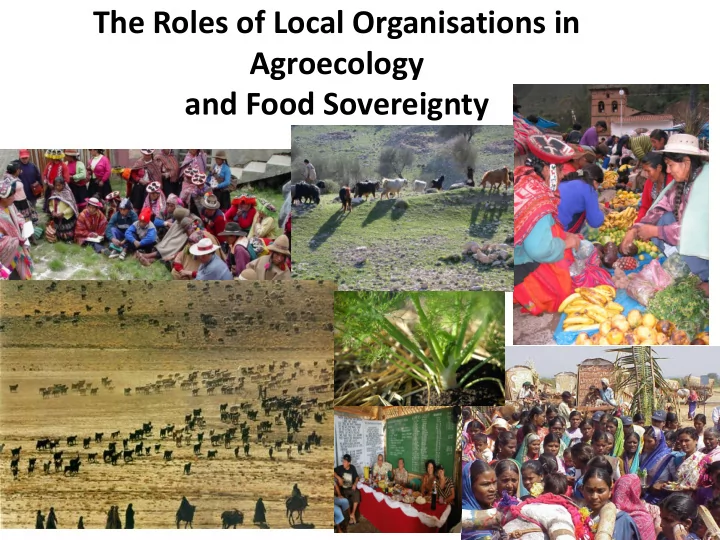
The Roles of Local Organisations in Agroecology and Food Sovereignty Food, Agriculture, Environments and Livelihoods Local organisations and collective structures The Medicinal Plant The Video The Native Potatoes Collective Collective
SLIDE 2
SLIDE 3
Local organisations and collective structures
The Video Collective The Native Potatoes Collective The Medicinal Plant Collective
SLIDE 4
Local adaptive management of food-producing environments
- The use of
sophisticated environmental indicators to track and respond to change
Spring Summer Fall Winter
SLIDE 5
SLIDE 6
Local adaptive management of food-producing environments
- The use of diversity to
reduce risks and mitigate impacts of natural disasters and long-term environmental change
SLIDE 7
SLIDE 8
Nested local
- rganisations
and networks
SLIDE 9
SLIDE 10
Local organisations and people’s access to land and food
- Locally-developed
rules for resource access and use
- Local organisations
and access to land
- Local organisations
regulating access to food
SLIDE 11
Local organisations and economic exchange
- Emphasis on market based
solutions to meet food and
- ther human needs - no or
little thinking outside this box
- Focus on money based
markets overlooks importance of more plural forms of economic exchange (subsistence based markets, barter, solidarity economy…)
- Local organisations
mediate economic exchanges
SLIDE 12
Federations, networks and organised policy influence
SLIDE 13
Multi-scale networks of nested local
- rganisations
- Local and regional
coalitions e.g. AFSA
- Producer alliances –
e.g. WAMIP)
- Federations of
indigenous peoples
- La Via Campesina
SLIDE 14
Shared values and visions
- Self-determination
and endogenous development – many worlds possible and desirable
- Rights based
approaches e.g. UN Declaration on Rights
- f Indigenous Peoples
- Emphasis on
alternative policy framework for food and agriculture – “Food Sovereignty”
SLIDE 15
Federations of local organisations are well placed
to promote countervailing power and more
- democracy. They can:
- create safe spaces and participatory processes in
which expert knowledge is put under public scrutiny through appropriate methods for deliberation and inclusion (e.g. citizens’ juries)
- strengthen the voices of the excluded in setting
agendas and framing policies and regulatory frameworks for development and environment— at local, national and global levels
- Case study: Prajateerpu in South India
SLIDE 16
Democratizing the Governance of Food Systems
- putting peasants and other citizens at the
centre of governance
- Six pathways for empowering citizens in
policy-making & institutional choices:
- 1. Learning from history to re-invent active
forms of citizenship
- e.g. Spanish civil war and peasant’s reclaiming
control over land and other resources - http://www.diversefoodsystems.org/tfs/tfs5_anarchi sm.mov
SLIDE 17
- 2. Strengthening civil
society
- Collaboration between
local and external civil society actors - Building upon synergies between the government and society
- Independent pathways
from below
- 3. Methodologies for
citizen participation in policy and institutional choices, including risk assessments
SLIDE 18
- 4. Towards greater
information democracy
- Autonomous media
- Web based
knowledge networks and multimedia
SLIDE 19
- 5. Nurturing citizenship
Politics are too important to be left to professionals: they must become the domain of amateurs—of
- rdinary citizens.
- With training and experience citizens can learn to
deliberate, make decisions, and implement their choices responsibly
- These skills do not arise spontaneously; they have to
be consciously nurtured and are the result of careful political education, which includes character formation, personal and social training, and civic schooling—to produce citizens with the competence to act in the public interest.
SLIDE 20
- 6. Strengthening local organisations to expand
agroecology, food sovereignty and democracy
- Local adaptive
management of environment
- People’s access to land
and food
- Federations, networks
and organized policy influence
SLIDE 21
- facilitate the horizontal
interlinking and federating of citizen spaces as a way of decentralising and democratising the governance of food systems
- support the emergence
- f large scale coalitions
for change committed to agroecology, food sovereignty and well being (‘buen vivir’)
SLIDE 22
Two big challenges for local
- rganisations
SLIDE 23
Social inclusion in local organisations
Consciously developing forms
- f governance and relations
that are: i) genuinely inclusive of gender and difference ii) democratic, with effective safeguards against the abuse, and concentration of power
SLIDE 24
Horizontal forms of organized cooperation – why and how?
- Collective action and local
adaptive management of ecosystems and natural resources over a wide area
- Organized cooperation for
economic exchanges among interdependent communities
- Forms of governance:
State-centric? Democratic confederalism? Or?
SLIDE 25