The road not taken Robert Frost Two roads diverged in a yellow - - PowerPoint PPT Presentation

the road not taken
SMART_READER_LITE
LIVE PREVIEW

The road not taken Robert Frost Two roads diverged in a yellow - - PowerPoint PPT Presentation

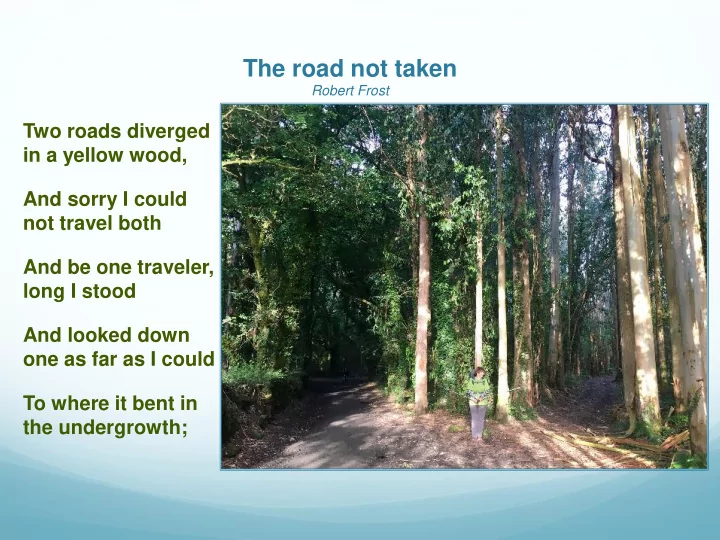
The road not taken Robert Frost Two roads diverged in a yellow wood, And sorry I could not travel both And be one traveler, long I stood And looked down one as far as I could To where it bent in the undergrowth; About this course:


slide-1
SLIDE 1

The road not taken

Robert Frost

Two roads diverged in a yellow wood, And sorry I could not travel both And be one traveler, long I stood And looked down

  • ne as far as I could

To where it bent in the undergrowth;

slide-2
SLIDE 2

About this course: Crafting the Present for Future Employability An AHECS Employability Module

A.

Designing my destiny, with others - past influences

B.

I think, therefore I am … employable? –self-awareness

C.

The competency contest – key skills and competencies

D.

Career paths: Paved with possibility - career decision-making process

E.

Future-proofing my career – broad range of perspectives

F.

Building my brand for the creative job search - creative communication

G.

Recruitment and selection: Breaking the code - how organizations recruit and select graduates

H.

In the workplace: Steps to success - flexibility in the workplace

I.

Challenging yourself as an entrepreneur - entering the job market as an entrepreneur or self-employed

J.

One step ahead: Intercultural awareness and residence abroad – intercultural competence

slide-3
SLIDE 3

 Who influenced you in your career choice?  Other possible influences - two theories of career

development will help you to understand your choices better.

 You will evaluate these influences. Were they

enabling or limiting?

 Think how to how to develop influences to optimise

career exploration and career development.

Workshop A What you will learn here:

slide-4
SLIDE 4

Workshop A What you will learn here:

 Who influenced you in your career choice?

It is important when planning your future to take a look at your history.

  • Lifeline exercise
  • Language biography

exercise

slide-5
SLIDE 5

An example of a lifeline by a 24 years old student

www.mycareerplan.net/career/ch2-a.htm

slide-6
SLIDE 6
slide-7
SLIDE 7

Linguistic repertoire Maledive project http://maledive.ecml.at

slide-8
SLIDE 8

Linguistic repertoire

Today, formally and informally, we all learn, or are exposed, to more than one foreign language. We also master different varieties of our first language (dialects, hobby-related registers, language use typical to certain communities, etc.). Various languages and language varieties do not exist separately in people’s minds: they are part of the same linguistic repertoire, i.e. the languages and dialects that you speak or any languages that are important for you for some other reason.

From Maledive project http://maledive.ecml.at

slide-9
SLIDE 9

Workshop A An example of „localisation”

Identify your capabilities and interests as a ML student/graduate What did you like best about your language studies?

Being able to communicate in my learned language with growing ease and confidence

Discovering the structure of the language, the rules and exceptions of its grammar, the history of the language, etymology of words

Learning the registers – language appropriate to situation, finding out about slang, dialects

Being able to read literary works in the original

Sharing my knowledge of the language with others – informal teaching

Understanding films and songs, recognising accents

Learning about the culture and history

Learning about intercultural differences , understanding intercultural differences in contacts with native speakers

Translation and interpreting classes

Writing with confidence

Other

slide-10
SLIDE 10

Workshop A

Identify your capabilities and interests as a ML student/graduate

Which of the career choices below appeal to you most? Try matching your preferences from the previous list with possible career choices.

Teaching (on various levels of the education system)

Interpreting

Translation

Linguistic research

Literary research

Tour guiding

Media

Business – negotiations, interpreting, translating

Shared services centre - finance, human resources management

Developing language teaching materials – traditional and online

Teaching the language online

Marketing, e.g. multilingual social media marketing

Other

slide-11
SLIDE 11

In the previous exercise you have identified your career preferences connected with your language studies. What additional skills would you need to have the careers form the previous list?

Your local Zeteophilia Institute runs the following courses for professionals in many areas wishing to learn new skills. Choose a course/courses that would introduce you to/prepare you for a given career.

Excel for beginners

Loud and clear – voice training course

More memorable than the Colosseum - how to be an unforgettable guide

Bullying prevention training

Tech tools for educators

X-ray eyes – expert personality profiling

Talent management – how to hire the best staff

Go viral!

Teach the world - online course creation

Accounting - basic course

The Queen’s speech – advanced pronunciation course

Group health and safety issues

KISS – keep it short and simple. Effective writing skills

In pairs discuss what other courses would be useful for your planned career and share with the class.

Workshop A

Identify your capabilities and interests as a ML student/graduate

slide-12
SLIDE 12

Two theories of career influence

Widening my perspective

slide-13
SLIDE 13

Two theories of career influence

Learning Theory of Career Choice & Counselling

Mitchel and Krumboltz External Influences on Career Decisions Krumboltz examines the impact of 4 categories of factors:

  • 1. Genetic endowment and special

abilities 2.Environmental conditions and events

  • 3. Learning experiences
  • 4. Task approach skills

Community Interaction Theory Bill Law identified five main modes in which community influence occurs:

1.Expectations — pressures from family or community group 2.Feedback — messages about your strengths and weaknesses, and your suitability for particular roles 3.Support — reinforcement of aspirations and assistance you received 4.Modelling — professional role-models 5.Information — opportunities to find out about

  • ptions and the extent to which data is filtered

by the norms of the social group. These five forms of influence can come from sources such as family, peers, ethnic groups, teachers. These influences could be positive or negative, enabling or hampering people in their career choices.

slide-14
SLIDE 14

Everyone is a genius. But if you judge a fish by its ability to climb a tree, it will live its whole life believing it is stupid

Attributed to Albert Einstein

slide-15
SLIDE 15

Workshop A Who influenced you in your career choice. Evaluating the influences Were the influences enabling or limiting?

Video exercise

slide-16
SLIDE 16

Workshop A Who influenced you in your career choice. Evaluating the influences Were the influences enabling or limiting?

Video exercise

slide-17
SLIDE 17

Video 3 transcript

02:05 Well I worked at Glengoyne as a tour guide, when I was a student, when I was at university and then, when I graduated, a position became available for a full-time position in marketing and that’s how I got the job, having worked as a tour guide before that. 02:20 I mean university education’s been a huge help, in the fact that getting you to do presentations, working to deadlines, having to do, having to write, you know, dissertations and essays, things like that, have helped. At the time you don’t really see how this is ever going to be applicable in your career, but it’s only now that I can see that, you know, having had that background, it’s been really helpful to work to deadlines, as I say, and you know, just even working with other people as well, cos you have to work in a lot of groups at university and it does help you to work in a team, when you come in to, when you work here as well. 02:52 Going to university is not the be all and everything. I think that it’s gaining experience throughout life that is really important. Quite a few of my friends at school, who weren’t particularly academic or just didn’t enjoy studying, felt that they had to go on to college or university and then they ended up, you know, not finishing that course and they felt they’d maybe wasted some time, where they could have been, you know, if they’d gone into a job and worked their way up or got some experience in other areas, that that would have been more useful for them. 03:20 What’s really nice about working for Ian Macleod Distillers, the owners of Glengoyne is that they’re quite a small company but they are forward-thinking and, and they give you lots of

  • pportunities to work on various different projects, so you’re not

just kind of stuck to doing the one job every day. 03:34 I don’t think I can point kind of pick out one particular turning point in my life, I think that my, I feel that going to school and then going to university and then working here and then getting through to a job here, all just kind of worked, was quite a natural progression, I don’t think there’s any point that there was

  • ne decision I made or anything that suddenly kind of turned my

life around. I think that it was all just quite a natural, natural progression, ending up here. 03:57 END

Sarah B Modern Languages and Business graduate

00:02 My name is Sarah B and I’m the sales and marketing manager at Glengoyne distillery. 00:06 My job involves basically promoting Glengoyne as a world- class visitor attraction and encouraging as many visitors to come and learn about whisky. Oh it’s a really enjoyable job and you get to work with people from all over the world. 00:18 When I was at school there were subjects that I really enjoyed and there were subjects that I just didn’t particularly enjoy or didn’t do particularly well at so I kind of focussed on the things that I could do well and so I did my Highers and then went

  • n to the sixth year studies. I found that I liked languages and I

was good at it so I kind of stuck to the subjects I enjoyed doing. 00:37 I think the one area I think is with maths, that I felt that I maybe could, I didn’t, I didn’t do higher maths, I chose to do Italian instead of maths and because I enjoyed languages, I felt it was fine for me just to focus on the language side of things and

  • ther subjects that I enjoyed, whereas because I didn’t

particularly like maths, I felt that I could get away with not having to do that because I wanted to do languages. Whereas now I wish that I had maybe had done higher maths, just so I could have done it and really improved a little bit. 01:06 I went to Strathclyde University and studied international business and modern languages and it was a five year course, which involved spending one year in France, which was fantastic and so I spent one year, my fourth year, at a university, a business school in France and then came back to do my final honours year. 01:25 My dad is a sales manager for a car company and my mum is a teacher, a head teacher. So they were, they never pushed me into going into university, but as I say, it was just that seemed to be a natural kind of course of what I was to do but I didn’t feel there was any pressure from my parents to have to go to university. 01:42 I think university was always in my plans, probably from high school onwards, you know, it was clear I was kind of, I think most of the people that I went to school with were encouraged to go to university or, or college or that’s what you’re taking, working

  • towards. I don’t think when I was at school there was much talk
  • f not going to college and university, it was all kind of about

following on from school into another course of future education.

slide-18
SLIDE 18

I shall be telling this with a sigh Somewhere ages and ages hence: Two roads diverged in a wood, and I, I took the one less traveled by, And that has made all the difference.

 Thank you

slide-19
SLIDE 19

Workshop A Designing my destiny, with others

Original author: Orlaith Tunney (TCD) Adapted by: CES&L Partners Presented by Urszula Szczepanczyk, Global Village, Kielce, Poland and Dave Kilmartin, DIT

Opening up career perspectives

Adaptation of AHECS Employability Module for HE language students

slide-20
SLIDE 20