
SLIDE 1
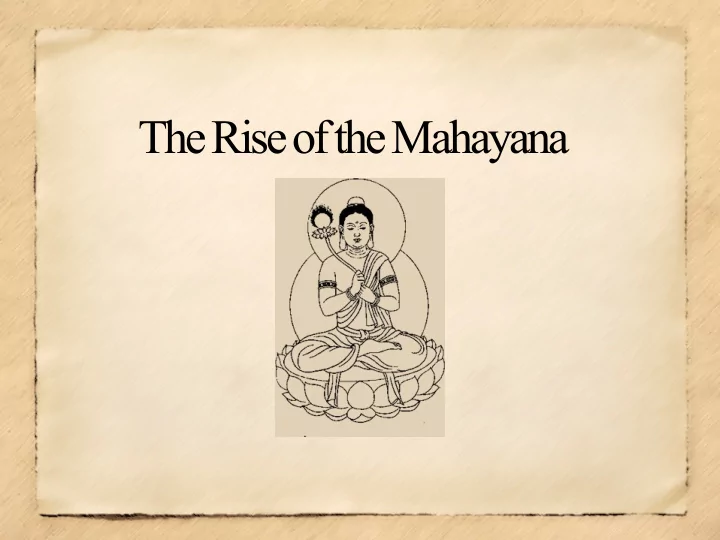
The Rise of the Mahayana The Mah s ghikas The Mah s ghikas (great - - PowerPoint PPT Presentation
The Rise of the Mahayana The Mah s ghikas The Mah s ghikas (great assembly) Arose as a liberal movement Provided a vehicle for the lay community The Three Classes of Disciple: Sravaka, Pratyeka, Bodhisattva What is the
New interpretations of the Buddha’s original teaching that emerged around the first century BCE in (in Gandhara?) in the form of texts known as the Prajñāparamitā (‘Perfection of Wisdom’) Monks and nuns of Śravakāyāna and Mahāyāna orientation practiced side by side, in same monasteries Question of orientation of practice rather than separate schools The Mahayana Sutras were composed in Sanskrit (and variations)
In t h e M ah ay an a t h e ‘Bu d d h a’ si g n i fi es t h e S u p reme, Ul t i mat e real i t y
T h i s i s cal l ed t h e d o ct ri n e o f ‘t ri k ay a’ o r ‘T h ree b o d i es’
Dharmakaya – ‘Truth Body’ The ultimate reality underlying the whole universe Sambhogakaya – ‘Enjoyment Body’ The way that reality appears to the bodhisattva. Nirmanakaya – ‘Form Body’ The way ordinary beings experience ultimate reality
The ‘uninstructed worlding’ is a puttujjana. On hearing the teaching, aspirants progress through the stages:
Identity view, attachment to rites and rituals, and doubt
Sensual Desire and Ill Will
for existence in the ideal world (heaven), conceit, restlessness, ignorance
The Bodhisattva as the embodiment of wisdom Committed to the enlightenment of all sentient beings The great Bodhisattvas embody different aspects of enlightenment Manjusri embodies wisdom, Avalokitesvara embodies compassion But a Bodhisattva might be anyone! Mahāyāna as a ‘universalising religion’
The Mahāyāna expanded on the idea of the ‘stages of enlightenment’:
From the Avatamsaka Sutra
The name "Mother of All-the-Tathagatas" is attributed to the Prajñāpāramitā who was depicted as a beautiful female figure. Edward Conze, in his essay 'Sophia and Prajñaparamita' says that such figures symbolise the universal feminine principle which is found in both Western gnostic movements and Mahāyāna Buddhism.
With devotion I pay homage to the Buddhas gone to bliss To their Dharma body, noble heirs and all worthy of respect In accordance with the scriptures, I shall now in brief describe The way to adopt the discipline of all the Buddhas’ heirs There is nothing here that’s not been said before And I have no skill in the art of composition Therefore I do not expect this to be of much use to others And write it only to acquaint it to my mind Through this, my faith will be strengthened for a while, And I will grow more accustomed to what is virtuous Then should others, somehow equal to myself in fortune, Chance upon these words, they might find them beneficial
This free and well-favoured human form is difficult to obtain Now that we have the chance to realise the full human potential If we don’t make good use of this opportunity How could we possibly expect to have such a chance again? Like a flash of lightning on a dark and cloudy night, Which, for just a single instant, sheds its brilliant light Rarely, through the buddhas’ power A mind of virtue arises, briefly, to people of the world All ordinary virtues therefore are forever feeble, Whilst negativity is strong and difficult to bear— But for the mind intent on perfect buddhahood, What other virtue could ever overcome it?
....
Buddhism: Its Essence and Development by Edward Conze http://a.co/39G1UvZ