The Rise of Modern Financial Regulation J. Parman (College of - - PowerPoint PPT Presentation

the rise of modern financial regulation
SMART_READER_LITE
LIVE PREVIEW

The Rise of Modern Financial Regulation J. Parman (College of - - PowerPoint PPT Presentation

The Rise of Modern Financial Regulation J. Parman (College of William & Mary) Regulation of Markets, Spring 2013 April 22, 2013 1 / 21 The Rise of Modern Financial Regulation J. Parman (College of William & Mary) Regulation of

slide-1
SLIDE 1

The Rise of Modern Financial Regulation

  • J. Parman (College of William & Mary)

Regulation of Markets, Spring 2013 April 22, 2013 1 / 21

slide-2
SLIDE 2

The Rise of Modern Financial Regulation

  • J. Parman (College of William & Mary)

Regulation of Markets, Spring 2013 April 22, 2013 2 / 21

slide-3
SLIDE 3

The Rise of Modern Financial Regulation

  • J. Parman (College of William & Mary)

Regulation of Markets, Spring 2013 April 22, 2013 3 / 21

slide-4
SLIDE 4

The Rise of Modern Financial Regulation

  • J. Parman (College of William & Mary)

Regulation of Markets, Spring 2013 April 22, 2013 4 / 21

slide-5
SLIDE 5

The Rise of Modern Financial Regulation

Main provisions of the Glass-Steagall Act Separation of investment and commercial banking Creation of the FDIC Restricted speculative uses of bank credit Restricted loans to banks’ executive officers

  • J. Parman (College of William & Mary)

Regulation of Markets, Spring 2013 April 22, 2013 5 / 21

slide-6
SLIDE 6

The Rise of Modern Financial Regulation

The other major legislation to arise out of the Great Depression relates to securities We get the Securities Act of 1933 and the Securities Exchange Act of 1934 What these add to the mix:

The Securities and Exchange Commission Public disclosure requirements Antifraud provisions

  • J. Parman (College of William & Mary)

Regulation of Markets, Spring 2013 April 22, 2013 6 / 21

slide-7
SLIDE 7

The Rise of Modern Financial Regulation

http://www.thisamericanlife.org/radio-archives/episode/377/scenes-from-a-recession?act=2

  • J. Parman (College of William & Mary)

Regulation of Markets, Spring 2013 April 22, 2013 7 / 21

slide-8
SLIDE 8

Modern Financial Regulation Put to the Test

  • J. Parman (College of William & Mary)

Regulation of Markets, Spring 2013 April 22, 2013 8 / 21

slide-9
SLIDE 9

Modern Financial Regulation Put to the Test

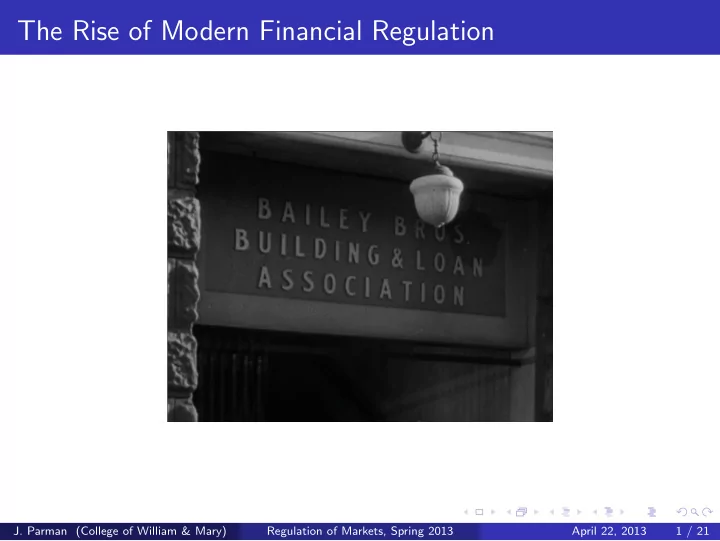
One of the major modern failures of financial regulation actually has very historical roots The savings and loan crisis in the 1980s Thrifts (buildings and loans, later savings and loans) emerged in the 1800s to help working class individuals save for and buy homes These organizations were designed to have long-term deposits used to finance long term loans (mortgages) Thrifts grew up alongside commercial banks but were smaller with different objectives, customers, assets and liabilities

  • J. Parman (College of William & Mary)

Regulation of Markets, Spring 2013 April 22, 2013 9 / 21

slide-10
SLIDE 10

The Rise of Modern Financial Regulation

  • J. Parman (College of William & Mary)

Regulation of Markets, Spring 2013 April 22, 2013 10 / 21

slide-11
SLIDE 11

Modern Financial Regulation Put to the Test

The ’national’ crisis occurred in the 1890s National B & L’s were using higher interest rates on deposits, high late fees, and higher interest rates on loans A decline in the economy caused a crisis At the time, the high interest on deposits was a bit of a Ponzi scheme exposed by the decline in the economy This ushers in more state regulation and uniform guidelines for the thrifts During the Great Depression, thrifts reach out to the federal government for help The close relationship between the thrifts and the federal government raises concerns of ’capture’

  • J. Parman (College of William & Mary)

Regulation of Markets, Spring 2013 April 22, 2013 11 / 21

slide-12
SLIDE 12

Modern Financial Regulation Put to the Test

  • J. Parman (College of William & Mary)

Regulation of Markets, Spring 2013 April 22, 2013 12 / 21

slide-13
SLIDE 13

Modern Financial Regulation Put to the Test

So the S & L’s experience a post-war boom with the huge demand for home loans To get depositors, S & L’s start engaging in interest rate wars In 1966, Congress actually sets limits on savings rates Then come the 1970s and some bad macroeconomic conditions

  • J. Parman (College of William & Mary)

Regulation of Markets, Spring 2013 April 22, 2013 13 / 21

slide-14
SLIDE 14

Modern Financial Regulation Put to the Test

  • J. Parman (College of William & Mary)

Regulation of Markets, Spring 2013 April 22, 2013 14 / 21

slide-15
SLIDE 15

Modern Financial Regulation Put to the Test

Depositors withdrew money to seek out unregulated interest rates elsewhere The high interest rates also meant fewer people seeking mortgages Creates a big problem for the S & L’s A doubling of oil prices in 1979 compounded these problems Congress decides to deregulation with the Depository Institutions Deregulation and Monetary Control Act of 1980 and the Garn-St. Germain Act of 1982

Allowed for wider range of savings products Expanded lending authority

  • J. Parman (College of William & Mary)

Regulation of Markets, Spring 2013 April 22, 2013 15 / 21

slide-16
SLIDE 16

Modern Financial Regulation Put to the Test

  • J. Parman (College of William & Mary)

Regulation of Markets, Spring 2013 April 22, 2013 16 / 21

slide-17
SLIDE 17

Modern Financial Regulation Put to the Test

So what happened? Initial deregulation was incomplete (think back to issues in CA electricity crises) Deposit restrictions were relaxed but firms couldn’t make variable rate mortgages The further deregulation went overboard and severely hampered regulatory oversight You get a lot of fraud and mismanagement

  • J. Parman (College of William & Mary)

Regulation of Markets, Spring 2013 April 22, 2013 17 / 21

slide-18
SLIDE 18

Modern Financial Regulation Put to the Test

  • J. Parman (College of William & Mary)

Regulation of Markets, Spring 2013 April 22, 2013 18 / 21

slide-19
SLIDE 19

Modern Financial Regulation Put to the Test

“And always remember the weak, meek and ignorant are always good targets.” – Lincoln Savings and Loan sales document

  • J. Parman (College of William & Mary)

Regulation of Markets, Spring 2013 April 22, 2013 19 / 21

slide-20
SLIDE 20

Modern Financial Regulation Put to the Test

The intential fraud and greedy mismanagement wasn’t the only problem Having (some) deposits insured generate some serious moral hazard issues, particularly once losses started

  • ccurring

There was also a change in the nature of the risk being taken on by the managers: it was getting more complicated Managers didn’t necessarily know how to evaluate the more exotic assets This brings us to the Great Recession

  • J. Parman (College of William & Mary)

Regulation of Markets, Spring 2013 April 22, 2013 20 / 21

slide-21
SLIDE 21

Modern Financial Regulation Put to the Test, Again

Otters, the cause of the Great Recession

  • J. Parman (College of William & Mary)

Regulation of Markets, Spring 2013 April 22, 2013 21 / 21