The revolution on mould level measurement for continuous casting - - PowerPoint PPT Presentation

the revolution on mould level measurement for continuous
SMART_READER_LITE
LIVE PREVIEW

The revolution on mould level measurement for continuous casting - - PowerPoint PPT Presentation

The revolution on mould level measurement for continuous casting machines. System overview in times were quality, performance, information and diagnosis are the key to remain competitive Mold Caster is the evolution of steel mould


slide-1
SLIDE 1

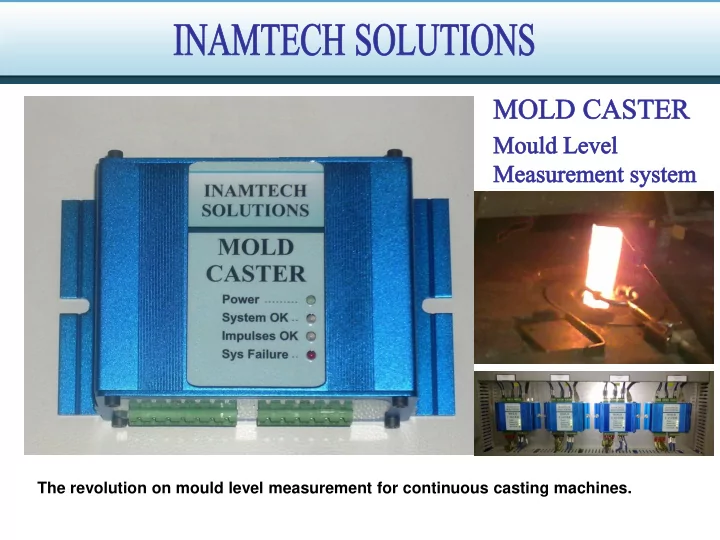
The revolution on mould level measurement for continuous casting machines.
slide-2
SLIDE 2

System overview

… in times were quality, performance, information and diagnosis are the key to remain competitive …

  • Mold Caster is the evolution of steel mould level measurement for continuous cast machines.
  • Mold Caster is a stand-alone system, and can be directly connected to the scintillator to give you

the Analogic mould Steel Level.

  • Mold Caster is not a just “black box” that gives you the mould level without understanding what

happens inside…

  • Mold Caster gives an Ethernet Interface with a lot of information such as: actual frequency, taring

frequencies, real level, actual filter, diagnostics and much more…

  • Mold Caster Ethernet Interface also allows you to command and parameterize your system.
slide-3
SLIDE 3

Main Characteristics

  • Single board system. No moveable parts.
  • Stand alone: 100% Compatible with 7 pin scintillator connector. So the

system can be ready as soon as connecting the scintillator and power

  • supply. If Ethernet communication available, all features of this new

system are available.

  • Highly integrated modern system. New and powerful microcontroller.
  • Ethernet interface: Lot of commands and information available.
  • No more battery!!! Flash EPROM memory.
  • 10msec level calculation upgrade (more than enough).
  • Real level. Compensated level curve (the only one in the market).
  • Level filtering: moving average (variable time) + 3rd order filter available

(can be changed on the fly!!!).

  • 3 high precision (0.05%), low noise Analog Outputs: V.control, Level,
  • spare. More accurate measurement.
slide-4
SLIDE 4

Main Characteristics

… and More…

  • 2 spare Analog Inputs + 2 standard DI for Tara Empty and full + 2 Relay

DO for System Fault (and one spare).

  • Oscillation subtraction from the level  cleaner mould level signal !!!

Space requirements is also another feature for this powerfull product.

slide-5
SLIDE 5

Ethernet Interface

Available as reading values (all EPROM saved)

  • Actual frequency.
  • Actual level (compensated and not compensated).
  • Actual level compensation coefficient.
  • Actual Empty and Full calibration.
  • Actual calibration time.
  • Actual absolute counting (as a double integer counter).
  • Actual filter coefficients: moving average filter time + 3rd order filter

coefficients.

  • Actual V. Control (to pins 3-4 of the scintillator).
  • Actual Level Current (for diagnostics)
  • Diagnostics: communication, memory, and so.
  • And much more information that can be on your video or level 1-2

system.

slide-6
SLIDE 6

Ethernet Interface

Available as writing values

  • Mode change: Level Measuring, Calibrate, Sampling, Plateau.
  • Calibrate(empty & full) time. It is also possible write the calibration

frequencies (empty and full).

  • Calibrate time (1..255 seconds).
  • Level compensation coefficient.
  • Filter coefficients.
  • Sampling period (for sampling mode).

System Integration All the Ethernet information from Mold Caster can be integrated in your automation system in order to elaborate it and generate precious diagnosis such as alarms, logging, and so.

slide-7
SLIDE 7

RS 485 Interface

For Mold Caster Sensor (Inamtech’s scintillator) With the new scintillator from Inamtech Solutions we also have the integration for all the scintillator’s variables and Setpoints:

  • 2 scintillator temperatures (PCB and casing temperature).
  • Serial number.
  • Plateau curve handling.
  • Working hours.
  • Mould oscillation position (great feature to improve mould level quality

without and external mould position transmitter).

  • Real time clock handling
  • Logging for peak values: peak value and timestamp for maximum

temperatures and impact (200g accelerometer).

  • Power supply local measurement: Current, Tension and Power.
slide-8
SLIDE 8

Plateau’s Curve

Plateau Curve in situ: directly from Mold Caster it is possible to see the scintillator health, even before or right after casting.

slide-9
SLIDE 9

Plateau’s Curve

It is well known that the Plateau’s Curve is a characteristic of the scintillator, and the shape shows the good health of it. So the frequency

  • Vs. Control Voltage curve must be relatively flat in the range of the working

Control Voltage (around 4V). For the new MC sensor, it is done directly form the RS485 interface.

  • Plateau’s Curve in situ: directly from Mold Caster it is possible to see the

scintillator health, even before casting.

  • So, no more need of scintillator verification to the provider, saving

around € 2000 /year / casting line.

  • Saving time: No need to disconnect the scintillator to do this test.
  • Gaining availability and maintenance professionalism: doing this test

always before and after casting.

slide-10
SLIDE 10

Real Vs. Estimated level

Real level and Berthold estimated Level 10 20 30 40 50 60 70 80 90 100 5000 10000 15000 20000 25000 30000 35000 Frequency Stimated % Level form Berthold 20 40 60 80 100 120 140 160 mm in a 170mm Mold Estimated % Berthold level real level [mm]

The mould tested in this example is:

  • 170mm measurement range.
  • Mould diameter = 148mm

The geometry of the mould and the measurement system lead to this non-linearity it the frequency – real level curve. You can see up to 45mm of difference between the curves

  • Mold caster correct this effect with a mould coefficient (for each size). With the

coefficient, only Empty and Full calibration values are needed to get the real level.

  • All other systems in the market give you just the estimated level or need other

calibrating points, making this unpractical to do.

  • Real level guarantee the same shroud immersion for different mould sections… so

quality Is improved…

slide-11
SLIDE 11

Filter changing on the fly

As shown in the above picture. It possible to see the filter changing on the fly. In blue the “Real Level” In green the “Berthold or other system Level” In red the “non compensated Level” Depending on the casting phase or the mould size, you can optimize your filter for best accuracy/dynamics rate… and once again… quality is improved…

slide-12
SLIDE 12

Oscillation subtraction

As shown in the above picture, it is possible to “cancel” or subtract the oscillation effect from the level signal with an optional Analog Input reserved for the mould

  • position. Adding the oscillator position to the Mold Caster will allow the release of the

mould level processed signal (without oscillation).

In red the “normal level” measurement (with oscillation). In blue the “mould level without oscillation”

This way, no matter the frequency, amplitude, or even the oscillation function, it will always be processed and subtracted by the Mold Caster. So this intrinsic measurement issue is not a problem anymore, leaving a cleaner level signal for frequency analysis, level control and so. Mold Caster is the only one that gives this feature… … so once again, quality is improved…

slide-13
SLIDE 13

Oscillation subtraction

If we take standard deviation of the level as a reference for quality, you can see that it is reduced to a half. This means, improve the quality…

slide-14
SLIDE 14

Sampling Mode

For development and analysis purposes, the Mold Caster allows a sampling mode.

  • Where you decide the time window (from 100msec to 25,5 sec)
  • The system gives you the average frequency of this window without any

further filter.

  • The system also gives you the sampling number, that allows right

computing.

  • This is an essential tool to define an optimum filter or to study dynamics
  • f the system.
slide-15
SLIDE 15

System Integration

1 – Production Operator – TP screen Once connected to your automation system you can elaborate the information given and show it in your HMI, log it in your Lev 2, and so…

slide-16
SLIDE 16

System Integration

2 – Maintenance (password protected) TP screen

slide-17
SLIDE 17

System Integration

3 – Scintillator (Mold Caster sensor) TP screen

slide-18
SLIDE 18

... so as diagnosis …

  • Ethernet interface: Lot of commands and information and diagnose available.
  • New alarms and warnings available (only possible with Mold Caster).
  • Real Mould Level  right shroud immersion.
  • Empty and Full Frequencies on video  wrong calibration detection.
  • Actual frequency  problem detection for calibrating of before casting.
  • Very versatile and efficient filtering.
  • Plateau curve (scintillator health evaluation).
  • Closed radioactive source (or lack) detection.
  • Sampling Mode.

All these lead to:

  • Less human mistakes before startup casting.
  • Better knowledge of the entire mould system behavior.
  • Lot of alarms that can be generated from the Ethernet Interface information.
  • More system availability… more information (new alarms and warnings)…
slide-19
SLIDE 19

... and so as money saving …

  • More diagnosis  less lost lines.
  • More diagnosis  faster failure detection.
  • Less human mistakes before startup casting  More system availability.
  • No need to change any battery or part every xx years.
  • Plateau curve: saving around € 2000 /year / casting line.
  • More system availability  more production.
  • Unbeatable price
slide-20
SLIDE 20

Other brands compatibility

Mold Caster can be used in combination of serveral detector brands Even though Inamtech Solutions is producing its own scintillator with extended diagnosis, Mold Caster can perfectly match with most known scintillator detectors

  • Mold Caster Sensor (the new scintillator from Inamtech Solutions)
  • All Berthold Scintillators, including LB6639 and LB6739.
  • Ronan scintillators.
  • Qualtec / Qualicast (as a substitution for the measurement system)
slide-21
SLIDE 21

References

  • Tenaris Dalmine: from October 2010 (all 2 CCM – 8 lines)
  • Tenaris Silcotub (Romania – Calarasi) (all 3 lines)
  • Tenaris Siderca (Argentina) (all 4 lines)
  • IRO S.p.A.
  • Çebitaş

… in total 25 units sold Contact

  • Inamtech solutions (Italy)

www.inamtech.com info@inamtech.com

  • Inamtech solutions S.r.l. (Argentina)

www.inamtech.com.ar

Distribuitor in North America

  • Janus Automation (USA, Mexico)

http://www.janusautomation.com info.usa@janusautomation.com