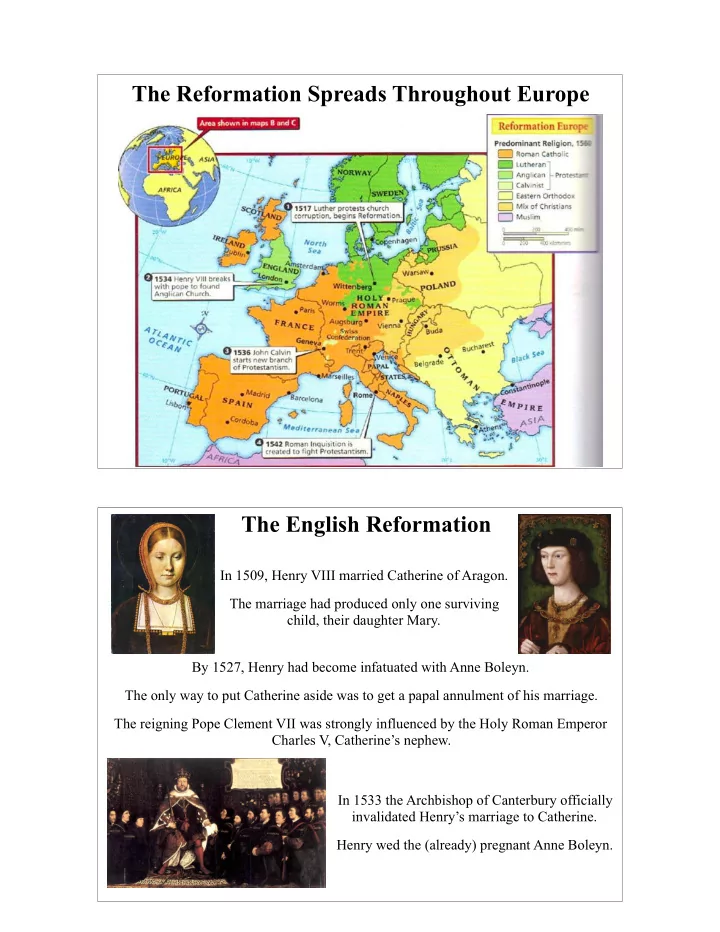
The Reformation Spreads Throughout Europe The English Reformation - - PDF document
The Reformation Spreads Throughout Europe The English Reformation In 1509, Henry VIII married Catherine of Aragon. The marriage had produced only one surviving child, their daughter Mary. By 1527, Henry had become infatuated with Anne Boleyn.
Expanding Secular Power
The “Reformation Parliament” passed the Submission of the Clergy, placing religious law officially under royal control. Parliament established a precedent: Whenever fundamental changes are made in religion, the monarch must consult with and work through Parliament. In 1534, Parliament: ended all English payments to Rome gave Henry sole jurisdiction over religious appointments passed the Act of Succession passed the Act of Supremacy
When the King’s longtime trusted advisor Thomas More refused to recognize the Act of Succession and the Act of Supremacy, Henry had him executed, making clear his determination to have his way regardless of the cost.
Catherine of Aragon
(daughter Elizabeth)
Anne Boleyn
(daughter Elizabeth)
Jane Seymour
(son Edward)
Anne of Cleves Catherine Howard Catherine Parr
(survived him)
Henry VIII’s Many Wives
To to secure a male heir Henry married six times: Despite his break with Rome, Henry maintained most elements of Catholic doctrine:
Despite his many wives and amorous adventures, Henry absolutely forbade the English clergy to marry and threatened any clergy who were caught twice in concubinage with execution.
provided for private masses
- rdered the continuation of auricular confession
reaffirmed transubstantiation denied the Eucharistic cup to the laity declared celibate vows inviolable
priest who adopted Lutheranism and became a pastor in Zurich in 1518
The Reformation in Switzerland
attacked the custom of fasting during Lent saw the Eucharist as only symbolic promoted clerical marriage introduced a new communion liturgy established a theocracy in Zurich removed statues, paintings, altars, bones
- f local saints, etc.
1525: followers of Zwingli who believed his preachings did not go far enough they refused to take civil oaths, pay taxes, hold public office, or serve in the military did not believe in childhood baptism believed the end of the world was near
Ulrich Zwingli Anabaptists John Calvin
believed in predestination: God already knows who is saved good works does not earn your way into heaven God reveals if one has been chosen for salvation by a “conversion experience” these “elect” who become model Christians, or “visible saints” Protestant Work Ethic: emphasized the importance of hard work Calvinism had a far greater impact on future generations than Lutheranism: France: French Calvinists called Huguenots / England: Puritans
did not spread to Ireland, Spain, or Italy (heavily Catholic)
Frenchman who moved to Geneva in 1536 wrote The Institutes of the Christian Religion very strict: activities such as drinking, singing, dancing, usury, and gambling were expressly prohibited
The Reformation in Germany
German peasants wanted to end feudalism created a list of demands called the Twelve Articles Luther was disgusted by their use of violence
German Peasants’ Revolt
(1524-1525)
Holy Roman Emperor Charles V allied with the pope to try to “stamp out heresy” In 1531 Protestant princes in Northern Germany formed the League of Schmalkalden goal was to fight Charles V’s drive to re-Catholicize all of Germany although Charles V’s forces won, Catholic unity in Germany never occurred again played an important role in the long-term political fragmentation of Germany German princes had supported Lutheranism because they could now confiscate Church lands German princes violently stamped out the revolt, killing as many as 100,000 peasants
Peace of Augsburg (1555)
Temporarily ended the struggle in Germany over Lutheranism Provisions: Princes in Germany could choose the religion for their region Protestants living in Catholic states were allowed to move to Protestant states Resulted in permanent religious division
- f Germany
Reformation Europe
(Late 16c)