Why an Eco-Reformation? Cherice Bock Berkeley Friends Church - - PowerPoint PPT Presentation

why an eco reformation
SMART_READER_LITE
LIVE PREVIEW

Why an Eco-Reformation? Cherice Bock Berkeley Friends Church - - PowerPoint PPT Presentation

Why an Eco-Reformation? Cherice Bock Berkeley Friends Church Quaker Heritage Day March 10, 2018 Overview Session 1: Why an Eco-Reformation? Session 2: Quakers & Creation Care: Potentials & Pitfalls in Quaker Theology


slide-1
SLIDE 1

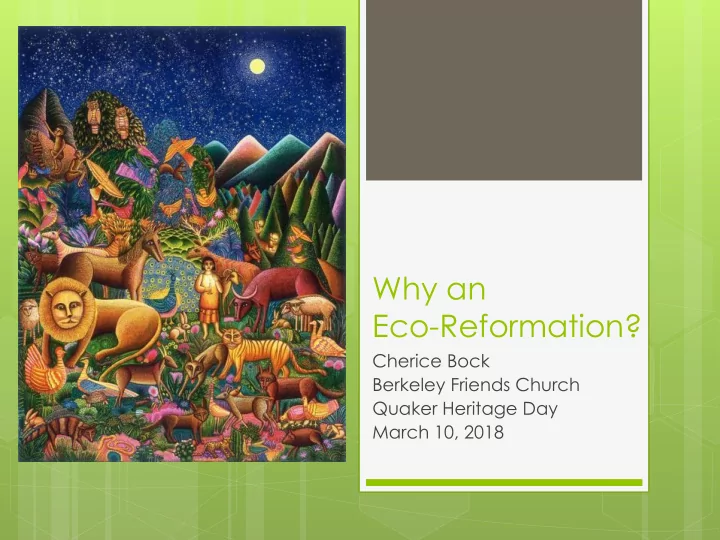
Why an Eco-Reformation?

Cherice Bock Berkeley Friends Church Quaker Heritage Day March 10, 2018
slide-2
SLIDE 2

Overview

 Session 1: Why an

Eco-Reformation?

 Session 2: Quakers

& Creation Care: Potentials & Pitfalls in Quaker Theology

 Session 3: Joining

the Eco- Reformation through Watershed Discipleship

slide-3
SLIDE 3

Eco-Reformation

Salvation: Not for sale. Human beings: Not for sale. Creation: Not for sale.

slide-4
SLIDE 4

Christians & the Environment

Augustine: “Others, in order to find God, will read a book. Well, as a matter of fact there is a certain great big book, the book

  • f created nature. Look carefully

at it top and bottom, observe it, read it. God did not make letters

  • f ink for you to recognize God

in; God set before your eyes all these things God has made. Why look for a louder voice? Heaven and earth cries out to you, ‘God made me.’ … Observe heaven and earth in a religious spirit.” (Sermon 68.6)

slide-5
SLIDE 5

Creation Care in the Bible

 Creation stories  Care for the land in the Law  Prophets  Wilderness theme  Incarnate Christ  Love for neighbor  Creation groans  New heaven and new Earth

slide-6
SLIDE 6

Creation Stories

 Male and female

created in the image of God (Gen 1)

 A’dam = human

being (ish and isha

  • nly after put to

sleep)

 Adamah = soil

slide-7
SLIDE 7

Creation Stories

 Plants given to

people and animals for food (Gen 1:29- 30)

 Land itself is not

given

 People, fish, and

birds aretold to be fruitful and multiply (Gen 1:22)

slide-8
SLIDE 8

Creation Stories

 Genesis 1-2: human beings given

responsibility to care for the Earth, to till it and keep it, to become “skilled masters” (dominion = radah, skilled mastery, art, craft)

 Different from the “order vs. chaos”

creation story of the ancient Babylonians

 Creation has an order, and people fit into it

and are part of it

 Order does not equal control

slide-9
SLIDE 9

Law

 Major themes in

the law:

 Community  Rest  Trust  Enough  Shalom, wholeness

slide-10
SLIDE 10

Prophets

 Critiquing the

system

 Offering hope for

renewal

 Land-based  Shalom

slide-11
SLIDE 11

Wilderness

 Israelites  Prophets  John the Baptist  Jesus  Paul  Desert Fathers &

Mothers

 Francis of Assisi

slide-12
SLIDE 12

Jesus

 Became embodied

(incarnate)

 Parables based on

natural elements to teach us about God

 Lived within a

particular place and time

slide-13
SLIDE 13

Romans 8:19-25

For the creation waits with eager longing for the revealing of the children of God; for the creation was subjected to futility, not of its own will but by the will of the one who subjected it, in hope that the creation itself will be set free from its bondage to decay and will obtain the freedom of the glory of the children of God. We know that the whole creation has been groaning in labor pains until now; and not only the creation, but we ourselves, who have the first fruits of the Spirit, groan inwardly while we wait for adoption, the redemption of our bodies. For in hope we were saved. Now hope that is seen is not hope. For who hopes for what is seen? But if we hope for what we do not see, we wait for it with patience.

slide-14
SLIDE 14

Eschatology: Where is the Kingdom?

 New Heaven and

Earth described as an actual place (Rev 21)

 Tree of life and river

  • f life flowing

through the city (Rev 22)

 Built and natural

environment in harmony

slide-15
SLIDE 15
slide-16
SLIDE 16
slide-17
SLIDE 17

Communities of color in the USA still have higher rates of exposure to air pollution and lead, citing near toxic waste and landfills, and disproportionately suffer the effects of climate change

slide-18
SLIDE 18
slide-19
SLIDE 19
slide-20
SLIDE 20

Pendle Hill, 1652

slide-21
SLIDE 21

Shalom

slide-22
SLIDE 22