How to Read Well Pastor Curtis Mort 7/19/2020 _____ Reading can be - - PDF document

how to read well
SMART_READER_LITE
LIVE PREVIEW

How to Read Well Pastor Curtis Mort 7/19/2020 _____ Reading can be - - PDF document

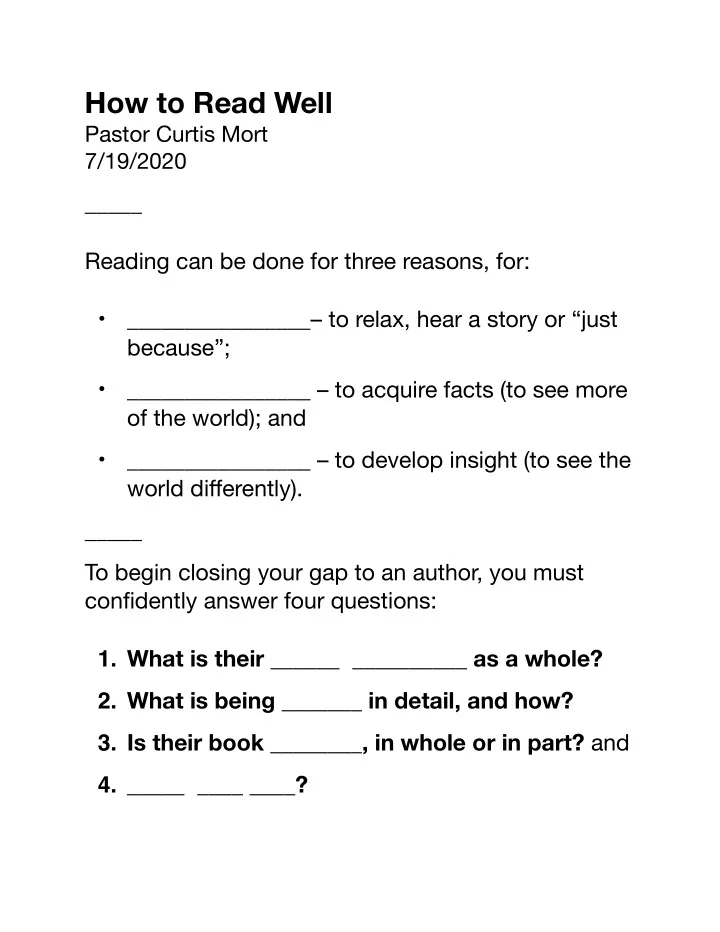
How to Read Well Pastor Curtis Mort 7/19/2020 _____ Reading can be done for three reasons, for: ________________ to relax, hear a story or just because; ________________ to acquire facts (to see more of the world); and


slide-1
SLIDE 1

How to Read Well

Pastor Curtis Mort 7/19/2020 _____ Reading can be done for three reasons, for:

  • ________________– to relax, hear a story or “just

because”;

  • ________________ – to acquire facts (to see more
  • f the world); and
  • ________________ – to develop insight (to see the

world differently). _____ To begin closing your gap to an author, you must confidently answer four questions:

  • 1. What is their ______ __________ as a whole?
  • 2. What is being _______ in detail, and how?
  • 3. Is their book ________, in whole or in part? and
  • 4. _____ ____ ____?
slide-2
SLIDE 2

_____ THE 4 LEVELS OF READING Reading actively means mastering four levels of reading:

  • 1. _______________ reading – Turning symbols into

information;

  • 2. _______________ reading – Getting the most

from a book in a given time;

  • 3. _______________ reading – Thorough and

complete reading for understanding; and

  • 4. _______________ reading – Exploring a subject

through wide reading. _____ GENERAL READING TIPS

  • Always approach reading as a _____________ with

the author.

  • Don’t treat everything you read as inflexible

statements of _________.

slide-3
SLIDE 3

______

  • Make every book you read your own. To do so,

use:

  • ____________ – underline, circle, star, asterisk

and fold pages;

  • ____________ – number arguments on the page,

reference other pages or sections; and

  • ____________ – write in the margins, top and

bottoms of pages and front and endpapers.

  • The final tip for active-reading is to set your

____________ _________________ up for success. _____ 1 – ELEMENTARY READING Elementary reading is the skill of turning symbols into information. _____ The majority of speed reading courses focus on two tricks:

slide-4
SLIDE 4
  • 1. Reducing ____________ – The number of jumps

your eye makes; and

  • 2. Reducing ____________ – The time you spend

rereading. _____ 2 – INSPECTIONAL READING Inspectional reading is the art of getting the most from a book in a given time. _____ You should inspect every book you are thinking of reading _________ reading it. Why? Doing so helps in two ways:

  • 1. It primes you with an _________ _____________ of

the book; and

  • 2. It tells you ___________ ________ _____ to read it.
slide-5
SLIDE 5

_____

PART I: SYSTEMATIC SKIMMING

Takes: Ten minutes to an hour.
 Answers: What kind of book is it? What’s it about? How is it structured? Is it worth reading? _____ To begin your systematic skimming, first study the:

  • _______ – Take a moment to read it aloud. What

does it tell you to expect?

  • ___________ – How has the author structured

their work? How does it flow? What are the pivotal chapters?

  • ___________ – What terms are most frequently

referenced? Do any surprise you?

  • ___________ _______ – What does the publisher

think is important? How have they synthesised the work? and

slide-6
SLIDE 6
  • ________ __________ – What does the author

want you to take away? How do they want you to read? _____ The next step is turning the pages, as you do so:

  • Read ______, sub-titles, figures and tables;
  • Read a __________ or two, sometimes several

pages – Never more;

  • Skim ___________ chapters in full – Especially
  • pening and summary statements); and
  • Read the ____________________ in the main

part of the book. _____ Third, pencil some brief, structural notes (blank front pages are a great place to do this):

  • __________ the book – is it:
  • Non-fiction, narrative non-fiction, fiction?
slide-7
SLIDE 7
  • Prose, verse, theatre, other or a mix?
  • History, science or philosophy?
  • Theoretical or practical?
  • ________ a short synthesis of its contents –

One to three sentences at most; and

  • ____________ its high-level structure.

_____ Decide whether to read the book or not. _____

PART II: SUPERFICIAL READING

Takes: Depends on the book, but at a faster rate than comfortable.
 Answers: What does it say (big picture)? _____

  • Do take __________ and make the book your

_________ but ________ look anything up or puzzle

  • ut bits you don’t immediately understand.
slide-8
SLIDE 8
  • As you finish, if you decide you do want to go back –

if this book is really worth pulling apart – then it’s time to start… _____ 3 – ANALYTICAL READING Analytical reading is the art of thorough and complete reading for understanding. _____

PART I: WHAT IS THE BOOK ABOUT AS A WHOLE?

  • 1. Classify the book;
  • 2. Synthesize it briefly;
  • 3. Identify, organize and outline the parts; and
  • 4. Define the __________ the author is trying to

solve. _____

PART II: WHAT IS BEING SAID IN DETAIL AND HOW?

  • 5. Spot all the _________ and understand what

the author means by them;

  • 6. Distill the key ____________ from the author’s

most important sentences;

slide-9
SLIDE 9
  • 7. Find or build the author’s arguments

from _______ of sentences; and

  • 8. Decide which _____________ the author has,

hasn’t and knew they couldn’t solve. _____ PART III: IS THE BOOK TRUE, IN WHOLE OR IN PART? ___ PART A: GENERAL MAXIMS OF INTELLECTUAL ETIQUETTE

  • 9. _______________ before you “agree”,

“disagree” or “abstain”; 10.Be open-minded and _______________, even when you disagree; and 11.Be ________________ in any criticisms you make. _____

slide-10
SLIDE 10

PART B: MAKE YOUR CRITICISMS SPECIFIC AND DETAILED An author and their arguments can fall short by being: 12.__________ – The author does not know something important; 13.___________ – The author states something that is incorrect; 14.___________ – The author’s arguments are inconsistent or don’t follow; or 15.___________ – One or more important additional conclusions omitted. _____ 4 – SYNOPTIC READING Synoptic reading is the art of exploring a question or subject by reading widely. _____

PART I: SETTING UP FOR SYNOPTIC SUCCESS

_____

slide-11
SLIDE 11
  • 1. __________ identify the subject you want to

tackle – Try to be as specific as possible, but don’t worry – you’ll be refining this as you go along;

  • 2. ___________ more than one book is necessary

to tackle it – Sounds obvious, but how many people do you know (including yourself) that read

  • ne book and then regurgitate it like it’s the

single, objective authority on a topic? _____

  • 3. Draw up a long ___________ – Draw from libraries,

advisors and bibliographies in other books.

  • 4. Systematically ________ all the books on your

list – Do this before reading anything on your list superficially, let alone analytically. Add any extra sources you discover to your long-list as you go; _____

  • 5. Solidify the _______ you’re tackling – List the

questions you want to address. These will set your boundaries and define your terms; and

slide-12
SLIDE 12
  • 6. _________ your bibliography – Include only those

books that say something important about the questions you’ve asked. _____

PART II: READING SYNOPTICALLY

Synoptic reading is the fourth level of reading because it involves a skillful combination of elementary, inspectional and analytical reading. To do it: _____

  • 1. Find the __________ passages – Do not read

every book on your short-list analytically. How much time you spend with a book in synoptic reading depends on how much of and how well it relates to your questions;

  • 2. Bring the authors to ______ terms – “Translate”

each author’s terms to bring everyone on to the same (your) page (this can be the hardest part of the process);

slide-13
SLIDE 13

_____

  • 3. Get the _________ clear – Refine and order your

questions to shed the greatest light possible on the subject;

  • 4. Define the ______ – Set out the different ways

each author answers each question; and

  • 5. Analyze the ____________ – Order the debate to

throw as much light on the subject as possible. _____ LEARNING TO READ WELL IS A ____________! BUT IT PAYS DIVIDENDS OVER A ____________! _____