SLIDE 18 18
36
- J. Lienig, M. Thiele: The Pressing Need for Electromigration-Aware Physical Design, Proc. of ISPD 2018, pp. 144-151,
https://doi.org/10.1145/3177540.3177560 36
Outlook: New Materials
Cu Single-wall CNTs Multi-wall CNTs Cu-CNT Composites Maximum current density (A/cm2) 1∙106 > 1∙109 > 1∙109 > 6∙108 Thermal conductivity @300K (W/m∙K) 385 3,000-10,000 3,000 ~ 800
Sources: Fraunhofer IPMS, Dresden, Germany, H2020 CONNECT Project, and A. Todri-Sanial et al., “A Survey of Carbon Nanotube Interconnects for Energy Efficient Integrated Circuits”, IEEE Circuits and Systems Magazine, no. 2, pp. 47–62, 2017.
38
- J. Lienig, M. Thiele: The Pressing Need for Electromigration-Aware Physical Design, Proc. of ISPD 2018, pp. 144-151,
https://doi.org/10.1145/3177540.3177560 38
Summary
- Restricting physical design to EM-robust structures can provide relief
from severe reliability constraints in future technologies
- Need to increase current density limits by putting in place
EM-inhibiting measures, such as short-length and reservoir effects
- Future design flows: using the dependence between current density limits
and the specific layout geometry
- Pattern generator: generates EM-robust layout configurations
based on the technological parameters of the specific design
- Utilizing these layout configurations, design tools can significantly
improve the EM robustness of the circuit
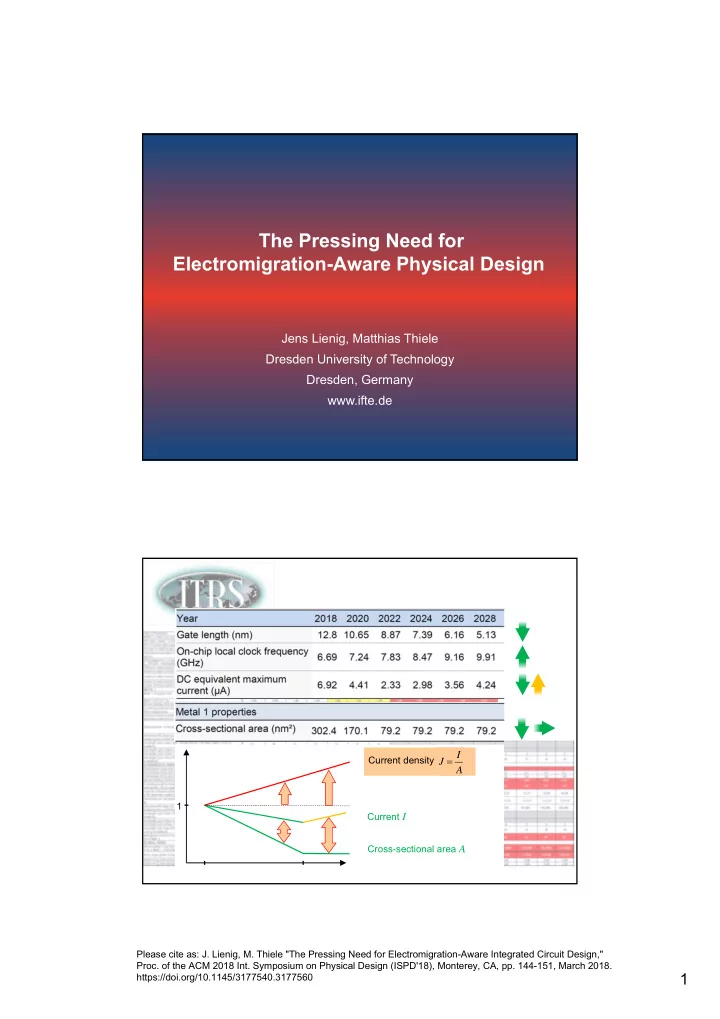
- Electromigration is fast becoming a physical design problem
due to increased current densities driven by IC down-scaling
Please cite as: J. Lienig, M. Thiele "The Pressing Need for Electromigration-Aware Integrated Circuit Design,"
- Proc. of the ACM 2018 Int. Symposium on Physical Design (ISPD'18), Monterey, CA, pp. 144-151, March 2018.
https://doi.org/10.1145/3177540.3177560