THE analysis place / transition invariants state equation MUTEX - - PowerPoint PPT Presentation

the
SMART_READER_LITE
LIVE PREVIEW

THE analysis place / transition invariants state equation MUTEX - - PowerPoint PPT Presentation

dependability engineering & Petri nets May 2020 dependability engineering & Petri nets May 2020 QUALITATIVE ANALYSIS METHODS , OVERVIEW NET REDUCTION STRUCTURAL PROPERTIES LINEAR PROGRAMMING static THE analysis place / transition


slide-1
SLIDE 1

dependability engineering & Petri nets May 2020 monika.heiner@b-tu.de 7 - 1 / 27

THE MUTEX PATTERN

  • DIFFERENT

ANALYSIS APPROACHES

dependability engineering & Petri nets May 2020 monika.heiner@b-tu.de 7 - 2 / 27
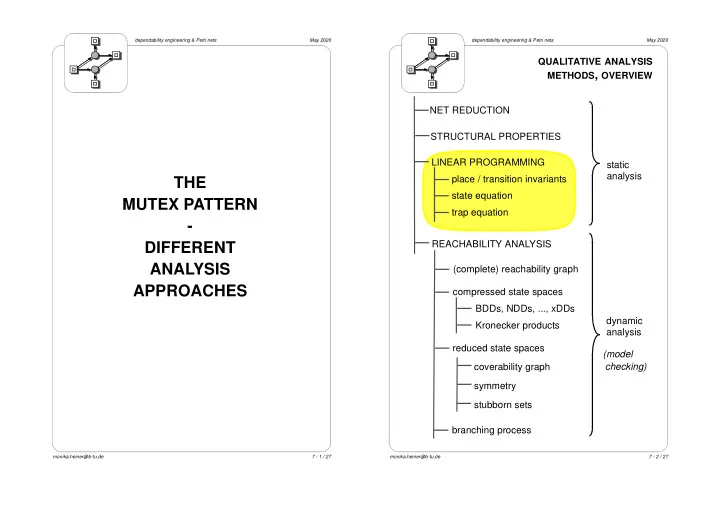
QUALITATIVE ANALYSIS METHODS, OVERVIEW REACHABILITY ANALYSIS (complete) reachability graph reduced state spaces coverability graph symmetry stubborn sets NET REDUCTION STRUCTURAL PROPERTIES LINEAR PROGRAMMING place / transition invariants state equation static dynamic analysis analysis trap equation compressed state spaces BDDs, NDDs, ..., xDDs Kronecker products branching process (model checking)

slide-2
SLIDE 2

dependability engineering & Petri nets May 2020 monika.heiner@b-tu.de 7 - 3 / 27

SEMAPHORE AS ADT

public class Semaphore { private int value; public Semaphore (int initial) { if (initial<0) { System.exit(1); // out of range error } else { value = initial; } // if } // Semaphore synchronized public void up() { ++value; notify(); } // up synchronized public void down() { try { while (value==0) wait();

  • -value;

} catch(InterruptedException e){} } // down } // class Semaphore

dependability engineering & Petri nets May 2020 monika.heiner@b-tu.de 7 - 4 / 27

PATTERN OF BEHAVIOUR

class MutexLoop extends Thread { private Semaphore mutex; private char ch; MutexLoop (Semaphore sema, char toPrint) { mutex=sema; ch = toPrint; } // MutexLoop public void run() { for (int i=0;i<MutexDemo.LENGTH;i++) { Simulate.doSomething();// pre action mutex.down(); // get mutual exclusion System.out.println(); for (int j=0;j<MutexDemo.MAX;j++) { System.out.print(ch); } // for mutex.up(); //release mutual exclusion Simulate.doSomething();// post action } // for } // run } // class MutexLoop

slide-3
SLIDE 3

dependability engineering & Petri nets May 2020 monika.heiner@b-tu.de 7 - 5 / 27

PETRI NET MODEL, PATTERN OF BEHAVIOUR

  • 3. run

mutex mutex down forI up mutex

  • 2. inMutex

forI doSomething endForI endMutexLoo beginMutexLoop mutex endForJ print(ch) forJ println() beginMutexLoop endMutexLoop endForI doSomething forI down up mutex mutex up down inMutex begin

(1) (2) (3) (4) (5)

mutex mutex up

  • 2. inMutex

down

dependability engineering & Petri nets May 2020 monika.heiner@b-tu.de 7 - 6 / 27

APPLICATION MUTEXDEMO

public class MutexDemo { static final int MAX = 30;// line width to weave static final int LENGTH = 50;// number of lines public static void main (String[] argv) { Semaphore mutex = new Semaphore(1); Thread a = new MutexLoop(mutex,'a'); Thread b = new MutexLoop(mutex,'b'); // Thread c = new MutexLoop(mutex,'c'); System.out.println(" -- begin of MutexDemo -- "); a.start(); b.start(); // c.start(); } // main } // class MutexDemo

slide-4
SLIDE 4

dependability engineering & Petri nets May 2020 monika.heiner@b-tu.de 7 - 7 / 27

PETRI NET MODEL, MUTEXDEMO

B_inMutex B_up B_down A_inMutex A_up A_down mutex A_begin B_begin

  • 2. B_run

B_begin A_begin mutex

  • 1. A_run

ORD HOM NBM PUR CSV SCF CON SC Ft0 tF0 Fp0 pF0 MG SM FC EFC ES Y Y Y Y N N Y Y N N N N N N N N Y DTP SMC SMD SMA CPI CTI B SB REV DSt BSt DTr DCF L LV L&S Y Y Y Y Y Y Y Y Y N ? N N Y Y Y

FLATTEN

SYNCHRONIZATION SKELETON

dependability engineering & Petri nets May 2020 monika.heiner@b-tu.de 7 - 8 / 27

MUTEXDEMO, ANALYSIS

B_up _T0_ B_down _T1_ A_up _T2_ A_down _T3_ B_inMutex _P1_ A_inMutex _P4_ mutex _P0_ A_begin _P3_ B_begin _P2_

REQUIRED SAFETY PROPERTY forever, there is at most one process in the mutex section (critical section) HOW TO ANALYZE IT ? (1) reachability graph (2) state equation (3) p-invariants, non-reachability check (4) p-invariants, reasoning (5) model checking of temporal formulae

slide-5
SLIDE 5

dependability engineering & Petri nets May 2020 monika.heiner@b-tu.de 7 - 9 / 27

ANALYSIS OF MUTEXDEMO (1), REACHABILITY GRAPH A_begin, A_in, A_begin, B_begin, mutex B_begin B_in A_down B_down B_up A_up

  • > RG is finite
  • >

BND

  • > 1 SC component, containg all transitions
  • > LIVE & REV
  • >

no state with (A_in = 1 and B_in = 1) reachable

  • >

safety property is valid in temporal logics: not EF (A_in and B_in) AG ( not(A_in and B_in) )

dependability engineering & Petri nets May 2020 monika.heiner@b-tu.de 7 - 10 / 27

INCIDENCE MATRIX C- A REPRESENTATION OF THE NET STRUCTURE

P T t1 tj tm p1 pi pn cij POST - PRE P+T P+T t1 p1 card(P) card(T) p1 t1 card(T) card(P) + POST

  • PRE

φ φ cij = (pi, tj) = F(tj,pi) - F(pi, tj) = ∆ tj(pi)

  • > token change

in place pi by firing of transition tj

. . . . . . . . . . . .

slide-6
SLIDE 6

dependability engineering & Petri nets May 2020 monika.heiner@b-tu.de 7 - 11 / 27

MUTEXDEMO, INCIDENCE MATRIX

B_up _T0_ B_down _T1_ A_up _T2_ A_down _T3_ B_inMutex _P1_ A_inMutex _P4_ mutex _P0_ A_begin _P3_ B_begin _P2_

A_begin mutex B_inMutex B_begin A_inMutex B_up B_down A_up A_down P T

  • 1
  • 1

+1 +1

  • 1

+1

  • 1

+1

  • 1

+1

  • 1

+1

dependability engineering & Petri nets May 2020 monika.heiner@b-tu.de 7 - 12 / 27

STATE EQUATION 1

P T t1 tj tm p1 pi pn

incidence matrix C

∆tj

∆tj - vector describing the change of the whole marking by firing of tj

C 1 tj ∆tj . . . . . . . .

Let the word w = t1-t0-t1-. . . be a sequence of firing transitions; The change of the marking ∆w by firing that sequence can be computed by multiplying the incidence matrix C with the Parikh vector parikh(w)

  • f that transition sequence.

PARIKH VECTOR

C 1 t0 ∆w . . . . . .

PARIKH VECTOR

2 t1

parikh(w) parikh(tj)

slide-7
SLIDE 7

dependability engineering & Petri nets May 2020 monika.heiner@b-tu.de 7 - 13 / 27

STATE EQUATION 2

The new marking reached by firing the given transition sequence can then be computed by adding ∆w to the current marking.

C 1 t0 ∆w . . . . . . 2 t1

+ = mo m m0 - initial marking m

STATE EQUATION

  • > linear programming problem

m = m0 + C x, x - T-vector x >= 0 There exists an integer solution for every reachable marking m (the Parikh vector of the transition sequence going to m).

  • >

the integer solvability is a necessary condition for the reachability of a marking;

  • >

NON-REACHABILITY CHECK

if there is no integer solution, then the marking is not reachable.

  • new marking reached by firing of w

dependability engineering & Petri nets May 2020 monika.heiner@b-tu.de 7 - 14 / 27

ANALYSIS OF MUTEXDEMO (2), STATE EQUATION

  • 1
  • 1

+1 +1

  • 1

+1

  • 1

+1

  • 1

+1

  • 1

+1 + = 1 1 1 1 1 m m0 C * x x0 x1 x2 x3

  • 1

= + x0

  • x1

+ x2

  • x3

1 =

  • x0

+ x1

  • 1

= + x0

  • x1
  • 1

= + x2

  • x3

1 =

  • x2

+ x3

slide-8
SLIDE 8

dependability engineering & Petri nets May 2020 monika.heiner@b-tu.de 7 - 15 / 27

T-INVARIANTS ❑ Lautenbach, 1973 ❑ T-invariants

  • >

integer solutions x of

  • >

Parikh vector

  • >

exponential complexity ❑ minimal T-invariants

  • >

there is no T-invariant with a smaller support

  • >

greatest common divisor (gcd) of all entries is 1 ❑ support

  • >

set of transitions belonging to the T-invariant ❑ any T-invariant is a non-negative linear combination

  • f minimal ones
  • >

multiplication with a positive integer

  • >

addition

  • >

division by gcd ❑ Covered by T-Invariants (CTI)

  • >

each transition belongs to a T-invariant

C x

Cx 0 x 0 x ≥ , ≠ , = kx aixi i

=

dependability engineering & Petri nets May 2020 monika.heiner@b-tu.de 7 - 16 / 27

T-INVARIANTS, INTERPRETATION ❑ T-invariants = (multi-) sets of transitions

  • >

zero effect on marking

  • >

reproducing a marking / system state

  • >

steady state substance flows

  • >

elementary modes, Schuster 1993 ❑ the T-invariant corresponds to cycles in the RG, if the T-invariant is realizable ❑ in the RG, concurrency of transitions is described by all transitions’ interleaving sequences ❑ if there are concurrent transitions in a realizable T-invariant, then there is a RG cycle for each interleaving sequence

  • > T-inv3, T-inv4

❑ pre-sets of supports = post-sets of supports ❑ a T-invariant defines a (connected) subnet

  • >

the T-invariant’s transitions (the support), + all their pre- and post-places + the arcs in between

slide-9
SLIDE 9

dependability engineering & Petri nets May 2020 monika.heiner@b-tu.de 7 - 17 / 27

T-INVARIANTS, THEOREMS ❑

If a bounded net is live, then it is CTI.

  • > NECESSARY CONDITION FOR well-formedness

A net with home states is CTI [Balbo 2001].

  • > NECESSARY CONDITION FOR reversibility

dependability engineering & Petri nets May 2020 monika.heiner@b-tu.de 7 - 18 / 27

T-INVARIANTS, MUTEXDEMO ❑

INA, session protocol 1 | 0.B_up : 1, | 1.B_down : 1 2 | 2.A_up : 1, | 3.A_down : 1

interpretation: T-invariant1 reproduces m0 by a cyclic run of process B T-invariant2 reproduces m0 by a cyclic run of process A

  • >

both T-invariants are cycles in the reachability graph

  • >

both T-invariants are realizable

CTI

slide-10
SLIDE 10

dependability engineering & Petri nets May 2020 monika.heiner@b-tu.de 7 - 19 / 27

P-INVARIANTS ❑ Lautenbach, 1973 ❑ P-invariants

  • >

integer solutions y of

  • >

exponential complexity ❑ minimal P-invariants

  • >

there is no P-invariant with a smaller support

  • >

gcd of all entries is 1 ❑ support

  • >

set of places belonging to the P-invariant ❑ any P-invariant is a non-negative linear combination

  • f minimal ones
  • >

multiplication with a positive integer

  • >

addition

  • >

division by gcd ❑ Covered by P-Invariants (CPI)

  • >

each place belongs to a P-invariant

C y

yC 0 y 0 y ≥ , ≠ , = ky aiyi i

=

dependability engineering & Petri nets May 2020 monika.heiner@b-tu.de 7 - 20 / 27

P-INVARIANTS, INTERPRETATION ❑ set of places with

  • >

a constant weighted sum of tokens ym = ym0 for all from m0 reachable markings m

  • >

token / compound preservation ❑ a place belonging to a P-invariant is bounded

  • >

CPI - sufficient condition for BND ❑ the firing of any transition has no influence on the weighted sum of tokens on the P-invariant’s places

  • >

for all transition t: the effect of the arcs, removing tokens from a P-invariant’s place is equal to the effect of the arcs, adding tokens to a P-invariant’s place ❑ pre-sets of supports = post-sets of supports ❑ a P-invariant defines a (connected) subnet

  • >

the P-invariant’s places (the support), + all their pre- and post-transitions + the arcs in between

slide-11
SLIDE 11

dependability engineering & Petri nets May 2020 monika.heiner@b-tu.de 7 - 21 / 27

P-INVARIANTS, THEOREMS ❑

a place belonging to a P-invariant is bounded

a net is covered by P-invariants (CPI)

  • >

each place belongs to a P-invariant

  • >

SUFFICIENT CONDITION FOR BND

non-reachability check of m

  • >

if there is a P-invariant y with ym0 ym, then m is not reachable from m0.

  • >

SUFFICIENT CONDITION FOR NON-REACHABILITY OF M

sub-P-invariants

  • >
  • >

covered by sub-P-invariants

  • >

NECESSARY AND SUFFICIENT CONDITION FOR STRUCTRURALLY BND

≠ yC 0 y 0 y ≥ , ≠ ,

dependability engineering & Petri nets May 2020 monika.heiner@b-tu.de 7 - 22 / 27

ANALYSIS OF MUTEXDEMO (3), NON-REACHABILITY CHECK ❑

P-Invariants/ Charlie (INA) session protocol 1 | 1.B_inMutex : 1, | 2.B_begin : 1 2 | 3.A_begin : 1, | 4.A_inMutex : 1 3 | 0.mutex : 1, | 1.B_inMutex : 1, | 4.A_inMutex : 1

m0 = (A_begin, B_begin, mutex), m = (A_inMutex, B_inMutex) m0 * y3 = m * y3 ? m0 * y3 = 1 m * y3 = 2

  • >

the marking m is not reachable

NOTE: If the equation is fullfilled for all P-invariants, we know N O T H I N G concerning the reachability of the marking!

slide-12
SLIDE 12

dependability engineering & Petri nets May 2020 monika.heiner@b-tu.de 7 - 23 / 27

ALL MINIMAL (POSITIVE) P/ T- INVARIANTS ❑

T - invariants (ag, ap), (bg, bp), (cg, bp)

  • > local process cycles reproducing mo

P - invariants (a1, a2), (b1, b2), (c1, c2)

  • > possible local process states

(a2, b2, c2, r)

  • > a resource is either free or occupied

b2 b1 r a1 a2 c2 c1 bp bg ag ap cp cg

dependability engineering & Petri nets May 2020 monika.heiner@b-tu.de 7 - 24 / 27

ALL MINIMAL (POSITIVE) P/ T- INVARIANTS

b2 b1 r a1 a2 c2 c1 bp bg ag ap cp cg b2 b1 r a1 a2 c2 c1 bp bg ag ap cp cg b2 b1 r a1 a2 c2 c1 bp bg ag ap cp cg

remark: invariants computed with Charlie can be visualised with Snoopy

slide-13
SLIDE 13

dependability engineering & Petri nets May 2020 monika.heiner@b-tu.de 7 - 25 / 27

ZANALYSIS OF MUTEXDEMO (4), REASONING WITH P-INVARIANTS ❑

sometimes it is possible to use P-invariants for logical reasoning to prove a property in question;

example: y3 is a so-called 1-P-invariant (the constant token sum is 1) because y3 * mo = 1, y3 = (mutex, B_inMutex, A_inMutex) mo = (A_begin, B_begin, mutex)

consequently, either mutex xor A_inMutex xor B_inMutex can carry a token at any time;

  • > they can never carry a token at the same time
  • > the mutex property is fullfilled

dependability engineering & Petri nets May 2020 monika.heiner@b-tu.de 7 - 26 / 27

UNREACHABILITY ANALYSIS, COMPARISON ❑

reachability graph pros: necessary & sufficient condition, rg allows also the decision of other properties, also sub-markings may be checked; cons: uncontrolled growth (potentially beyond exponential growth)

state equation pros: static analysis technique (size of the state space does not matter); cons: only sufficient condition, no sub-markings can be checked;

p-invariants, token conservation pro/cons: see above

p-invariants, reasoning pros: logical faults/hints for the reachability may be found cons: limited by human skills in reasoning, not applicable for larger nets with larger invariants

slide-14
SLIDE 14

dependability engineering & Petri nets May 2020 monika.heiner@b-tu.de 7 - 27 / 27

REFERENCES

[Desel 1998] Desel, J.: Petrinetze, lineare Algebra und lineare Programmierung;

  • B. G. Teubner 1998.
  • > additional material, not discussed here

[Heiner 2008] M Heiner, D Gilbert and R Donaldson: Petri Nets for Systems and Synthetic Biology; SFM 2008, Bertinoro, Springer, LNCS 5016, pages 215–264. [Heiner 2009] M Heiner: Understanding Network Behaviour by Structured Representations of Transition Invariants – A Petri Net Perspective on Systems and Synthetic Biology; Algorithmic Bioprocesses, Springer, pages 367–389, 2009. [Starke 1990] Starke, P. H.: Analyse von Petri-Netz-Modellen;

  • B. G. Teubner 1990.