The potential of Canavalia Brasiliensis in Integrated Soil Fertility - - PowerPoint PPT Presentation

the potential of canavalia brasiliensis in integrated
SMART_READER_LITE
LIVE PREVIEW

The potential of Canavalia Brasiliensis in Integrated Soil Fertility - - PowerPoint PPT Presentation

The potential of Canavalia Brasiliensis in Integrated Soil Fertility Management in Semi-Arid Environment in Tanzania 1 F. M.Bagarama*, 2 A.E.Majule, 3 A. J.Mwilawa Special features of Canavalia brasiliensis Introduction High biomass


slide-1
SLIDE 1

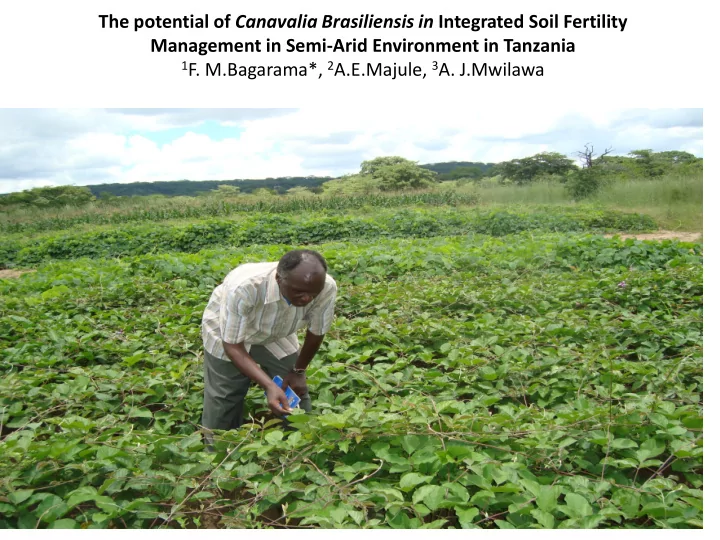
The potential of Canavalia Brasiliensis in Integrated Soil Fertility Management in Semi-Arid Environment in Tanzania

  • 1F. M.Bagarama*, 2A.E.Majule, 3A. J.Mwilawa
slide-2
SLIDE 2

Special features of Canavalia brasiliensis

  • Introduction

Biophysical,Climate,and Human factors have increased soil fertility degradation in the Miombo woodland ecosystems

  • Biological characteristics of

Canavalia brasiliensis

  • Drought tolerance
  • Deep penetration in soil
  • High biomass production
  • N input in the soil
  • Improved water infiltration
  • Soil surface cover against soil

erosion

  • Protecting the soil surface

against solar influxes improves the biological activity of soils

slide-3
SLIDE 3

Objectives

  • To test potential of Canavalia brasiliensis as the component of

ISFM in the semi-arid Miombo woodland system in Tabora Tanzania

  • To study the opportunities of improving crop residues fodder

quality with Canavalia brasiliensis in the dry season.

slide-4
SLIDE 4

Materials and methods

  • The research was conducted at Tumbi Agricultural Research

Institute farm, S 05003’57.9 E 032040’04.8’’ 1152m asl Tabora region in Tanzania. The soil at the experimental site is classified as a Ferric acrisols (Palexerults;USDA taxonomy).

  • Field trials comparing different green manure with

NPK(YARA) Mila cereal

  • Growing maize in rotation with Canavalia brasiliensis
slide-5
SLIDE 5

Late planted Maize under sown with Canavalia brasiliensis at Tumbi,Tanzania

slide-6
SLIDE 6

Maize grown on rotation with Canavalia brasiliensis+ NPK YARA

slide-7
SLIDE 7

Maize crop residues- Canavalia brasiliensis(protein source) in the dry season(July) leads to high quality manure

slide-8
SLIDE 8

Canavalia brasiliensis after two consecutive seasons under semi-arid conditions in Tabora

slide-9
SLIDE 9

Effective nodulation of Canavalia brasiliensis in Tabora

slide-10
SLIDE 10

Deep rooting Canavalia brasiliensis is a biological sub-soil tillage mechanism which improves water infiltration

slide-11
SLIDE 11

The effect of green manure on maize grain yield on a low fertile soil

Treatments Maize grain(kg/ha) Maize stover(kg/ha) Control 1889a 1568a Grilicidia sepium(10t/ha) 4407b 3852b Canavalia brasiliensis(10t/ha) 3578b 2617a Chamaecrista rotundifolia(10t/ha) 2592a 2210a NPK(YARA) 100kg/ha 3484b 3148b LSD 0.05 1436.8 1067.8

slide-12
SLIDE 12

Conclusions

  • Benefits of including Canavalia brasiliensis in

ISFM under semi-arid environment

  • Production of high N biomass 18-50 tons/ha
  • Soil moisture improvement and reduction of

soil erosion

  • Nitrogen input into the soil
  • Easy to establish under semi-arid and low

fertile soils