The Polar dream is about collaboration An integrated and - - PowerPoint PPT Presentation
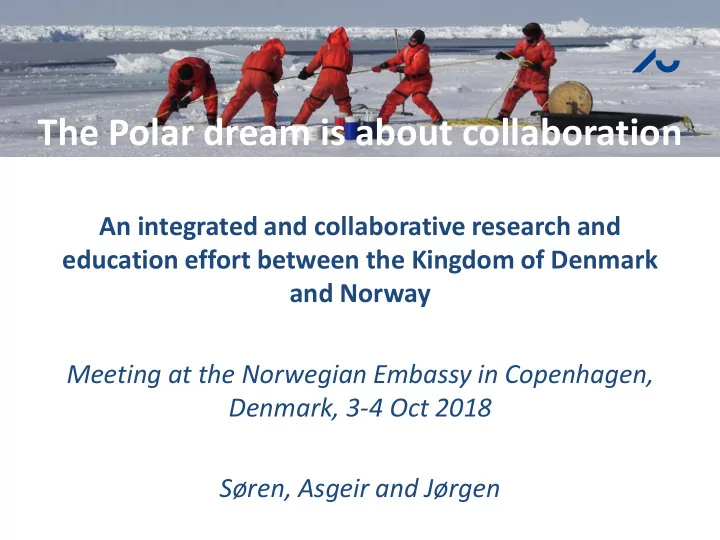
The Polar dream is about collaboration An integrated and collaborative research and education effort between the Kingdom of Denmark and Norway Meeting at the Norwegian Embassy in Copenhagen, Denmark, 3-4 Oct 2018 Sren, Asgeir and Jrgen
Eureka: Idea launched at Outreach Campaign June 2018 organized by UiT – The Arctic University of Norway
Partners
- Aarhus University, Denmark
- The Greenland Institute of Natural Resources
- Havstovan, the Faeroe Islands
- UiT - The Arctic University of Norway
- Norwegian University of Science and Technology
(NTNU)
- The University Centre on Svalbard (UNIS)
- REV Ocean
Other relevant partners
- Bergen University
- Copenhagen University
- The Marine Institute, Iceland
- Marin Research Institute, Norway
- Technical University Denmark (DTU), Denmark
- Norwegian Polar Institute
- Kongsberg Group
- SMB companies
- Royal Greenland
- DNV GL
- Arctic Science Partnership
- More
The Polar dream
Vision
- The overarching vision is to develop an
integrated environmental observation system that will enable a sustained, near real-time
- bservation of the atmosphere, ice and ocean.
at the scale of an entire ocean basin.
Why do we need an observing system?
- Climate change is occurring rapidly and has
cascading effects from physical changes to the environment, to ecosystems, and to social, economic and political conditions.
- There is a need to understand larger scales in
- rder to understand local conditions.
- To operate safely and responsible there is a
need for improved weather, ice hazard and environmental forecasting
What will we get from it?
- Near real time high quality data with high coverage and
resolution both in space and time, which will improve understanding of a data poor region.
- This will deliver better weather, ice hazard and
environmental forecasting.
- It will deliver better advice for fisheries and harvest
enabling a sustainable economy.
- It will provide vital basic variables for research projects
and attract and increase collaboration between local, regional and international investigators.
Greenland Integrated Observing System (GIOS)
http://www.isaaffik.org
Greenland Integrated Observing System (GIOS): A contribution to international Arctic research and development from the Kingdom of Denmark
Background
- Strong climate gradient (N,S) along East
Greenland
- Little is known about E, W gradients
- Need for upscaling of long-term
measurements and from few monitoring sites to the Greenland scale
- Need to link atmosphere-ice-land-
- cean compartments and interactions
- Time is ready for this adventure
Rysgaard et al 2003, 35:301-312. Arctic, Antarctic and Alpine Research
Greenland land-based stations and weather stations
ARC iClimate
- Large areas with few or
missing data, especially on East Greenland
- Let’s use this meeting to identify:
- Geographic focus areas along and across the ARC domain
- Key parameters to measure (e.g. more E, W weather/ice/ocean stations
- Key platforms for joint logistics and operations
- How to upscale our results
Infrastructure
Norway: Ships: Helmer Hanssen, Kronprins Haakon, Gunnerus, REV Robotic platforms by NTNU AUR and UAV Labs: 5 AUVs, 3 ROVs, 4 USV, 5-10 UAV, smallsats from 2021 Denmark: Ships: Dana, Lauge Koch Long-term monitoring programs: Zackenberg, Nuuk, Disko & St Nord, various moorings and autonomous platforms (drones, AUVs), Royal Greenland trawler instrumentation Greenland: Ships: Sanna, and new Paamiut Long-term fishery and oceanographic data series, monitoring programs, various moorings. Various research stations in Greenland Faroe Islands: Ships: Magnus Heinason Long-term fishery and oceanographic, nutrients data series, monitoring programs, various moorings.
NTNU & UiT The Arctic University of Norway: Integrated technology platforms for ocean space research Air:
Penguin B fixed-wing UAV X8 fixed-wing UAV Hexa-copters
Underwater:
ROV Minerva ROV 30k ROV SEABOTIX AUV Remus 100 HUGIN HUS 2 LAUVs
Sea surface:
Gunnerus (NTNU) Unmanned vessel – Jetyak (UiT) Unmanned vessel – 4 Otters (NTNU) Helmer Hanssen (UiT) Kronprins Haakon (UiT)
ROV Minerva AUV REMUS 100 at Svalbard
Integrated marine mapping and monitoring using ships and autonomous robotics solutions/platforms operating in space, air, surface and underwater
Next step – joint campaigns
- Step 1 – coastal ecosystems – aligning existing
data (ongoing). Joint publications review, in progress
- Step 2 – Ships of opportunity – e.g. make LOI
for Lauge Kock, new Pamiut, Sanna, REV
- Step 3 – Dream cruise sections from coastal to
- pen water – (preliminar sections, Dana, L.
Kock ans small vessels have been made)
- Step 4 – Dream synoptic campaign in 2021.
Next Step - Education
- Mapping existing courses (Norway &
Denmark/Greenland/Faroe Island)
- MoU (UNIS-ARC)
- Increase mobility between contries
- Organize PhD summer schools in 2020
Next step - Funding
- National – public and private
- Scandinavia (NorForsk)
- EU (new polar program).
- ITN PhD network (proposal should be submitted