SLIDE 1 ORU Library Resources for Distance Learners
The ORU Library is a key resource for all students, providing access to many thousands of books, journals and other types of resources.
www.oru.edu/library
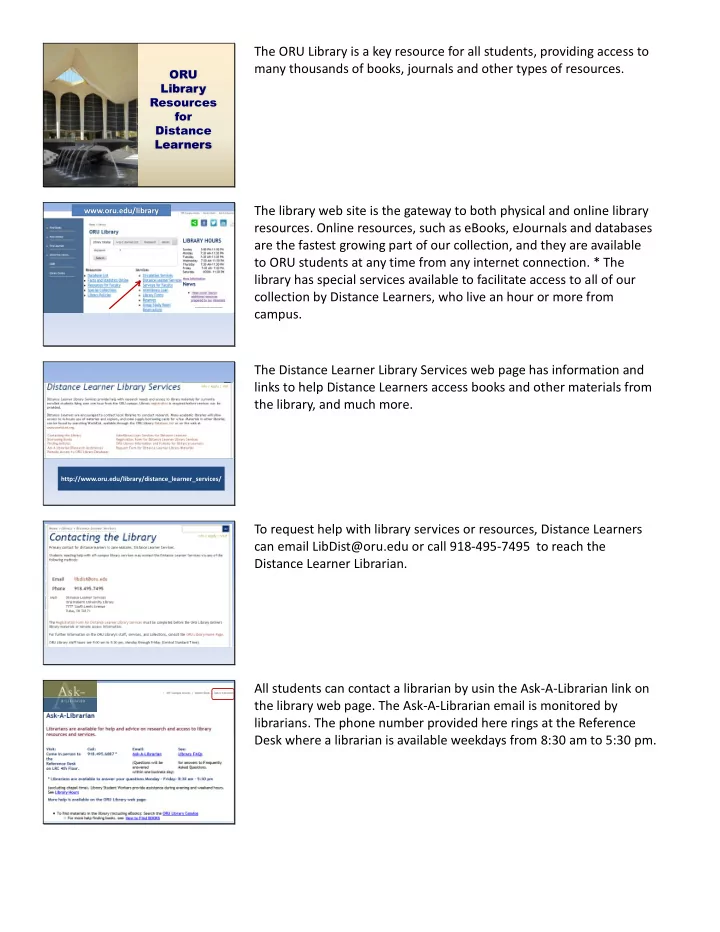
The library web site is the gateway to both physical and online library
- resources. Online resources, such as eBooks, eJournals and databases
are the fastest growing part of our collection, and they are available to ORU students at any time from any internet connection. * The library has special services available to facilitate access to all of our collection by Distance Learners, who live an hour or more from campus.
http://www.oru.edu/library/distance_learner_services/
The Distance Learner Library Services web page has information and links to help Distance Learners access books and other materials from the library, and much more. To request help with library services or resources, Distance Learners can email LibDist@oru.edu or call 918-495-7495 to reach the Distance Learner Librarian. All students can contact a librarian by usin the Ask-A-Librarian link on the library web page. The Ask-A-Librarian email is monitored by
- librarians. The phone number provided here rings at the Reference
Desk where a librarian is available weekdays from 8:30 am to 5:30 pm.
SLIDE 2 Online resources are available to you 24/7 from any internet
- connection. Your key to accessing online resources is your Novell
login. * Use the Off-Campus Access link on the library web page to log in with your Novell username and password, the same as your ORU email login. If you don’t know your Novell login, contact the IT Help Desk.
Shortcut to catalog: webopac.oru.edu
You can search for books in the library, both print and online by using the library catalog, available under the Find Books menu. * You can also search the catalog from the quick search box on the main web page.
Finding eBooks
The ORU Library provides access to more than 100,000 eBooks, available online any time you need them from any internet connection in the world. To limit your catalog search to eBooks, you can use the quick search
- n the main library page, * selecting the tab labeled eBooks.
* You can search by keyword, subject, author, or title. Note: this does not search within the full text of the ebooks. The maximum searching options are available by clicking the Advanced Keyword option on the library catalog page.
SLIDE 3
On the Advanced Search page, you can search multiple fields, and limit your results to eBooks or other formats. You can also limit by language and date of publication. Here is an example of a search for Bible commentaries available to you as eBooks. To access the ebook, click the title link. On the next page you will click a link to access the full book. If you haven’t already logged in through Off-Campus Access, you’ll be prompted at that point for your Novell username and password. On the next page you will click a link to access the full book. If you haven’t already logged in through Off-Campus Access, you’ll be prompted at that point for your Novell username and password. For more information on eBooks, * you can also visit the Research Guide under the Find Books menu. Select the tab labeled eBooks/eAudiobooks http://webapps.oru.edu/new_php/library/guides/findBooks.html Most of our ebooks can be downloaded, but access restrictions may vary. You will need to use your Novell login for off-campus access to ebooks. Let’s look at some of the eBook collections. Ebrary is our largest collection, with nearly 70,000 books, over 3,000 in the area of religion.
SLIDE 4
By accessing this collection directly, you can search for words in the full text of every book in the collection. The eBook Collection on EBSCOhost has nearly 10,000 titles. You can also browse by subject or search the full text of this collection. In the two ebook collections we just looked at, there are plenty of e- Reference books, but we also have two ebook collections that are specifically Reference books. Credo has over 500 online reference books. The Gale Virtual Reference Library has a smaller collection, but several of the sources in this collection are in-depth specialized sources, such as * Encyclopaedia Judaica, or A reference book called Contemporary American Religion. Here is an example of an article on pastoral counseling from this book. You can download the article text or in PDF format.
SLIDE 5 Finding books in
libraries
There are times when it is helpful to know how to find books available in other libraries. This is especially helpful for Distance Learners. There may be a university or seminary library near you that can be a helpful resource.
www.worldcat.org
When you need to find a book not available in our collection, you have several options. WorldCat is a free web database which combines the catalogs of most US and some international libraries. WorldCat is available free at www.worldcat.org, and also on the ORU library database list. By entering your zip code, you can find the library nearest you that
We recommend that you contact the library to inquire about guest access options. Most state university libraries are open to the public, but many private institutions have restrictions. Check out privileges aren’t usually available, so you may only be able to use the resources
- n site and make copies to take home.
http://books.google.com/advanced_book_search
Here are some options for when there isn’t a library near you and you need something right away. Google advanced book search allows you to search for books with previews or full text available. If the preview is very small, you may be able to see more by making multiple visits and searching different words within the book each time.
Online bookseller previews
Online book sellers like Amazon and Barnes and Noble often offer sample pages. Again, you can sometimes see more pages on subsequent visits.
SLIDE 6 Many Distance Learners save time and money by using the Interlibrary Loan service of their local public library. Many public libraries will borrow books for you from another library at little or no cost.
Using books in the ORU Library
Request scanned pages from ORU Library
Email your request to LibDist@oru.edu
- r use the request form on the Distance Learner Library Services web page
If a print book is in the ORU Library, you can request that pages from it be scanned and sent to you. You can identify the book by searching the catalog, or ask for recommended sources for your topic. Here is the Dictionary of Pastoral Care and Counseling. You can email your request to LibDist@oru.edu or…
Fill in as much information as you have. Scanned pages will be emailed to you at no cost, usually within one business day.
….use the form on the Distance Learner Library Services web page to make your request. Either way, we can usually have the pages scanned and emailed to you within one business day. If you don’t know the page numbers or the name of the article, provide as much information as you have. For instance, for a Bible commentary, you may give the scripture reference and we will scan the pages that relate to that passage. Distance Learners can request to have circulating books checked out and mailed to them. Articles are emailed to Distance Learners at no cost, but Distance Learners are responsible for postage costs for
- books. Books are checked out for 28 days and can be renewed online.
An alternative which may save time and money is to use the Interlibrary Loan service at your local public library to borrow books. Fees vary, but they are often less than the postage costs of borrowing from ORU. More information on borrowing books is available on the Distance Learner Library Services web site.
SLIDE 7
Finding journals and journal articles
In addition to books, you will need to find articles from periodicals. Periodical is the generic name for a "periodic" publication such as newspaper, journal, or magazine. To learn more about finding articles, click the link to the Research Guide under the Find Articles menu. The Research Guide for Finding Articles explains in detail how to use a database to find articles on your topic. Notice the tabs for different sections of this guide. To search for journal articles, select Database List from the Find Articles menu. * Academic Search Complete is one of the largest multidisciplinary databases, with thousands of full text journals. * The Database list can be sorted by Subject from this link.
SLIDE 8 From the list of databases by subject, you can find databases in your field by clicking the link from the list of subjects.
- Databases in the Multidisciplinary category cover all subjects, so
they might be a good starting place for a general topic, or one that spans several fields.
- Each of the other categories, such as Theology, lists databases
associated with a particular field of study.
- To the left is a list of categories of databases by type, such as
Dissertations, or Dictionaries and Encyclopedias. The ATLA Religion Database is a good starting place for theological and biblical topics. It works best to search the key words, rather than natural language, as you might with a web search engine. It may help to limit your search to articles, because this database also includes books and essays, which are book chapters. ATLA has a high percentage of non-English content, so you can also save yourself time with a language limit. Most Ebsco databases allow you to limit your results to scholarly journals, which can also save you time. For many articles, the full text is available directly from the database, either in PDF or other format. Click the full text link to download the article. If you don’t see a full text link, use the Article Linker by clicking the Check for full text link near the article citation. The Article Linker may link you to another database that does have the full text, or to the library catalog if print journal is in the library. Click the link to find the journal in the catalog, then check the catalog to see if the date of the issue you need is here. If we have the journal in our print collection, you can request to have the article scanned and emailed to you at no cost. Just email the citation to LibDist@oru.edu. We can usually send the article within one business day. If you have a citation for a journal article, such as one that is cited in a bibliography, you can use the A-Z Journals List to see if the full text of that journal is available through the ORU Library. You can search the Journals List from the quick search box on the library web page.
SLIDE 9 You can also access the Journals List from the link under “Find Journals.” The results of this search tell you where the journal is available, both
- nline and in the library.
To access the full text of this journal, click the link to one of the databases. Note that the ATLA Religion Database has the full text of this journal from 1943 to present. Click the link to the ORU Library Catalog to see if older volumes of this journal are in the library. The library catalog shows print and microfilm back issues of journals. * Watch for the link to view an expanded list of dates available. Distance learners may request articles from journals that are only available in the library. The article will be scanned and emailed to you at no cost.
Library Guides and Help
Remember that research guides for finding books, articles and journals are available on the menu under each category.
SLIDE 10 The Library Guides page provides research guides to recommended sources and tips for using library resources.
* The links to Subject Guides are on the left side of the page and the
links to “How to find” guides and General Guides are on the right.
* Notice the guide for Access to Electronic Resources.
This guide has information on how to log in from off campus to access
- nline databases, including ejournals and ebooks. * It also provides
information on contacting the IT Help Desk for password assistance or
- ther non-library technical help.
Another example of the General Guides is the guide on Citing and Documenting Sources. You will find tips and links to help you learn to cite your sources and avoid plagiarism. Subject research guides recommend sources in your subject area, and tips for finding different types of resources in this field. Notice the tabs at the top of the page for different types of sources. On the Databases by Subject page of the Databases List, you can find a link (http://oru.libguides.com/biblecommentaries) to this guide to Bible Commentaries under the tab for Theology & Ministry. This list can help you identify some of the best commentaries available in our library.
SLIDE 11 Pull down the menu under Databases by Name to find tutorials for many of our databases, including a very helpful video tutorial for using the scripture search tool in the ATLA Religion Database. You may also call the Ask-A-Librarian line during any hours the library is open. During evening and weekend hours, this desk is staffed by student workers trained to provide basic help with accessing library
- resources. The Ask-A-Librarian web page also has links to Frequently
Asked Questions, and Library Guides. Whenever you have an opportunity to visit the ORU campus, please stop by the library, on the 4th floor of the Learning Resource Center. We will be happy to see you whenever you are here.