The Homeschooling - Library Connection Diane Pamel- Library - - PowerPoint PPT Presentation

the homeschooling library
SMART_READER_LITE
LIVE PREVIEW

The Homeschooling - Library Connection Diane Pamel- Library - - PowerPoint PPT Presentation

The Homeschooling - Library Connection Diane Pamel- Library Director Southworth Library and homeschool parent of 5 sons (now adults) Anna Chappell Library Assistant at Interlaken Library and current homeschool parent of 2? Gina


slide-1
SLIDE 1

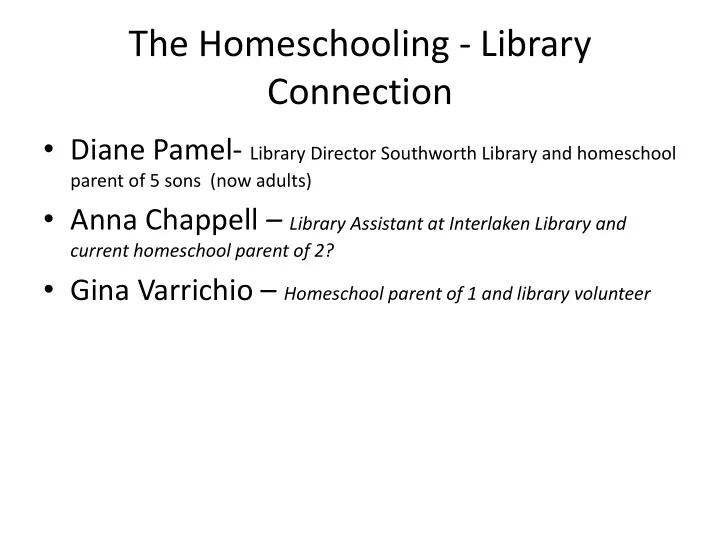
The Homeschooling - Library Connection

  • Diane Pamel- Library Director Southworth Library and homeschool

parent of 5 sons (now adults)

  • Anna Chappell – Library Assistant at Interlaken Library and

current homeschool parent of 2?

  • Gina Varrichio – Homeschool parent of 1 and library volunteer
slide-2
SLIDE 2

Homeschooling Today

slide-3
SLIDE 3

Homeschooling in the mainstream

slide-4
SLIDE 4

Why do families choose to homeschool?

  • 1. Concern about the school environment
  • 2. Ability to incorporate religious beliefs or world view

into instruction

  • 3. Special needs issues, food allergies
  • 4. School curriculums, which parents/care givers

perceive to have little relevance to life

  • 5. Support development of special talents and interests
  • 6. Disagreements with the Common Core Curriculum
  • 7. Desire to provide a nontraditional approach to

education

  • 8. Children struggling in school
slide-5
SLIDE 5

The Public Library is their school library and their resource for physical materials and digital resources .

slide-6
SLIDE 6
slide-7
SLIDE 7

Talk to homeschoolers who visit the library. Find out what the homeschoolers in your area are looking for in library services. Make sure to offer library tours for them

  • 1. Talk
slide-8
SLIDE 8

Make sure people can find homeschooling materials— they can’t check out what they can’t find. Make a special section for homeschooling materials, even if it has to start small, and make resources more visible.

  • 2. Make a place for Homeschool

materials

slide-9
SLIDE 9
  • 3. Find your local homeschool

groups and cooperatives

http://www.home-school.com/groups/NY.php https://www.hslda.org/orgs/Default.aspx?State=NY

slide-10
SLIDE 10
  • 4. Provide some space

Allow homeschoolers to use your library space for meetings, studying, informal classes and

  • play. Create a Bulletin Board for

information exchange

slide-11
SLIDE 11
  • 5. Create opportunities

for public display or presentations

slide-12
SLIDE 12
  • 6. Have copies of NY state laws and

regulations pertaining to homeschoolers and sample forms

slide-13
SLIDE 13
  • 6. Provide curriculum & supply

catalogs

  • Maintain a file of catalogs from

companies that sell materials and supplies of interest to homeschoolers.

  • Consider purchasing popular

curriculum for review

slide-14
SLIDE 14
  • 7. Homeschool programs
  • Programs during regular school

hours that are just for homeschooled students

  • Programs that need group

interaction

  • Programs that require specific skill

sets to teach

  • Multi-age programs
slide-15
SLIDE 15
  • 9. Make homeschool

friendly library policies

  • Consider the needs of homeschoolers when

creating library policies such as meeting rooms, loan periods, item limits, interlibrary loan fees, overdue fines/maximum fines, and volunteer programs.

  • Give them teacher privileges such as extended

due dates or increased limits

slide-16
SLIDE 16
  • 8. Volunteer & Social Opportunities
  • Make a way for teens to

volunteer to help

  • Include them in teen advisory

group

  • Provide social engagement for

children and teens

slide-17
SLIDE 17
  • 10. Create a resource request form
  • Create a form for homeschool patrons to

request items for purchase consideration

  • Create a form for families to request collected

materials for unit study, including the grade level and specific interests

  • Provide specific information on the website
  • Consider facilitating a curriculum swap or

used curriculum sale

slide-18
SLIDE 18

Libraries around the country are finding new ways to serve this population through physical spaces and creative programs catered to homeschooling families’ needs

slide-19
SLIDE 19
slide-20
SLIDE 20

The Johnsburg Public Library converted a 12-by-12-foot study room into a Homeschool Resource Center stocked with circulating material.

slide-21
SLIDE 21

The Homeschool Resource Center sells some of the donations it receives at the HRC Open House and Used Curriculum Flea Market.

slide-22
SLIDE 22

The two-room Educational Resource Center at the Pikes Peak Library District houses kits, software, science equipment and toys for younger patrons to play with.

slide-23
SLIDE 23

Thirty participants presented projects at the Pike's Peak annual Homeschool Science Fair last February.

slide-24
SLIDE 24

The Nashville Public Library hosts its tween homeschooling club in "The Alley," a space dedicated to teens that houses a 3D printer.

slide-25
SLIDE 25

Lovettsville Library, a branch

  • f Loudoun County (VA) Public Library
slide-26
SLIDE 26

Challenges for libraries

  • Space for curriculum and resources
  • Getting connected
  • Cost of curriculum resources
  • Staff time to manage it
  • Creating multigenerational programs
  • Time/staff to create pathfinders/resource

guides

slide-27
SLIDE 27

Going outside of the Box

  • Whether online or in-person, through community

centers or programs, these public libraries evolved to fit the needs of the growing homeschool population. For libraries that want to start offering homeschool resources, reach out to homeschool groups.

  • Find out if you can attend a support group

meeting or survey families. Ask them what their interests are, how you can support them and what timing works best for them

slide-28
SLIDE 28