
SLIDE 1
The Numbers Challenge…..
Doing More with Less…
The UCT Experience following #RhodesMustFall, #FeesMustFall & #EndOutsourcing
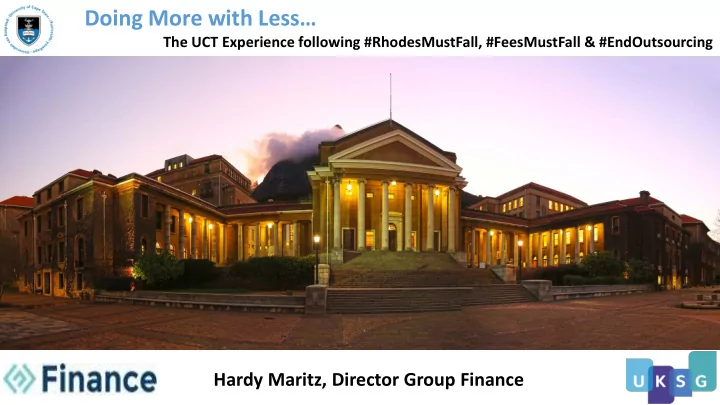
The Numbers Challenge.. Hardy Maritz, Director Group Finance - - PowerPoint PPT Presentation
Doing More with Less The UCT Experience following #RhodesMustFall, #FeesMustFall & #EndOutsourcing The Numbers Challenge.. Hardy Maritz, Director Group Finance Contents the story outlined Co Context xt Key E y Even ents 01
The UCT Experience following #RhodesMustFall, #FeesMustFall & #EndOutsourcing
page 01
UCT Financial Policy, history of increasing fees, less state funding, massive disparities, broken promises
Key decisions, choices, actions and
#RhodesMustFall, #FeesMustFall and
#EndOutsourcing – the perfect storm
Where we are now, new challenges, is it sustainable?
page 02
Target of 3% of revenue as a surplus Grow cash reserves
20% - 30% of operational costs 3 – 4 months’ cover Unexpected incurrence of expenditure
Pay for capital expenditure Pay for strategic spend Pay for discretionary spend
Understanding key cost drivers – Internal Inflation Control recurrent costs Coverage for unexpected costs Consistent surplus Rolling 5 year, cash flow by month forecast
page 03
Symbolic artworks/sculptures seen as insensitive and celebratory UCT campus and culture still largely Eurocentric and not sensitive to differing student contexts = #RMF at UCT Broken political promises “Born fees” no longer tolerant of repeated promises – lack of struggle? Institutional disparities – UCT vs Others = #FMF at WITS which spreads In 2018 is 42.5% of total revenue related to teaching operations Had become tool to charge wealthier students full fees and discount them for poor student Had become a tool to balance the budget 10.3% approved, supported by UCT students for 2016 Multi-year history of increases around or exceeding double digits to fund poor students and cover “loss” of state funding .
In 2018 is 42.4% of total revenue related to teaching operations Increases below inflation for over 5 years Outlook for economy and state funding/support very poor Department of Higher Education & Training has conflicting mandate and priorities – tainted by political appearances Increasing pressure on the state to improve outcomes for citizens 20 years post democracy
page 05
Students rallied staff providing core services such as cleaning and security to join the fees protest in 2015 In return, students vowed to support staff to become university employed staff Big driver was for improved wages and benefits UCT Management and Council agreed to insource from July 2016 at R80m extra cost Not all universities did this – very divisive in sector and has seriously skewed labour market Started in 2015 two weeks into #RMF at WITS Gathered rapid momentum and wide spread support at many campuses March on Parliament by western Cape students March on Union Buildings by students and public Demands were for the “promised” free, decolonialised higher education State caved to pressure in late October 2015 and announced it would partially fund increases for 2016
In 2015, a group of student activists smeared the Rhodes statue overlooking UCTs Golden Mile with faeces and paint In short, the call was for removal of an installation that was seen as celebratory of Rhodes and his achievements as a colonial “overseer” Protester tactics were to occupy Bremner, intimidate staff, try and force discourse Student comments, Council vote – statue removed and stored
page 07
page 08
In early December 2017, ex President Zuma announces fee free higher education for students from families with gross annual incomes of ZAR350k and below Throws existing under pressure National Financial Aid Scheme under the bus – battling to cope with one system, now have two In February 2018 new Finance Minster announces budget – VAT increase, more to HE and NSFAS, less to all other key state
State interferes in institutional autonomy on fees – announces it will fund increases up to 8% in both 2017 and 2018 via fee settlement Fee losses from 2016 on residence fees are not covered by the state – so keeping housing sustainable becomes a further crisis Heher Commission reports in October 2017 – “Fee Free Higher Education not feasible or affordable at this time…………” Reignites protests, UCT establishes “November Hall” and for the first time since 2014 substantially completes academic year in the year
In 2016, state funded 83% of lost fee increase due to 0% decision In 2017, this 83% was rolled into
further loss of 4% of total revenue by 2018 President appointed Heher Commission of enquiry into “Fee Free Higher Education” Ongoing student unrest at various campuses
page 09
Largest expense item at 67% of total costs
A 5 to 6 year history of operating efficiencies and increases at below inflation
Fee increases beyond Internal Inflation from 2009 to make up declining state funding and increase financial aid to students at UCT who cannot afford fees (EFC)
Maintained Library Acquisitions spend, as well as ensuring existing IT and Related infrastructure replacement provisions maintained
page 10
e to to 5 5 yea ear r rolling c g cash f forec ecasts, h had started ed proces ess to to c cut to total costs b by R R120m/6% i in 2013/4
early retirements and retirements
eviewi wing s services es p previously o
ed – initial f findings gs that e exter ternal p provider ers s simply a added ed people to e to s solve p e problem ems r rather er than f focus on p proces ess improvem emen ent and e efficien encies es
allowed students to apply for fee discounts via financial aid if family income below R350k
state f e funding o g of f free h ee higher er e educati tion f for F FTEN ENS p provided ed f funding r g relief to f to U UCT – in es essence a an under erwriting s g saving o g of s some R e R75m
page 11
minimums and timeframes to right-size, while focusing on strategic objectives
iew c credit it l load ads, a acad ademic ic w wor
kloads, a acad ademic ic y year ar – ensure e appropriate to e to d deliver er b bet etter er te teaching a g and r resea earch, w while a e also i improving s g succes ess r rates es d due to to less s studen ent “ “overstr tres ess”
establish new opportunities for third stream revenues
eady o
erating: g: Confer eren ence M e Managem emen ent C Centre, e, V Vacati tion A Accommodati tion, C Commercial Let etti ting, F Film S Shoots ts, B Brea eakwater er L Lodge, e, P Protea b by M Marriott M t Mowb wbray, Food & & Connect, t, A Academ emic Devel elopmen ent P Progr gramme ( e (early career eer, m mid-career eer)
come: e: C Confer erence C e Centre f e for 6 600pax, i improve V e Vacati tion A Accommodati tion o
etter er manage l e leases es a and occupancies es f for C Commercial L Letting, A Adver erti tising g on C Campus w wher ere e appropriate, e, S Short C t Courses es ( (primarily o
e or b blended ed)
Department
page 13
Focus on throughput improvements – will generate
more students into the system Shut down marginal departments, focus on offering subjects at a single institution rather than duplication = Sector Collaboration Ensure operational efficiency through investments in IT systems and improved building and related infrastructure which makes
Ensure investments into new revenue sources deliver on business plans Remain relevant and alert State again interferes in institutional autonomy on fees – On 1 November 2018 state “suggests” all fees increase by no more than 5.3% for 2019 State agrees to engage sector on a three year rolling fee increase model which allows for differentiation – to be done in 2019 Residences remain an issue – not subsidised by the state, big disparities in quality, costs to
availability, etc. State is conflicted – now biggest payer of fees, yet university Councils determine fees?
On 1 November 2018 indicates total pool for subsidy for 2019 will increase at 19.6% However, after volume and systemic “shuffling of deck chairs” increase only in the order of 9% 2020 indicative funding increase of 6.7%, closer to 4% allowing for volume State under pressure and reverting to subsidy increases below inflation?
page 14
Business minded, relevant to academic enterprise, forward looking, transparent
Ensure sufficient to manage short term shocks, remain focused on core needs and invest to maintain and improve
Not used for recurrent costs, actively manage cash for best returns while taking appropriate risk
Continually scan environment to understand all influences Plan on a rolling 5 year forward looking basis, with cash flow needs by month Understand key cost drivers – Internal Inflation Deficit budgets not an option, make choices not compromises – fund medium term transitions from investment returns
@hardymaritz Hardy.Maritz@uct.ac.za +27-83-259-9122