The Morphology of Complex Materials: MTEN 657 MWF 3:00-3:50 Baldwin - - PowerPoint PPT Presentation

the morphology of complex materials mten 657 mwf 3 00 3
SMART_READER_LITE
LIVE PREVIEW

The Morphology of Complex Materials: MTEN 657 MWF 3:00-3:50 Baldwin - - PowerPoint PPT Presentation

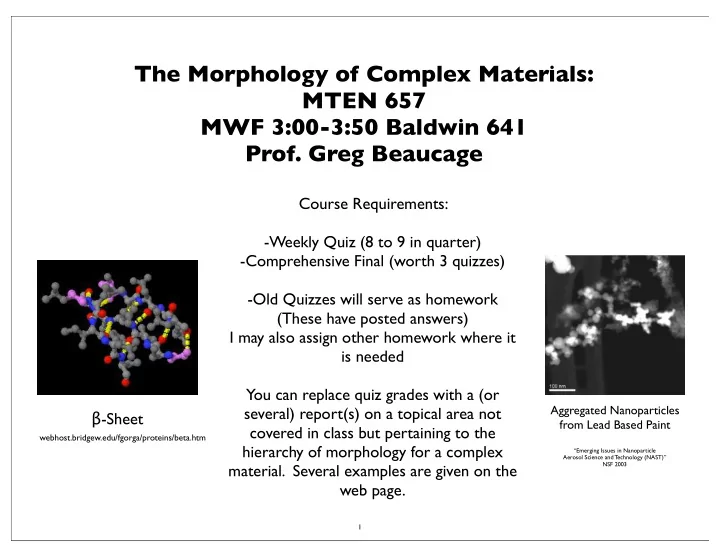
The Morphology of Complex Materials: MTEN 657 MWF 3:00-3:50 Baldwin 641 Prof. Greg Beaucage Course Requirements: -Weekly Quiz (8 to 9 in quarter) -Comprehensive Final (worth 3 quizzes) -Old Quizzes will serve as homework (These have posted


slide-1
SLIDE 1

1

The Morphology of Complex Materials: MTEN 657 MWF 3:00-3:50 Baldwin 641

  • Prof. Greg Beaucage

β-Sheet

webhost.bridgew.edu/fgorga/proteins/beta.htm

Aggregated Nanoparticles from Lead Based Paint

“Emerging Issues in Nanoparticle Aerosol Science and Technology (NAST)” NSF 2003

Course Requirements:

  • Weekly Quiz (8 to 9 in quarter)
  • Comprehensive Final (worth 3 quizzes)
  • Old Quizzes will serve as homework

(These have posted answers) I may also assign other homework where it is needed You can replace quiz grades with a (or several) report(s) on a topical area not covered in class but pertaining to the hierarchy of morphology for a complex

  • material. Several examples are given on the

web page.

slide-2
SLIDE 2

2

Structural Hierarchy of Complex Materials

Consider that we would like to understand a forest, such as the Amazon Forest from a Structural Perspective in order to develop predictive capabilities and an understanding

  • f the basic features to such a complex structure.
slide-3
SLIDE 3

3

Structural Hierarchy of Complex Materials

Consider that we would like to understand a forest, such as the Amazon Forest from a Structural Perspective in order to develop predictive capabilities and an understanding

  • f the basic features to such a complex structure.

http://www.eng.uc.edu/~gbeaucag/Classes/MorphologyofComplexMaterials/Overview.html

1) The first logical step is to consider a base (primary) unit for the forest and 2) then devise a repetition or branching rule (fractal scaling law) to create trees (secondary structure). We revise the scaling rules and primary unit until we produce the type of trees we are interested in.

slide-4
SLIDE 4

4

Structural Hierarchy of Complex Materials

Consider that we would like to understand a forest, such as the Amazon Forest from a Structural Perspective in order to develop predictive capabilities and an understanding

  • f the basic features to such a complex structure.

http://www.eng.uc.edu/~gbeaucag/Classes/MorphologyofComplexMaterials/Overview.html

We could consider other types of trees in the same way. 3) Trees form clusters or groves (tertiary structure) that can follow a spacing and shape rule, for instance, redwoods grow in “fairy” rings or “cathedral” groups around an old tree.

slide-5
SLIDE 5

5

Structural Hierarchy of Complex Materials

Consider that we would like to understand a forest, such as the Amazon Forest from a Structural Perspective in order to develop predictive capabilities and an understanding

  • f the basic features to such a complex structure.

4) Groupings of groves of trees interact with the environment to form forests (quaternary structures) 5) Higher levels of organization can be considered

slide-6
SLIDE 6

6

Structural Hierarchy of Complex Materials

  • We have considered discrete “levels” of structure within a hierarchical model.
  • In constructing the hierarchy is it natural to start from the smallest scale and to build up.
  • We have borrowed from proteins in labeling the hierarchical levels primary, secondary, tertiary and

quaternary.

  • The hierarchical approach gives insight into how complex natural systems can be understood as if the

structural levels acted independently in some respects.

  • One of the main insights from hierarchical models is to understand in detail how and why structural

levels are not independent and how they can interact to accommodate the environment.

  • In this course we will consider the application of hierarchical models to understand complex molecular

systems with the goal of understanding how the hierarchical approach can be expanded.

slide-7
SLIDE 7

7

Topics we will cover: 1) Protein structure (the origin of the hierarchical concept) 3 weeks 2) DNA and RNA structure (first adaptation of the hierarchical approach) 1 week 3) Polymer Chain Structure in Solution (a statistical hierarchy) 2 weeks 4) Hierarchy of Polymer Dynamics in Solution (a kinetic hierarchy) 1 week 5) Polymer Crystalline Structure (hierarchy in a structural material) 2 weeks 6) Branched Fractal Aggregates (hierarchy in a statistical structural material) 1 week

Structural Hierarchy of Complex Materials

slide-8
SLIDE 8

8

Twig Tree/Branching Grove/Cluster

Structural Hierarchy of Complex Materials

slide-9
SLIDE 9

9

The Structural Hierarchy of Proteins

slide-10
SLIDE 10

10

Size of proteins.html Four Levels of Protein Structure.html

http://learn.genetics.utah.edu/content/begin/cells/scale/ http://www.youtube.com/watch?v=y8Z48RoRxHg&feature=related

slide-11
SLIDE 11

11

http://www.friedli.com/herbs/phytochem/proteins.html#peptide_bond

The α-carbon is a chiral center it is always in an L-configuration spelling “CORN” in the Newman projection There are 20 choices for the “R” group in nature. This makes an alphabet from which sequences of these 20 letters can code for any protein. Depending on the chemical functionality of the “R” groups different properties, polarity, hydrophobicity, ability to bond by disulfide linkages, hydrogen bonding and chain flexibility or rigidity can be imparted to the protein. Quick Look at Amino Acids.html

http://www.johnkyrk.com/aminoacid.html

slide-12
SLIDE 12

12

Amino Acids.html 3D Amino Acids

http://www.bioscience.org/urllists/aminacid.htm http://www.mcb.ucdavis.edu/courses/bis102/Polar.html

More Amino Acids

http://biology.clc.uc.edu/courses/bio104/protein.htm

slide-13
SLIDE 13

13

Methionine Start Amino Acid (usually removed in later steps) Glycine -H Flexible non-polar Alanine -CH3 Flexible non-polar Proline 10-40% Cis Configuration depending on neighboring amino acid residues Found in Turns and at start of α-helix Cystine Disulfide Linkages (Hair is 5% cystine) Hydrogen Bonding in Kevlar NH = Donor C=O = Acceptor Polyamides are similar to proteins Know These 5 Amino Acids Well

slide-14
SLIDE 14

14

The Genetic Code Links.html Post Translational Modification of Insulin Movie of Protein Synthesis

http://nutrition.jbpub.com/resources/animations.cfm?id=14&debug=0 http://www.eng.uc.edu/~gbeaucag/Classes/MorphologyofComplexMaterials/GeneticCode.html

slide-15
SLIDE 15

15

The Peptide Bond Resonance structures make the peptide group planar (like a card). Proline is the exception Proline adds main chain curvature found in turns and at start of α-helix

http://www.friedli.com/herbs/phytochem/proteins.html#peptide_bond

slide-16
SLIDE 16

16

slide-17
SLIDE 17

17

The peptide linkage forms a planar structure with the two α-carbons and the N, H, C and O atoms PSI ψ is the rotation angle between the carboxyl C and the α-carbon PHI Φ is the rotation angle between N and the α- carbon Certain values of these two rotation angles are preferred in certain structures So the angles serve as a map for the protein secondary structure

http://www.friedli.com/herbs/phytochem/proteins.html#peptide_bond

Fully Extended Chain (Planar Zig-Zag) Phi/Psi 180, 180

slide-18
SLIDE 18

18

http://employees.csbsju.edu/hjakubowski/classes/ch331/protstructure/olunderstandconfo.html http://visu.uwlax.edu/BioChem/Rotate.mov

Phi rotation for Psi = 0 Psi rotation for Phi = 0

slide-19
SLIDE 19

19

http://employees.csbsju.edu/hjakubowski/classes/ch331/protstructure/olunderstandconfo.html

slide-20
SLIDE 20

20

Ramachandran Plots.html

slide-21
SLIDE 21

21

Folding Simple Dynamic Simulation.html More Complicated Simulation.html Yet more complicated.html Where and When do Proteins Fold.html Small Protein Folding.html Another Small Protein Folding.html Folding a Protein by Hand.html Entropy and Protein Folding.html Folding of Villin.html Lets Jump Ahead and Look at Protein Folding

http://intro.bio.umb.edu/111-112/111F98Lect/folding.html http://www.youtube.com/watch?v=_xF96sNWnK4&feature=related

http://www.cs.ucl.ac.uk/staff/D.Jones/t42morph.html

http://www.youtube.com/watch?v=meNEUTn9Atg

http://www.youtube.com/watch?v=BrUdCVwgJxc&feature=related

http://www.youtube.com/watch?v=E0TX3yMEZ8Y&feature=related

http://www.youtube.com/watch?v=va92d9Ei1QM&feature=related

http://www.youtube.com/watch?v=gaaiepNVyvE&feature=related http://www.youtube.com/watch?v=1eSwDKZQpok&feature=related

slide-22
SLIDE 22

22

Secondary Structures of Proteins α-Helix, β-Sheets, Turns

slide-23
SLIDE 23

23

pdb of α-Helix

http://employees.csbsju.edu/hjakubowski/Jmol/alpha_helix/alpha_helix.htm

Right Handed α-Helix

http://employees.csbsju.edu/hjakubowski/classes/ch331/protstructure/olunderstandconfo.html

C=O from residue “i” hydrogen bonds with NH from residue “i+4” Phi/Psi angles are -57, -47 Residues per turn = 3.6 Rise per turn = 5.4 Å Amino Acids and Helix Glycine too flexible Proline too rigid Short H-Bonding (Ser, Asp, Asn) Disrupt Coil Long H-Bonding are OK Branches at α-C Disrupt Coil (Val, Ile)

slide-24
SLIDE 24

24

http://employees.csbsju.edu/hjakubowski/classes/ch331/protstructure/olunderstandconfo.html

Valine Isoleucine Serine

Asparagine

Aspartic Acid Glycine Proline

slide-25
SLIDE 25

25

Other Types of Helices 310 helix

slide-26
SLIDE 26

26

β-Sheets Phi Psi Parallel -119 +113 Anti-Parallel -139 +135 α-Helix -57 -47 Extended ±180 ±180 Rippled Sheets H-Bonding between strands in Sheet H-Bonding within strand in Helix Parallel => 12 member rings Anti-Parallel => 14 and 10 member rings alternating

slide-27
SLIDE 27

27

Parallel β-Sheets 12-member rings

slide-28
SLIDE 28

28

Anti-Parallel β-Sheets Alternating 10- and 14-member rings

slide-29
SLIDE 29

29

Twisted β-Sheet/Saddle Twisted β-Saddle

http://employees.csbsju.edu/hjakubowski/Jmol/ Twisted%20Beta%20Sheet/ Twisted_Beta_Sheet.htm

β-Barrel β-Barrel

http://employees.csbsju.edu/hjakubowski/Jmol/ beta_barrel_tpi/Beta_Barrel_tpi.htm

slide-30
SLIDE 30

30

http://employees.csbsju.edu/hjakubowski/classes/ch331/protstructure/olunderstandconfo.html

Valine Isoleucine Serine

Asparagine

Aspartic Acid Glycine Proline

slide-31
SLIDE 31

31

β-Turns

slide-32
SLIDE 32

32

β-Turns Reverse Turn

http://employees.csbsju.edu/hjakubowski/Jmol/RevTurnTryInhib/revturnTrpInhib.htm

Type 2 and Type 1 Reverse Turns

slide-33
SLIDE 33

33

Micelles (Vesicle)

Dodecylphosphocholine (DPC) Micelle

http://employees.csbsju.edu/hjakubowski/Jmol/Micelle/micelle.htm

slide-34
SLIDE 34

34

Materials Science and Engineering Graduate Seminar Series

January 12, 2012 Baldwin 544/644 2:00 - 2:50 pm

The Design of Vesicles

  • Dr. Michael R. Weaver

Analytic Discovery Procter & Gamble Corporation

The$Materials$Science$ and$Engineering$ Graduate$Program$

slide-35
SLIDE 35

35

Protein with a buried hydrophobic group

http://employees.csbsju.edu/hjakubowski/Jmol/HAAPBJmol/HAAPBBovineBuryF10.htm

slide-36
SLIDE 36

36

~50% of amino acids are in well defined secondary structures 27% in α-helix and 23% in β-sheets Native state proteins have a packing density slightly higher than FCC/HCP 0.75 vs 0.74 Organic liquids 0.6-0.7 Synthetic Polymer Chain in Solution ~0.001 So the transition from an unfolded protein in solution to a native state protein involves a densification of about 750 to 1000 times. Nonpolar 83% internal, Charged 54% exposed, uncharged 63% internal

slide-37
SLIDE 37

37

Super-Secondary Structures Common motifs Helix-Loop-Helix EF-Hand

http://employees.csbsju.edu/hjakubowski/Jmol/Lambda_Repressor/Lambda_Repressor.htm

http://employees.csbsju.edu/hjakubowski/Jmol/Calmodulin_EF_Hand/Calmodulin_EF_Hand.htm

DNA and Calcium Binding sites

slide-38
SLIDE 38

38

β-Hairpin or Beta-Beta in Anti-Parallel Structures Super-Secondary Structures

http://employees.csbsju.edu/hjakubowski/Jmol/Bovine%20Pancreatic%20Trypsin%20Inhibitor/Bovine_Pancreatic_Trypsin_Inhibitor.htm

Greek Key Motif

slide-39
SLIDE 39

39

Beta-Alpha-Beta (to connect two parallel β-sheets)

http://employees.csbsju.edu/hjakubowski/Jmol/BETA-ALPHA-BETA_MOTIFF/BETA-ALPHA-BETA_MOTIFF.htm

β-Helicies

http://cti.itc.virginia.edu/~cmg/Demo/pdb/ap/ap.htm

(seen in pathogens, viruses, bacteria)

slide-40
SLIDE 40

40

Many β-Topologies

http://www.cryst.bbk.ac.uk/PPS2/course/section10/all_beta.html

slide-41
SLIDE 41

41

3 Classes of Proteins (Characteristic Secondary Structures) α-Proteins αβ-Proteins β-Proteins Cytochrome B562

http://employees.csbsju.edu/hjakubowski/Jmol/Cytochrome_B562/Cytochrome_B562.htm

Met-Myoglobin

http://employees.csbsju.edu/hjakubowski/Jmol/Met-Myoglobin

Triose Phosphate Isomerase

http://employees.csbsju.edu/hjakubowski/Jmol/Triose%20Phosphate%20Isomerase/TRIOSE_PHOSPHATE_ISOMERASE.htm

Hexokinase

http://employees.csbsju.edu/hjakubowski/Jmol/Hexokinase/HEXOKINASE.htm

Superoxide Dismutase

http://employees.csbsju.edu/hjakubowski/Jmol/Superoxide%20Dismutase/SUPEROXIDE_DISMUTASE.htm

Human IgG1 Antibody

http://employees.csbsju.edu/hjakubowski/Jmol/Human%20Antibody%20Molecule-IgG1/Human_Antibody_Molecule%C2%AD_IgG1.htm

Retinol Binding Protein

http://employees.csbsju.edu/hjakubowski/Jmol/Retinol%20Binding%20Protein/RETINOL_BINDING_PROTEIN.htm

slide-42
SLIDE 42

42

Fibrillar (elastic) versus Globular Proteins Elastin (Blood Vessels) β-sheets and α-helicies with β-turns Reslin (Insects Wings) Silk (Spiders etc.) β-sheets and α-helicies with β-turns Fibrillin (Cartilage) - Folded β-Sheet like and Accordian

slide-43
SLIDE 43

43

Tertiary Structure and Protein Folding Consider a protein of 100 residues each with two bond angles Φ and ψ that can take 3 positions each so 9 conformations. The chain has 9100 = 2.7 x 1095

  • conformations. Even with 10-13s to change a

conformation, it would take 8.4 x 1074 years to probe all conformations (that is along time). Such a protein folds in less than a second. This is called Levinthal’s Paradox. The key to resolving Levinthal’s Paradox is to limit the choices. Disulfide bonds are a major limiting factor, Consider Ribonuclease (RNase A) (an enzyme that degrades RNA) Having 4 disulfide bonds that serve as tethers for the folding process.

slide-44
SLIDE 44

44

Folds “like a taco” to bind with the RNA substrate Armour purified 1 kilo and gave it away for study 124 residues 13.7 kDa Polycation that binds with polyanionic RNA Positive charges are in the taco cleft. RNase A

http://www.rcsb.org/pdb/explore/jmol.do?structureId=7RSA&bionumber=1

Nobel Prize Lecture published as: Anfinsen, C.B. (1973) "Principles that govern the folding of protein chains." Science 181 223-230. Anfinsen Postulate: For Small Globular Proteins the Tertiary Structure is determined only by the amino acid sequence

http://employees.csbsju.edu/hjakubowski/Jmol/RNase/RNase.htm

RNase Structure

slide-45
SLIDE 45

45

β-Mercapto Ethanol Urea Competes with H-Bonds Denatures (Destablizes) Proteins Competes with H-Bonds Denatures (Destablizes) Proteins Guanidine-HCl

slide-46
SLIDE 46

46

http://employees.csbsju.edu/hjakubowski/classes/ch331/protstructure/olprotfold.html

slide-47
SLIDE 47

47

http://employees.csbsju.edu/hjakubowski/classes/ch331/protstructure/olprotfold.html

slide-48
SLIDE 48

48

slide-49
SLIDE 49

49

Native state is a “Global Minimum in Free Energy” Folding Process Occurs on an Energy “Funnel”

slide-50
SLIDE 50

50

Folding does not occur by a single pathway, but is a statistical process

  • f searching the energy landscape for minima

For large proteins we see intermediates, molten globules, non-biologically active dense states

slide-51
SLIDE 51

51

Simple proteins undergo a cooperative process y-axis could be viscosity (hydrodynamic radius), circular dichroism, fluorescence, diffusion coefficient (hydrodynamic radius) from dynamic light scattering, radius of gyration from static light scattering

slide-52
SLIDE 52

52

Viscosity Native state has the smallest volume

slide-53
SLIDE 53

53

Mass Fractal Dimension, 1 ≤ df ≤ 3 Mass ~ Size1 Mass ~ Size2 1-d df = 1 df = 2 2-d Mass ~ Size3 df = 3 3-d

slide-54
SLIDE 54

54

Mass Fractal Dimension, 1 ≤ df ≤ 3 Mass ~ Size2 Mass ~ Size1.67 2-d df = 2 df = 5/3 Random (Brownian) Walk θ-Solvent Condition Self-Avoiding Walk/Expanded Coil Good Solvent Condition In the collapse transition from an expanded coil to a native state for a protein of 100 residues (N = Mass = 100) Size ~ 15.8 for Expanded Coil (10 for Gaussian) and 4.6 for Native State For N = 10000 this becomes 251 : 100 : 21.5 For large proteins the change in size is dramatic (order of 10x)

slide-55
SLIDE 55

55

1) Mass Fractal dimension, df.

Nano-titania from Spray Flame

f

d p

d R z ⎟ ⎟ ⎠ ⎞ ⎜ ⎜ ⎝ ⎛ = 2 α

Random aggregation (right) df ~ 1.8; Randomly Branched Gaussian df ~ 2.5; Self-Avoiding Walk df = 5/3 Problem: Disk df = 2 Gaussian Walk df=2

2R/dp = 10, ~ 1, z ~ 220 df = ln(220)/ln(10) = 2.3 A Measure of Branching is not Given. z is mass/DOA dp is bead size R is coil size

slide-56
SLIDE 56

56

Viscosity For the Native State Mass ~ ρ VMolecule Einstein Equation (for Suspension of 3d Objects) For “Gaussian” Chain Mass ~ Size2 ~ V2/3 V ~ Mass3/2 For “Expanded Coil” Mass ~ Size5/3 ~ V5/9 V ~ Mass9/5 For “Fractal” Mass ~ Sizedf ~ Vdf/3 V ~ Mass3/df

slide-57
SLIDE 57

57

Viscosity For the Native State Mass ~ ρ VMolecule Einstein Equation (for Suspension of 3d Objects) For “Gaussian” Chain Mass ~ Size2 ~ V2/3 V ~ Mass3/2 For “Expanded Coil” Mass ~ Size5/3 ~ V5/9 V ~ Mass9/5 For “Fractal” Mass ~ Sizedf ~ Vdf/3 V ~ Mass3/df “Size” is the “Hydrodynamic Size”

slide-58
SLIDE 58

58

Circular Dichroism Light Polarization

http://www.enzim.hu/~szia/cddemo/edemo0.htm?CFID=1025184&CFTOKEN=88815524

CD Spectroscopy for Proteins

http://www.cryst.bbk.ac.uk/PPS2/course/section8/ss-960531_21.html

Wikipedia on CD

http://en.wikipedia.org/wiki/Circular_dichroism http://www.ruppweb.org/cd/cdtutorial.htm

Difference in Absorption Molar Circular Dichroism (c = molar concentration) Degrees of Ellipticity These change with the extent and nature of secondary structure such as helicies Examples of CD

http://www.ap-lab.com/circular_dichroism.htm

slide-59
SLIDE 59

59

slide-60
SLIDE 60

60

Binary Interference Yields Scattering Pattern. I(q) ~ N ne

2

ne Reflects the density of a Point generating waves N is total number of points

slide-61
SLIDE 61

61

The Scattering Event

I() is related to amount Nn2 is related to size/distances

( )

q 2 d 2 sin 4 π θ λ π = = q

2) Rather than consider specific structures, we can consider general scattering laws by which all scatters are governed under the premises that 1) Particles have a size and 2) Particles have a surface.

slide-62
SLIDE 62

62

Binary Interference Yields Scattering Pattern.

  • Consider that an in-phase

wave scattered at angle θ was in phase with the incident wave at the source of scattering.

  • This can occur for points

separated by r such that |r| = 2θ/|q|

  • q = 4π

λ sinθ 2

slide-63
SLIDE 63

63

Binary Interference Yields Scattering Pattern.

  • For high θ, r is small
slide-64
SLIDE 64

64

Binary Interference Yields Scattering Pattern.

  • For small θ, r is large
slide-65
SLIDE 65

65

For an isotropic sample we consider scattering as arising from the probability of the random placement

  • f a vector r in the scattering phase.
slide-66
SLIDE 66

66

For an isotropic sample we consider scattering as arising from the probability of the random placement

  • f a vector r in the scattering phase.
slide-67
SLIDE 67

67

For an isotropic sample we consider scattering as arising from the probability of the random placement

  • f a vector r in the scattering phase.

Rather than random placement of the vector we can hold The vector fixed and rotate the particle

slide-68
SLIDE 68

68

For an isotropic sample we consider scattering as arising from the probability of the random placement

  • f a vector r in the scattering phase.

Rather than random placement of the vector we can hold The vector fixed and rotate the particle

slide-69
SLIDE 69

69

For an isotropic sample we consider scattering as arising from the probability of the random placement

  • f a vector r in the scattering phase.

Rather than random placement of the vector we can hold The vector fixed and rotate the particle

slide-70
SLIDE 70

70

Rather than random placement of the vector we can hold The vector fixed and rotate the particle For an isotropic sample we consider scattering as arising from the probability of the random placement

  • f a vector r in the scattering phase.
slide-71
SLIDE 71

71

The particle becomes a probability density function from the center of mass. That follows a Gaussian Distribution.

p r

( ) = exp −3r2

4Rg

2

⎛ ⎝ ⎜ ⎜ ⎞ ⎠ ⎟ ⎟

slide-72
SLIDE 72

72

The particle becomes a probability density function from the center of mass. Whose Fourier Transform is Guiniers Law.

p r

( ) = exp −3r2

4Rg

2

⎛ ⎝ ⎜ ⎜ ⎞ ⎠ ⎟ ⎟ ⇒ I q

( ) = Gexp − q2Rg

2

3 ⎛ ⎝ ⎜ ⎞ ⎠ ⎟ G = Nne

2

slide-73
SLIDE 73

73

Guiniers Law Pertains to a Particle with no Surface.

p r

( ) = exp −3r2

4Rg

2

⎛ ⎝ ⎜ ⎜ ⎞ ⎠ ⎟ ⎟ ⇒ I q

( ) = Gexp − q2Rg

2

3 ⎛ ⎝ ⎜ ⎞ ⎠ ⎟ G = Nne

2

Any Particle can be Approximated as a Gaussian probability distribution in this context.

slide-74
SLIDE 74

74

p r

( ) = exp −3r2

4Rg

2

⎛ ⎝ ⎜ ⎜ ⎞ ⎠ ⎟ ⎟ ⇒ I q

( ) = Gexp − q2Rg

2

3 ⎛ ⎝ ⎜ ⎞ ⎠ ⎟ G = Nne

2

Guiniers Law can be thought of as the First Premise of Scattering: All Particles have a size reflected by the radius of gyration.

slide-75
SLIDE 75

75

Static Light Scattering for Radius of Gyration Guinier’s Law

Beaucage G J. Appl. Cryst. 28 717-728 (1995).

γGaussian r

( ) = exp −3r2

2σ 2

( )

σ 2 = xi −µ

( )

2 i=1 N

N −1 = 2Rg

2

I q

( ) = IeNne

2 exp −Rg 2q2

3 ⎛ ⎝ ⎜ ⎞ ⎠ ⎟

Lead Term is

I(1/r) ~ N r

( )n r ( )

2

I(0) = Nne

2

γ0 r

( ) =1− S

4V r +...

A particle with no surface

r ⇒ 0 then d γGaussian r

( )

( )

dr ⇒ 0

Consider binary interference at a distance “r” for a particle with arbitrary orientation Rotate and translate a particle so that two points separated by r lie in the particle for all rotations and average the structures at these different orientations Binary Autocorrelation Function Scattered Intensity is the Fourier Transform of The Binary Autocorrelation Function

slide-76
SLIDE 76

76

slide-77
SLIDE 77

77

At intermediate sizes the chain is self-similar

Mass ~ Size

d f

z ~ R2 R

1

⎛ ⎝ ⎜ ⎞ ⎠ ⎟

d f

slide-78
SLIDE 78

78

At intermediate sizes the chain is self-similar I(q) ~ N ne

2

N = Number of Intermediate Spheres in the Aggregate ne = Mass of inter. sphere I(q) ~ N ne

2

N ~ R2 r

int

⎛ ⎝ ⎜ ⎞ ⎠ ⎟

d f

ne ~ r

int

R

1

⎛ ⎝ ⎜ ⎞ ⎠ ⎟

d f

Nne

2 ~ r int

R

1

⎛ ⎝ ⎜ ⎞ ⎠ ⎟

d f R2

R

1

⎛ ⎝ ⎜ ⎞ ⎠ ⎟

d f

⇒ I q

( ) ~ R2

R

1 2

⎛ ⎝ ⎜ ⎞ ⎠ ⎟

d f

q

−d f

slide-79
SLIDE 79

79

The Debye Scattering Function for a Polymer Coil

I(Q) = 2 Q2 Q −1+ exp −Q

( )

( )

Q = q2Rg

2

For qRg << 1

exp −Q

( ) =1− Q + Q2

2! − Q3 3! + Q4 4! − ... I q

( ) =1− Q

3 + ... ≈ exp − q2Rg

2

3 ⎛ ⎝ ⎜ ⎞ ⎠ ⎟

Guiniers Law!

slide-80
SLIDE 80

80

The Debye Scattering Function for a Polymer Coil

I(Q) = 2 Q2 Q −1+ exp −Q

( )

( )

Q = q2Rg

2

For qRg >> 1 df = 2

slide-81
SLIDE 81

81

slide-82
SLIDE 82

82

For static scattering p(r) is the binary spatial auto-correlation function We can also consider correlations in time, binary temporal correlation function g1(q,τ) For dynamics we consider a single value of q or r and watch how the intensity changes with time I(q,t) We consider correlation between intensities separated by t We need to subtract the constant intensity due to scattering at different size scales and consider only the fluctuations at a given size scale, r or 2π/r = q

slide-83
SLIDE 83

83

Dynamic Light Scattering a = RH = Hydrodynamic Radius

slide-84
SLIDE 84

84

Dynamic Light Scattering

http://www.eng.uc.edu/~gbeaucag/Classes/Physics/DLS.pdf

my DLS web page Wiki

http://webcache.googleusercontent.com/search?q=cache:eY3xhiX117IJ:en.wikipedia.org/wiki/Dynamic_light_scattering+&cd=1&hl=en&ct=clnk&gl=us

Wiki Einstein Stokes

http://webcache.googleusercontent.com/search?q=cache:yZDPRbqZ1BIJ:en.wikipedia.org/wiki/Einstein_relation_(kinetic_theory)+&cd=1&hl=en&ct=clnk&gl=us

slide-85
SLIDE 85

85

slide-86
SLIDE 86

86

Optical Tweezers Dielectric particles are attracted to the center of a focused beam Scattering Force moves particles downstream Force can be controlled with intensity of laser

slide-87
SLIDE 87

87

Stretching of a single protein (RNase)

http://employees.csbsju.edu/hjakubowski/classes/ch331/protstructure/olprotfold.html

Blue: Stretch just DNA linker molecules Red: Stretch DNA and Protein Green: Release tension on Protein/DNA

Link to Paper at Science

http://www.sciencemag.org/content/309/5743/2057

slide-88
SLIDE 88

88

It's been estimated that over half of all native proteins have regions (greater than 30 amino acids) that are disordered, and upwards of 20% of proteins are completely disordered.

Natively Unfolded Proteins

slide-89
SLIDE 89

89

Membrane Proteins

http://blanco.biomol.uci.edu/mp_assembly.html

slide-90
SLIDE 90

90

http://blanco.biomol.uci.edu/translocon_machinery.html

slide-91
SLIDE 91

91

slide-92
SLIDE 92

92

http://www.portfolio.mvm.ed.ac.uk/studentwebs/session2/group5/introliz.htm

slide-93
SLIDE 93

93

Electron transport chain is part of the ATP/ADP energy generation pathway for cells This involves many tertiary protein structures. For instance, Complex III is a quaternary structure

  • f 9 proteins.

Heme B group Quaternary Structures

http://en.wikipedia.org/wiki/Electron_transport_chain

http://proteopedia.org/wiki/index.php/Complex_III_of_Electron_Transport_Chain

slide-94
SLIDE 94

94

Quaternary Structure Page

http://proteopedia.org/wiki/index.php/Main_Page

Ribosome

http://proteopedia.org/wiki/index.php/Ribosome

Poly(A) Polymerase

http://proteopedia.org/wiki/index.php/2q66

Ribosome in Action

http://www.youtube.com/watch?v=Jml8CFBWcDs

Role of Ribosome

http://www.cytochemistry.net/cell-biology/ribosome.htm

slide-95
SLIDE 95

95

DNA/Protein Quaternary Structures

http://www.biochem.ucl.ac.uk/bsm/prot_dna/prot_dna_cover.html

slide-96
SLIDE 96

96

RNA structure Ribose

http://www.rnabase.org/primer/

t-RNA (Folded Structure) Deoxyribose DNA

slide-97
SLIDE 97

97

If it takes DNA/RNA to template a protein and proteins to make/control DNA/RNA Which came first Proteins or Nucleic Acids? RNA World Hypothesis:

http://en.wikipedia.org/wiki/RNA_world_hypothesis

http://exploringorigins.org/rna.html L1 Ligase Ribozyme

slide-98
SLIDE 98

98

slide-99
SLIDE 99

99

Hierarchy of a Chromosome

slide-100
SLIDE 100

100

Core Histone

slide-101
SLIDE 101

101

http://www.eng.uc.edu/~gbeaucag/Classes/MorphologyofComplexMaterials/Physics%20of%20Chromatin%20Schiessel%202003.pdf

slide-102
SLIDE 102

102