SLIDE 1 1
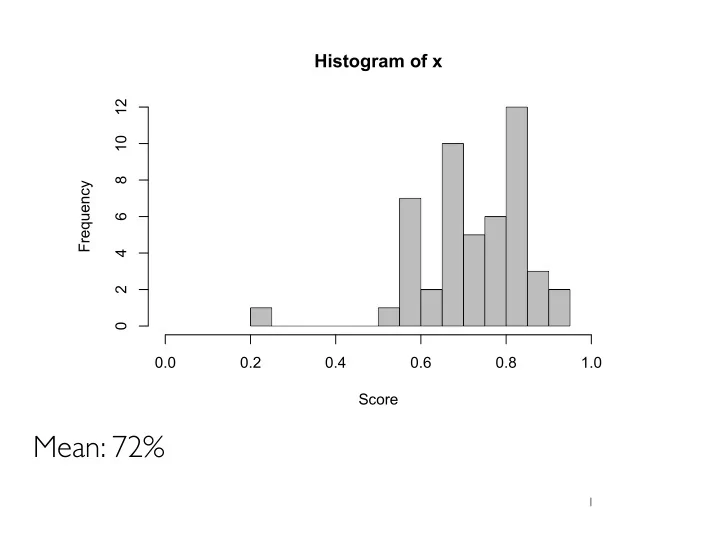
Histogram of x
Score Frequency 0.0 0.2 0.4 0.6 0.8 1.0 2 4 6 8 10 12
Mean: 72%
SLIDE 2
Flying Reptiles of the Mesozoic
SLIDE 3
- Birds are theropod dinosaurs, demonstrated by similarities in
- steology, oology, integument, and behavior
- Feathers and arm flapping evolved before the animals were
capable of powered flight
- Flight likely first evolved in paravian theropods (not in birds),
but they were poor fliers
- Further acquisition of flight adaptations (pygostyle, sternum,
alula) occurred during Mesozoic bird evolution
- Flying pterosaur reptiles are not related to birds but display
convergent evolution of many flight adaptations
Bird Evolution Summary
SLIDE 4
Pterosauria Earliest vertebrates known to evolve powered flight!
SLIDE 5 Pterosauria
10 in 33 ft 23 ft 13 ft
Quetzalcoatlus
SLIDE 7
Pterosauria: early forms Late Triassic - Late Jurassic
Eudimorphodon: (sea gull sized) Already and advanced flyer
Short body Elongate 4th finger Pteroid bone
SLIDE 8
Archosauria Crown-clade Archosauria Ornithodira
Crurotarsi Ornithosuchidae Pterosauria Dinosauria “Rauisuchia” Crocodylomorpha Basal archosaurs
SLIDE 9 9
Pterosauria
Ornithodira:
Scleromochlus Pterosauria Lagosuchus Dinosauria Upright gait S-curved necks Hinged Ankle Aves
SLIDE 10 10
Pterosaur Traits
Hollow limb bones Breastbone with Keel Enlarged brain Stiff torso Pteroid Elongate 4th finger 3 membranes: First Arm Tail Cranial Crests
SLIDE 11 11
Pterosaur Traits: pneumatic bones
SLIDE 12 12
Pterosaur Traits: air sacs
SLIDE 13 Dsungaripterus Pteranodon
Pterosaur Traits: cranial crests Keratinous
SLIDE 15
Pterosaur Traits: cranial crests
Nyctosaurus; late Cretaceous Sometime, ridiculous things happen.
SLIDE 16
Pterosaur Traits: jaw diversity
Ramphorynchids
Scaphognathus Dorygnathus Sordes Campylongnathoides
Basal Pterosaurs (paraphyletic) Late Triassic Long teeth and nails Most lacked bony crests
SLIDE 18 18
Ornithocheirus Pterodaustro Ctenochasma
Fisheaters, Filterers
SLIDE 19
Pterosaur Traits: jaw diversity Pteranodon
No teeth Scoop-shaped bill One of the best known large Pterosaurs Sexually Dimorphic crests Heavily fused body to protect against flight-related stress Potentially more Glider-like (Wing shape similar to Albatross)~ dynamic soaring Piscivore
SLIDE 21
Pterosaur Traits: skin
Covered in hair-like filaments: Pycnofibres NOT HAIR Similar in structure: convergent evolution Very convincing evidence that these animals were endothermic
SLIDE 22
Sordes pilosus “Hairy Demon”
SLIDE 23 23
Pterosaur Eggs
Thin, soft shelled eggs No evidence of multiple laminar layers
SLIDE 24
Pterosaur Flight
SLIDE 25 25
high aspect ratio (long, slender) low aspect ratio (short, squat) Frigate Bird
SLIDE 26
Convergent Flight Adaptations in Pterosaurs
SLIDE 27
Pterosaurs independently evolved a pectoral girdle for supporting flight muscles Pterosaur pectoral girdle Avian pectoral girdle
Pectoral Girdle Similarities
Large fused sternum with keel Strut-like coracoid bones fused to sternum Short, stout humerus (arm bone)
SLIDE 28
No feathers – instead use skin membrane stretched across hand Wing surface primarily supported by extended finger digit IV Pteroid bone – unique to pterosaurs Bird alula Bird wing: feathers Wing surface primarily supported by ulna, wrist
SLIDE 30
SLIDE 31
SLIDE 32
SLIDE 33
SLIDE 34
SLIDE 35 35
Unique Flight Adaptations in Pterosaurs
Wing support Outer wing supported by Actinofibrils 3 distinct layers of criss-crossed fibers Keratin? Elastin? Unknown. Oxygenated by looping blood vessels
SLIDE 36 36
Actinofibrils: Arranged perpendicularly to lines of highest tension in wing Tension
SLIDE 37 37
Alternative Wing Structures
Wing structure highly variable in modern animals Almost certainly was variable among Pterosaurs There is likely no ‘One right answer’ here
SLIDE 38
Pterosaur Walking
An evolving concept... A) 1970s: Belly dragging B) 1980s: Bipedality C) 1990: Semi-erect D) 1990s: Sprawling Still a source of contention!
SLIDE 39 39
Top: Pteraichnus Bottom: Running Caiman
A B
Pterosaur Walking
SLIDE 40
Tail Vanes
Present among early Pterosaurs; particularly Ramphorynchus Much reduced among derived Pterosaurs Probably a stabilizing feature More diamond-shaped among older animals
SLIDE 41
Unique Flight Adaptations in Pterosaurs
Laser Beam eyes Convergently evolved in Kryptonian humanoids
SLIDE 42
Largest bird (Argentavis, Miocene) had 7 m wingspan and weighed 80 kg
Giant Flying Animals
Largest pterosaur (Quetzalcoatlus, from the latest Cretaceous) had a 12 m wingspan and weighed 100 kg
SLIDE 43
Largest pterosaurs were probably excellent gliders but would have had difficult reaching takeoff velocity
Giant Pterosaurs
SLIDE 44 44
Pterosaur documentary 10:13