The Moral Imperative for Creating a New Vision for Texas Public - - PDF document

the moral imperative for creating a new vision for texas
SMART_READER_LITE
LIVE PREVIEW

The Moral Imperative for Creating a New Vision for Texas Public - - PDF document

The Moral Imperative for Creating a New Vision for Texas Public Education and in Denton ISD Presented by Chris Shade, Director of School Improvement [Innovation] and Support on 06/09/14 The Moral Imperative for [VD] = Visioning Document: Creating


slide-1
SLIDE 1

The Moral Imperative for Creating a New Vision for Texas Public Education and in Denton ISD Presented by Chris Shade, Director of School Improvement [Innovation] and Support on 06/09/14

The Moral Imperative for Creating a New Vision for Texas Public Education and in 06/09/14

[VD] = Visioning Document: http://www.tasanet.org/cms/lib07/TX01923126/Centricity/Domain /111/workinprogress.pdf [FR] = Student Centered Schools Future-Ready Students The Moral Imperative: From Vision to Action http://www.tasanet.org/cms/lib07/TX01923126/Centricity/domain /126/2014/frsli_report_full.pdf Today is about the BIG picture.

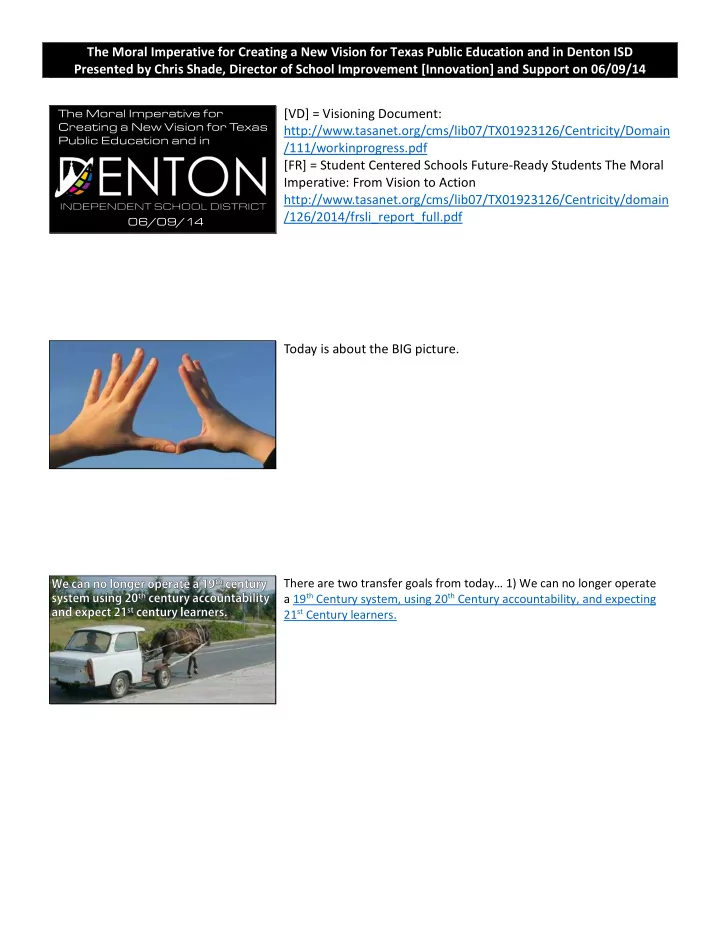
There are two transfer goals from today… 1) We can no longer operate a 19th Century system, using 20th Century accountability, and expecting 21st Century learners.

slide-2
SLIDE 2

2) Schools cannot do it alone.

WHY?

I’m going to start with “why.” If the #2 pencil is the most popular, why is it still #2?

slide-3
SLIDE 3

If 7-Elevens are always open, why do they have locks on their doors? Why is the small size of a candy bar the "fun size" when it's more fun to eat the king size. Why haven't we come up with something better than sliced bread in the last 80 years?

slide-4
SLIDE 4

If Wile E. Coyote had enough money to buy all that ACME stuff, why didn't he just buy dinner? Why is there braille at a drive-through ATM? Why do we sing "Take Me Out to the Ball Game" when we're already there?

slide-5
SLIDE 5

Why do we spend the first year of a children’s life teaching them to walk and talk and the rest of their lives telling them to sit down and shut up? Why are you so frazzled today?

WHY?

slide-6
SLIDE 6

Perhaps it is because we are trying to fit a square peg in a round hole. http://www.youtube.com/watch?v=xoSJ3_dZcm8

Bureaucracy

Government policymakers, in an effort to correct what they perceived as inefficiency and ineffectiveness in publication, have

  • ver-mandated and over-regulated the local function. Multiple and

largely punitive accountability provisions were created to ensure

  • compliance. Though the continual proliferation of prescriptive rules

and requirements is probably well-intentioned, its impact on schools is inherently counterproductive. Rather than focusing efforts on student success, school districts have been forced to behave like inflexible and unresponsive bureaucracies, more accountable to policies set by the government and their enforcement agencies than responsive to meeting the needs of their students and the communities they serve. This shift in power has stripped the local community of a sense of ownership of its schools and denied its citizens the right and opportunity to make meaningful choices about the quality and nature of education it desires for its youth. [VD8]

slide-7
SLIDE 7

State curricular standards

The state standards outline curricular expectations lack specificity and relevance. [FR7] Our curriculum is “a mile wide and an inch deep” requiring students to be a “jack of all trades and master of none.” According to Robert Marzano, “If you wanted to teach all of the standards in the national documents, you would have to change schooling from K-12 to K-22 .”

High-stakes tests

High-stakes tests hinder the things that have made America strong and prosperous, such as cherishing individual talents, cultivating creativity, celebrating diversity, and inspiring curiosity. [Zhao, 2009). [FR7] Multiple and largely punitive accountability provisions were created to ensure compliance. [VD8] The present bureaucratic structure [is a] system based on compliance, coercion, and fear. If proper focus is to be restored, the system must be transformed into one based on trust, shared values, creativity, innovation, and respect. [VD2] “We don’t like to use fear, but it’s the only tool we’ve got.” Director at the Texas Education Agency, ACET Spring Conference 2013

slide-8
SLIDE 8

“Here’s the deal our parents signed up for: Our world was filled with factories. Factories that make widgets and insurance and Web sites, factories that make movies and take care of sick people and answer the telephone. These factories need workers. If you learn how to be one of these workers, if you pay attention in school, follow instructions, show up on time, and try hard, we will take care of you. You won’t have to be brilliant or creative or take big

  • risks. We will pay you a lot of money, give you health insurance,

and offer you job security. We will cherish you, or at the very least, take care of you. It’s a pretty seductive bargain. So seductive that for a century, we embraced it. We set up our schools and our systems and our government to support the bargain. It was the American Dream. For a long time, it worked. But in the face of competition and technology, the bargain has fallen apart.” Seth Godin, Linchpin http://www.amazon.com/Linchpin-Are- Indispensable-Seth-Godin/dp/1591844096 “In routinizing work, we risked routinized human beings. Indeed, this was inevitable, since the goal of bureaucracy was (and is) to excise the human factor, to turn people into machines made of flesh and blood.” Gary Hamel, What Matters Now: How to Win in a World of Relentless Change, Ferocious Competition, and Unstoppable Innovation http://www.amazon.com/What-Matters- Now-Competition- Unstoppable/dp/1118120825/ref=sr_1_1?s=books&ie=UTF8&qid= 1402352508&sr=1-1&keywords=gary+hamel http://www.youtube.com/watch?v=8NPzLBSBzPI&feature=kp

slide-9
SLIDE 9

Most white-collar workers wear white collars, but they’re still working in the factory. They push a pencil or process an application

  • r type on a keyboard instead of operating a [machine]. The white-

collar job was supposed to save the middle class, because it was machine-proof. Of course, machines have replaced those workers. If we can measure it, we can do it faster. If we can put it in a manual, we can outsource it. If we can outsource it, we can get it cheaper.” Seth Godin, Linchpin “Factories didn’t happen because there were schools, schools happened because there were factories.” “A hundred and fifty years ago, adults were incensed about child

  • labor. Low-wage kids were taking jobs away from hard-working
  • adults. Sure, there was some moral outrage about seven-year-olds

losing fingers and being abused at work, but the economic rationale was paramount. Factory owners insisted that losing child workers would be catastrophic to their industries and fought hard to keep the kids at work—they said they couldn’t afford to hire

  • adults. It wasn’t until 1918 that nationwide compulsory education

was in place. Part of the rationale used to sell this major transformation to industrialists was the idea that educated kids would actually become more compliant and productive workers. Our current system of teaching kids to sit in straight rows and obey instructions isn’t a coincidence—it was an investment in our economic future. The plan: trade short-term child-labor wages for longer term productivity by giving kids a head start in doing what they’re told. Large-scale education was not developed to motivate kids or to create scholars. It was invented to churn out adults who worked well within the system. Scale was more important than quality, just as it was for most industrialists. Of course, it worked. Several generations of productive, fully employed workers followed. But now?” Seth Godin, Stop Stealing Dreams: What is School For? http://sethgodin.typepad.com/files/stop-stealing-dreams6print.pdf

slide-10
SLIDE 10

“School, no surprise, is focused on creating hourly workers, because that’s what the creators of school needed, in large

  • numbers. Think about the fact that school relentlessly downplays

group work. It breaks tasks into the smallest possible measurable

  • units. It does nothing to coordinate teaching across subjects. It
  • ften isolates teachers into departments. And most of all, it

measures, relentlessly, at the individual level, and re-processes those who don’t meet the minimum performance standards. Every

  • ne of those behaviors is a mirror of what happens in the factory of
  • 1937. Of course, business in the U.S. evolved over time to be less

draconian than it was seventy years ago. Companies adopted a social contract (usually unstated). Union movements and public

  • utcry led to the notion that if you were obedient and

hardworking, your hourly gig would continue, probably until you retired, and then your pension would keep you comfortable. In the last twenty years, though, under pressure from competition and shareholders, the hourly social contract has evaporated.” Seth Godin, Stop Stealing Dreams: What is School For? http://sethgodin.typepad.com/files/stop-stealing-dreams6print.pdf

From the students' perspective...

Students describe their educational experience as “boring” and “pointless” while others depict it more like a bridge they have to cross to enter the greener pastures of college or their careers…This depiction of school from the voices of our students does not indicate a learning environment where creativity and innovation are fostered and future-ready students are developed. [FR7]

slide-11
SLIDE 11

“In the face of competition and technology, the bargain has fallen

  • apart. Job growth is flat at best. Wages in many industries are in a

negative cycle. The middle class is under siege like never before, and the future appears dismal. People are no longer being taken care of—pensions are gone; 401(k)s have been sliced in half; and it’s hard to see where to go from here. It’s futile to work hard at restoring the take-care-of-you bargain. The bargain is gone and it’s not worth whining about and it’s not effective to complain. There’s a new bargain now, one that leverages talent and creativity and art more than it rewards obedience. Change has changed. We are surrounded by all sorts of things that are changing at an exceptional pace: the number of mobile phones in the world, CO2 emissions, data storage, the power of semiconductor chips, the number of devices connected to the Internet, the number of genes that have been sequenced, world energy consumption, and knowledge itself. As human beings, we don’t have much experience with exponential change.” Gary Hamel, What Matters Now: How to Win in a World of Relentless Change, Ferocious Competition, and Unstoppable Innovation http://www.amazon.com/What-Matters-Now-Competition- Unstoppable/dp/1118120825/ref=sr_1_1?s=books&ie=UTF8&qid= 1402352508&sr=1-1&keywords=gary+hamel “If all we do…is teach compliance and consumption, that’s all we’re going to get. School can and must do more than train the factory workers of tomorrow. It’s clear that the economy has changed. What we want and expect from our best citizens has changed. Not

  • nly in what we do when we go to our jobs, but also in the doors

that have been opened for people who want to make an impact on

  • ur culture. At the very same time, the acquisition of knowledge

has been forever transformed by the Internet. Often overlooked in the rush to waste time at Facebook and YouTube is the fact that the Internet is the most efficient and powerful information delivery system ever developed. The change in the economy and the delivery of information online combine to amplify the speed of

  • change. These rapid cycles are overwhelming the ability of the

industrialized system of education to keep up. As a result, the education-industrial system, the one that worked very well in creating a century’s worth of factory workers, lawyers, nurses, and soldiers, is now obsolete. We can prop it up or we can fix it. I don’t think it’s practical to say, “We want what we’ve been getting, but cheaper and better.” That’s not going to happen, and I’m not sure we want it to, anyway. We need school to produce something different, and the only way for that to happen is for us to ask new
slide-12
SLIDE 12

questions and make new demands on every element of the educational system we’ve built. Whenever teachers, administrators, or board members respond with an answer that refers to a world before the rules changed, they must stop and start their answer again. No, we do not need you to create compliance. No, we do not need you to cause memorization. And no, we do not need you to teach students to embrace the status quo. Anything a school does to advance those three agenda items is not just a waste of money, but actually works against what we do need. The real shortage we face is dreams, and the wherewithal and the will to make them come true. No tweaks. A revolution.” Seth Godin, Stop Stealing Dreams: What is School For? http://sethgodin.typepad.com/files/stop-stealing-dreams6print.pdf

We can no longer operate a 19th Century system, using 20th Century accountability, and expecting 21st Century learners.

Knowledge without action [is known] as a knowing-doing gap. [FR7]

slide-13
SLIDE 13

We cannot deny our moral imperative. We must take the vision to action by transforming and allowing students to have the educational freedom foundational to our democracy. [FR10] We are at a seismic shift in education with the opt-out movement championed by Kyle Massey’s blog (http://kyledmassey.com/myblog/) and Standardized – Lies, Money, and Civil Rights: How Testing Is Ruining Public Education (http://www.standardizedthefilm.com/ and http://vimeo.com/ondemand/standardized) being shown in communities around the country (including Denton), by advocacy groups such as Texans Advocating for Meaningful Student Assessment, a.k.a. “Mothers Against Drunk Testing” (http://www.tamsatx.org/), and the messages being shared by Diane Ravitch, author of Reign of Error (http://www.danpink.com/wp- content/uploads/2013/10/OH_Ravitch.mp3), Dale J. Stephens with his “Uncollege” movement (http://www.uncollege.org/), and Seth Godin (http://sethgodin.typepad.com/files/stop-stealing- dreams6print.pdf), etc.

slide-14
SLIDE 14

Keep trying hardest or work harder, but we’ll continue to be exhausted trying to reform the system. It’s kind of like eating junk food while working out at the gym… http://www.youtube.com/watch?v=brQYPCYvtwU.

slide-15
SLIDE 15

WHY?

http://www.ted.com/talks/simon_sinek_how_great_leaders_inspir e_action Simon Sinek’s (2013) theory of “the golden circle” teaches us that successful organizations start with a shared understanding of the purpose or the beliefs behind the work, which he calls the “why.” [FR7] Using the Golden Circles, give examples of campus and/or district initiative that emphasized the “what” and “how” rather than the “why.” Think of examples that emphasized the “why.” Compare and contrast the outcomes.

slide-16
SLIDE 16

"The law of diffusion of innovation"

Using the “law of diffusion of innovation,” provide an example of something as a school or as a district we’ve accomplished based on this theory. Give a non-example. How will this “law” impact the vision of Denton ISD?

slide-17
SLIDE 17

WHAT?

“There are only two things, I think, that can throw our habits into sharp relief: a crisis that brutally exposes our collective myopia, or a mission so compelling and preposterous that it forces us to rethink

  • ur time-worn practices.” Gary Hamel, What Matters Now: How to

Win in a World of Relentless Change, Ferocious Competition, and Unstoppable Innovation http://www.amazon.com/What-Matters- Now-Competition- Unstoppable/dp/1118120825/ref=sr_1_1?s=books&ie=UTF8&qid= 1402352508&sr=1-1&keywords=gary+hamel

slide-18
SLIDE 18

[The “Visioning Document”] describes what [members of the Public Education Visioning Institute] believe and [see as] the possibilities for the future of public education. [The] statement of principle and supporting premises furnish the foundation for developing an understanding and commitment to a shared set of values and a common vision for public education in Texas, our public schools, and their success on which our democracy depend. View the document at http://www.tasanet.org/cms/lib07/TX01923126/Centricity/Domain /111/workinprogress.pdf. 2006: Public Education Visioning Institute, 35 superintendents [VD1] [FR5] Texas High Performance Schools Consortium [FR4] 2008: Creating a New Vision for Public Education in Texas [FR5] HB/SB/veto 2012: Future Ready Superintendent Leadership Institute, 38 superintendents 2014: Consortium Associates

slide-19
SLIDE 19

See Appendix A: The Story Behind the Visioning Institute [VD36]. Our country I founded on “the people” having a majority voice through the election process. In recent years, the voice of “the people” has been lost in policies that hinder a community from making local decisions in the best interests of their children. [FR8] External forces are creating requirements that are detrimental to children and their teachers, as well as to the systems and communities in which they live and work, and ultimately, to our democratic way of life. The principles and premises we embrace are defined in the context

  • f six separate articles:

Article I: The New Digital Learning Environment Article II: The New Learning Standards Article III: Assessments for Learning Article IV: Accountability for Learning Article V: Organizational Transformation Article VI: A More Balanced and Reinvigorated State/Local Partnership

slide-20
SLIDE 20
slide-21
SLIDE 21
slide-22
SLIDE 22

Transformation, Not Reformation: From a Caterpillar to a Butterfly Presented by Lyneille Meza, Coordinator of Data and Assessment on 06/09/14

Transformation is best described metaphorically using the stages of a

  • butterfly. When a caterpillar becomes a butterfly, it is transformed,

leaving little evidence of its former structure. This “metamorphosis” is equivalent to educational transformation in that the organization must move into a stage of redesign and emerge as a learning organization (Schlechty, 2009). [FR8]

“I’m a beautiful butterfly.” Heimlich, A Bug’s Life http://www.youtube.com/watch?v=755f0iUuJY0&feature=kp From a Caterpillar to a Butterfly chart [FR9]. Caterpillar to butterfly activity.

slide-23
SLIDE 23

Metamorphosis is a Greek word ( ) for transformation. Metamorphosis is a Greek word ( ) for transformation.

Change: http://www.youtube.com/watch?v=urHCYBOdNGg Transformation: http://www.youtube.com/watch?v=PZ8h2L63D0Y

slide-24
SLIDE 24

Transformation requiring things we've never done before... NOT a change of practice.

Transformation should not be misunderstood and narrowed to a simple change of practice. Transformation requires us “to do things [we] have never done before – not just get better at what [we] have always done” (Schlechty, 2009).

Assessment of learning is done through a standardized exam providing lagging data of concepts mastered.

slide-25
SLIDE 25
slide-26
SLIDE 26 Transformational Statement: ___________________________ ___________________________ ___________________________ ___________________________ ___________________________
  • f our campus are
already butterflies. ____% List our campus needs to move us through the pupa stage to become a beautiful butterfly: _______________________ _______________________ _______________________ _______________________ _______________________ _______________________ _______________________ ____________________ Transformational Statement: ___________________________ ___________________________ ___________________________ ___________________________ ___________________________
  • f our campus are
already butterflies. ____% List our campus needs to move us through the pupa stage to become a beautiful butterfly: _______________________ _______________________ _______________________ _______________________ _______________________ _______________________ _______________________ ____________________ Assessment is for l learni ning ng using m multipl iple q qualit ity, valid measure res t to ensure re con
  • ncepts ar
are m mas astered an and appl pplied. 1.Mu Multiple a assessment traini ning ng 2. . Com
  • mmunity p
proj
  • ject
exampl ples
  • 3. C
Communit ity part rtners rs to
  • wo
work wi with. 35 35
slide-27
SLIDE 27

http://www.youtube.com/watch?v=2uxbj5cRdOE

  • 1. Read the "caterpillar" statement.
  • 2. On your own or with a partner, rewrite

how this could be transformed.

  • 3. Estimate the percent of campus

staff who are already have their "butterfly" wings.

  • 4. Make a list of things it would

take to increase that percentage.

slide-28
SLIDE 28

The Moral Imperative for Creating a New Vision for Texas Public Education and in Denton ISD Presented by Chris Shade, Director of School Improvement [Innovation] and Support on 06/09/14

HOW?

"All great things begin with a conversation between two people."

To quote author Margaret Wheatly, “All great things begin with a conversation between two people.” The authors of Creating a New Vision for Public Education in Texas [crafted a] document to “serve as a stimulus for conversations.” [FR5]

http://www.jamievollmer.com/book.html

slide-29
SLIDE 29

For information regarding the Blueberry story, visit http://www.jamievollmer.com/blueberries and/or http://www.jamievollmer.com/pdf/blueberry-story.pdf. http://www.youtube.com/watch?v=O9TUrHMZMno Before [Jamie Vollmer, author] became an advocate for public schools, [he] was a critic. 13 [Vollmer managed] a manufacturing firm called The Great Midwestern Ice Cream Company, famous when People magazine declared [their] Blueberry ice cream the “Best Ice Cream in America.” 13 [Vollmer joined] an independent group of private and public sector leaders formed to make recommendations for improving Iowa’s

  • schools. 14

[Vollmer’s] opinions were largely based upon what [he] heard in the business press and popular media, where it was taken for granted that schools were failing. 14 [Vollmer] shared the view that we had a people problem. Unionized teachers and overpaid administrators were obstacles to

  • progress. [Vollmer] believed we needed to impose accountability

measures that rewarded success and punished failures, needed to raise standards, demand rigor, reject excuses, and introduce

  • competition. 15

The business side [of the independent group] reached the conclusion: run schools like a business. 15 [Vollmer] was the perfect double threat: ignorant and arrogant. [He] knew nothing about teaching or managing a school, but was sure [he] had the answers. 16 The first of [Vollmer’s] transformative encounters occurred; and [his] conviction that we [need] to run our schools like a business was gone… 17

slide-30
SLIDE 30

Human beings form assumptions to make sense of the world. We construct our assumptions from facts, opinions, memories, and

  • intuition. Not all of our assumptions are correct. Some are based
  • n false information. Others are shaped by our prejudices and
  • beliefs. Over time, erroneous assumptions can coalesce to create

cognitive illusions—distorted perceptions of reality. 25 [Vollmer describes his day of working in schools at bus duty, as a teacher’s aide, and a temporary aide, but was “spared any of the after-school chores that are routine for most teachers [and] not asked to grade papers, prepare lessons, or supervise extracurricular activities.” 26 “No one is qualified to criticize public schools unless he or she has been locked in a room” with a group of eighth graders (“Most of the kids were thirteen. Some looked like babies. Some, looked twenty-three.”) 27 [Vollmer notes] thirty years of reform initiatives aimed at changing behavior via performance incentives, teacher-proof materials, site- based councils, raised standards, wall-to-wall testing, and school take-overs were missing the core problem. 29 [Vollmer noted] restructuring a massive, heavily regulated, culturally entrenched system was a task that was harder by a factor

  • f a thousand.

http://www.jamievollmer.com/pdf/the-list.pdf

slide-31
SLIDE 31

http://www.jamievollmer.com/products.html#video_package http://www.youtube.com/watch?v=VrSUe_m19FY&feature=kp

Mission statement:

slide-32
SLIDE 32

Vision: Graduate profile: Employee profile:

slide-33
SLIDE 33

http://www.tasanet.org/cms/lib07/TX01923126/Centricity/Domain /111/matrix.pdf

slide-34
SLIDE 34

Starting today, and throughout the year, we will film a documentary of the transformation taking place in our community. And perhaps if we’re fortunate, we’ll invite Jamie Vollmer to speak to our community.