
SLIDE 1
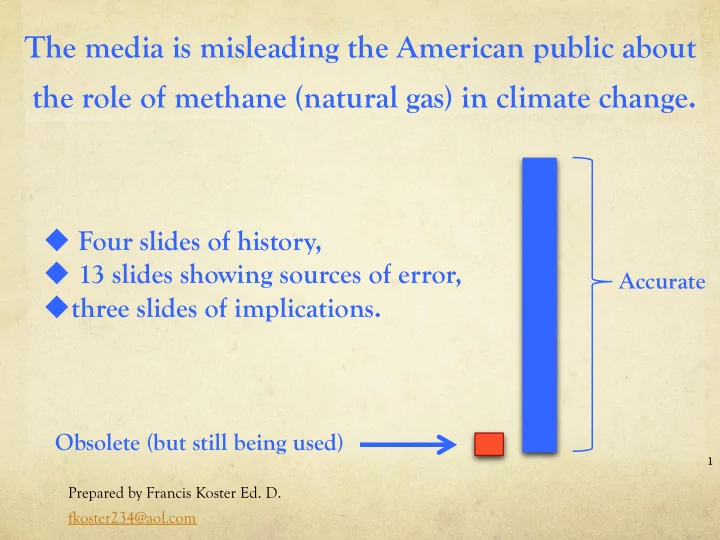
The media is misleading the American public about the role of methane (natural gas) in climate change.
Prepared by Francis Koster Ed. D. fkoster234@aol.com
1
The media is misleading the American public about the role of - - PowerPoint PPT Presentation
The media is misleading the American public about the role of methane (natural gas) in climate change. u Four slides of history, u 13 slides showing sources of error, Accurate u three slides of implications. Obsolete (but still being
Prepared by Francis Koster Ed. D. fkoster234@aol.com
1
Prepared by Francis Koster Ed. D. fkoster234@aol.com
2
4 ¡
GWP values and lifetimes from 2013 IPCC AR5 p714
http://www.damascuscitizensforsustainability.org/2013/03/ manhattan-natural-gas-pipeline-emissions-final-report/
Methane leakage in New York City
more than 20 times greater than carbon dioxide, according to the EPA.” (Wall Street Journal, August 17, 2015)
accounts for just 9 percent of the nation’s greenhouse gas pollution — but it is over 20 times more potent than carbon dioxide, so even small amounts of it can have a big impact on global warming.” (New York Times, August 17, 2015).
more powerful than carbon dioxide at trapping atmospheric heat — is a contributor to global
Prepared by Francis Koster Ed. D. fkoster234@aol.com
7
http://www3.epa.gov/climatechange/science/indicators/ghg/global-ghg-emissions.html
Carbon Dioxide
CO2 1 1
(1) IPCC Fourth Assessment Report, AR4, 2007, Table 2.14, Chapter 2, P. 212 (2) GWP values and lifetimes from 2013 IPCC AR5 p714 (https://www.ipcc.ch/pdf/assessment-report/ar5/wg1/ WG1AR5_Chapter08_FINAL.pdf) (3) EPA uses 28-36 (http://www3.epa.gov/climatechange/ghgemissions/gases/ch4.html)
Carbon Dioxide
CO2 1 1
(1) IPCC Fourth Assessment Report, 2005, Table 2.14, Chapter 2, P. 212 (2) GWP values and lifetimes from 2013 IPCC AR5 p714 (3) IPCC, CLIMATE CHANGE 2013: THE PHYSICAL SCIENCE BASIS. CONTRIBUTION OF WORKING GROUP I TO THE FIFTH ASSESSMENT REPORT OF THE INTERGOVERNMENTAL PANEL ON CLIMATE CHANGE at 711 (2013).
Carbon Dioxide
CO2 1 1
(1) IPCC Fourth Assessment Report, 2005, Table 2.14, Chapter 2, P. 212 (2) GWP values and lifetimes from 2013 IPCC AR5 p714 (3) IPCC, CLIMATE CHANGE 2013: THE PHYSICAL SCIENCE BASIS. CONTRIBUTION OF WORKING GROUP I TO THE FIFTH ASSESSMENT REPORT OF THE INTERGOVERNMENTAL PANEL ON CLIMATE CHANGE at 711 (2013).
0 ¡ 20 ¡ 40 ¡ 60 ¡ 80 ¡ 100 ¡ 120 ¡ 140 ¡ 160 ¡ 180 ¡ 200 ¡ 1 ¡ 3 ¡ 5 ¡ 7 ¡ 9 ¡ 11 ¡ 13 ¡ 15 ¡ 17 ¡ 19 ¡ 21 ¡ 23 ¡ 25 ¡ 27 ¡ 29 ¡ 31 ¡ 33 ¡ 35 ¡ 37 ¡ 39 ¡ 41 ¡ 43 ¡ 45 ¡ 47 ¡ 49 ¡ 51 ¡ 53 ¡ 55 ¡ 57 ¡ 59 ¡ 61 ¡ 63 ¡ 65 ¡ 67 ¡ 69 ¡ 71 ¡ 73 ¡ 75 ¡ 77 ¡ 79 ¡ 81 ¡ 83 ¡ 85 ¡ 87 ¡ 89 ¡ 91 ¡ 93 ¡ 95 ¡ 97 ¡ 99 ¡
¡
(1) ¡h/p://www3.epa.gov/climatechange/ghgemissions/gases/ch4.html ¡ ¡
100 ¡Years ¡
11
0 ¡ 20 ¡ 40 ¡ 60 ¡ 80 ¡ 100 ¡ 120 ¡ 140 ¡ 160 ¡ 180 ¡ 200 ¡ 1 ¡ 3 ¡ 5 ¡ 7 ¡ 9 ¡ 11 ¡ 13 ¡ 15 ¡ 17 ¡ 19 ¡ 21 ¡ 23 ¡ 25 ¡ 27 ¡ 29 ¡ 31 ¡ 33 ¡ 35 ¡ 37 ¡ 39 ¡ 41 ¡ 43 ¡ 45 ¡ 47 ¡ 49 ¡ 51 ¡ 53 ¡ 55 ¡ 57 ¡ 59 ¡ 61 ¡ 63 ¡ 65 ¡ 67 ¡ 69 ¡ 71 ¡ 73 ¡ 75 ¡ 77 ¡ 79 ¡ 81 ¡ 83 ¡ 85 ¡ 87 ¡ 89 ¡ 91 ¡ 93 ¡ 95 ¡ 97 ¡ 99 ¡
¡
12
(1) GWP values and lifetimes from 2013 IPCC AR5 p714
Methane leaks mapped along 785 miles
Environmental Pollution
A satellite view of methane leakage from old and abandon coal mines and abandon natural gas wells not counted in any previous estimates. Scientific American, October 10, 2014 NASA/JPL-Caltech/University of Michigan
1.
2.
3.
Prepared by Francis Koster Ed. D. fkoster234@aol.com
16
U.S. EPA, DRAFT: Global Anthropogenic Emissions of Non-CO2 Greenhouse Gases: 1990–2030 (EPA Report 430-D-11-003), 2011. www.epa. gov/climatechange/economics/downloads/EPA_NonCO2_Projections_2011_draft.pdf.
Prepared by Francis Koster Ed. D. fkoster234@aol.com
17
(1) http://www.edf.org/sites/default/files/US-Natural-Gas-Leakage-Model-User-Guide.pdf.
2011 ¡Es+mates ¡(1) ¡
“In 2011, EPA increased its estimate
gas supply chain by a factor of two, based on new data which… revised emission factors for gas well cleanups, condensate storage tanks, and centrifugal compressors.” (1)
Prepared by Francis Koster Ed. D. fkoster234@aol.com
18
(1) GWP values and lifetimes from 2013 IPCC AR5 p714 (2) http://www.edf.org/sites/default/files/US-Natural-Gas-Leakage-Model-User-Guide.pdf.
2011 ¡Es+mates ¡(2) ¡ 2013 additional 36% (1)
Prepared by Francis Koster Ed. D. fkoster234@aol.com
19
(1) http://time.com/3487638/four-corners-arizona-new-mexico-colorado-methane-gas-global-warming- climate-change-utah/
2011 Estimates (1) ¡ 2013 additional 36% potency
Reminder: These units are based
Prepared by Francis Koster Ed. D. fkoster234@aol.com
20
100 year data corrected for 2011 leakage, 2013 potency increase, and 2014 leakage revisions (prior slide)
Prepared by Francis Koster Ed. D. fkoster234@aol.com
21
(1) https://minnpost.com/earth-journal/ 2015/08/us-inventory-methane-emissions-may- be-based-bad-measurements (2) Also http://www.tandfonline.com/doi/full/ 10.1080/10962247.2015.1025925#abstract
1.
2.
3.
Francis Koster has a doctorate from the Program For The Study Of The Future, at Umass Amherst, with a concentration on “Why Leaders Do Not Listen to Warnings About The Basic Life Support Systems”. A pioneer pubic advocate for energy conservation and solar energy, he founded the UMass renewable energy programs in the 1970’s, and set up groundbreaking renewable energy programs for the Tennessee Valley Authority under President Carter. After leaving TVA, and following several years as a renewable energy and conservation consultant to major electric utilities and other interested parties, he was recruited to assist with innovation at The Nemours Foundation, a leading sub-specialty pediatric healthcare system now delivering well over 1 million seriously ill patient visits a year. His duties as Vice President for Innovation included Information Systems (implementing pioneer electronic medical records and telemedicine systems, creating electronic patient education material), and bringing innovation (at various times) to Human Resources, Marketing, Development, Media Relations, Training, and Risk Management. During this time, as a consequence of the emerging ability to map disease, he developed a strong interest in the environment’s impact on the health of the public. In 2007, he relocated to North Carolina, and began writing weekly columns about successful projects in environmental public health existing someplace in America. In 2013 these were turned into a book titled Discovering The New America. He has three more books due to be published during 2015. In addition to the material written for the media,Dr. Koster has presented over 50 papers at various professional meetings, and currently is a frequent public speaker about improving society by imitating successful programs already in place, with a focus on the adoption of current and emerging science to solve issues on the horizon likely to impact the health of the public. Futuristfran@aol.com WWW.TheOptimisticFuturist.org 704-934-2081