The low frequency radio follow-up of gravitational wave merger - - PowerPoint PPT Presentation

the low frequency radio follow up of gravitational wave
SMART_READER_LITE
LIVE PREVIEW

The low frequency radio follow-up of gravitational wave merger - - PowerPoint PPT Presentation

The low frequency radio follow-up of gravitational wave merger events with LOFAR Kelly Gourdji PhD student, University of Amsterdam. On behalf of the LOFAR GW follow-up team. Outline EM follow-ups of GW events LOFAR: What, why and how

slide-1
SLIDE 1

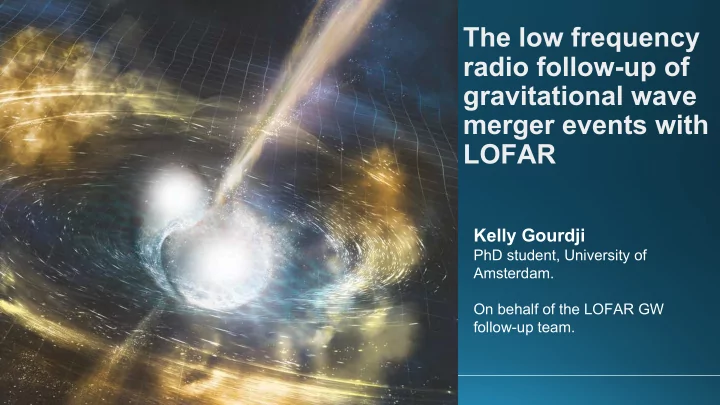
The low frequency radio follow-up of gravitational wave merger events with LOFAR

Kelly Gourdji

PhD student, University of Amsterdam. On behalf of the LOFAR GW follow-up team.

slide-2
SLIDE 2

Outline

EM follow-ups of GW events LOFAR: What, why and how Our GW follow-up strategy Results for GW170817 Byproduct: extremely deep transient searches

Kelly Gourdji 2

slide-3
SLIDE 3

Kelly Gourdji 3

Compact mergers involving at least one neutron star: possible evolutionary scenarios and accompanying emission

Chu et al. 2016 Coherent Incoherent

slide-4
SLIDE 4

Multimessenger observations of GW170817

Kelly Gourdji 4 Abbott et al. 2017

slide-5
SLIDE 5

Kelly Gourdji 5

Chu et al. 2016 (adapted)

  • bserved for GW170817
  • Coherent

Incoherent

slide-6
SLIDE 6

Some of the proposed emission mechanisms have been confirmed, while there have been additional surprises…

Kelly Gourdji 6

slide-7
SLIDE 7

Some of the proposed emission mechanisms have been confirmed, while there have been additional surprises…

Kelly Gourdji 7

  • 1.7 s time delay between GW and GRB
  • delay in observation of X-rays
  • dimmest, yet closest sGRB ever observed
  • Radio emission at unexpected late timescale
slide-8
SLIDE 8

Some of the proposed emission mechanisms have been confirmed, while there have been additional surprises…

Kelly Gourdji 8

More events & EM follow-ups needed!

  • 1.7 s time delay between GW and GRB
  • delay in observation of X-rays
  • dimmest, yet closest sGRB ever observed
  • Radio emission at unexpected late timescale
  • cocoon vs off-axis jet? High velocity tail of the kilonova

merger ejecta?

slide-9
SLIDE 9

Low-frequency radio follow-up with the LOw Frequency ARray (LOFAR)

Kelly Gourdji 9

We collect data from 110-190 MHz

slide-10
SLIDE 10

Large instantaneous field of view

Kelly Gourdji 10

Why LOFAR?

~60 deg2

Contours: cWB probability map LOFAR follow-up of GW 150914

slide-11
SLIDE 11

Low frequency

Kelly Gourdji 11

Why LOFAR?

Lorimer et al. 2007

Dispersion delay scales inversely with frequency. Lower frequencies arrive later. Gives us a chance to catch coherent emission related to mergers!

slide-12
SLIDE 12

LOFAR rapid response

Kelly Gourdji 12

On source within <5 mins of trigger!

Searching for coherent emission from e.g. FRB related to merger. Check out www.asterics2020.eu (ASTERICS) for more info.

slide-13
SLIDE 13

Late time follow-up

Kelly Gourdji 13

Example for GW170817 Searching for incoherent emission from e.g. reverse shock and/or afterglow.

  • K. Hotokezaka

LOFAR observations

slide-14
SLIDE 14

Sensitivity

Kelly Gourdji 14

Why LOFAR?

GW170817

  • T. Shimwell

~2 mJy/beam upper limit

Best limit at these frequencies (2 mJy/beam) MWA: 17 mJy/beam Deeper image to come following more calibration/cleaning The deepest image ever made at very southerly declinations with LOFAR. Max elevation of observation: ~13.7 deg

2017-12-25 to 2018-01-2

slide-15
SLIDE 15

Late time follow-up

1 week, 1 month, 3 months, 6 months, 1 year timescales

Kelly Gourdji 15

Our preliminary images are reaching 0.8 mJy/beam noise.

slide-16
SLIDE 16

Byproduct: deep transient searches

Kelly Gourdji 16

40-840 MHz

Our data

slide-17
SLIDE 17

Looking ahead

  • We have 10 triggers for the next 2 years + ~300 hours of

follow-up time

  • we rely on NS system probability
  • Larger GW detector network
  • Smaller localization thus deeper images
  • Lower latencies for GW alerts and LOFAR triggering

Kelly Gourdji 17

slide-18
SLIDE 18

Thank you

18

slide-19
SLIDE 19

Additional slides

Kelly Gourdji 19

slide-20
SLIDE 20

Turnover in light curve supports structured jet model

Kelly Gourdji 20

Alexander et al 2018

slide-21
SLIDE 21

Kelly Gourdji 21

Mooley et al 2018

Recent light curves disagree somewhat. Somewhere between these two models?