The low-down on Masking Up for COVID-19 The How to Ask Dr. - - PDF document

the low down on masking up for covid 19
SMART_READER_LITE
LIVE PREVIEW

The low-down on Masking Up for COVID-19 The How to Ask Dr. - - PDF document

7/8/2020 The low-down on Masking Up for COVID-19 The How to Ask Dr. science make, wear Mask! July 7, 2020 behind & care for Questions Sophy S. Wong, MD masks masks & answers There are lower COVID case rates in places where


slide-1
SLIDE 1

7/8/2020 1

The low-down on Masking Up for COVID-19

Ask Dr. Mask! Questions & answers How to make, wear & care for masks The science behind masks

July 7, 2020 Sophy S. Wong, MD

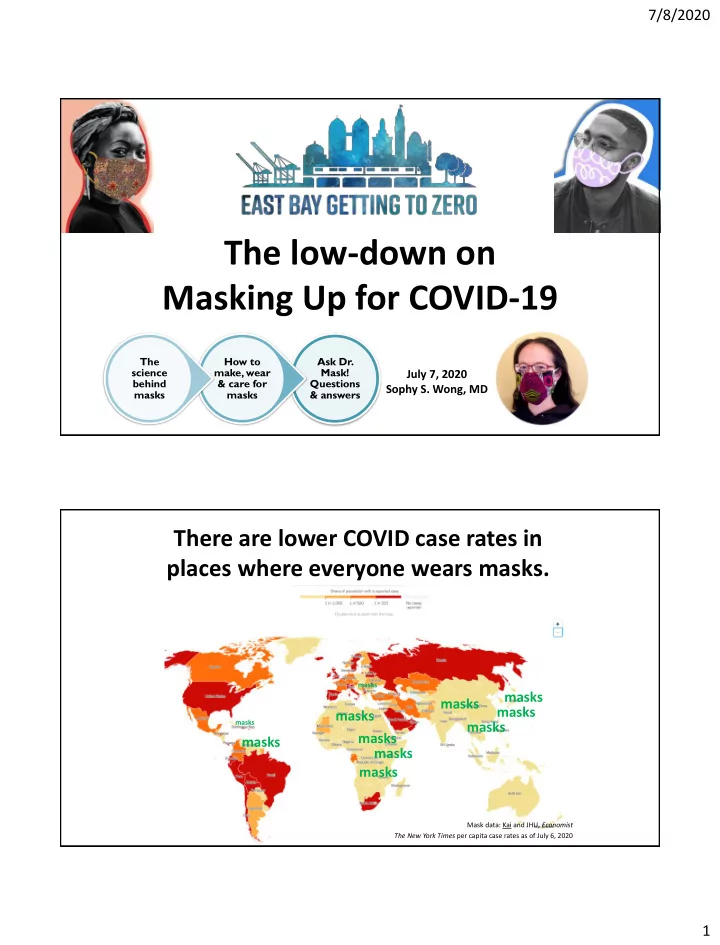
There are lower COVID case rates in places where everyone wears masks.

The New York Times per capita case rates as of July 6, 2020

masks masks masks masks

masks Mask data: Kai and JHU, Economist

masks masks masks masks masks

masks

slide-2
SLIDE 2

7/8/2020 2

Universal masking has the biggest impact of the COVID-19 harm reduction strategies studied.

Data compiled by Sophy S. Wong, MD Icons by Freepik and Srip on Flaticon.com Please see EBGTZ.org/resources for the complete list of sources for this table.

Strategy % reduction

  • 1. Masking

60-95%

  • 2. Distancing

53-88%

  • 3. Eye protection

78%

  • 4. Hand hygiene

28-45%

  • 5. Case isolation

33%

  • 6. Contact tracing

10-20%

If everyone wears face coverings, we can stop the spread of COVID-19.

Face coverings effectively block transmission COVID-19 is transmitted by respiratory droplets People without symptoms spread COVID-19

The top 3 things people should know about the spread of COVID-19:

slide-3
SLIDE 3

7/8/2020 3

Many people with COVID-19 do not have symptoms at the time they test positive- up to 88%!

COVID-19 transmission is primarily by respiratory droplets and may become airborne as microdroplets.

Microdroplet study from Morawska, CID, July 6, 2020; Image from Condair UK

slide-4
SLIDE 4

7/8/2020 4

Respiratory droplets can travel 30+ feet

Image from Dr. Atul Gawande’s article in The New Yorker meters (31 feet) meters (31 feet)

Respiratory droplets: a sneeze at 3 feet (40,000 droplets)

Bourouiba, JAMA

slide-5
SLIDE 5

7/8/2020 5

  • 3. Face coverings are effective in blocking droplets

(even homemade ones!)

  • 3. Face coverings are effective in blocking droplets

(even homemade ones!)

slide-6
SLIDE 6

7/8/2020 6

  • 3. Face coverings are effective in blocking droplets

(even homemade ones!)

Nice mask! ☺ Thanks! I made it myself!

  • 3. Face coverings are effective in blocking droplets

(even homemade ones!)

Nice mask! ☺ Thanks! I made it myself! 6 feet

slide-7
SLIDE 7

7/8/2020 7

  • 3. Face coverings are effective in blocking droplets

(even homemade ones!)

Nice mask! Thanks! I made it myself!

6 feet No masks One masked Everyone masked Everyone masked and distancing

We can make our own effective masks!

DIY instructions: CDC (easy no-sew), Maker Mask (sewn, science-based), Olson Mask (sewn)

slide-8
SLIDE 8

7/8/2020 8

Effectiveness of homemade mask types:

Verma, Phys. Fluids

Type of mask/cover Distance droplets traveled Uncovered cough 96 inches (8’) Bandana (knit blend) 43 inches (3’7”) Folded cotton handkerchief 15 inches (1’3”) Store-bought cone mask 8 inches Stitched cotton mask 2.5 inches Folded handkerchief: 15” cone mask: 8” stitched mask: 2.5”

Filtering effectiveness of materials:

Recommended materials chosen by Sophy S. Wong, MD based on their combined effectiveness, breathability and household availability. Image from smartairfilters.com

Recommended materials: Paper towel

(as single-use filter)

Bed sheet

(80-120 thread cotton)

T-shirt (2 layers)  Polypropylene

slide-9
SLIDE 9

7/8/2020 9

Recommendations for materials:

Images from makermask.org and Sophy Wong, MD

1.Wear what you’re comfortable with! 2.Non-woven polypropylene (NWPP) 3.Tightly woven cotton 4.Filters: NWPP, paper towels (single-use)

Take-home points and action steps:

  • Universal masking prevents the spread of COVID-

19 better than other interventions by blocking respiratory droplet transmission from people with and without symptoms.

  • Make or buy masks that are comfortable to wear

and ideally made out of 2-3 layers of breathable cotton and/or non-woven polypropylene.

  • Clean your hands before and after touching your
  • mask. Keep it fitted over your nose and mouth.
  • Wash your masks in hot water and dry in hot dryer
  • r sun after each use.

www.EBGTZ.org #EBGTZ