SLIDE 1
Seungmoon Song and Hartmut Geyer Robotics Institute Carnegie Mellon University
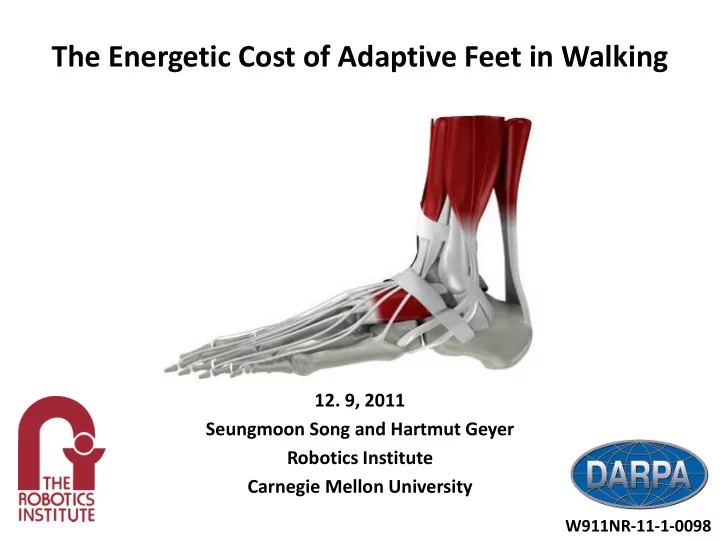
The Energetic Cost of Adaptive Feet in Walking
W911NR-11-1-0098
SLIDE 2
Related Studies
Variable height (Kang et al., 2010) Variable stiffness (Hashimoto et al., 2010) Toe (Zhang et al., 2010, Zhu et al., 2011)
1/10
Stiffness change (Briggs et al., 2001) Ball cushion (Bojsen-Moller et al., 1976) Windlass mechanism (Hicks, 1954)
SLIDE 3
2/10
How Much Do We Pay for Adaptive Feet?
Baseline foot Human foot Absorbs impacts Provides secure grip Requires additional muscles Provides less power transfer
SLIDE 4 Baseline foot Human foot
How Much Do We Pay for Adaptive Feet?
- 1. Neuromuscular Model
- 3. Future Direction
- 2. Results
Contents
SLIDE 5
(Hicks, 1954 II, Bolgla et al., 2004) 3/10
The Windlass Mechanism
1 ~ 2cm
SLIDE 6 Baseline foot Human foot
How Much Do We Pay for Adaptive Feet?
- 1. Neuromuscular Model
- 3. Future Direction
- 2. Results
TFL, TEX (Yamaguchi et al., 1990), PF (Gunther et al., 2002), MTJ (Hashimoto et. al, 2010)
SLIDE 7 Model Human
Control algorithm for robotic platforms Research platform for understanding human
4/10
Neuromuscular Model
(Geyer et al., 2010)
SLIDE 8
Energy rate (Umberger, 2003), CMA-ES (Hansen, 2006)
Target speed Pain Energy cost
5/10
Neuromuscular Model: Optimization (CMA-ES)
SLIDE 9 Baseline foot Human foot
How Much Do We Pay for Adaptive Feet?
- 1. Neuromuscular Model
- 3. Future Direction
- 2. Results
SLIDE 10
Baseline, 0.8ms-1 Human, 1.8ms-1 6/10
Neuromuscular Model: Simulation
Human walking speed (Murray et al., 1984)
SLIDE 11
7/10
Result I: Human Feet Incur About 20% More Energetic Cost up to 1.2ms-1
SLIDE 12
8/10
Result II: Passive Feet Reduces the Energetic Cost by 15% or More
SLIDE 13 Baseline foot Human foot
How Much Do We Pay for Adaptive Feet?
- 1. Neuromuscular Model
- 3. Future Direction
- 2. Results
SLIDE 14
Simulation studies to interpret the result Development of a robotic foot
Current and Future Directions
9/10
SLIDE 15
- 1. Human Feet Incur About 20% More
Energetic Cost up to 1.2ms-1
- 2. Passive Feet Reduces the Energetic
Cost by 15% or more
Conclusion
10/10