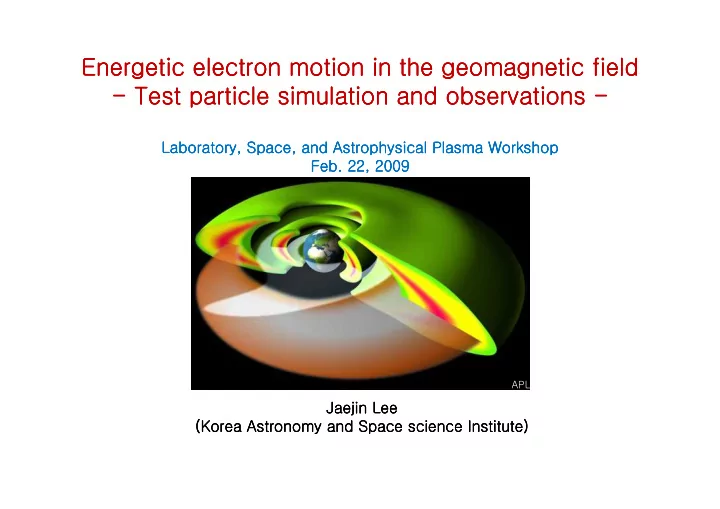
Energetic electron motion in the geomagnetic field Energetic - - PowerPoint PPT Presentation

energetic electron motion in the geomagnetic field
SMART_READER_LITE
LIVE PREVIEW

Energetic electron motion in the geomagnetic field Energetic - - PowerPoint PPT Presentation

Energetic electron motion in the geomagnetic field Energetic electron motion in the geomagnetic field Energetic electron motion in the geomagnetic field Energetic electron motion in the geomagnetic field - - - - Test particle simulation and


slide-1
SLIDE 1

Jaejin Lee Jaejin Lee Jaejin Lee Jaejin Lee (Korea Astronomy and Space science Institute) (Korea Astronomy and Space science Institute) (Korea Astronomy and Space science Institute) (Korea Astronomy and Space science Institute)

Energetic electron motion in the geomagnetic field Energetic electron motion in the geomagnetic field Energetic electron motion in the geomagnetic field Energetic electron motion in the geomagnetic field

  • Test particle simulation and observations

Test particle simulation and observations Test particle simulation and observations Test particle simulation and observations -

  • Laboratory, Space, and Astrophysical Plasma Workshop

Laboratory, Space, and Astrophysical Plasma Workshop Laboratory, Space, and Astrophysical Plasma Workshop Laboratory, Space, and Astrophysical Plasma Workshop

  • Feb. 22, 2009
  • Feb. 22, 2009
  • Feb. 22, 2009
  • Feb. 22, 2009

APL

slide-2
SLIDE 2

In My Talk, In My Talk, In My Talk, In My Talk, How energetic electrons are accelerated How energetic electrons are accelerated How energetic electrons are accelerated How energetic electrons are accelerated How they are lost (precipitation) from the radiation belt How they are lost (precipitation) from the radiation belt How they are lost (precipitation) from the radiation belt How they are lost (precipitation) from the radiation belt How they interact with waves How they interact with waves How they interact with waves How they interact with waves

slide-3
SLIDE 3
  • Discovery of Van Allen radiation

belts – Explorer 1, 1958

  • Trapped protons & electrons,

spatial distribution (2-7 RE), energy (~MeV)

Radiation Belt Radiation Belt Radiation Belt Radiation Belt

slide-4
SLIDE 4

Three Adiabatic Invariant Three Adiabatic Invariant Three Adiabatic Invariant Three Adiabatic Invariant

First Adiabatic Invariant Second Adiabatic Invariant Third Adiabatic Invariant Total magnetic flux Φ enclosed by a drift surface

=

=

slide-5
SLIDE 5

Charged Particle Motion in Magnetosphere

Gyro, bounce and drift motions

Gyro ~millisecond, bounce ~ 0.1-1 second, drift ~1-10 minutes

To change particle energy, must violate one or more invariants

Sudden changes of field configurations Small but periodic variation of field configurations

slide-6
SLIDE 6

It It It It’ ’ ’ ’s still open problem. s still open problem. s still open problem. s still open problem.

Proposed physical processes

Acceleration Acceleration Acceleration Acceleration: large- and small-scale recirculations, heating by Whistler waves, radial diffusion by ULF waves, cusp source, substorm injection, sudden impulse of solar wind pressure and etc. Loss Loss Loss Loss: pitch angle diffusion, Coulomb collision, and Magnetopause shadowing. Transport Transport Transport Transport

  • +

× =

slide-7
SLIDE 7
  • +

=

+

Euler method Euler method Euler method Euler method Runge Runge Runge Runge-

  • Kutta method

Kutta method Kutta method Kutta method

Solving Ordinary Derivative Equation Solving Ordinary Derivative Equation Solving Ordinary Derivative Equation Solving Ordinary Derivative Equation

  • +

+ = + + = =

+

slide-8
SLIDE 8

Loss Process Loss Process Loss Process Loss Process

Pitch Angle Diffusion by Field Line Curvature Pitch Angle Diffusion by Field Line Curvature Pitch Angle Diffusion by Field Line Curvature Pitch Angle Diffusion by Field Line Curvature

slide-9
SLIDE 9

Relativistic Electron Dropouts (RED) Relativistic Electron Dropouts (RED) Relativistic Electron Dropouts (RED) Relativistic Electron Dropouts (RED)

LANL data

slide-10
SLIDE 10

Electron Dropout Sequence Electron Dropout Sequence Electron Dropout Sequence Electron Dropout Sequence

slide-11
SLIDE 11

Space Space Space Space Environment Environment Environment Environment

Date (Jun 2004) Date (Jun 2004) Date (Jun 2004) Date (Jun 2004)

slide-12
SLIDE 12
  • 1. Fast dropouts for 1 ~ 5 hours
  • 1. Fast dropouts for 1 ~ 5 hours
  • 1. Fast dropouts for 1 ~ 5 hours
  • 1. Fast dropouts for 1 ~ 5 hours
  • 2. Observed for both of electrons and protons
  • 2. Observed for both of electrons and protons
  • 2. Observed for both of electrons and protons
  • 2. Observed for both of electrons and protons
  • 3. More effective for higher energy charged particles
  • 3. More effective for higher energy charged particles
  • 3. More effective for higher energy charged particles
  • 3. More effective for higher energy charged particles
  • 4. Started from dusk and midnight sector and
  • 4. Started from dusk and midnight sector and
  • 4. Started from dusk and midnight sector and
  • 4. Started from dusk and midnight sector and

propagate to noon sector propagate to noon sector propagate to noon sector propagate to noon sector

  • 5. Correlation with magnetic field stretching
  • 5. Correlation with magnetic field stretching
  • 5. Correlation with magnetic field stretching
  • 5. Correlation with magnetic field stretching

Relativistic electron dropout Relativistic electron dropout Relativistic electron dropout Relativistic electron dropout characteristics characteristics characteristics characteristics

slide-13
SLIDE 13

Electron Loss Electron Loss Electron Loss Electron Loss

Escape from the magnetopause Escape from the magnetopause Escape from the magnetopause Escape from the magnetopause

  • Magnetopause can be compressed inside L = 6.6
  • De-trapping of particles and drift outward to magnetopause

Loss to the atmosphere Loss to the atmosphere Loss to the atmosphere Loss to the atmosphere

  • Pitch angle scattering into the loss cone
  • Observation of particle precipitation
slide-14
SLIDE 14

First Adiabatic Invariant Violation First Adiabatic Invariant Violation First Adiabatic Invariant Violation First Adiabatic Invariant Violation

  • =

= = ρ ρ κ

slide-15
SLIDE 15

Pitch angle diffusion by field line curvature Pitch angle diffusion by field line curvature Pitch angle diffusion by field line curvature Pitch angle diffusion by field line curvature

First Adiabatic Invariant Violation First Adiabatic Invariant Violation First Adiabatic Invariant Violation First Adiabatic Invariant Violation

First adiabatic invariant : The magnetic moment of gyrating part First adiabatic invariant : The magnetic moment of gyrating part First adiabatic invariant : The magnetic moment of gyrating part First adiabatic invariant : The magnetic moment of gyrating particle is icle is icle is icle is conserved conserved conserved conserved as long as magnetic field is constant during a gyro period. as long as magnetic field is constant during a gyro period. as long as magnetic field is constant during a gyro period. as long as magnetic field is constant during a gyro period.

slide-16
SLIDE 16

Loss cone filling (Particle simulation) Loss cone filling (Particle simulation) Loss cone filling (Particle simulation) Loss cone filling (Particle simulation)

Electrons of 0.0075% are lost by precipitation. dF/dt = (-2 x 0.000075) F / T_b E-folding loss time : ~ 3.1 hr

slide-17
SLIDE 17
  • Correlation with magnetic field stretching

Correlation with magnetic field stretching Correlation with magnetic field stretching Correlation with magnetic field stretching

Precipitations by curvature explains a lot of things of RED Precipitations by curvature explains a lot of things of RED Precipitations by curvature explains a lot of things of RED Precipitations by curvature explains a lot of things of RED event event event event

  • Fast loss process for 1 ~ 5 hours

Fast loss process for 1 ~ 5 hours Fast loss process for 1 ~ 5 hours Fast loss process for 1 ~ 5 hours

  • Observed for both of electrons and protons

Observed for both of electrons and protons Observed for both of electrons and protons Observed for both of electrons and protons

  • More effective for higher energy charged particles

More effective for higher energy charged particles More effective for higher energy charged particles More effective for higher energy charged particles

  • Started from dusk and midnight sector and propagate to noon sect

Started from dusk and midnight sector and propagate to noon sect Started from dusk and midnight sector and propagate to noon sect Started from dusk and midnight sector and propagate to noon sector

  • r
  • r
  • r
slide-18
SLIDE 18

Electron Energy Dispersion Electron Energy Dispersion Electron Energy Dispersion Electron Energy Dispersion

STSAT STSAT STSAT STSAT-

  • 1 Data observed on Jun 14, 2004

1 Data observed on Jun 14, 2004 1 Data observed on Jun 14, 2004 1 Data observed on Jun 14, 2004

slide-19
SLIDE 19

Can the Tsyganenko model reproduce the energy dispersion?

Jun 14, 2004 Data

  • Dst index : -20 nT
  • Solar wind pressure : 2.81 nPa
  • IMF By : 7.25 nT
  • IMF Bz : -7.1 nT

Real Input Parameters

  • Dst index : -33 nT
  • Solar wind pressure : 2.81 nPa
  • IMF By : 7.25 nT
  • IMF Bz : -9.1 nT
slide-20
SLIDE 20

Electron Orbits on the XY Plan Electron Orbits on the XY Plan Electron Orbits on the XY Plan Electron Orbits on the XY Plan

slide-21
SLIDE 21

Waves contribute to loss and acceleration Waves contribute to loss and acceleration Waves contribute to loss and acceleration Waves contribute to loss and acceleration

slide-22
SLIDE 22

There were no significant precipitations There were no significant precipitations There were no significant precipitations There were no significant precipitations except mid night sector except mid night sector except mid night sector except mid night sector

E > 300keV

slide-23
SLIDE 23

Acceleration Process Acceleration Process Acceleration Process Acceleration Process

Perpendicular Electric Field Perpendicular Electric Field Perpendicular Electric Field Perpendicular Electric Field

slide-24
SLIDE 24

Evidence of Local Electron Acceleration

slide-25
SLIDE 25

Calculating Radiation Belt Dropout Time

  • Electron energy : 150 ~ 315 KeV
  • Flux density at the equator (LANL) :

1x10^4 / cm^2 sr s

  • Precipitating flux (STSAT-1) : 3x10^5

/ cm^2 sr s

  • Magnetic field at the equator : 100 nT
  • Magnetic field at 680 km : 40000 nT
  • Estimated dropout time = Total

electron number in a flux tube / precipitating flux

~ 2 min ~ 2 min ~ 2 min ~ 2 min

slide-26
SLIDE 26

Perpendicular electric field can not accelerate Perpendicular electric field can not accelerate Perpendicular electric field can not accelerate Perpendicular electric field can not accelerate charged particles. charged particles. charged particles. charged particles. Is it true? Is it true? Is it true? Is it true?

slide-27
SLIDE 27

Charged Particle Motion in E/M Field Charged Particle Motion in E/M Field Charged Particle Motion in E/M Field Charged Particle Motion in E/M Field (Uniform E field) (Uniform E field) (Uniform E field) (Uniform E field)

  • Equation

Equation Equation Equation of Motion

  • f Motion
  • f Motion
  • f Motion
  • ExB Drift motion

ExB Drift motion ExB Drift motion ExB Drift motion

  • Energy & Charge Independent

Energy & Charge Independent Energy & Charge Independent Energy & Charge Independent

  • No energy gain under the condition of

No energy gain under the condition of No energy gain under the condition of No energy gain under the condition of

uniform electric field uniform electric field uniform electric field uniform electric field

  • ×

=

  • +

× =

  • E

E E E (+y) (+y) (+y) (+y) B (+z) B (+z) B (+z) B (+z) (+x) (+x) (+x) (+x)

Electron Trajectory Electron Trajectory Electron Trajectory Electron Trajectory Electron Energy Electron Energy Electron Energy Electron Energy

slide-28
SLIDE 28

Charged Particle Motion in E/M Field Charged Particle Motion in E/M Field Charged Particle Motion in E/M Field Charged Particle Motion in E/M Field (Non (Non (Non (Non-

  • Uniform E field)

Uniform E field) Uniform E field) Uniform E field)

E = 20 mV/m E = 20 mV/m E = 20 mV/m E = 20 mV/m E = 0 E = 0 E = 0 E = 0

Acceleration Acceleration Acceleration Acceleration By E field By E field By E field By E field Free Gyro Free Gyro Free Gyro Free Gyro-

  • motion

motion motion motion B = 20 nT (+z) B = 20 nT (+z) B = 20 nT (+z) B = 20 nT (+z)

Electrons can be accelerated in the non Electrons can be accelerated in the non Electrons can be accelerated in the non Electrons can be accelerated in the non-

  • uniform electric field space.

uniform electric field space. uniform electric field space. uniform electric field space. This is very fast acceleration process. This is very fast acceleration process. This is very fast acceleration process. This is very fast acceleration process.

Electron Energy Electron Energy Electron Energy Electron Energy

Electron energy gain from 1MeV to 2 MeV Electron energy gain from 1MeV to 2 MeV Electron energy gain from 1MeV to 2 MeV Electron energy gain from 1MeV to 2 MeV for 40 msec for 40 msec for 40 msec for 40 msec

E E E E B B B B

Electron motion in the electric field gradient Electron motion in the electric field gradient Electron motion in the electric field gradient Electron motion in the electric field gradient and uniform magnetic field and uniform magnetic field and uniform magnetic field and uniform magnetic field

slide-29
SLIDE 29

Relativistic Electron Acceleration Relativistic Electron Acceleration Relativistic Electron Acceleration Relativistic Electron Acceleration

E E E Ey

y y y = 70

= 70 = 70 = 70

  • 42 mV/m

42 mV/m 42 mV/m 42 mV/m

E E E Ey

y y y Electric Field

Electric Field Electric Field Electric Field Electron Trajectory Electron Trajectory Electron Trajectory Electron Trajectory Electron Energy Electron Energy Electron Energy Electron Energy

Electric field changes from 70 to 42 mV/m in Electric field changes from 70 to 42 mV/m in Electric field changes from 70 to 42 mV/m in Electric field changes from 70 to 42 mV/m in the uniform magnetic field of 20 nT. the uniform magnetic field of 20 nT. the uniform magnetic field of 20 nT. the uniform magnetic field of 20 nT. Electrons drift to +x direction by ExB. Electrons drift to +x direction by ExB. Electrons drift to +x direction by ExB. Electrons drift to +x direction by ExB. Electron gain energy form 1MeV to 1.9 MeV Electron gain energy form 1MeV to 1.9 MeV Electron gain energy form 1MeV to 1.9 MeV Electron gain energy form 1MeV to 1.9 MeV for about 70 msec. for about 70 msec. for about 70 msec. for about 70 msec. Electric field increase makes electron Electric field increase makes electron Electric field increase makes electron Electric field increase makes electron deceleration. deceleration. deceleration. deceleration. Just small change of perpendicular electric Just small change of perpendicular electric Just small change of perpendicular electric Just small change of perpendicular electric fields accelerates or decelerate electrons. fields accelerates or decelerate electrons. fields accelerates or decelerate electrons. fields accelerates or decelerate electrons.

slide-30
SLIDE 30

Energetic Electron Injection Energetic Electron Injection Energetic Electron Injection Energetic Electron Injection

Uniform e Uniform e Uniform e Uniform e-

  • folding energy

folding energy folding energy folding energy Precipitating electrons Precipitating electrons Precipitating electrons Precipitating electrons ExB drift ExB drift ExB drift ExB drift Energized electrons Energized electrons Energized electrons Energized electrons

Energetic electrons are injected by ExB drift Energetic electrons are injected by ExB drift Energetic electrons are injected by ExB drift Energetic electrons are injected by ExB drift through plasma sheet. through plasma sheet. through plasma sheet. through plasma sheet. Electrons gain energy at the injection boundary Electrons gain energy at the injection boundary Electrons gain energy at the injection boundary Electrons gain energy at the injection boundary where electric field should be decreased. where electric field should be decreased. where electric field should be decreased. where electric field should be decreased. Non Non Non Non-

  • uniform E

uniform E uniform E uniform E-

  • field acceleration model can

field acceleration model can field acceleration model can field acceleration model can explain trapped particle acceleration explain trapped particle acceleration explain trapped particle acceleration explain trapped particle acceleration.

. . .

Oct 13, 2004 Oct 13, 2004 Oct 13, 2004 Oct 13, 2004 Trapped electrons Trapped electrons Trapped electrons Trapped electrons

slide-31
SLIDE 31

Electron Acceleration in the Curvature Field Electron Acceleration in the Curvature Field Electron Acceleration in the Curvature Field Electron Acceleration in the Curvature Field (Uniform E field) (Uniform E field) (Uniform E field) (Uniform E field)

Ey = Ey = Ey = Ey = -

  • V x B

V x B V x B V x B

Solar Wind Solar Wind Solar Wind Solar Wind IMF Bz IMF Bz IMF Bz IMF Bz

Several keV electron injection Several keV electron injection Several keV electron injection Several keV electron injection

  • Accelerated by Ey

Accelerated by Ey Accelerated by Ey Accelerated by Ey

  • Precipitation into atmosphere

Precipitation into atmosphere Precipitation into atmosphere Precipitation into atmosphere

slide-32
SLIDE 32

Electrons are accelerated to 1 MeV Electrons are accelerated to 1 MeV Electrons are accelerated to 1 MeV Electrons are accelerated to 1 MeV

Electric Field decreased from 1.3 Re Initial Pitch Angle: 15° Non uniform electric field acceleration is efficient for larger pitch angle electrons

Non Uniform Electric Field Acceleration Non Uniform Electric Field Acceleration Non Uniform Electric Field Acceleration Non Uniform Electric Field Acceleration

slide-33
SLIDE 33

Energetic electron precipitation on the polar region Energetic electron precipitation on the polar region Energetic electron precipitation on the polar region Energetic electron precipitation on the polar region

slide-34
SLIDE 34

Relativistic Electron Acceleration Relativistic Electron Acceleration Relativistic Electron Acceleration Relativistic Electron Acceleration (in (in (in (in electric field cavity) electric field cavity) electric field cavity) electric field cavity)

Ey Electric Field Ey Electric Field Ey Electric Field Ey Electric Field Electron Trajectory Electron Trajectory Electron Trajectory Electron Trajectory Electron Energy Electron Energy Electron Energy Electron Energy

Electric field change Electric field change Electric field change Electric field change 50 mV/m 50 mV/m 50 mV/m 50 mV/m

  • 50 mV/m

50 mV/m 50 mV/m 50 mV/m Cavity size : 0.2 Re Cavity size : 0.2 Re Cavity size : 0.2 Re Cavity size : 0.2 Re Electron energy increased from 1 MeV to 4.6 Electron energy increased from 1 MeV to 4.6 Electron energy increased from 1 MeV to 4.6 Electron energy increased from 1 MeV to 4.6 MeV and decreased to 1.5 MeV. MeV and decreased to 1.5 MeV. MeV and decreased to 1.5 MeV. MeV and decreased to 1.5 MeV. Perpendicular electric fields can make fast Perpendicular electric fields can make fast Perpendicular electric fields can make fast Perpendicular electric fields can make fast charged particle acceleration process. charged particle acceleration process. charged particle acceleration process. charged particle acceleration process.

slide-35
SLIDE 35
  • Energetic electron precipitation was

Energetic electron precipitation was Energetic electron precipitation was Energetic electron precipitation was enhanced in the scale length of 0.43 Re. enhanced in the scale length of 0.43 Re. enhanced in the scale length of 0.43 Re. enhanced in the scale length of 0.43 Re. The e The e The e The e-

  • folding energy increased sharply.

folding energy increased sharply. folding energy increased sharply. folding energy increased sharply. Ionospheric plasma depletion was Ionospheric plasma depletion was Ionospheric plasma depletion was Ionospheric plasma depletion was

  • bserved at the same region.
  • bserved at the same region.
  • bserved at the same region.
  • bserved at the same region.

Magnetic field data shows strong upward Magnetic field data shows strong upward Magnetic field data shows strong upward Magnetic field data shows strong upward electric current. electric current. electric current. electric current.

  • The electric field might be reduced by

The electric field might be reduced by The electric field might be reduced by The electric field might be reduced by thermal plasma shielding thermal plasma shielding thermal plasma shielding thermal plasma shielding

slide-36
SLIDE 36

Energy Diffusion Coefficient by wave particle interaction Energy Diffusion Coefficient by wave particle interaction Energy Diffusion Coefficient by wave particle interaction Energy Diffusion Coefficient by wave particle interaction

Glauert and Horn JGR 2005

slide-37
SLIDE 37

Wave Particle Interaction Wave Particle Interaction Wave Particle Interaction Wave Particle Interaction

Electron Microburst Electron Microburst Electron Microburst Electron Microburst

slide-38
SLIDE 38

What is the What is the What is the What is the electron micro electron micro electron micro electron micro-

  • bursts?

bursts? bursts? bursts?

Strong energetic (~ hundred keV) Strong energetic (~ hundred keV) Strong energetic (~ hundred keV) Strong energetic (~ hundred keV) electron precipitations which duration is electron precipitations which duration is electron precipitations which duration is electron precipitations which duration is less than less than less than less than 1 second. 1 second. 1 second. 1 second.

slide-39
SLIDE 39

Electron microburst observed by Electron microburst observed by Electron microburst observed by Electron microburst observed by Korean STSAT Korean STSAT Korean STSAT Korean STSAT-

  • 1

1 1 1

1 Second 1 Second 1 Second 1 Second

Electron Electron Electron Electron Microbursts Microbursts Microbursts Microbursts

slide-40
SLIDE 40

What causes electron microbursts? What causes electron microbursts? What causes electron microbursts? What causes electron microbursts?

It is presumed that It is presumed that It is presumed that It is presumed that VLF Chorus wave VLF Chorus wave VLF Chorus wave VLF Chorus wave generates generates generates generates the microbursts, because the microbursts, because the microbursts, because the microbursts, because

  • a. Both occur preferentially in the morning
  • a. Both occur preferentially in the morning
  • a. Both occur preferentially in the morning
  • a. Both occur preferentially in the morning

sector. sector. sector. sector.

  • b. Strong intensity and short duration
  • b. Strong intensity and short duration
  • b. Strong intensity and short duration
  • b. Strong intensity and short duration

(~200msec) of Chorus wave. (~200msec) of Chorus wave. (~200msec) of Chorus wave. (~200msec) of Chorus wave.

  • c. Correlation between chorus occurrence and
  • c. Correlation between chorus occurrence and
  • c. Correlation between chorus occurrence and
  • c. Correlation between chorus occurrence and

microburst. microburst. microburst. microburst.

slide-41
SLIDE 41

Theoretical diffusion coefficients Theoretical diffusion coefficients Theoretical diffusion coefficients Theoretical diffusion coefficients

  • D = 6.0X10⁻⁵ rad2/sec (Horn, 2003) Quasi linear

theory

  • D = 1.5X10⁻⁵ rad2/sec (Albert, 2002) Test particle

simulation

  • D = 1.0X10⁻⁵ rad2/sec (Inan, 1987) Test particle

simulation with incoherent wave

  • Diffusion coefficient should be larger than 3.5 X 10⁻²

rad2/sec (Lee et al. Geophys. Res. Lett., 2005).

slide-42
SLIDE 42

Pitch angle diffusion coefficient by wave Pitch angle diffusion coefficient by wave Pitch angle diffusion coefficient by wave Pitch angle diffusion coefficient by wave particle interaction particle interaction particle interaction particle interaction

Glauert and Horn JGR 2005

slide-43
SLIDE 43

Pitch angle diffusion equation Pitch angle diffusion equation Pitch angle diffusion equation Pitch angle diffusion equation

f t 1 sin D sin f

slide-44
SLIDE 44

How do electrons interact with waves? How do electrons interact with waves? How do electrons interact with waves? How do electrons interact with waves?

Initial pitch angle : 0 Initial pitch angle : 0 Initial pitch angle : 0 Initial pitch angle : 0 Initial pitch angle : Initial pitch angle : Initial pitch angle : Initial pitch angle : α α α α0

2 4 6

  • θ

.

  • θ

α α θ α

  • +

〈 〈 −

slide-45
SLIDE 45

Test Particle Simulation

Method Method Method Method

  • a. Solve numerically Lorentz equation of motion for each
  • a. Solve numerically Lorentz equation of motion for each
  • a. Solve numerically Lorentz equation of motion for each
  • a. Solve numerically Lorentz equation of motion for each

electron electron electron electron

  • b. Used 720 x 500 test particles ( 0
  • b. Used 720 x 500 test particles ( 0
  • b. Used 720 x 500 test particles ( 0
  • b. Used 720 x 500 test particles ( 0˚

˚ ˚ ˚ ~ 5 ~ 5 ~ 5 ~ 5˚ ˚ ˚ ˚) ) ) )

  • c. Input parameters
  • c. Input parameters
  • c. Input parameters
  • c. Input parameters

Electron energy : 300keV Electron energy : 300keV Electron energy : 300keV Electron energy : 300keV Electron cyclotron frequency : f Electron cyclotron frequency : f Electron cyclotron frequency : f Electron cyclotron frequency : fc

c c c = 9.3 kHz (B

= 9.3 kHz (B = 9.3 kHz (B = 9.3 kHz (B0

0 = 334nT)

= 334nT) = 334nT) = 334nT) Electron plasma frequency : f Electron plasma frequency : f Electron plasma frequency : f Electron plasma frequency : fp

p p p = 113 kHz

= 113 kHz = 113 kHz = 113 kHz Wave frequency : Wave frequency : Wave frequency : Wave frequency : ω ω ω ωm

m m m = 1k

= 1k = 1k = 1k × × × × 2 2 2 2π π π π rad/sec rad/sec rad/sec rad/sec δω

δω δω δω = 1k

= 1k = 1k = 1k × × × × 2 2 2 2π

π π π rad/sec

rad/sec rad/sec rad/sec Wave amplitude : B Wave amplitude : B Wave amplitude : B Wave amplitude : Bwave

wave wave wave = 0.1nT

= 0.1nT = 0.1nT = 0.1nT

  • !

!

  • δω

δω ω

δω ω ω

− = − −

∑ ∫

≈ =

slide-46
SLIDE 46

Results Results Results Results

T = 0 msec T = 2 msec T = 4 msec T = 6 msec

slide-47
SLIDE 47

Where do electrons interact with waves ? Where do electrons interact with waves ? Where do electrons interact with waves ? Where do electrons interact with waves ?

γ ω

  • =
  • ω

ω ω ω −

  • +

=

  • "
  • p

8.98 10

3 ne 1 2

B

1 2

Resonance Condition Resonance Condition Resonance Condition Resonance Condition Dispersion Relation Dispersion Relation Dispersion Relation Dispersion Relation Plasma Frequency Plasma Frequency Plasma Frequency Plasma Frequency

θ θ

  • #
  • +

=

slide-48
SLIDE 48

Wave Particle Interaction

slide-49
SLIDE 49

Energy Dispersion when electrons diffuse at single point

slide-50
SLIDE 50

Energy Dispersion when electrons diffuse at multipoint

slide-51
SLIDE 51

Thank You !! Thank You !! Thank You !! Thank You !!