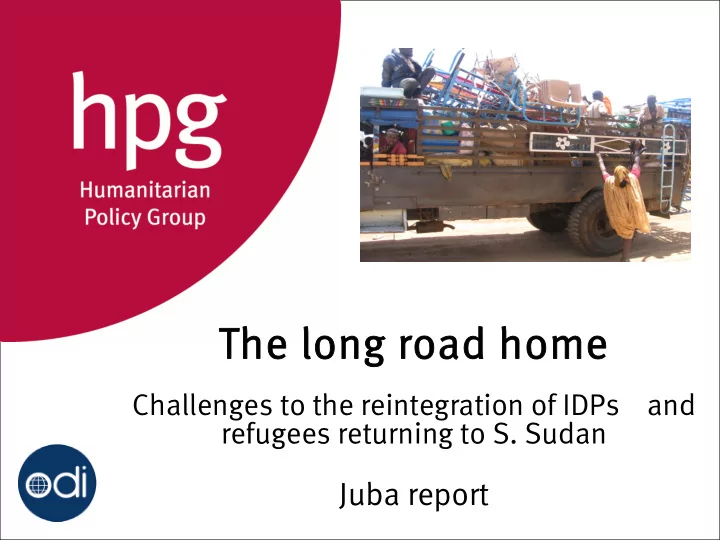
The long road home The long road home Challenges to the - - PowerPoint PPT Presentation

the long road home the long road home
SMART_READER_LITE
LIVE PREVIEW

The long road home The long road home Challenges to the - - PowerPoint PPT Presentation

The long road home The long road home Challenges to the reintegration of IDPs and refugees returning to S. Sudan Juba report The context The context Juba town uba town Population increase From garrison town to capital


slide-1
SLIDE 1

The long road home The long road home

Challenges to the reintegration of IDPs and refugees returning to S. Sudan

Juba report

slide-2
SLIDE 2
  • Population increase
  • From garrison town to capital of Southern

Sudan

  • A challenging transition for a young

government

The context – The context – Juba town uba town

slide-3
SLIDE 3
  • Positive: families reunited, new skills
  • Negative: language differences; youth

behaviour; antagonism residents/returnees

  • Resident population bearing the burden of

reintegration:

– hosting large numbers of returning relatives – severe pressure on household resources – relatives forced to stay even when they find work (no land)

  • Violence and intimidation by soldiers

Social reintegration Social reintegration

slide-4
SLIDE 4
  • Rapidly growing economy, yet saturated labour market

for unskilled

  • Challenges for returnees with skills in finding work
  • Lack of micro-credit opportunities and limitations of

vocational training

  • Public sector employment:
  • integration of SPLM workforce and impact on payroll
  • language barrier, nepotism and corruption
  • unrealistic expectations of returnees
  • Private sector:
  • ‘cowboy capitalism’
  • work permit issue
  • legislative vacuum

Economic reintegration Economic reintegration

slide-5
SLIDE 5
  • Population expansion → deterioration of services
  • Service delivery dependent on NGOs: decline in funding

= decline in services

  • Education: v. crowded schools; drop in quality; language

problem

  • Health: reliance on JTH; lack of PHCCs

in suburbs

  • Water: reliance on the Nile with serious consequences
  • Basic services personnel challenges
  • Returnees used to higher levels of services in area of

displacement

  • Lack of services in other areas of CES

Services Services

slide-6
SLIDE 6
  • Tribal leadership shaped by urban context and

GoS rule

  • Mistrust of urban Bari chiefs by GOSS
  • IDP and refugee chiefs not recognized on return;

returnees not yet integrated into leadership structures

  • Uncertainty about new leadership structures at

local level: awaiting local elections and new legislation

Leadership and institutions Leadership and institutions

slide-7
SLIDE 7
  • Cornerstone of returnees’

reintegration

  • Land and property disputes
  • IDP occupation of abandoned property
  • plots being forcibly occupied by military or the powerful
  • multiple issuing of leases for one plot
  • unauthorised building on plots
  • illegal sale of land
  • long term occupancy without registration
  • women’s rights
  • Town planning (evictions)
  • Creation of new plots (Bari vs

CES and GOSS)

  • Dispute resolution: hybrid system/contested chief role
  • Legislative vacuum

Land Land

slide-8
SLIDE 8
slide-9
SLIDE 9
  • The next few years will be crucial to the

future stability and prosperity of Juba.

  • Successes must be built on and the lessons
  • f failure learnt.
  • Head of UNMIS in S.S.: ‘there is a real
  • pportunity to make a difference here, but it

needs serious investment’.

Conclusion Conclusion