The Internet Structure routers 1 The Internet Structure The AS - - PDF document

the internet structure
SMART_READER_LITE
LIVE PREVIEW

The Internet Structure routers 1 The Internet Structure The AS - - PDF document

DIMES DIMES Distributed Internet MEasurement and Simulation Yuval Shavitt shavitt@eng.tau.ac.il http://www.netdimes.org The Internet Structure routers 1 The Internet Structure The AS graph The Internet Structure The AS graph The PoP level


slide-1
SLIDE 1

1

DIMES

Distributed Internet MEasurement and Simulation Yuval Shavitt shavitt@eng.tau.ac.il http://www.netdimes.org

DIMES

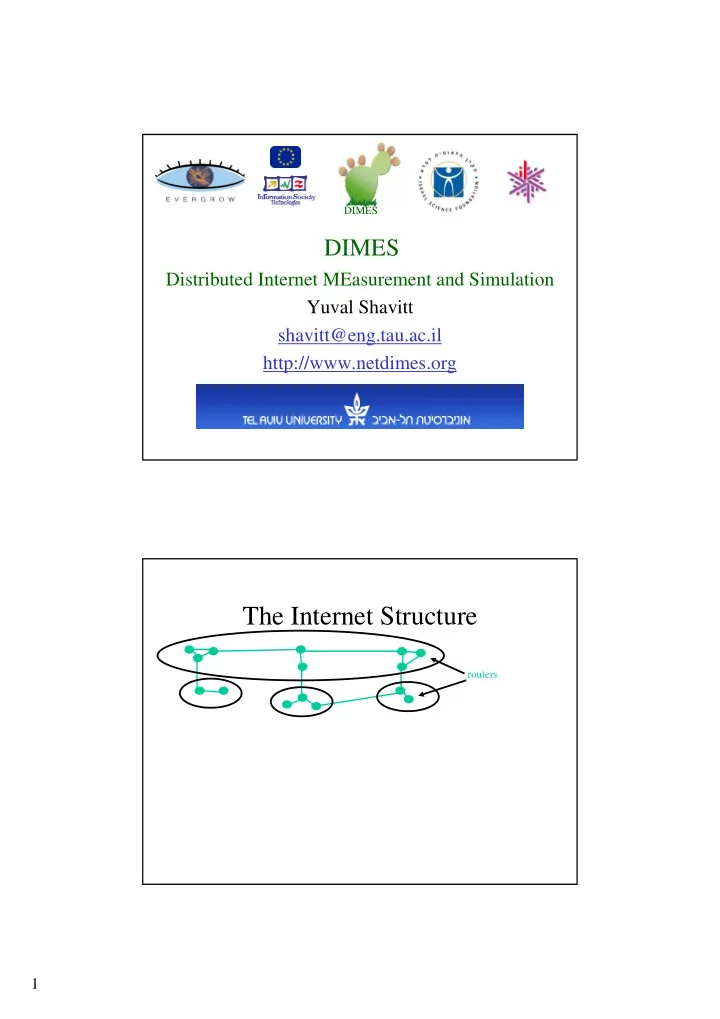
The Internet Structure

routers
slide-2
SLIDE 2

2

The Internet Structure

The AS graph

The Internet Structure

The AS graph The PoP level graph

Metropology

slide-3
SLIDE 3

3

Revealing the Internet Structure Revealing the Internet Structure

slide-4
SLIDE 4

4

Revealing the Internet Structure Revealing the Internet Structure

30 new links

7 new links NO new links

Diminishing return! Diminishing return!

⇓ Deploying more boxes does not pay-off

slide-5
SLIDE 5

5

Revealing the Internet Structure

To obtain the ‘horizontal’ links we need strong presence in the edge

Diminishing Return?

  • [Chen et al 02], [Bradford et al 01]: when

you combine more and more points of view the return diminishes very fast

  • What have they missed?

– The mass of the tail is significant

  • No. of views
slide-6
SLIDE 6

6

Diminishing Return?

  • [Chen et al 02], [Bradford et al 01]: when

you combine more and more points of view the return diminishes very fast

  • What have they missed?

– The mass of the tail is significant

  • No. of views
  • Diminishing return?

– Replace instrumentation boxes with software agents – Ask for volunteers do help with the measurement ⇓ – The cost of the first agent is very high – each additional agent costs almost zero

  • Advantages

– Large scale distribution: view the Internet from everywhere – Remove the “academic bias” measure the commercial Internet

  • Capabilities

– Anything you can write in Java! – Obtaining Internet maps at all granularity level with annotations

  • connectivity, delay, loss, bandwidth, jitter, ….

– Tracking the Internet evolution in time – Monitoring the Internet in real time DIMES

DIMES: Why and What

slide-7
SLIDE 7

7

Diminish … Shminimish

2005 6500 0.8 b Science slashdot YNET

How many ASes see an edge?

~9000/6000 are seen

  • nly by one
slide-8
SLIDE 8

8

DIMES

Distributed System Design: Obtaining the Internet Structure

The Internet as a complex system: static and dynamic analysis

Correlating the Internet with the World: Geography, Economics, Social Sciences

Challenges

  • It’s a distributed systems:

– Measurement traffic looks malicious

  • Flying under the NOC radar screens

(Agents cannot measure too much)

– Optimize the architecture:

  • Minimize the number of measurements
  • Expedite the discovery rate
  • BUT agents are

– Unreliable – Some move around Distributed System

complex system

real world

slide-9
SLIDE 9

9

Agents

  • To be able to use agents

wisely we need agents profiles:

– Reliablility

  • Daily (seen in 7 of the last

10 days)

  • Weekly (seen in 3 of the

last 4 weeks)

– Location:

  • Static
  • Bi-homed: where mostly?
  • Mobile: identify home

base

– Abilities: what type of measurements can it perform?

Distributed System

complex system

real world

  • Many new agents vanish

within days

  • Surprise: those who stay

tend to be very reliable

– Almost 24/7

  • Mobile agents

– New vantage points – Challenge for dynamic analysis

  • Current agent count

– Daily: 1200-1400 – Weekly: over 1800

  • Degree distribution

[Faloutsos99,Lakhina03,Barford01,Chen02]

  • Clustering coefficient [Bar04]
  • Disassortativity [Vespignani]
  • Network motifs (ala Uri Alon)

Distributed System

complex system

real world

Static Internet Graph Analysis

slide-10
SLIDE 10

10

Degree Distribution

k

Pr(k) <k>

2 4 6 8 10 12 2 4 6 8 10 12 14 log(degree) log(Pr(degree)) DIMES+BGP (Feb 05) 2 4 6 8 10 12 14 16 2 4 6 8 10 12 log(rank) log(degree) DIMES+BGP (Feb 05)

Zipf plot

+

AS map for Oct 2005

RouteViews (BGP)

  • 21281 nodes
  • 48629 edges
  • <k> = 4.57

DIMES

  • 17573 nodes
  • 51485 edges
  • <k> = 5.86

30,984 in both maps 20,501 new edges

69,130 edges <k> > 6.47

slide-11
SLIDE 11

11

Current Status

  • Over 4400 users, over 9700 agents

– 87 countries – All continents – Over 650 ASes – More than 1200 are active daily

  • Over 5,000,000 measurements a day
slide-12
SLIDE 12

12

Agents by country

Albania Argentina Australia Austria Belarus Belgium Bermuda Bosnia and Herzegovina Brazil Bulgaria Canada Chile China Colombia Costa Rica Croatia Cyprus Czech Republic Denmark Egypt Estonia Finland

Ru Aus Ger May 2006

Vision

  • A Network that optimizes itself:

– every device with a measurement module. – How to concert the measurements? – How to aggregate them? – How to analyze them is a hierarchical fashion?

slide-13
SLIDE 13

13

The DIMES Architecture

  • Client-server
  • Pull model

– All communication is originated by agent – Future: agent-agent communication

  • Data is kept in a rational database (MySQL)
  • Hard bound on network usage

– Negligible CPU usage

Agent Join Process

1. User download the DIMES agent

  • User id, join group, agent id

2. An entry is created in the database agent table 3. Agent gets random script 4. Every hour: keep alive (query for new scripts) 5. Send results:

1. When result file crosses a threshold 2. When agent wakes up

slide-14
SLIDE 14

14

Measurements

Current

  • Ping
  • Traceroute
  • Packettrain (in debug)

Future

  • IPv6 (initial trials)

Target Set

  • Initial set of 300,000,000 web sites

– Using DNS we got 3,000,000 IP addresses

  • Collected IP addresses from measurements
  • Scan APs without known addresses

– Space scans to same AP from an agent

⇒ We have over 5,000,000 IP addresses

slide-15
SLIDE 15

15

The Experiment Life-Cycle

  • Planning
  • Deploying
  • Executing
  • Result aggregation & filtering
  • Default result analysis

– Topology inference – AS path analysis

Topology Discovery

  • Discovery

– Random probing – Motifs

  • Triangles

– Geographic location

  • Same country
  • Validation

– Greedy set cover

slide-16
SLIDE 16

16

Router Alias Resolution

  • Ping, ping, ping ,…
  • No DNS
  • No Rocketfuel tricks (and potholes)

Experiments

  • Currently three priorities

– Urgent

  • Timed experiments
  • Time synchronized

– Normal

  • Most planned experiments

– Background

  • Random topology discovery
  • Router alias resolution
  • Easy to add more
slide-17
SLIDE 17

17

Data Filtering

  • IP level loops

– But not in the last hop – Disregard for topology

  • AS level loops

– But not in the last hop – Disregard for topology

  • Destination appears

early

– Disregard for topology

Agent Black List

  • Too many discoveries
  • Close to too many

destinations (ping)

Database Structure

  • Every measurement has a unique id and is

placed in a raw result table (insert time, agent, id, source IP, dest IP, experiment id, run id)

  • The unique id is used to access the

measurement details in other tables (traceroute/ping/packettrain tables)

slide-18
SLIDE 18

18

Main Database Tables

Main Meas Tab. raw_res_main Traceroute Tab. raw_res_traceroute Ping Tab. raw_res_ping AS topology Router topology

  • Alt. Traceroute Tab.

raw_res_traceroute_alt AS Traceroute Tab. AStraceroute

AS Level Topology

AS node:

  • AS Number
  • AS name
  • Discovering time
  • Validation time
  • In Degree
  • Out Degree
  • Max Radius

AS edge:

  • Source AS
  • Dest AS
  • Discovering time
  • Validation time
  • Discovering Agent
  • Measurement number
  • Min Delay & Max Delay
  • Betweeness
  • Visit Count
  • Validating Agent
  • Validating IP
slide-19
SLIDE 19

19

IP Traceroute Tables

  • A traceroute measurement is comprised of 4

traceroutes.

  • Traceroutes are done vertically:

1,2,3,4,…,1,2,3,...,1,2,3,…,1,2,3,…

  • Each hop has an entry that is connected to a

measurement via the unique id and hop number.

  • The most commom IP per hop is kept in the main

traceroute table

– Additional IP addresses are kept in alternative tables

Planner

  • A web interface to

easy

– Design expr. – Deploy expr. – Get results

  • Support XML feed
  • Support Java API

Agent groups Destination groups

slide-20
SLIDE 20

20

Measurements Software

  • Agents perform scripts
  • A new agent s/w

design:

– just write it in Java – use macro at the script level

thin C++ dll deliver a packet to the interface Java wrapper traceroute ping Packet train your module

DIMES Future

  • DIMES as a leading research tool (6-8M measurements/day)

– Data is available to all – Easy to run distributed experiments

  • Fast deployment cycle

– Easy to add new capabilities

  • Plug-ins to improve applications

– P2P communication – Web downloads (FireFox plug-in is available)

slide-21
SLIDE 21

21

Who

  • PI: Yuval Shavitt
  • Ph.D. students: Eran Shir, Tomer Tankel
  • Master’s student: Dima Feldman, Udi, Elad,

Anat..

  • Programmers: Anat Halpern, Ohad

Serfati, Yoav Freund, Ela M.

  • Undergrads: Roni Ilani, ….
  • Collaborators: HUJI, ColBud

http://www.netdimes.org