Network/Internet Threats/Attacks 1 Internet Structure backbone - - PDF document

network internet threats attacks
SMART_READER_LITE
LIVE PREVIEW

Network/Internet Threats/Attacks 1 Internet Structure backbone - - PDF document

Lecture 17 CS 134 Spring 2019 Network/Internet Threats/Attacks 1 Internet Structure backbone ISP local network Internet service Autonomous system (AS) is a provider (ISP) local network collection of IP networks under control of a


slide-1
SLIDE 1

1

Network/Internet Threats/Attacks

1

Lecture 17 CS 134 Spring 2019

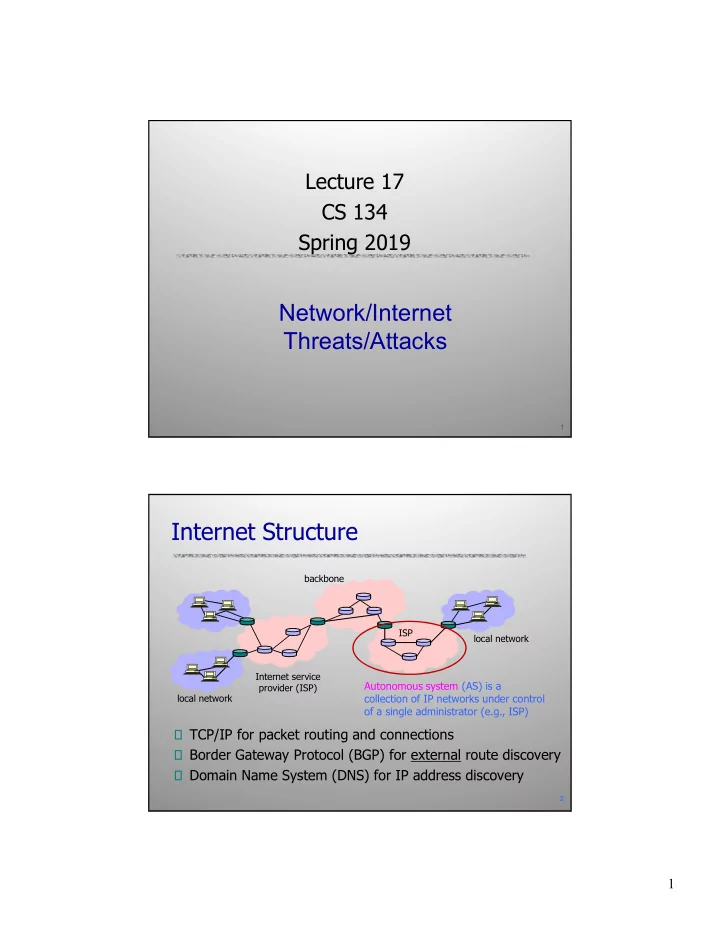
Internet Structure

local network Internet service provider (ISP) backbone ISP local network

฀ TCP/IP for packet routing and connections ฀ Border Gateway Protocol (BGP) for external route discovery ฀ Domain Name System (DNS) for IP address discovery

Autonomous system (AS) is a collection of IP networks under control

  • f a single administrator (e.g., ISP)

2

slide-2
SLIDE 2

2

OSI Protocol Stack

application presentation session transport network data link physical IP TCP email, Web, NFS RPC Ethernet

3

Data Formats

Application data data

TCP header

data

TCP header

data

TCP header

data

TCP header IP header

data

TCP header IP header Ethernet header Ethernet trailer

application layer transport layer network layer data link layer message segment packet frame

4

IPv6 only (IPv4 may fragment)

slide-3
SLIDE 3

3

TCP (Transmission Control Protocol)

฀ Sender: break data into segments

  • Sequence number is attached to every packet

฀ Receiver: reassemble segments

  • Acknowledge receipt; lost packets are re-sent

฀ Connection state maintained by both sides

IP (Internet Protocol)

฀ Connectionless

  • Unreliable, “best-effort” protocol

฀ Uses addresses (and prefixes thereof) used for routing

  • Longest-prefix match
  • Typically several hops in route

Alice’s computer Alice’s ISP Bob’s ISP Bob’s computer

IP Packet

Source

128.83.130.239 171.64.66.201

33040

Dest Seq #

128.83.130.239 171.64.66.201

slide-4
SLIDE 4

4

ICMP (Control Message Protocol)

฀ Provides feedback about network operation

  • Out-of-band (control) messages carried in IP packets
  • Error reporting, congestion control, reachability, etc.

฀ Example messages:

  • Destination unreachable
  • Time exceeded
  • Parameter problem
  • Redirect to better gateway
  • Reachability test (echo / echo reply)
  • Timestamp request / reply

7

Security Issues in TCP/IP

฀ Network packets pass by and thru untrusted hosts

  • Eavesdropping (packet sniffing)

฀ IP addresses are public

  • E.g., Ping-of-Death, Smurf attacks

฀ TCP connection requires state

  • SYN flooding

฀ TCP state easy to guess

  • TCP spoofing and connection hijacking

8

slide-5
SLIDE 5

5 network

Packet Sniffing

฀ Many old applications send data unencrypted

  • Plain ftp, telnet send passwords in the clear

(as opposed to sftp and ssh)

฀ Network Interface Card (NIC), e.g., Ethernet device, in “promiscuous mode” can read all data

  • n its broadcast segment

Solution: encryption (e.g., IPsec), improved routing

9

“Smurf” Attack

router Victim

might be local or remote

  • 1. ICMP Echo Req

Src: victim’s address Dest: broadcast address

Looks like a legitimate “Are you alive?” ping request from the victim

  • 2. Every host on the segment

generates a ping reply (ICMP Echo Reply) to victim’s address

  • 3. Flood of ping

replies

  • verwhelms victim

Solution: reject external packets to broadcast addresses

10

slide-6
SLIDE 6

6

“Ping of Death”

u When an old Windows machine receives an ICMP packet with payload over 64K, it crashes and/or reboots

  • Programming error in older versions of Windows
  • Packets of this length are illegal, so programmers of old

Windows code did not account for them

Solution: patch OS, filter out ICMP packets

11

“Teardrop” and “Bonk”

฀ TCP packets contain Offset field ฀ Attacker sets Offset field to:

  • overlapping values

– Bad/old implementation of TCP/IP stack crashes when attempting to re-assemble the fragments

  • … or to very large values

– Target system crashes Solution: use up-to-date TCP/IP implementation

12

slide-7
SLIDE 7

7

“LAND”

฀ Single-packet denial of service (DoS) attack ฀ IP packet with: <source-address,port> equal to <destination-address,port>, SYN flag set ฀ Triggers loopback in Windows XP SP2 implementation of TCP/IP stack

  • Locks up CPU

Solution: ingress filtering???

13

TCP Handshake Reminder

C S

SYNC SYNS, ACKC ACKS Listening… Spawn thread, store data

(connection state, etc.)

Wait Connected

14

slide-8
SLIDE 8

8

SYN Flooding Attack

S

SYNC1 Listening… Spawn a new thread, store connection data SYNC2 SYNC3 SYNC4 SYNC5 … and more … and more … and more … and more … and more

15

SYN Flooding Explained

฀ Attacker sends many connection requests (SYNs) with spoofed source addresses ฀ Victim allocates resources for each request

  • New thread, connection state maintained until timeout
  • Fixed bound on half-open connections

฀ Once server resources are exhausted, requests from legitimate clients are denied ฀ This is a classic DoS attack example: ASYMMETRY!!!

  • Common pattern: it costs nothing to TCP client to send a connection

request, but TCP server must spawn a thread for each request

  • Other examples of this behavior?

– TLS/SSL server public key decryption

16

slide-9
SLIDE 9

9

Preventing Denial of Service

฀ DoS is caused by asymmetric state allocation

  • If server opens new state for each connection attempt,

attacker can initiate many connections from bogus or forged IP addresses

฀ Cookies allow server to remain stateless until client produces:

  • Server state (IP addresses and ports) stored in a cookie

and originally sent to client

฀ When client responds, cookie is verified

17

SYN Cookies

[Bernstein and Schenk]

C S

SYNC

Listening… Does not store state

F(source addr, source port, dest addr, dest port, coarse time, server secret key)

SYNS, ACKC

sequence # = cookie

  • Cookie must be fresh, and

unforgeable

  • Client should not be able to

invert a cookie (why?)

F() can be truncated AES or a hash, e.g., SHA2

Recompute cookie, compare with with the one received, only establish connection if they match

ACKS(cookie)

Compatible with standard TCP; simply a “weird” sequence number scheme

More info: http://cr.yp.to/syncookies.html Note: each TCP packet carries a 32-bit seq numbers

18
slide-10
SLIDE 10

10

Anti-Spoofing Cookies: Basic Pattern

฀ Client sends request (message #1) to server ฀ Typical protocol:

  • Server sets up connection, responds with message #2
  • Client may complete session or not (potential DoS)

฀ Cookie version:

  • Server responds with hashed connection data instead
  • f message #2

– Does not spawn any threads, does not allocate resources!

  • Client confirms by returning cookie (with other fields)

– If source IP address is bogus, attacker can’t confirm – WHY?

19

Passive Defense: Random Deletion

121.17.182.45 231.202.1.16 121.100.20.14 5.17.95.155 SYNC

฀ If SYN queue is full, delete random entry

  • Legitimate connections have a chance to complete
  • Fake addresses will be eventually deleted. WHY?

฀ Easy to implement

Table of half-open connections on server

20

slide-11
SLIDE 11

11

TCP Connection Spoofing

฀ Each TCP connection has associated “state” info:

  • Sequence number, port number, src IP, dst IP, etc.

฀ TCP state is easy to guess

  • Port numbers are standard, seq numbers are predictable

฀ Can inject packets into existing connections

  • If attacker knows initial sequence number and amount of traffic, can

guess current number

  • Guessing a 32-bit seq number is not practical, BUT…
  • Most systems accept a large window of sequence numbers (to handle

massive packet losses, e.g., in shaky wireless networks)

  • Send a flood of packets with likely sequence numbers

21

DoS by Connection Reset

฀ If attacker can guess the current sequence number for an existing connection, can send a reset packet to close it (RST flag=1 in TCP header) ฀ Especially effective against long-lived connections

  • For example, BGP route updates

– Adjacent BGP routers keep long-lived TCP connections

23

slide-12
SLIDE 12

12

User Datagram Protocol (UDP)

฀ UDP – alternative to TCP, connectionless protocol

  • Simply sends datagram to application process at the

specified port of the IP address

  • Source port number provides return address
  • Applications: media streaming, broadcast

฀ No acknowledgements, no flow control ฀ So…. Denial of Service by UDP data flood is easy

24

Countermeasures

฀ Above transport layer: Kerberos (coming up!)

  • Provides authentication, protects against application-

layer spoofing

  • Does not protect against connection hijacking

฀ Above network layer: SSL/TLS and SSH

  • Protects against connection hijacking and injected data
  • Does not protect against DoS by spoofed packets

฀ Network (IP) layer: IPsec

  • Protects against hijacking, injection, DoS using

connection resets, IP address spoofing

  • But muddled/poor key management…

฀ Below network layer?

25

slide-13
SLIDE 13

13

IP Routing

฀ Routing of IP packets is based on IP addresses

  • 32-bit host identifiers (128-bit in IPv6)

฀ Routers use a forwarding table (FIB)

  • Entry = [destination, nxt hop, interface, metric ]
  • Table look-up for each IP packet to decide how to route it

฀ Routers learn routes to hosts and networks via routing protocols

  • Host identified by its IP address, network – by IP prefix

฀ BGP (Border Gateway Protocol) is the core Internet protocol for establishing inter-AS routes

NOTE: most classical routing protocols are either distance-vector or link-state

26

Distance-Vector Routing

฀ Each node keeps vector with distances to all nodes ฀ Periodically sends distance vector to all neighbors ฀ Neighbors reciprocate; node updates its vector based on received information

  • Bellman-Ford algorithm: for each destination, router

picks the neighbor advertising the cheapest route, adds his entry into its own routing table and re-advertises

  • Used in RIP (routing information protocol)

฀ Split-horizon update

  • Do not advertise a route on an interface from which you

learned the route in the first place!

27

slide-14
SLIDE 14

14 A: 0 A: 1 A: 2 A: 3 A: 4 A: 5 1 1 1 1 1 G1 G2 G3 G4 G5

Good News Travels Fast

฀ G1 advertises route to network A with distance 1 ฀ G2-G5 quickly learn the good news and install the routes to A (via G1) in their local routing tables

28

A A: 0 A: 1 A: 2 A: 3 A: 4 A: 5 1 1 1 1 G1 G2 G3 G4 G5

Bad News Travels Slowly

฀ G1’s link to A goes down ฀ G2 is advertising a pretty good route to G1 (cost=2) ฀ G1’s packets to A are forever looping between G2 and G1 ฀ G1 is now advertising a route to A with cost=3, so G2 updates its own route to A via G1 to have cost=4, and so on

  • G1 and G2 are slowly counting to infinity
  • Split-horizon updates only prevent two-node loops

Exchange routing tables

29

slide-15
SLIDE 15

15

Overview of BGP

฀ BGP is a path-vector INTER-AS protocol ฀ Just like distance-vector, but routing updates, for each entry *also* contain an AS-level path to destination

  • List of traversed AS-s and a set of network prefixes

belonging to the first AS on the list

฀ Each BGP router receives UPDATE messages from neighbors, selects one “best” path for each prefix, and advertises to its neighbors

  • Can be shortest path, but doesn’t have to be
  • AS doesn’t have to use the path it advertises!

30

BGP Example

฀ AS 2 provides transit service for AS 7

  • Traffic to and from AS 7 travels through AS 2

3 4 6 5 7 1 8 2

7 7 2 7 2 7 2 7 3 2 7 6 2 7 2 6 5 2 6 5 2 6 5 3 2 6 5 7 2 6 5 6 5 5 5 [Wetherall]

31

slide-16
SLIDE 16

16

Some BGP Statistics

฀ BGP routing tables contain about 125,000 address prefixes mapping to about 17-18,000 paths ฀ Approx. 10,000 BGP routers ฀ Approx. 2,000 organizations are AS-es ฀ Approx. 6,000 organizations own prefixes ฀ Average route length (AS hops) is about 3.7 ฀ 50% of routes have length less than 4 AS-s ฀ 95% of routes have length less than 5 AS-s

32

BGP Misconfiguration

฀ Blackholing: Domain advertises good routes to addresses it does not know how to reach

  • Result: packets go into a network “black hole”

฀ April 25, 1997: “The day the Internet died”

  • AS 7007 (Florida Internet Exchange) de-aggregated the

BGP route table and re-advertised all prefixes as if it

  • riginated paths to them
  • In effect, AS 7007 was advertising that it has the best

route to every host on the Internet

  • Huge network instability as incorrect routing data

propagated and routers crashed under traffic

33

slide-17
SLIDE 17

17

BGP Security

฀ BGP update messages contain no authentication or integrity protection

  • However, today BGP updates are sent over secure tunnels

฀ Attacker may falsify advertised routes

  • Modify IP prefixes associated with the route

– Can blackhole traffic to certain IP prefixes

  • Change AS path

– Either attract traffic to attacker’s AS, or divert traffic away – Interesting economic incentive: an ISP wants to dump its traffic on

  • ther ISPs without routing their traffic in exchange
  • Re-advertise/propagate AS path without permission

– For example, multi-homed customer (a stub AS) may end up advertising transit capability between two large ISPs

34

YouTube (Normally)

฀ AS36561 (YouTube) advertises 208.65.152.0/22

35

slide-18
SLIDE 18

18

YouTube (February 24, 2008)

฀ Pakistan government wants to block YouTube

  • AS17557 (Pakistan Telecom) advertises 208.65.153.0/24
  • All YouTube traffic worldwide directed to AS17557

฀ Result: two-hour YouTube outage

36

Other BGP Incidents

฀ May 2003: Spammers hijack unused block of IP addresses belonging to Northrop Grumman

  • Entire Northrop Grumman ends up on spam blacklist
  • Took two months to reclaim ownership of IP addresses

฀ May 2004: Malaysian ISP hijacks prefix of Yahoo California data center ฀ Dec 2004: Turkish ISP advertises routes to the entire Internet, including Amazon, CNN, Yahoo

37

slide-19
SLIDE 19

19

DNS: Domain Name Service

Client Local DNS recursive resolver root & edu DNS server uci.edu DNS server

www.ics.uci.edu

ics.uci.edu DNS server

DNS maps symbolic names to numeric IP addresses

(for example, www.uci.edu  128.195.188.233)

38

DNS Root Name Servers

฀ Root name servers for top-level domains ฀ Authoritative name servers for subdomains ฀ Local name resolvers contact authoritative servers when they do not know a name Feb 6, 2007: DoS attack on root DNS servers

39

slide-20
SLIDE 20

20

DNS Caching

฀ DNS responses are cached:

  • Quick response for repeated queries
  • Other queries may reuse some parts of lookup

– NS records for domains

฀ DNS negative queries are cached

  • Don’t have to repeat past mistakes, e.g., typos

฀ Cached data periodically times out

  • Lifetime (TTL) of data controlled by owner of data
  • TTL passed with every record

40

Cached Lookup Example

Client Local DNS recursive resolver root & edu DNS server uci.edu DNS server ics.uci.edu DNS server

ftp.ics.uci.edu

41

slide-21
SLIDE 21

21

DNS “Authentication”

Client Local DNS recursive resolver root & edu DNS server uci.edu DNS server

www.ics.uci.edu

ics.uci.edu DNS server Request contains random 16-bit transaction id  TXID Response accepted if TXID is the same Stays in cache for a long time (TTL)

42

DNS Spoofing

Client Local resolver ns.foo.com DNS server

host1.foo.com

Trick client into looking up host1.foo.com (how?) Guess TXID, host1.foo.com is at 6.6.6.6

6.6.6.6

Another guess, host1.foo.com is at 6.6.6.6 Another guess, host1.foo.com is at 6.6.6.6

Several opportunities to win the race If attacker loses, has to wait until TTL expires … but can try again with host2.foo.com, host3.foo.com, etc. … but what’s the point of hijacking host3.foo.com?

43

slide-22
SLIDE 22

22

Exploiting Recursive Resolving

Client Local resolver ns.foo.com DNS server

host1.foo.com

Trick client into looking up host1.foo.com Guessed TXID, very long TTL I don’t know where host1.foo.com is Ask the authoritative server at ns2.foo.com It lives at 6.6.6.6

6.6.6.6

  • If attacker wins, all future DNS requests for foo.com will go to 6.6.6.6
  • The cache is now poisoned… for a very long time!
  • No need to win future races!

[Kaminsky]

host2.foo.com

44

Triggering DNS Lookup

฀ Any link, any image, any ad, anything can cause a DNS lookup

  • No Javascript required, though it helps

฀ Mail servers will do a DNS lookup:

  • Upon first greeting: HELLO
  • Upon first learning who they’re talking to: MAIL FROM
  • Upon spam check (oops!)
  • When trying to deliver a bounce

45

slide-23
SLIDE 23

23

Reverse DNS Spoofing

฀ Trusted access is often based on host names

  • E.g., permit all hosts in .rhosts to run remote shell

฀ Network requests such as rsh or rlogin arrive from numeric (IP) source addresses

  • System performs reverse DNS lookup to determine

requester’s host name and checks if it’s in .rhosts

฀ If attacker can spoof the answer to reverse DNS query, he can fool target machine into thinking that request comes from an authorized host

  • No authentication for DNS responses and typically no

double-checking (numeric  symbolic  numeric)

46

Pharming

฀ Many anti-phishing defenses rely on DNS ฀ Can bypass them by poisoning DNS cache and/or forging DNS responses

  • Browser: give me the address of www.paypal.com
  • Attacker: sure, it’s 6.6.6.6 (attacker-controlled site)

฀ Dynamic pharming

  • Provide bogus DNS mapping for the trusted server, trick

user into downloading a malicious script from evil server

  • Force user to download content from the real trusted

server, by temporarily providing correct DNS mapping

  • Malicious script and content have the same origin!

Thus, malicious script can access (sensitive) content

47

slide-24
SLIDE 24

24

48

JavaScript/DNS Intranet attack (I)

฀ Consider a web server: intra.good.net

  • IP: 10.0.0.7, inaccessible outside good.net private network
  • Hosts sensitive CGI applications/scripts
  • CGI: Common Gateway Interface

฀ Attacker at evil.org gets a browser user on a.good.net to click/browse www.evil.org (e.g., via a link in an email msg) ฀ Places JavaScript on www.evil.org that, when invoked by client browser, accesses sensitive CGI applications on intra.good.net

  • This wouldn’t work since JavaScript is subject to same origin policy --

user’s browser tries to prevent client-side scripts from different places

  • But, suppose that attacker controls DNS

49

JavaScript/DNS Intranet attack (II)

a.good.net browser

Evil.org DNS Lookup www.evil.org 222.33.44.55 Evil.org Web GET /, host www.evil.org Response Evil.org DNS Lookup www.evil.org 10.0.0.7 Intra.good.net 10.0.0.7 POST /cgi/app, host www.evil.org Response – short ttl = compromise!

Javascript’s “same origin” policy is now satisfied (malicious script can access results of cgi script) Invoke sensitive CGI app: Get malicious javascript:

10.0.0.21

Short TTL expires

slide-25
SLIDE 25

25

Solving the DNS Spoofing Problem

฀ Long TTL for legitimate responses

  • Does it really help?

฀ Randomize port in addition to TXID

  • 32 bits of randomness – makes it harder for attacker

to guess TXID

฀ DNSSEC

  • Cryptographic authentication of host-address

mappings

53