The influence of particle shape on jamming: From ellipsoids to - - PowerPoint PPT Presentation

the influence of particle shape on jamming from
SMART_READER_LITE
LIVE PREVIEW

The influence of particle shape on jamming: From ellipsoids to - - PowerPoint PPT Presentation

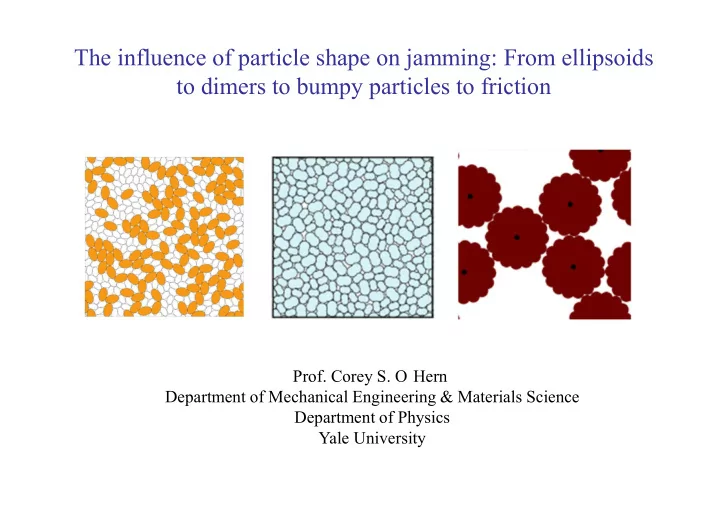
The influence of particle shape on jamming: From ellipsoids to dimers to bumpy particles to friction Prof. Corey S. O Hern Department of Mechanical Engineering & Materials Science Department of Physics Yale University The O Hern Group The


slide-1
SLIDE 1
  • Prof. Corey S. O Hern

Department of Mechanical Engineering & Materials Science Department of Physics Yale University

The influence of particle shape on jamming: From ellipsoids to dimers to bumpy particles to friction

slide-2
SLIDE 2

http://jamming.research.yale.edu/

The O Hern Group

The O'Hern group in the Fall 2011: (from left to right) Thibault Bertrand, Diego Caballero, Wendell Smith, Mate Nagy, Mark Shattuck, Alice Zhou, Jared Harwayne-Gidansky, Corey O'Hern, Georgia Lill, Maxwell Micali, Minglei Wang, Robert Hoy, Tianqi Shen, Carl Schreck, S. S. Ashwin, and Stefanos Papanikolaou

slide-3
SLIDE 3

Apply driving to attain reversible set of states Different driving mechanisms lead to different sets of states! What are the microstates of granular packings and what determines their probabilities?

PRE 57 (1998) 1971 EPJE 3 (2000) 309

Statistical Mechanics of Granular Media

slide-4
SLIDE 4

Attributes of Simple Granular Materials

  • 1. Finite number of macroscopic spherical grains
  • 2. Dissipative and repulsive contact interactions; exist at

`zero temperature unless driven by external forces

  • 3. Non-spherical particle shapes
  • 4. Static frictional and `history-dependent interactions
slide-5
SLIDE 5

repulsive central forces, Fij~  ~ (1-rij/ij), =1 zero force, Fij = 0

mr ai  r F

ij j

 br vi

Simple Granular Model: Frictionless Disks

 Minimize energy V(r) to reach T=0 at each 

V r r

 

V r

ij

 

i j

V r

ij

  

 1 r

ij

 ij      

for overlapping particles

slide-6
SLIDE 6

V( r)

 r

Mechanically stable packing Local minimum

 r

V( r)

 r

V( r)

Degenerate minima shrink grow

  • verlapped

non-overlapped

Mechanically stable packing

MS Packing-Generation Algorithm

slide-7
SLIDE 7

QuickTime and a TGA decompressor are needed to see this picture.

slide-8
SLIDE 8

c

max 

 2 3  0.91

N=256 512 1024

c

min 

<c>

Jamming of spherical particles via isotropic compression

  • P. Chaudhuri, L.Berthier, & S. Sastry, Phys. Rev. Lett, 104, 165701 (2010).
  • C. F. Schreck, C. S. O Hern, & L. E. Silber, Phys. Rev. E 84, 011305 (2011).

fast quench; amorphous; isostatic Slow quench; xtalline; hyperstatic b

slide-9
SLIDE 9

Jammed = mechanically stable (MS) configuration with extremely small particle overlaps; net forces (and torques) are zero on each particle; quadratically stable to small perturbations

 r

 

V  r

 

 

MS packng

Nc  Nc

iso  Nd f  d 1

z  ziso  2d f ; z  2Nc N

Isostaticity

slide-10
SLIDE 10

Configuration is mechanically stable if dynamical matrix contains dfN-d eigenvalues 2 > 0 (periodic b.c.s)

M,   2V( r) r

r   r   r0

,=x, y, z, particle index

 r

0 = positions of

MS packing

slide-11
SLIDE 11

Shape Matters: Packings of Frictionless Ellipsoidal Particles Are Stabilized by Quartic Modes

  • C. F. Schreck, M. Mailman, B. Chakraborty, & C. S. O Hern, Constraints and vibrations in static

packings of ellipsoidal particles, submitted to PRE (2012).

  • A. Donev, S. Torquato, & F. H. Stillinger, Phys. Rev. E 71 (2005) 011105.
  • Z. Zeravic, N. Xu, A. J. Liu, S. R. Nagel, & W. van Saarloos, EPL 87 (2009) 26001.
slide-12
SLIDE 12

QuickTime and a Photo - JPEG decompressor are needed to see this picture.

Packings of ellipse-shaped particles

compression method-fixed aspect ratio  bidisperse a2 b2 a1 b1 a1 b1  a2 b2  

a1 a2  1.4

slide-13
SLIDE 13 This image cannot currently be displayed. This image cannot currently be displayed. This image cannot currently be displayed. This image cannot currently be displayed.

Pairwise Repulsive Interactions: True Contact Distance

 ij

r

ij

V r

ij

  0

V r

ij

 

  1 r

ij

 ij      

r   ij r   ij       

V r

ij

  0

=2; linear springs

slide-14
SLIDE 14

annealing

Average Contact Number for Ellipse Packings

compression

Naïve isostatic condition for ellipses:

Not a discontinuous jump from <z> = 4 to 6.

Missing contacts

z  ziso  2d f

slide-15
SLIDE 15

z  ziso  2d f

Naïve isostatic condition for ellipsoids:

Average Contact Number for Ellipsoid Packings

Not a discontinuous jump from <z> = 6 to 10.

slide-16
SLIDE 16

If z < ziso, are ellipsoid packings mechanically stable?

slide-17
SLIDE 17

Density of Vibrational Modes from Dynamical Matrix

  • C. F. Schreck, M. Mailman, B. Chakraborty, & C. S. O Hern, Constraints and vibrations in static

packings of ellipsoidal particles, submitted to PRE (2012). =1 1.001 1.05 2

Dynamical matrix eigenvalues 2 > 0 for all dfN - d modes

N(ziso-z) modes

slide-18
SLIDE 18

Scaling of Characteristic Frequencies

3 1 2

=10-8

slide-19
SLIDE 19

lowest frequency for disks lowest frequency for ellipses

Slope=2 Slope=4

Perturbations along lowest frequency eigenmodes

*

 * : 

 

12

 1

 

14

=1 =1.1

Crossover frequency scales as

slide-20
SLIDE 20

concave constraint convex constraint

Ellipsoid packings are quartically stabilized at =0; i.e. For N(ziso-z) modes, V4; for Nz modes, V2

Spherical, ellipsoidal particles inaccessible inaccessible Only ellipsoidal particles

slide-21
SLIDE 21

What is the difference between between a dimer and an ellipse?

a b a b  = a/b

slide-22
SLIDE 22

<z> c  

dimers ellipses dimers ellipses

Dimer packings are isostatic with no quartic modes

slide-23
SLIDE 23

filled=dimers

  • pen=ellipses

Slope=1 Slope=0.5

Weaker linear response to shear

(-c)

slide-24
SLIDE 24

Microstates of Frictional Packings: Geometrical Families

slide-25
SLIDE 25

QuickTime and a Cinepak decompressor are needed to see this picture.

Frictional Geometrical Families

slide-26
SLIDE 26

Frictional Geometric Families

xc  s yc  s

Plot of all centers of mass that evolve to MS packing A

A

slide-27
SLIDE 27

Bumpy Particle Model for Friction

Linear repulsive spring bump-bump, bump-particle, and particle- particle interactions

max  R 2NbRb

slide-28
SLIDE 28

frictional contact frictionless contact

slide-29
SLIDE 29

Hertz-Mindlin Friction Model

tij

F

t   F n

slide-30
SLIDE 30

Provides energy sink when contacts break

slide-31
SLIDE 31

Advantages of Bumpy-Particle Model over Hertz-Mindlin

No ad hoc sliding, history dependence Forces depend only on particle positions and orientations; Use dynamical matrix to calculate vibrational response Test Hertz-Mindlin mobility distribution, P(m) m  F

t

F

n

slide-32
SLIDE 32

QuickTime and a GIF decompressor are needed to see this picture.

slide-33
SLIDE 33

Hertz-Mindlin Bumpy-particle model

c=0.6131, Nc=10, Nc

bb  17

slide-34
SLIDE 34

`Minimum Distance from Reference MS Packing

slide-35
SLIDE 35

bumpy particles Hertz-Mindlin

Comparison of Hertz-Mindlin and Bumpy-Particle Minimum-Distance Maps

family index

slide-36
SLIDE 36

2N-1 3N-1 isostatic

slide-37
SLIDE 37

max

Nc

bb

3N-1 2N-1

Energy Minimization Tolerance

isostatic

slide-38
SLIDE 38
  • L. Silbert, Soft Matter, 6 (2010) 2918.

Hertz-Mindlin Results

slide-39
SLIDE 39

Conclusions

Nonspherical particle shapes changes simple `jamming scenario for spherical grains

  • 1. Quartic modes lead to linear softening, perhaps nonlinear

strengthening

  • 2. For bumpy particles, microstates occur as geometrical

families, instead of random points in configuration space