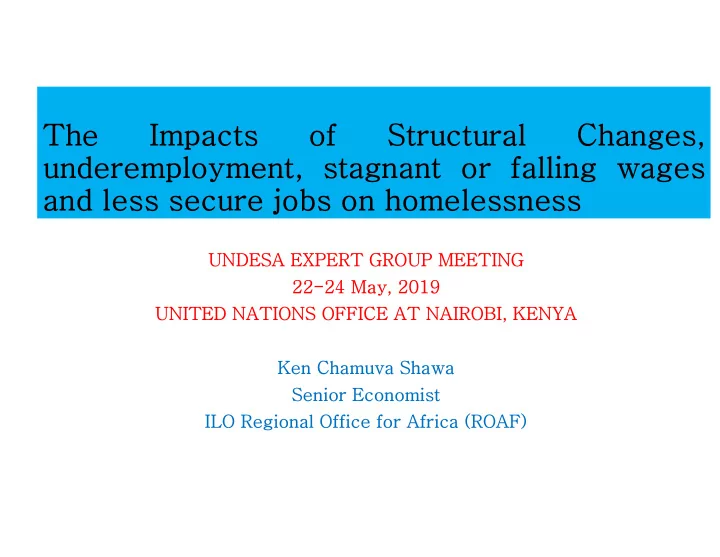
The Impacts of Structural Changes, underemployment, stagnant or - - PowerPoint PPT Presentation

the impacts of structural changes underemployment
SMART_READER_LITE
LIVE PREVIEW

The Impacts of Structural Changes, underemployment, stagnant or - - PowerPoint PPT Presentation

The Impacts of Structural Changes, underemployment, stagnant or falling wages and less secure jobs on homelessness UNDESA EXPERT GROUP MEETING 22-24 May, 2019 UNITED NATIONS OFFICE AT NAIROBI, KENYA Ken Chamuva Sh Shawa Se Senior


slide-1
SLIDE 1

The Impacts

  • f

Structural Changes, underemployment, stagnant or falling wages and less secure jobs on homelessness

UNDESA EXPERT GROUP MEETING 22-24 May, 2019 UNITED NATIONS OFFICE AT NAIROBI, KENYA Ken Chamuva Sh Shawa Se Senior Economist ILO Regional Office for Africa (ROAF)

slide-2
SLIDE 2

0: Approach

  • 1. The Concept of Homelessness
  • 2. Dynamics in the Labour Markets in

Africa

  • 3. Linkages between Labour Markets and

Homelessness 4. Proposed Interventions

slide-3
SLIDE 3
  • I. The Concept of Homelessness
  • Usually associated with “where individuals live or sleep”, the

physical place.

  • What is not there” or “what is lacking”
  • Lacking access to minimally adequate housing.
  • Depending on the definition of homelessness considered,

different perceptions, interventions, and even policy options, abound.

slide-4
SLIDE 4
  • 2. African Labour Markets (1)

Unemployment, employment growth and labour productivity

Unemployment Rate Unemployment (Millions) 2018 2019 2020 2018 2019 2020 Africa 6.8 6.8 6.8 33.0 34.0 34.5 NA 11.8 11.8 11.7 8.8 9.0 9.2 SSA 5.9 5.9 5.9 24.2 25.0 25.9 Employment Growth Labour Productivity Growth Africa 3.0 2.9 2.9 0.9 1.1 1.4 NA 2.0 1.9 1.8 2.2 2.3 2.5 SSA 3.1 3.1 3.1 0.6 0.9 1.2

slide-5
SLIDE 5
  • 2. African Labour Markets (2)

Share of Informal Employment in Total Employment

Category Africa North Africa Sub-Saharan Africa Ce Central Africa Ea Eastern Africa Southern Africa Western Africa Share of informal employment and its components in total employment 85.8 67.3 89.2 91.0 91.6 40.2 92.4 Share of non-agricultural informal employment and its components in non- agricultural employment 71.9 56.3 76.8 78.8 76.6 36.1 87.0

slide-6
SLIDE 6
  • 2. African Labour Markets (4)

20 40 60 80 100 Africa North Africa Sub-Saharan Africa Central Africa Eastern Africa Southern Africa Western Africa

Percentage

Sub Regions

Informal Employment Rate by Age

Youth (15-24) Adults(25+)

slide-7
SLIDE 7
  • 2. African Labour Markets (5)

31 31.5 32 32.5 33 33.5 34 2017 2018 2019 2020

Extreme Working Poverty Rate (Percentage)

slide-8
SLIDE 8
  • 2. African Labour Markets (6)

142 143 144 145 146 147 148 149 150 151

2017 2018 2019 2020

Extreme Working Poverty (Millions)

slide-9
SLIDE 9
  • 3. What are the likely labour market effects on

homelessness in Africa?

a) Poor incomes and other decent work deficits such lack of social protection, poor working conditions, and poor rights at work. b) Knowing that children of the homeless are also homeless, Deborah et al (2017) found that experiencing homelessness for the first time as children, affects their employment status later c)The costs of childhood homelessness are likely to be even greater given that key investments during children’s formative years are disrupted (see Molnar et al. 1990; Duncan et al. 2010; Miller 2011). d) According to Phelan & Link (1999) homelessness has long-term consequences as it often leads to deterioration of basic health, loss

  • f self-confidence, dignity and self-respect, and drug and alcohol

abuse.

slide-10
SLIDE 10
  • V. Possible Interventions

a)

Enhancing So Social protection b) Promoting and implementing pro-employment labour policies c) Se Setting and Implementing Mi Minimum Wages d) Su Supporting the Transition from informality to formality e) Instituting Pro-employment macroeconomic policies

slide-11
SLIDE 11
  • Thank You for Listening to

Me