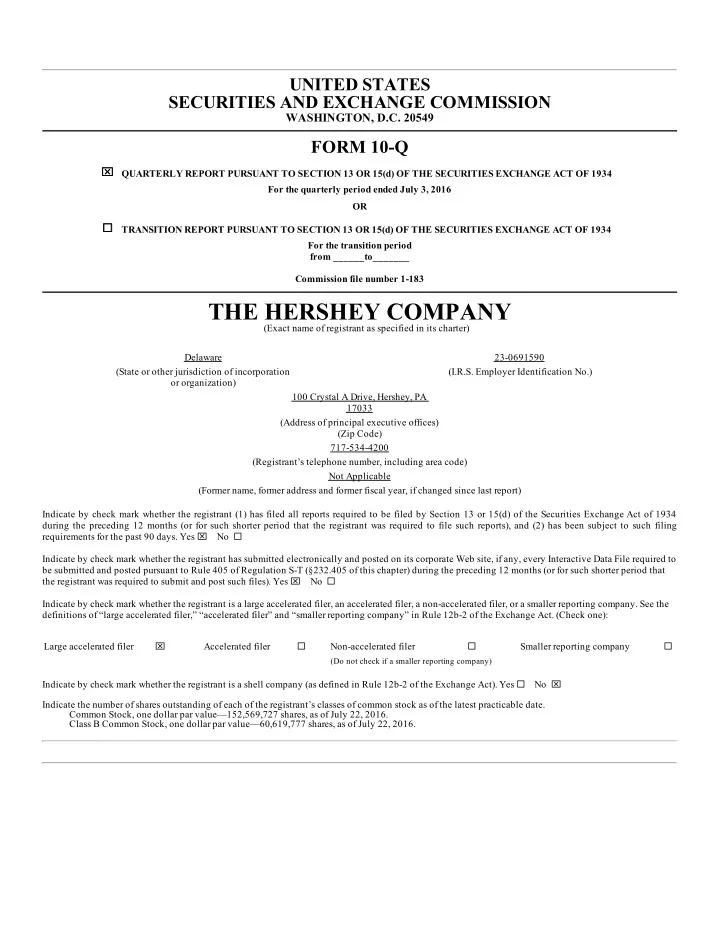
THE HERSHEY COMPANY (Exact name of registrant as specified in its - - PDF document

the hershey company
SMART_READER_LITE
LIVE PREVIEW

THE HERSHEY COMPANY (Exact name of registrant as specified in its - - PDF document

UNITED STATES SECURITIES AND EXCHANGE COMMISSION WASHINGTON, D.C. 20549 FORM 10-Q x x QUARTERLY REPORT PURSUANT TO SECTION 13 OR 15(d) OF THE SECURITIES EXCHANGE ACT OF 1934 For the quarterly period ended July 3, 2016 OR TRANSITION


slide-1
SLIDE 1

UNITED STATES SECURITIES AND EXCHANGE COMMISSION

WASHINGTON, D.C. 20549

FORM 10-Q

x x

QUARTERLY REPORT PURSUANT TO SECTION 13 OR 15(d) OF THE SECURITIES EXCHANGE ACT OF 1934 For the quarterly period ended July 3, 2016 OR

¨ ¨

TRANSITION REPORT PURSUANT TO SECTION 13 OR 15(d) OF THE SECURITIES EXCHANGE ACT OF 1934 For the transition period from ______to_______ Commission file number 1-183

THE HERSHEY COMPANY

(Exact name of registrant as specified in its charter) Delaware 23-0691590 (State or other jurisdiction of incorporation

  • r organization)

(I.R.S. Employer Identification No.) 100 Crystal A Drive, Hershey, PA 17033 (Address of principal executive offices) (Zip Code) 717-534-4200 (Registrant’s telephone number, including area code) Not Applicable (Former name, former address and former fiscal year, if changed since last report) Indicate by check mark whether the registrant (1) has filed all reports required to be filed by Section 13 or 15(d) of the Securities Exchange Act of 1934 during the preceding 12 months (or for such shorter period that the registrant was required to file such reports), and (2) has been subject to such filing requirements for the past 90 days. Yes x No ¨ Indicate by check mark whether the registrant has submitted electronically and posted on its corporate Web site, if any, every Interactive Data File required to be submitted and posted pursuant to Rule 405 of Regulation S-T (§232.405 of this chapter) during the preceding 12 months (or for such shorter period that the registrant was required to submit and post such files). Yes x No ¨ Indicate by check mark whether the registrant is a large accelerated filer, an accelerated filer, a non-accelerated filer, or a smaller reporting company. See the definitions of “large accelerated filer,” “accelerated filer” and “smaller reporting company” in Rule 12b-2 of the Exchange Act. (Check one): Large accelerated filer x Accelerated filer ¨ Non-accelerated filer ¨ Smaller reporting company ¨

(Do not check if a smaller reporting company)

Indicate by check mark whether the registrant is a shell company (as defined in Rule 12b-2 of the Exchange Act). Yes ¨ No x Indicate the number of shares outstanding of each of the registrant’s classes of common stock as of the latest practicable date. Common Stock, one dollar par value—152,569,727 shares, as of July 22, 2016. Class B Common Stock, one dollar par value—60,619,777 shares, as of July 22, 2016.

slide-2
SLIDE 2

THE HERSHEY COMPANY Quarterly Report on Form 10-Q For the Period Ended July 3, 2016 TABLE OF CONTENTS PART I. FINANCIAL INFORMATION 3 Item 1. Financial Statements 3 Consolidated Statements of Income for the Three and Six Months Ended July 3, 2016 and July 5, 2015 3 Consolidated Statements of Comprehensive Income for the Three and Six Months Ended July 3, 2016 and July 5, 2015 4 Consolidated Balance Sheets as of July 3, 2016 and December 31, 2015 5 Consolidated Statements of Cash Flows for the Six Months Ended July 3, 2016 and July 5, 2015 6 Consolidated Statement of Stockholders' Equity for the Six Months Ended July 3, 2016 7 Notes to Unaudited Consolidated Financial Statements 8 Item 2. Management's Discussion and Analysis of Financial Condition and Results of Operations 30 Item 3. Quantitative and Qualitative Disclosures About Market Risk 47 Item 4. Controls and Procedures 47 PART II. OTHER INFORMATION 48

  • Item1. Legal Proceedings

48 Item 1A. Risk Factors 48 Item 2. Unregistered Sales of Equity Securities and Use of Proceeds 48 Item 3. Defaults Upon Senior Securities 48 Item 4. Mine Safety Disclosures 48 Item 5. Other Information 48 Item 6. Exhibits 49 Signatures 50 2

slide-3
SLIDE 3

PART I — FINANCIAL INFORMATION Item 1. Financial Statements. THE HERSHEY COMPANY CONSOLIDATED STATEMENTS OF INCOME (in thousands, except per share amounts) (unaudited) Three Months Ended Six Months Ended July 3, 2016 July 5, 2015 July 3, 2016 July 5, 2015 Net sales $ 1,637,671 $ 1,578,825 $ 3,466,483 $ 3,516,625 Costs and expenses: Cost of sales 890,273 843,417 1,901,709 1,880,374 Selling, marketing and administrative 462,531 455,545 934,265 969,555 Goodwill impairment — 249,811 — 249,811 Business realignment charges 22,105 22,552 28,238 25,219 Total costs and expenses 1,374,909 1,571,325 2,864,212 3,124,959 Operating profit 262,762 7,500 602,271 391,666 Interest expense, net 21,338 18,877 42,343 38,079 Other (income) expense, net 8,128 4,759 (13,097) (5,081) Income (loss) before income taxes 233,296 (16,136) 573,025 358,668 Provision for income taxes 87,340 83,805 197,237 213,872 Net income (loss) $ 145,956 $ (99,941) $ 375,788 $ 144,796 Net income (loss) per share—basic: Common stock $ 0.70 $ (0.47) $ 1.79 $ 0.67 Class B common stock $ 0.64 $ (0.42) $ 1.64 $ 0.62 Net income (loss) per share—diluted: Common stock $ 0.68 $ (0.47) $ 1.74 $ 0.65 Class B common stock $ 0.64 $ (0.42) $ 1.63 $ 0.62 Dividends paid per share: Common stock $ 0.583 $ 0.535 $ 1.166 $ 1.070 Class B common stock $ 0.530 $ 0.486 $ 1.060 $ 0.972 See Notes to Unaudited Consolidated Financial Statements. 3

slide-4
SLIDE 4

THE HERSHEY COMPANY CONSOLIDATED STATEMENTS OF COMPREHENSIVE INCOME (in thousands) (unaudited)

Three Months Ended Six Months Ended July 3, 2016 July 5, 2015 July 3, 2016 July 5, 2015

Net income (loss) $ 145,956 $ (99,941) $ 375,788 $ 144,796 Other comprehensive income (loss), net of tax: Foreign currency translation adjustments 1,420 2,668 13,586 (25,050) Pension and post-retirement benefit plans (2,612) 5,466 2,489 10,927 Cash flow hedges: Gains (losses) on cash flow hedging derivatives (13,789) 91,029 (35,933) 64,937 Reclassification adjustments (2,175) (11,098) (7,087) (11,497) Total other comprehensive income (loss), net of tax (17,156) 88,065 (26,945) 39,317 Total comprehensive income (loss) $ 128,800 $ (11,876) $ 348,843 $ 184,113 Comprehensive loss (income) attributable to noncontrolling interests 213 (578) 1,289 2,931 Comprehensive income (loss) attributable to The Hershey Company $ 129,013 $ (12,454) $ 350,132 $ 187,044 See Notes to Unaudited Consolidated Financial Statements. 4

slide-5
SLIDE 5

THE HERSHEY COMPANY CONSOLIDATED BALANCE SHEETS (in thousands, except share data) July 3, 2016 December 31, 2015 ASSETS (unaudited) Current assets: Cash and cash equivalents $ 250,185 $ 346,529 Accounts receivable—trade, net 483,545 599,073 Inventories 871,285 750,970 Prepaid expenses and other 202,584 152,026 Total current assets 1,807,599 1,848,598 Property, plant and equipment, net 2,198,615 2,240,460 Goodwill 818,380 684,252 Other intangibles 521,233 379,305 Other assets 157,213 155,366 Deferred income taxes 64,344 36,390 Total assets $ 5,567,384 $ 5,344,371 LIABILITIES AND STOCKHOLDERS’ EQUITY Current liabilities: Accounts payable $ 455,225 $ 474,266 Accrued liabilities 718,921 856,967 Accrued income taxes 102 23,243 Short-term debt 997,120 363,513 Current portion of long-term debt 500,078 499,923 Total current liabilities 2,671,446 2,217,912 Long-term debt 1,571,179 1,557,091 Other long-term liabilities 496,110 468,718 Deferred income taxes 53,988 53,188 Total liabilities 4,792,723 4,296,909 Stockholders’ equity: The Hershey Company stockholders’ equity Preferred stock, shares issued: none at July 3, 2016 and December 31, 2015, respectively — — Common stock, shares issued: 299,281,967 at July 3, 2016 and 299,281,967 at December 31, 2015, respectively 299,281 299,281 Class B common stock, shares issued: 60,619,777 at July 3, 2016 and 60,619,777 at December 31, 2015, respectively 60,620 60,620 Additional paid-in capital 817,135 783,877 Retained earnings 6,030,252 5,897,603 Treasury—common stock shares, at cost: 147,104,547 at July 3, 2016 and 143,124,384 at December 31, 2015, respectively (6,082,657) (5,672,359) Accumulated other comprehensive loss (396,681) (371,025) The Hershey Company stockholders’ equity 727,950 997,997 Noncontrolling interests in subsidiaries 46,711 49,465 Total stockholders’ equity 774,661 1,047,462 Total liabilities and stockholders’ equity $ 5,567,384 $ 5,344,371 See Notes to Unaudited Consolidated Financial Statements. 5

slide-6
SLIDE 6

THE HERSHEY COMPANY CONSOLIDATED STATEMENTS OF CASH FLOWS (in thousands) (unaudited)

Six Months Ended July 3, 2016 July 5, 2015 Operating Activities Net income $ 375,788

$

144,796 Adjustments to reconcile net income to net cash provided by operating activities: Depreciation and amortization 156,779 118,801 Stock-based compensation expense 26,208 26,615 Excess tax benefits from stock-based compensation (14,813) (21,111) Deferred income taxes (5,615) (20,044) Goodwill impairment — 249,811 Contributions to pension and other benefits plans (16,544) (10,664) Write-down of equity investments 15,061 4,664 Gain on settlement of SGM liability (see Note 2) (26,650) — Changes in assets and liabilities, net of effects from business acquisitions and divestitures: Accounts receivable—trade, net 118,932 133,382 Inventories (110,987) (59,773) Accounts payable and accrued liabilities (120,935) (128,545) Other assets and liabilities (50,126) 48,383 Net cash provided by operating activities 347,098 486,315 Investing Activities Capital additions (including software) (104,109) (152,353) Proceeds from sales of property, plant and equipment 1,657 1,010 Proceeds from sale of business — 32,408 Equity investments in tax credit qualifying partnerships (16,763) (1,865) Business acquisitions, net of cash and cash equivalents acquired (285,374) (218,654) Net cash used in investing activities (404,589) (339,454) Financing Activities Net increase in short-term debt 630,121 253,978 Long-term borrowings — 1,564 Repayment of long-term debt — (660) Payment of SGM liability (see Note 2) (35,762) — Cash dividends paid (243,139) (228,962) Exercise of stock options 45,946 53,079 Excess tax benefits from stock-based compensation 14,813 21,111 Repurchase of common stock (452,580) (315,664) Net cash used in financing activities (40,601) (215,554) Effect of exchange rate changes on cash and cash equivalents 1,748 (3,502) Decrease in cash and cash equivalents (96,344) (72,195) Cash and cash equivalents, beginning of period 346,529 374,854 Cash and cash equivalents, end of period $ 250,185

$

302,659 Supplemental Disclosure Interest paid $ 42,005

$

42,568 Income taxes paid 239,501 214,072

See Notes to Unaudited Consolidated Financial Statements. 6

slide-7
SLIDE 7

THE HERSHEY COMPANY CONSOLIDATED STATEMENT OF STOCKHOLDERS’ EQUITY (in thousands) (unaudited)

Preferred Stock Common Stock Class B Common Stock Additional Paid-in Capital Retained Earnings Treasury Common Stock Accumulated Other Comprehensive Loss Noncontrolling Interests in Subsidiaries Total Stockholders’ Equity Balance, December 31, 2015

$

— $299,281 $ 60,620 $ 783,877 $5,897,603

$(5,672,359) $

(371,025) $ 49,465

$

1,047,462 Net income 375,788 375,788 Other comprehensive loss (25,656) (1,289) (26,945) Dividends: Common Stock, $1.166 per share (178,882) (178,882) Class B Common Stock, $1.06 per share (64,257) (64,257) Stock-based compensation 25,496 25,496 Exercise of stock options and incentive-based transactions 7,762 42,282 50,044 Repurchase of common stock (452,580) (452,580) Net loss attributable to noncontrolling interests (1,465) (1,465) Balance, July 3, 2016

$

— $299,281 $ 60,620 $ 817,135 $6,030,252

$(6,082,657) $

(396,681) $ 46,711

$

774,661

See Notes to Unaudited Consolidated Financial Statements. 7

slide-8
SLIDE 8

THE HERSHEY COMPANY NOTES TO UNAUDITED CONSOLIDATED FINANCIAL STATEMENTS (amounts in thousands, except share data or if otherwise indicated)

  • 1. SUMMARY OF SIGNIFICANT ACCOUNTING POLICIES

Basis of Presentation The unaudited consolidated financial statements provided in this report include the accounts of The Hershey Company (the “Company,” “Hershey,” “we” or “us”) and our majority-owned subsidiaries and entities in which we have a controlling financial interest after the elimination of intercompany accounts and

  • transactions. We have a controlling financial interest if we own a majority of the outstanding voting common stock and the noncontrolling shareholders do

not have substantive participating rights, or we have significant control over an entity through contractual or economic interests in which we are the primary beneficiary. The financial statements have been prepared in accordance with accounting principles generally accepted in the United States of America (“GAAP”) for interim financial reporting and with the rules and regulations for reporting on Form 10-Q. Accordingly, they do not contain certain information and disclosures required by GAAP for comprehensive financial statements. Our significant interim accounting policies include the recognition of a pro-rata share

  • f certain estimated annual amounts primarily for raw material purchase price variances, advertising expense, incentive compensation expenses and the

effective income tax rate. We have included all adjustments (consisting only of normal recurring accruals) that we believe are considered necessary for a fair presentation. Operating results for the quarter ended July 3, 2016 may not be indicative of the results that may be expected for the year ending December 31, 2016 because

  • f seasonal effects on our business. These financial statements should be read in conjunction with our Annual Report on Form 10-K for the year ended

December 31, 2015 (our “2015 Annual Report on Form 10-K”), which provides a more complete understanding of our accounting policies, financial position,

  • perating results and other matters.

Reclassifications Certain prior period amounts presented in the Consolidated Statements of Cash Flows have been reclassified to conform to the current year presentation. Recent Accounting Pronouncements In March 2016, the Financial Accounting Standards Board ("FASB") issued Accounting Standards Update ("ASU") No. 2016-09, Compensation—Stock Compensation (Topic 718): Improvements to Employee Share-Based Payment Accounting. This ASU is part of the FASB's simplification initiative. The areas for simplification in this ASU involve several aspects of the accounting for share-based payment transactions, including the income tax consequences, classification of awards as either equity or liabilities and classification on the statement of cash flows. ASU 2016-09 is effective for annual periods beginning after December 15, 2016 and interim periods within those annual periods, with early adoption permitted. We are currently evaluating the impact that the adoption of ASU 2016-09 will have on our consolidated financial statements and related disclosures. In February 2016, the FASB issued ASU No. 2016-02, Leases (Topic 842). This ASU will require lesses to recognize a right-of-use asset and lease liability for all leases with terms of more than 12 months. Recognition, measurement and presentation of expenses will depend on classification as a finance or operating

  • lease. This ASU also requires certain quantitative and qualitative disclosures. Accounting guidance for lessors is largely unchanged. The amendments should

be applied on a modified retrospective basis. ASU 2016-02 is effective for us beginning January 1, 2019. We are beginning to evaluate the impact that the adoption of ASU 2016-02 will have on our consolidated financial statements and related disclosures. In May 2014, the FASB issued ASU No. 2014-09, Revenue from Contracts with Customers, which requires an entity to recognize the amount of revenue to which it expects to be entitled for the transfer of promised goods or services to customers. ASU No. 2014-09 will replace most existing revenue recognition guidance in U.S. GAAP when it becomes effective. The new standard was originally effective for us on January 1, 2017; however, in July 2015 the FASB decided to defer the effective date by one year. Early application is not permitted, but reporting entities may choose to adopt the standard as of the original effective date. The standard permits the use of either the retrospective or 8

slide-9
SLIDE 9

THE HERSHEY COMPANY NOTES TO UNAUDITED CONSOLIDATED FINANCIAL STATEMENTS (amounts in thousands, except share data or if otherwise indicated) cumulative effect transition method. We are currently evaluating the effect that ASU No. 2014-09 will have on our consolidated financial statements and related disclosures, our transition date and transition method. No other new accounting pronouncement issued or effective during the fiscal year had or is expected to have a material impact on our consolidated financial statements or disclosures.

  • 2. BUSINESS ACQUISITIONS AND DIVESTITURES

Acquisitions of businesses are accounted for as purchases and, accordingly, the results of operations of the businesses acquired have been included in the consolidated financial statements since the respective dates of the acquisitions. The purchase price for each of the acquisitions is allocated to the assets acquired and liabilities assumed. 2016 Activity Ripple Brand Collective, LLC On April 26, 2016, we completed the acquisition of all of the outstanding shares of Ripple Brand Collective, LLC, a privately held company based in Congers, New York that owns the barkTHINS mass premium chocolate snacking brand. The barkTHINS brand is largely sold in the United States in take- home resealable packages and is available in the club channel, as well as select natural and conventional grocers. The business enables us to expand our mass premium offerings and is expected to generate 2016 annual net sales of approximately $65 million to $75 million. The purchase consideration was allocated to assets acquired and liabilities assumed based on their respective fair values as follows: Goodwill $ 127,455 Trademarks 91,200 Other intangible assets 60,900 Other assets, primarily current assets, net of cash acquired totaling $674 13,030 Current liabilities (7,211) Net assets acquired $ 285,374 The purchase price allocation presented above is preliminary. We are in the process of refining the valuation of acquired assets and liabilities and expect to finalize the purchase price allocation by the end of 2016. Goodwill is calculated as the excess of the purchase price over the fair value of the net assets acquired. The goodwill resulting from the acquisition is attributable primarily to the value of leveraging our brand building expertise, consumer insights, supply chain capabilities and retail relationships to accelerate growth and access to barkTHINS products. Acquired trademarks were assigned estimated useful lives of 27 years, while other intangibles, including customer relationships and covenants not to compete, were assigned estimated useful lives ranging from 2 to 14 years. The recorded goodwill, trademarks and other intangibles are expected to be deductible for tax purposes. Shanghai Golden Monkey (“SGM”) On February 3, 2016, we completed the purchase of the remaining 20% of the outstanding shares of SGM for cash consideration totaling $35,762, pursuant to a new agreement entered into during the fourth quarter of 2015 with the SGM selling shareholders which revised the originally-agreed purchase price for these shares. For accounting purposes, we treated the acquisition as if we had acquired 100% at the initial acquisition date in 2014 and financed the payment for the remaining 20% of the outstanding shares. Therefore, the cash settlement of the liability for the purchase of these remaining shares is reflected within the financing section of the Unaudited Consolidated Statements of Cash Flows. 9

slide-10
SLIDE 10

THE HERSHEY COMPANY NOTES TO UNAUDITED CONSOLIDATED FINANCIAL STATEMENTS (amounts in thousands, except share data or if otherwise indicated) The final settlement also resulted in an extinguishment gain of $26,650 representing the net carrying amount of the recorded liability in excess of the cash paid to settle the obligation for the remaining 20% of the outstanding shares. This gain is recorded within non-operating other (income) expense, net within the Unaudited Consolidated Statements of Income. 2015 Acquisition KRAVE Pure Foods In March 2015, we completed the acquisition of all of the outstanding shares of KRAVE Pure Foods, Inc. (“Krave”), manufacturer of KRAVE jerky, a leading all-natural snack brand of premium jerky products. The transaction was undertaken to allow Hershey to tap into the rapidly growing meat snacks category and further expand into the broader snacks space. Krave is headquartered in Sonoma, California and generated 2014 annual sales of approximately $35 million. Total purchase consideration included cash consideration of $220,016, as well as agreement to pay additional cash consideration of up to $20,000 to the Krave shareholders if certain defined targets related to net sales and gross profit margin are met or exceeded during the twelve-month periods ending December 31, 2015 or March 31, 2016. The fair value of the contingent cash consideration was appropriately classified as a liability of $16,800 as of the acquisition date. Based on revised targets in a subsequent agreement with the Krave shareholders, the fair value was reduced over the second and third quarters of 2015 to $10,000, with the adjustment to fair value recorded within selling, marketing and administrative expenses. The remaining $10,000 was paid in December 2015. The purchase consideration was allocated to assets acquired and liabilities assumed based on their respective fair values as follows: Goodwill $ 147,089 Trademarks 112,000 Other intangible assets 17,000 Other assets, primarily current assets, net of cash acquired totaling $1,362 9,465 Current liabilities (2,756) Non-current deferred tax liabilities (47,344) Net assets acquired $ 235,454 The goodwill resulting from the acquisition is attributable primarily to the value of leveraging our brand building expertise, consumer insights, supply chain capabilities and retail relationships to accelerate growth and access to KRAVE products. The recorded goodwill is not expected to be deductible for tax

  • purposes. The purchase price allocation for Krave was concluded in the third quarter of 2015.

Acquired trademarks were assigned estimated useful lives of 22 years, while other intangibles, including customer relationships and covenants not to compete, were assigned estimated useful lives ranging from 5 to 16 years. 2015 Divestiture In December 2014, we entered into an agreement to sell the Mauna Loa Macadamia Nut Corporation (“Mauna Loa”). The transaction closed in the first quarter of 2015, resulting in proceeds, net of selling expenses and an estimated working capital adjustment, of approximately $32,400. As a result of the expected sale, in 2014, we recorded an estimated loss on the anticipated sale of $22,256 to reflect the disposal entity at fair value, less an estimate of the selling costs. This amount included impairment charges totaling $18,531 to write down goodwill and the indefinite-lived trademark intangible asset, based

  • n the valuation of these assets as implied by the agreed-upon sales price. The sale of Mauna Loa resulted in the recording of an additional loss on sale of

$2,667 in the first quarter of 2015, based on updates to the selling expenses and tax benefits. The loss on the sale is reflected within business realignment charges in the Unaudited Consolidated Statements of Income. 10

slide-11
SLIDE 11

THE HERSHEY COMPANY NOTES TO UNAUDITED CONSOLIDATED FINANCIAL STATEMENTS (amounts in thousands, except share data or if otherwise indicated)

  • 3. GOODWILL AND INTANGIBLE ASSETS

The changes in the carrying value of goodwill by reportable segment for the six months ended July 3, 2016 are as follows:

North America International and Other Total

Balance at December 31, 2015 $ 662,083 $ 22,169 $ 684,252 Acquired during the period (see Note 2) 127,455 — 127,455 Foreign currency translation 7,444 (771) 6,673 Balance at July 3, 2016 $ 796,982 $ 21,398 $ 818,380 The following table provides the gross carrying amount and accumulated amortization for each major class of intangible asset:

July 3, 2016 December 31, 2015

Intangible assets not subject to amortization: Trademarks 43,362 43,775 Intangible assets subject to amortization: Trademarks, customer relationships, patents and other finite-lived intangibles 545,280 390,900 Less: accumulated amortization (67,409) (55,370) Total other intangible assets $ 521,233 $ 379,305 Total amortization expense for the three months ended July 3, 2016 and July 5, 2015 was $5,964 and $6,115, respectively. Total amortization expense for the six months ended July 3, 2016 and July 5, 2015 was $11,144 and $11,129, respectively.

  • 4. SHORT AND LONG-TERM DEBT

Short-term Debt As a source of short-term financing, we utilize cash on hand and commercial paper or bank loans with an original maturity of three months or less. We maintain a $1.0 billion unsecured revolving credit facility, which currently expires in November 2020. This agreement also includes an option to increase borrowings by an additional $400,000 with the consent of the lenders. On June 16, 2016, we entered into an additional unsecured revolving credit facility that provides for borrowings up to $500,000. This facility expires on June 15, 2017. These credit agreements contain certain financial and other covenants, customary representations, warranties and events of default. As of July 3, 2016, we were in compliance with all covenants pertaining to the credit agreements, and we had no significant compensating balance agreements that legally restricted these funds. For more information, refer to the Consolidated Financial Statements included in our 2015 Annual Report on Form 10-K. In addition to the revolving credit facilities, we maintain lines of credit with domestic and international commercial banks. We had short-term foreign bank loans against these lines of credit for $201,740 and $313,520 at July 3, 2016 and December 31, 2015, respectively. Commitment fees relating to our revolving credit facility and lines of credit are not material. At July 3, 2016, we had outstanding commercial paper totaling $795,380, at a weighted average interest rate of 0.44%. At December 31, 2015, we had

  • utstanding commercial paper totaling $49,993, at a weighted average interest rate of 0.40%.

11

slide-12
SLIDE 12

THE HERSHEY COMPANY NOTES TO UNAUDITED CONSOLIDATED FINANCIAL STATEMENTS (amounts in thousands, except share data or if otherwise indicated) Long-term Debt Long-term debt consisted of the following:

July 3, 2016 December 31, 2015

5.45% Notes due 2016 250,000 250,000 1.50% Notes due 2016 250,000 250,000 1.60% Notes due 2018 300,000 300,000 4.125% Notes due 2020 350,000 350,000 8.8% Debentures due 2021 84,715 84,715 2.625% Notes due 2023 250,000 250,000 3.20% Notes due 2025 300,000 300,000 7.2% Debentures due 2027 193,639 193,639 Other obligations, net of debt issuance costs and unamortized debt discount 92,903 78,660 Total long-term debt 2,071,257 2,057,014 Less—current portion 500,078 499,923 Long-term portion $ 1,571,179 $ 1,557,091 Interest Expense Net interest expense consisted of the following:

Three Months Ended Six Months Ended July 3, 2016 July 5, 2015 July 3, 2016 July 5, 2015

Interest expense $ 22,997 $ 23,259 $ 46,522 $ 46,283 Less: Capitalized interest (1,386) (3,226) (3,561) (6,243) Interest expense 21,611 20,033 42,961 40,040 Interest income (273) (1,156) (618) (1,961) Interest expense, net $ 21,338 $ 18,877 $ 42,343 $ 38,079

  • 5. DERIVATIVE INSTRUMENTS AND FAIR VALUE MEASUREMENTS

We are exposed to market risks arising principally from changes in foreign currency exchange rates, interest rates and commodity prices. We use certain derivative instruments to manage these risks. These include interest rate swaps to manage interest rate risk, foreign currency forward exchange contracts and

  • ptions to manage foreign currency exchange rate risk, and commodities futures and options contracts to manage commodity market price risk exposures.

In entering into these contracts, we have assumed the risk that might arise from the possible inability of counterparties to meet the terms of their contracts. We mitigate this risk by entering into exchanged-traded contracts with collateral posting requirements and/or by performing financial assessments prior to contract execution, conducting periodic evaluations of counterparty performance and maintaining a diverse portfolio of qualified counterparties. We do not expect any significant losses from counterparty defaults. Commodity Price Risk We enter into commodities futures and options contracts and other commodity derivative instruments to reduce the effect of future price fluctuations associated with the purchase of raw materials, energy requirements and transportation services. We generally hedge commodity price risks for 3- to 24-month

  • periods. Through 2015, we designated the majority of our commodity derivative instruments as cash flow hedges under the hedge accounting requirements.

Under hedge accounting, we account for the effective portion of mark-to-market gains and losses on commodity derivative instruments in other comprehensive income, to be recognized in cost of sales in the same period 12

slide-13
SLIDE 13

THE HERSHEY COMPANY NOTES TO UNAUDITED CONSOLIDATED FINANCIAL STATEMENTS (amounts in thousands, except share data or if otherwise indicated) that we record the hedged raw material requirements in cost of sales. The ineffective portion of gains and losses is recorded currently in cost of sales. Effective July 6, 2015 for cocoa commodity derivatives and January 1, 2016 for other commodity derivatives, we discontinued the designation of any of our existing or new cocoa or other commodity derivatives for hedge accounting treatment. Since such dates, changes in the fair value of these derivatives have been recorded as incurred within cost of sales. Effective as of such dates, we also revised our definition of segment income to exclude gains and losses on commodity derivatives until the related inventory is sold. This change to our definition of segment income enables us to continue to align the derivative gains and losses with the underlying economic exposure being hedged and thereby eliminate the mark-to-market volatility within our reported segment income. Foreign Exchange Price Risk We are exposed to foreign currency exchange rate risk related to our international operations, including non-functional currency intercompany debt and

  • ther non-functional currency transactions of certain subsidiaries. Principal currencies hedged include the euro, Canadian dollar, Japanese yen, and Brazilian
  • real. We typically utilize foreign currency forward exchange contracts and options to hedge these exposures for 3- to 24-month periods. The contracts are

either designated as cash flow hedges or are undesignated. The net notional amount of foreign exchange contracts accounted for as cash flow hedges was $49,852 at July 3, 2016 and $10,752 at December 31, 2015. The effective portion of the changes in fair value on these contracts is recorded in other comprehensive income and reclassified into earnings in the same period in which the hedged transactions affect earnings. The net notional amount of foreign exchange contracts that are not designated as accounting hedges was $2,791 at July 3, 2016 and December 31, 2015, respectively. The change in fair value

  • n these instruments is recorded directly in cost of sales or selling, marketing and administrative expense, depending on the nature of the underlying

exposure. Interest Rate Risk In order to manage interest rate exposure, we enter into interest rate swap agreements to protect against unfavorable interest rate changes relating to forecasted debt transactions. These swaps are designated as cash flow hedges, with gains and losses deferred in other comprehensive income to be recognized as an adjustment to interest expense in the same period that the hedged interest payments affect earnings. The notional amount of interest rate derivative instruments in cash flow hedging relationships was $500,000 at July 3, 2016 and December 31, 2015, respectively. We also manage our targeted mix of fixed and floating rate debt with debt issuances and by entering into fixed-to-floating interest rate swaps in order to mitigate fluctuations in earnings and cash flows that may result from interest rate volatility. These swaps are designated as fair value hedges, for which the gain or loss on the derivative and the offsetting loss or gain on the hedged item are recognized in current earnings as interest expense (income), net. The notional amount, interest payment and maturity date of these swaps generally match the principal, interest payment and maturity date of the related debt, and the swaps are valued using observable benchmark rates (Level 2 valuation). The notional amount of interest rate derivative instruments in fair value hedge relationships was $350,000 at July 3, 2016 and December 31, 2015, respectively. Equity Price Risk We are exposed to market price changes in certain broad market indices related to our deferred compensation obligations to our employees. We use equity swap contracts to hedge the portion of the exposure that is linked to market-level equity returns. These contracts are not designated as hedges for accounting purposes and are entered into for 3- to 12-month periods. The change in fair value of these derivatives is recorded in selling, marketing and administrative expense, together with the change in the related liabilities. The notional amount of the contracts outstanding was $19,048 at July 3, 2016 and $22,230 at December 31, 2015. 13

slide-14
SLIDE 14

THE HERSHEY COMPANY NOTES TO UNAUDITED CONSOLIDATED FINANCIAL STATEMENTS (amounts in thousands, except share data or if otherwise indicated) Fair Value Accounting guidance on fair value measurements requires that financial assets and liabilities be classified and disclosed in one of the following categories of the fair value hierarchy: Level 1 – Based on unadjusted quoted prices for identical assets or liabilities in an active market. Level 2 – Based on observable market-based inputs or unobservable inputs that are corroborated by market data. Level 3 – Based on unobservable inputs that reflect the entity's own assumptions about the assumptions that a market participant would use in pricing the asset or liability. We did not have any level 3 financial assets or liabilities, nor were there any transfers between levels during the periods presented. The following table presents assets and liabilities that were measured at fair value in the Consolidated Balance Sheet on a recurring basis as of July 3, 2016 and December 31, 2015: July 3, 2016 December 31, 2015 Assets (1) Liabilities (1) Assets (1) Liabilities (1) Derivatives designated as cash flow hedging instruments: Commodities futures and options (2) $ — $ — $ — $ 479 Foreign exchange contracts (3) 26 5,630 367 475 Interest rate swap agreements (4) — 87,248 — 40,299 26 92,878 367 41,253 Derivatives designated as fair value hedging instruments: Interest rate swap agreements (4) 15,374 — 4,313 — Derivatives not designated as hedging instruments: Commodities futures and options (2) 5,067 — — 1,574 Deferred compensation derivatives (5) 418 — 1,198 — Foreign exchange contracts (3) — 425 69 — 5,485 425 1,267 1,574 Total $ 20,885 $ 93,303 $ 5,947 $ 42,827 (1) Derivatives assets are classified on our balance sheet within prepaid expenses and other as well as other assets. Derivative liabilities are classified on

  • ur balance sheet within accrued liabilities and other long-term liabilities.

(2) The fair value of commodities futures and options contracts is based on quoted market prices and is, therefore, categorized as Level 1 within the fair value hierarchy. As of July 3, 2016, assets included the net of assets of $63,644 and liabilities of $58,663 associated with cash transfers receivable or payable on commodities futures contracts reflecting the change in quoted market prices on the last trading day for the period. The comparable amounts reflected on a net basis in liabilities at December 31, 2015 were assets of $54,090 and liabilities of $54,860. At July 3, 2016 and December 31, 2015, the remaining amount in assets and liabilities, respectively, related to the fair value of other non-exchange traded derivative instruments. (3) The fair value of foreign currency forward exchange contracts is the difference between the contract and current market foreign currency exchange rates at the end of the period. We estimate the fair value of foreign currency forward exchange contracts on a quarterly basis by obtaining market quotes of spot and forward rates for contracts with similar terms, adjusted where necessary for maturity differences. These contracts are classified as Level 2 within the fair value hierarchy. 14

slide-15
SLIDE 15

THE HERSHEY COMPANY NOTES TO UNAUDITED CONSOLIDATED FINANCIAL STATEMENTS (amounts in thousands, except share data or if otherwise indicated) (4) The fair value of interest rate swap agreements represents the difference in the present value of cash flows calculated at the contracted interest rates and at current market interest rates at the end of the period. We calculate the fair value of interest rate swap agreements quarterly based on the quoted market price for the same or similar financial instruments. Such contracts are categorized as Level 2 within the fair value hierarchy. (5) The fair value of deferred compensation derivatives is based on quoted prices for market interest rates and a broad market equity index and is, therefore, categorized as Level 2 within the fair value hierarchy. Other Financial Instruments The carrying amounts of cash and cash equivalents, short-term investments, accounts receivable, accounts payable and short-term debt approximated fair value as of July 3, 2016 and December 31, 2015 because of the relatively short maturity of these instruments. The estimated fair value of our long-term debt is based on quoted market prices for similar debt issues and is, therefore, classified as Level 2 within the valuation hierarchy. The fair values and carrying values of long-term debt, including the current portion, was as follows:

Fair Value Carrying Value July 3, 2016 December 31, 2015 July 3, 2016 December 31, 2015

Current portion of long-term debt $ 501,969 $ 509,580 $ 500,078 $ 499,923 Long-term debt 1,756,515 1,668,379 1,571,179 1,557,091 Total $ 2,258,484 $ 2,177,959 $ 2,071,257 $ 2,057,014 Income Statement Impact of Derivative Instruments The effect of derivative instruments on the Consolidated Statements of Income for the three months ended July 3, 2016 and July 5, 2015 was as follows:

Non-designated Hedges Cash Flow Hedges Gains (losses) recognized in income (a) Gains (losses) recognized in

  • ther comprehensive income

(“OCI”) (effective portion) Gains (losses) reclassified from accumulated OCI into income (effective portion) (b) Gains recognized in income (ineffective portion) (c)

2016 2015 2016 2015 2016 2015 2016 2015 Commodities futures and options $ 39,011 $ — $ — $ 112,288 $ 6,139 $ 19,100 $ — $ 1,141 Foreign exchange contracts (253) (209) (3,916) (1,744) (761) (253) — — Interest rate swap agreements — — (17,156) 36,357 (1,511) (1,124) — — Deferred compensation derivatives 418 207 — — — — — — Total $ 39,176 $ (2) $ (21,072) $ 146,901 $ 3,867 $ 17,723 $ — $ 1,141 (a) Gains (losses) recognized in income for non-designated commodities futures and options contracts were included in cost of sales. Gains (losses) recognized in income for non-designated foreign currency forward exchange contracts and deferred compensation derivatives were included in selling, marketing and administrative expenses. (b) Gains (losses) reclassified from accumulated OCI ("AOCI") into income were included in cost of sales for commodities futures and options contracts and for foreign currency forward exchange contracts designated as hedges of purchases of inventory or other productive assets. Other gains (losses) for foreign currency forward exchange contracts were included in selling, marketing and administrative expenses. Losses reclassified from AOCI into income for interest rate swap agreements were included in interest expense. 15

slide-16
SLIDE 16

THE HERSHEY COMPANY NOTES TO UNAUDITED CONSOLIDATED FINANCIAL STATEMENTS (amounts in thousands, except share data or if otherwise indicated) (c) Gains representing hedge ineffectiveness were included in cost of sales for commodities futures and options contracts. The effect of derivative instruments on the Consolidated Statements of Income for the six months ended July 3, 2016 and July 5, 2015 was as follows:

Non-designated Hedges Cash Flow Hedges Gains (losses) recognized in income (a) Gains (losses) recognized in OCI (effective portion) Gains (losses) reclassified from AOCI into income (effective portion) (b) Gains recognized in income (ineffective portion) (c)

2016 2015 2016 2015 2016 2015 2016 2015 Commodities futures and options $ 70 $ (2,777) $ — $ 97,190 $ 15,869 $ 20,300 $ — $ 854 Foreign exchange contracts (457) (276) (8,032) (504) (1,022) 88 — — Interest rate swap agreements — — (46,949) 8,003 (3,071) (2,313) — — Deferred compensation derivatives 821 379 — — — — — — Total $ 434 $ (2,674) $ (54,981) $ 104,689 $ 11,776 $ 18,075 $ — $ 854 (a) Gains (losses) recognized in income for non-designated commodities futures and options contracts were included in cost of sales. Gains (losses) recognized in income for non-designated foreign currency forward exchange contracts and deferred compensation derivatives were included in selling, marketing and administrative expenses. (b) Gains (losses) reclassified from AOCI into income were included in cost of sales for commodities futures and options contracts and for foreign currency forward exchange contracts designated as hedges of purchases of inventory or other productive assets. Other gains (losses) for foreign currency forward exchange contracts were included in selling, marketing and administrative expenses. Losses reclassified from AOCI into income for interest rate swap agreements were included in interest expense. (c) Gains representing hedge ineffectiveness were included in cost of sales for commodities futures and options contracts. The amount of net losses on derivative instruments, including interest rate swap agreements, foreign currency forward exchange contracts and options, commodities futures and options contracts, and other commodity derivative instruments expected to be reclassified from AOCI into earnings in the next 12 months was approximately $1,624 after tax as of July 3, 2016. This amount was primarily associated with losses on interest rate swap agreements and foreign currency forward exchange contracts which more than offset gains on commodities futures contracts. Fair Value Hedges For the three months ended July 3, 2016 and July 5, 2015, we recognized a pretax benefit to interest expense of $1,137 and $1,954, respectively, relating to

  • ur fixed-to-floating interest swap agreements. For the six months ended July 3, 2016 and July 5, 2015, we recognized a pretax benefit to interest expense of

$2,454 and $4,049, respectively, relating to our fixed-to-floating interest swap arrangements.

  • 6. NONCONTROLLING INTEREST IN SUBSIDIARY

We currently own a 50% controlling interest in Lotte Shanghai Food Company (“LSFC”), a joint venture established in 2007 in China for the purpose of manufacturing and selling product to the venture partners. 16

slide-17
SLIDE 17

THE HERSHEY COMPANY NOTES TO UNAUDITED CONSOLIDATED FINANCIAL STATEMENTS (amounts in thousands, except share data or if otherwise indicated) A roll-forward showing the 2016 activity relating to the noncontrolling interest follows:

Noncontrolling Interests

Balance, December 31, 2015 $ 49,465 Net loss attributable to noncontrolling interests (1) (1,465) Other comprehensive loss - foreign currency translation adjustments (1,289) Balance, July 3, 2016 $ 46,711 (1) Amount is not considered significant and is presented within selling, marketing and administrative expenses.

  • 7. COMPREHENSIVE INCOME

A summary of the components of comprehensive income is as follows:

Three Months Ended Three Months Ended July 3, 2016 July 5, 2015 Pre-Tax Amount Tax (Expense) Benefit After-Tax Amount Pre-Tax Amount Tax (Expense) Benefit After-Tax Amount

Net income (loss) $ 145,956 $ (99,941) Other comprehensive income (loss): Foreign currency translation adjustments $ 1,420 $ — 1,420 $ 2,668 $ — 2,668 Pension and post-retirement benefit plans (a) (4,181) 1,569 (2,612) 8,152 (2,686) 5,466 Cash flow hedges: Gains (losses) on cash flow hedging derivatives (21,072) 7,283 (13,789) 146,901 (55,872) 91,029 Reclassification adjustments (b) (3,867) 1,692 (2,175) (17,723) 6,625 (11,098) Total other comprehensive income (loss) $ (27,700) $ 10,544 (17,156) $ 139,998 $ (51,933) 88,065 Total comprehensive income (loss) $ 128,800 $ (11,876) Comprehensive loss (gain) attributable to noncontrolling interests 213 (578) Comprehensive income (loss) attributable to The Hershey Company $ 129,013 $ (12,454) 17

slide-18
SLIDE 18

THE HERSHEY COMPANY NOTES TO UNAUDITED CONSOLIDATED FINANCIAL STATEMENTS (amounts in thousands, except share data or if otherwise indicated)

Six Months Ended Six Months Ended July 3, 2016 July 5, 2015 Pre-Tax Amount Tax (Expense) Benefit After-Tax Amount Pre-Tax Amount Tax (Expense) Benefit After-Tax Amount

Net income $ 375,788 $ 144,796 Other comprehensive income (loss): Foreign currency translation adjustments $ 13,586 $ — 13,586 $ (25,050) $ — (25,050) Pension and post-retirement benefit plans (a) 4,499 (2,010) 2,489 16,814 (5,887) 10,927 Cash flow hedges: Gains (losses) on cash flow hedging derivatives (54,981) 19,048 (35,933) 104,689 (39,752) 64,937 Reclassification adjustments (b) (11,776) 4,689 (7,087) (18,075) 6,578 (11,497) Total other comprehensive income (loss) $ (48,672) $ 21,727 (26,945) $ 78,378 $ (39,061) 39,317 Total comprehensive income $ 348,843 $ 184,113 Comprehensive loss attributable to noncontrolling interests 1,289 2,931 Comprehensive income attributable to The Hershey Company $ 350,132 $ 187,044 (a) These amounts are included in the computation of net periodic benefit costs. For more information, see Note 11. (b) For information on the presentation of reclassification adjustments for cash flow hedges on the Consolidated Statements of Income, see Note 5. The components of accumulated other comprehensive loss, as shown on the Consolidated Balance Sheets, are as follows:

July 3, 2016 December 31, 2015

Foreign currency translation adjustments $ (86,361) $ (101,236) Pension and post-retirement benefit plans, net of tax (252,159) (254,648) Cash flow hedges, net of tax (58,161) (15,141) Total accumulated other comprehensive loss $ (396,681) $ (371,025)

  • 8. OTHER (INCOME) EXPENSE, NET

Other (income) expense, net reports certain gains and losses associated with activities not directly related to our core operations. A summary of the components of other (income) expense, net include the following:

Three Months Ended Six Months Ended July 3, 2016 July 5, 2015 July 3, 2016 July 5, 2015

Write-down of equity investments in partnerships qualifying for tax credits $ 9,468 $ 4,644 $ 15,061 $ 4,644 Settlement of Shanghai Golden Monkey liability (see Note 2) — — (26,650) — Gain on sale of non-core trademark — — — (9,950) Other (income) expense, net (1,340) 115 (1,508) 225 Total $ 8,128 $ 4,759 $ (13,097) $ (5,081)

  • 9. INCOME TAXES

The majority of our taxable income is generated in the U.S. and taxed at the U.S. statutory rate of 35%. The effective tax rates for the six months ended July 3, 2016 and July 5, 2015 were 34.4% and 59.6%, respectively. Adjusting for 18

slide-19
SLIDE 19

THE HERSHEY COMPANY NOTES TO UNAUDITED CONSOLIDATED FINANCIAL STATEMENTS (amounts in thousands, except share data or if otherwise indicated) the impact of the 2015 non-deductible goodwill impairment charge, the 2015 year to date effective income tax rate was 35.1%. The 2016 effective tax rate benefited from the impact of non-taxable income related to the settlement of the SGM liability and income tax benefits from investment tax credits, which were partially offset by the current period SGM valuation allowance. Hershey and its subsidiaries file tax returns in the U.S., including various state and local returns, and in foreign jurisdictions. We believe adequate provision has been made for all income tax uncertainties. We are routinely audited by taxing authorities in our filing jurisdictions, and a number of these audits are currently underway. We reasonably expect reductions in the liability for unrecognized tax benefits of approximately $6,883 within the next 12 months because of the expiration of statutes of limitations and settlement of tax audits.

  • 10. BUSINESS REALIGNMENT ACTIVITIES

2016 Operational Optimization Program In the second quarter of 2016, we commenced a program (the “Operational Optimization Program”) to optimize our production and supply chain network, which will result in select facility consolidations. The program encompasses the continued transition of our China chocolate and SGM operations into a united Golden Hershey platform, including the integration of the China sales force, as well as the consolidation of production within certain facilities in China and North America. We expect to incur pre-tax costs of approximately $120 million over three years, including approximately $65 million in non-cash asset-related incremental depreciation costs, with the remainder relating to severance and employee benefit costs, costs to consolidate and relocate production, and third-party costs incurred to execute these activities. The program is expected to drive annual savings of approximately $45 million by 2018. 2015 Productivity Initiative In mid-2015, we initiated a productivity initiative (the “2015 Productivity Initiative”) intended to move decision making closer to the customer and the consumer, to enable a more enterprise-wide approach to innovation, to more swiftly advance our knowledge agenda, and to provide for a more efficient cost structure, while ensuring that we effectively allocate resources to future growth areas. Overall, the 2015 Productivity Initiative was undertaken to simplify the

  • rganizational structure to enhance the Company's ability to rapidly anticipate and respond to the changing demands of the global consumer.

The 2015 Productivity Initiative was executed throughout the third and fourth quarters of 2015, resulting in a net reduction of approximately 300 positions, with the majority of the departures taking place by the end of 2015. For the three and six months ended July 3, 2016, we incurred charges totaling $14,826 and $16,284, respectively, representing pension settlement charges, adjustments to estimated severance benefits and incremental third-party costs related to the design and implementation of the new organizational structure. We have incurred total costs of $122,040 since the program's inception. This includes pension settlement charges of $12,646 recorded in the second quarter of 2016 and $10,178 recorded in the fourth quarter of 2015, relating to lump sum withdrawals by employees retiring or leaving the Company as a result of this program. Excluding the pension settlement costs recorded in 2016 and 2015 and any additional pension settlement costs that could be triggered by additional lump sum withdrawals in 2016, total pre-tax charges and costs for this program are currently expected to be approximately $103 million, the majority of which are

  • cash. The remaining costs for the 2015 Productivity Initiative are expected to be incurred in the third quarter of 2016.

Other international programs Costs incurred for the three and six months ended July 5, 2015 related principally to accelerated depreciation and amortization and employee severance costs for a couple of programs commenced in 2014 to rationalize certain non-U.S. manufacturing and distribution activities and to establish our own sales and distribution teams in Brazil in connection with our exit from the Bauducco joint venture. 19

slide-20
SLIDE 20

THE HERSHEY COMPANY NOTES TO UNAUDITED CONSOLIDATED FINANCIAL STATEMENTS (amounts in thousands, except share data or if otherwise indicated) Expenses recorded for business realignment activities during the three and six months ended July 3, 2016 and July 5, 2015 were classified as follows:

Three Months Ended Six Months Ended July 3, 2016 July 5, 2015 July 3, 2016 July 5, 2015

Cost of sales (1): Operational optimization program $ 33,965 $ — $ 33,478 $ — Other international restructuring programs — 1,328 — 2,676 Total cost of sales 33,965 1,328 33,478 2,676 Selling, marketing and administrative (2): Operational optimization program 3,376 — 9,408 — 2015 productivity initiative 2,649 — 5,401 — Other international restructuring programs — 4,945 — 6,070 Total selling, marketing and administrative 6,025 4,945 14,809 6,070 Business realignment charges (3): Operational optimization program 9,928 — 17,355 — 2015 productivity initiative 12,177 22,552 10,883 22,552 Divestiture of Mauna Loa (see Note 2) — — — 2,667 Total business realignment charges 22,105 22,552 28,238 25,219 Total charges associated with business realignment activities $ 62,095 $ 28,825 $ 76,525 $ 33,965 (1) Charges primarily relate to non-cash asset-related accelerated depreciation and amortization. (2) Charges primarily relate to third-party costs incurred to execute the restructuring initiatives. (3) Charges largely relate to employee severance and benefits, including pension settlement costs for the 2015 Productivity Initiative. The costs and related benefits of the Operational Optimization Program relate approximately 15% to the North America segment and 85% to the International and Other segment. The costs and related benefits to be derived from the 2015 Productivity Initiative relate primarily to the North American segment, while the costs and related benefits of the other international programs relate primary to the International and Other segment. However, segment operating results do not include business realignment and related charges because we evaluate segment performance excluding such charges. The following table presents the liability activity for employee-related costs qualifying as exit and disposal costs:

Total

Liability balance at December 31, 2015 $ 16,310 2016 business realignment charges 15,592 Cash payments (16,925) Other, net (161) Liability balance at July 3, 2016 $ 14,816 The charges reflected in the liability roll-forward above do not include items charged directly to expense, such as accelerated depreciation and amortization and the loss on the Mauna Loa divestiture and certain of the third-party charges associated with various programs, as those items are not reflected in the business realignment liability in our Consolidated Balance Sheets. 20

slide-21
SLIDE 21

THE HERSHEY COMPANY NOTES TO UNAUDITED CONSOLIDATED FINANCIAL STATEMENTS (amounts in thousands, except share data or if otherwise indicated)

  • 11. PENSION AND OTHER POST-RETIREMENT BENEFIT PLANS

The components of net periodic benefit cost for the second quarter were as follows:

Pension Benefits Other Benefits Three Months Ended Three Months Ended July 3, 2016 July 5, 2015 July 3, 2016 July 5, 2015

Service cost $ 5,699 $ 6,810 $ 75 $ 99 Interest cost 10,999 10,857 2,429 2,513 Expected return on plan assets (14,832) (17,158) — — Amortization of prior service (credit) cost (261) (296) 144 153 Amortization of net loss (gains) 8,801 7,232 6 (29) Net periodic benefit cost 10,406 7,445 2,654 2,736 Settlement cost 16,938 — — — Total net periodic benefit cost $ 27,344 $ 7,445 $ 2,654 $ 2,736 During the second quarter of 2016, the cumulative lump sum settlement distributions in the salaried defined benefit pension plan exceeded the anticipated annual service and interest costs, resulting in a non-cash pension settlement charge of $16,938 from the acceleration of a portion of the accumulated unrecognized actuarial loss. This includes lump sum withdrawals by employees retiring or leaving the Company as a result of the 2015 Productivity Initiative (see Note 10). As a result of the lump sum settlements, certain U.S. pension plan assets and liabilities were remeasured at July 3, 2016 using a discount rate of 3.25%, compared to 4.0% as of December 31, 2015 and an expected rate of return on plan assets of 6.1%. We made contributions of $661 and $7,044 to the pension plans and other benefits plans, respectively, during the second quarter of 2016. In the second quarter of 2015, we made contributions of $485 and $4,872 to our pension plans and other benefits plans, respectively. The contributions in 2016 and 2015 also included benefit payments from our non-qualified pension plans and post-retirement benefit plans. The components of net periodic benefit cost for the year-to-date periods were as follows:

Pension Benefits Other Benefits Six Months Ended Six Months Ended July 3, 2016 July 5, 2015 July 3, 2016 July 5, 2015

Service cost $ 11,583 $ 14,233 $ 149 $ 271 Interest cost 21,834 22,162 4,865 5,101 Expected return on plan assets (29,373) (34,539) — — Amortization of prior service (credit) cost (523) (587) 288 306 Amortization of net loss (gains) 17,608 15,304 (6) (29) Net periodic benefit cost 21,129 16,573 5,296 5,649 Settlement cost 16,938 — — — Total net periodic benefit cost $ 38,067 $ 16,573 $ 5,296 $ 5,649 We made contributions of $1,836 and $14,708 to the pension plans and other benefits plans, respectively, during the first six months of 2016. In the first six months of 2015, we made contributions of $1,336 and $9,328 to our pension plans and other benefits plans, respectively. The contributions in 2016 and 2015 also included benefit payments from our non-qualified pension plans and post-retirement benefit plans. For 2016, there are no significant minimum funding requirements for our domestic pension plans; however, we expect to make additional contributions of approximately $18,500 to maintain the funded status. Planned voluntary funding of our non-domestic pension plans in 2016 is not material. 21

slide-22
SLIDE 22

THE HERSHEY COMPANY NOTES TO UNAUDITED CONSOLIDATED FINANCIAL STATEMENTS (amounts in thousands, except share data or if otherwise indicated)

  • 12. STOCK COMPENSATION PLANS

We have various stock-based compensation programs under which awards, including stock options, performance stock units (“PSUs”) and performance stock, stock appreciation rights, restricted stock units (“RSUs”) and restricted stock may be granted to employees, non-employee directors and certain service providers upon whom the successful conduct of our business is dependent. These programs and the accounting treatment related thereto are described in Note 10 to the Consolidated Financial Statements included in our 2015 Annual Report on Form 10-K. For the periods presented, compensation expense for all types of stock-based compensation programs and the related income tax benefit recognized were as follows:

Three Months Ended Six Months Ended July 3, 2016 July 5, 2015 July 3, 2016 July 5, 2015

Pre-tax compensation expense $ 14,530 $ 12,726 $ 26,208 $ 26,615 Related income tax benefit 4,693 4,481 8,780 9,342 Compensation costs for stock compensation plans are primarily included in selling, marketing and administrative expense. As of July 3, 2016, total stock- based compensation cost related to non-vested awards not yet recognized was $87,511 and the weighted-average period over which this amount is expected to be recognized was approximately 2.3 years. Stock Options A summary of activity relating to grants of stock options for the period ended July 3, 2016 is as follows: Stock Options Shares Weighted-Average Exercise Price (per share) Weighted-Average Remaining Contractual Term Aggregate Intrinsic Value Outstanding at beginning of the period 6,842,563 $75.48 5.8 years Granted 1,330,005 $90.38 Exercised (1,182,665) $55.11 Forfeited (170,064) $101.29 Outstanding as of July 3, 2016 6,819,839 $81.28 6.6 years $ 124,086 Options exercisable as of July 3, 2016 4,018,692 $70.96 5.0 years $ 111,935 The weighted-average fair value of options granted was $11.42 and $19.26 per share for the periods ended July 3, 2016 and July 5, 2015, respectively. The fair value was estimated on the date of grant using a Black-Scholes option-pricing model and the following weighted-average assumptions:

Six Months Ended July 3, 2016 July 5, 2015

Dividend yields 2.4% 2.0% Expected volatility 16.8% 20.2% Risk-free interest rates 1.5% 1.9% Expected lives in years 6.8 6.6 The total intrinsic value of options exercised was $49,091 and $53,698 for the periods ended July 3, 2016 and July 5, 2015, respectively. 22

slide-23
SLIDE 23

THE HERSHEY COMPANY NOTES TO UNAUDITED CONSOLIDATED FINANCIAL STATEMENTS (amounts in thousands, except share data or if otherwise indicated) Performance Stock Units and Restricted Stock Units A summary of activity relating to grants of PSUs and RSUs for the period ended July 3, 2016 is as follows:

Performance Stock Units and Restricted Stock Units Number of units Weighted-average grant date fair value for equity awards (per unit)

Outstanding at beginning of year 495,207 $106.40 Granted 514,089 $92.95 Performance assumption change 77,168 $95.07 Vested (199,988) $95.69 Forfeited (24,873) $98.77 Outstanding as of July 3, 2016 861,603 $102.05 The table above excludes PSU awards for 6,765 units as of July 3, 2016 and 20,586 units as of December 31, 2015 for which the measurement date has not yet

  • ccurred for accounting purposes.

The following table sets forth information about the fair value of the PSUs and RSUs granted for potential future distribution to employees and non-employee

  • directors. In addition, the table provides assumptions used to determine the fair value of the market-based total shareholder return component using the

Monte Carlo simulation model on the date of grant.

Six Months Ended July 3, 2016 July 5, 2015

Units granted 514,089 304,972 Weighted-average fair value at date of grant $ 92.95 $ 108.08 Monte Carlo simulation assumptions: Estimated values $ 38.02 $ 61.22 Dividend yields 2.5% 2.0% Expected volatility 17.0% 14.9% The intrinsic value of share-based liabilities paid, combined with the fair value of shares vested, totaled $18,079 and $39,433 for the periods ended July 3, 2016 and July 5, 2015, respectively. Deferred PSUs, deferred RSUs and deferred stock units representing directors’ fees totaled 479,446 units as of July 3, 2016. Each unit is equivalent to one share of the Company’s Common Stock.

  • 13. SEGMENT INFORMATION

Our organizational structure is designed to ensure continued focus on North America, coupled with an emphasis on accelerating growth in our focus international markets, as we transform into a more global company. Our business is organized around geographic regions, which enables us to build processes for repeatable success in our global markets. As a result, we have defined our operating segments on a geographic basis, as this aligns with how our Chief Operating Decision Maker (“CODM”) manages our business, including resource allocation and performance assessment. Our North America business, which generates over 85% of our annual consolidated revenue, is our only reportable segment. None of our other operating segments meet the quantitative thresholds to qualify as reportable segments; therefore, these operating segments are combined and disclosed below as International and Other.

  • North America - This segment is responsible for our traditional chocolate and non-chocolate confectionery market position, as well as our grocery

and growing snacks market positions, in the United States and Canada. This includes developing and growing our business in chocolate and non- chocolate confectionery, pantry, food service and other snacking product lines.

  • International and Other - International and Other is a combination of all other operating segments that are not individually material, including

those geographic regions where we operate outside of North America. 23

slide-24
SLIDE 24

THE HERSHEY COMPANY NOTES TO UNAUDITED CONSOLIDATED FINANCIAL STATEMENTS (amounts in thousands, except share data or if otherwise indicated) We currently have operations and manufacture product in China, Mexico, Brazil, India and Malaysia, primarily for consumers in these regions, and also distribute and sell confectionery products in export markets of Asia, Latin America, Middle East, Europe, Africa and other regions. This segment also includes our global retail operations, including Hershey's Chocolate World stores in Hershey, Pennsylvania, New York City, Chicago, Las Vegas, Shanghai, Niagara Falls (Ontario), Dubai, and Singapore, as well as operations associated with licensing the use of certain of the Company's trademarks and products to third parties around the world. For segment reporting purposes, we use “segment income” to evaluate segment performance and allocate resources. Segment income excludes unallocated general corporate administrative expenses, unallocated mark-to-market gains and losses on commodity derivatives, business realignment and impairment charges, acquisition integration costs, the non-service related portion of pension expense and other unusual gains or losses that are not part of our measurement of segment performance. These items of our operating income are managed centrally at the corporate level and are excluded from the measure of segment income reviewed by the CODM as well the measure of segment performance used for incentive compensation purposes. Accounting policies associated with our operating segments are generally the same as those described in Note 1 to the Consolidated Financial Statements included in our 2015 Annual Report on Form 10-K, with the exception of our accounting methodology for commodities derivatives. As discussed in Note 5, derivatives used to manage commodity price risk are not designated for hedge accounting treatment. These derivatives are recognized at fair market value with the resulting realized and unrealized losses recognized in unallocated derivative gains (losses) outside of the reporting segment results. The gains and losses are subsequently recognized in the operating results of the segments in the period in which the underlying transaction being economically hedged is included in earnings. Certain manufacturing, warehousing, distribution and other activities supporting our global operations are integrated to maximize efficiency and

  • productivity. As a result, assets and capital expenditures are not managed on a segment basis and are not included in the information reported to the CODM

for the purpose of evaluating performance or allocating resources. We disclose depreciation and amortization that is generated by segment-specific assets, since these amounts are included within the measure of segment income reported to the CODM. 24

slide-25
SLIDE 25

THE HERSHEY COMPANY NOTES TO UNAUDITED CONSOLIDATED FINANCIAL STATEMENTS (amounts in thousands, except share data or if otherwise indicated) Our segment net sales and earnings were as follows:

Three Months Ended Six Months Ended July 3, 2016 July 5, 2015 July 3, 2016 July 5, 2015

Net sales: North America $ 1,444,841 $ 1,399,574 $ 3,078,312 $ 3,106,569 International and Other 192,830 179,251 388,171 410,056 Total $ 1,637,671 $ 1,578,825 $ 3,466,483 $ 3,516,625 Segment income: North America $ 425,723 $ 460,667 $ 955,113 $ 1,014,973 International and Other (3,462) (44,485) (16,695) (66,244) Total segment income 422,261 416,182 938,418 948,729 Unallocated corporate expense (1) 126,623 126,794 248,794 265,466 Unallocated mark-to-market gains on commodity derivatives (2) (39,886) — (4,940) — Goodwill impairment — 249,811 — 249,811 Charges associated with business realignment activities 62,095 28,825 76,525 33,965 Non-service related pension expense 9,205 931 14,306 2,927 Acquisition integration costs 1,462 2,321 1,462 4,894 Operating profit 262,762 7,500 602,271 391,666 Interest expense, net 21,338 18,877 42,343 38,079 Other (income) expense, net 8,128 4,759 (13,097) (5,081) Income (loss) before income taxes $ 233,296 $ (16,136) $ 573,025 $ 358,668 (1) Includes centrally-managed (a) corporate functional costs relating to legal, treasury, finance, and human resources, (b) expenses associated with the

  • versight and administration of our global operations, including warehousing, distribution and manufacturing, information systems and global shared

services, (c) non-cash stock-based compensation expense, and (d) other gains or losses that are not integral to segment performance. (2) Reflects gains and losses on commodity derivative instruments that are excluded from segment income until the related inventory is sold. See Note 5. Activity within the unallocated mark-to-market gains (losses) on commodity derivatives for the three and six months ended July 3, 2016 included:

Three Months Ended Six Months Ended July 3, 2016 July 3, 2016

Net gains on mark-to-market valuation of unallocated commodity derivative positions $ (39,011) $ (70) Net losses on commodity derivative positions allocated to segment income 875 4,870 Net gains on mark-to-market valuation of commodity derivative positions remaining in unallocated derivative gains $ (39,886) $ (4,940) Based on our forecasts of the timing of the recognition of the underlying hedged items, we expect to reclassify losses on commodity derivatives of $1.5 million after tax to segment operating results in the next twelve months. 25

slide-26
SLIDE 26

THE HERSHEY COMPANY NOTES TO UNAUDITED CONSOLIDATED FINANCIAL STATEMENTS (amounts in thousands, except share data or if otherwise indicated) Depreciation and amortization expense included within segment income presented above is as follows:

Three Months Ended Six Months Ended July 3, 2016 July 5, 2015 July 3, 2016 July 5, 2015

North America $ 39,844 $ 39,439 $ 78,786 $ 74,952 International and Other 13,085 9,090 24,008 20,140 Corporate (1) 43,937 11,934 53,985 23,709 Total $ 96,866 $ 60,463 $ 156,779 $ 118,801 (1) Corporate includes non-cash asset-related accelerated depreciation and amortization related to business realignment activities, as discussed in Note 10. Such amounts are not included within our measure of segment income.

  • 14. TREASURY STOCK ACTIVITY

A summary of our treasury stock activity is as follows:

Six Months Ended July 3, 2016 Shares Dollars In thousands

Shares repurchased in the open market under pre-approved share repurchase programs 4,640,964 $ 420,249 Shares repurchased to replace Treasury Stock issued for stock options and incentive compensation 354,320 32,331 Total share repurchases 4,995,284 452,580 Shares issued for stock options and incentive compensation (1,015,121) (42,282) Net change 3,980,163 $ 410,298 The $250 million share repurchase program approved by our Board of Directors in February 2015 was completed in the first quarter of 2016. In February 2016, our Board of Directors approved an additional $500 million authorization to repurchase shares of our Common Stock. As of July 3, 2016, $100 million remained available for repurchases of our Common Stock under this program. We are authorized to purchase our outstanding shares in open market and privately negotiated transactions. The program has no expiration date and acquired shares of Common Stock will be held as treasury shares. Purchases under approved share repurchase authorizations are in addition to our practice of buying back shares sufficient to offset those issued under incentive compensation plans.

  • 15. CONTINGENCIES

We are subject to various pending or threatened legal proceedings and claims that arise in the ordinary course of our business. While it is not feasible to predict or determine the outcome of such proceedings and claims with certainty, in our opinion these matters, both individually and in the aggregate, are not expected to have a material effect on our financial condition, results of operations or cash flows. 26

slide-27
SLIDE 27

THE HERSHEY COMPANY NOTES TO UNAUDITED CONSOLIDATED FINANCIAL STATEMENTS (amounts in thousands, except share data or if otherwise indicated)

  • 16. EARNINGS (LOSS) PER SHARE

We compute basic earnings (loss) per share for Common Stock and Class B common stock using the two-class method. The Class B common stock is convertible into Common Stock on a share-for-share basis at any time. With respect to dividend rights, the Common Stock holders are entitled to cash dividends 10% higher than those declared and paid on the Class B common stock. The computation of diluted earnings (loss) per share for Common Stock assumes the conversion of Class B common stock using the if-converted method, while the diluted earnings (loss) per share of Class B common stock does not assume the conversion of those shares. We compute basic and diluted earnings (loss) per share based on the weighted-average number of shares of Common Stock and Class B common stock

  • utstanding as follows:

Three Months Ended July 3, 2016 July 5, 2015 Common Stock Class B Common Stock Common Stock Class B Common Stock

Basic earnings (loss) per share: Numerator: Allocation of distributed earnings (cash dividends paid)

$

88,615

$

32,129 $ 84,795 $ 29,461 Allocation of undistributed earnings (loss) 18,528 6,684 (159,094) (55,103) Total earnings (loss)—basic

$

107,143

$

38,813 $ (74,299) $ (25,642) Denominator (shares in thousands): Total weighted-average shares—basic 152,774 60,620 158,993 60,620 Earnings (Loss) Per Share—basic

$

0.70

$

0.64 $ (0.47) $ (0.42) Diluted earnings (loss) per share: Numerator: Allocation of total earnings (loss) used in basic computation

$

107,143

$

38,813 $ (74,299) $ (25,642) Reallocation of total earnings (loss) as a result of conversion of Class B common stock to Common stock 38,813 — (25,642) — Reallocation of undistributed loss — (36) — — Total earnings (loss)—diluted

$

145,956

$

38,777 $ (99,941) $ (25,642) Denominator (shares in thousands): Number of shares used in basic computation 152,774 60,620 158,993 60,620 Weighted-average effect of dilutive securities (1): Conversion of Class B common stock to Common shares outstanding 60,620 — 60,620 — Employee stock options 973 — — — Performance and restricted stock options 137 — — — Total weighted-average shares—diluted 214,504 60,620 219,613 60,620 Earnings (Loss) Per Share—diluted

$

0.68

$

0.64 $ (0.47) $ (0.42)

(1) For the three months ended July 5, 2015, dilutive securities are not included as they are antidilutive in the calculation of earnings per share-diluted when calculated based on a net loss. The earnings per share calculations for the three months ended July 3, 2016 and July 5, 2015 excluded 3,601 and 4,175, respectively, of stock options that would have been antidilutive. 27

slide-28
SLIDE 28

THE HERSHEY COMPANY NOTES TO UNAUDITED CONSOLIDATED FINANCIAL STATEMENTS (amounts in thousands, except share data or if otherwise indicated)

Six Months Ended July 3, 2016 July 5, 2015 Common Stock Class B Common Stock Common Stock Class B Common Stock

Basic earnings per share: Numerator: Allocation of distributed earnings (cash dividends paid)

$

178,882

$

64,257 $ 170,041 $ 58,922 Allocation of undistributed earnings (loss) 97,737 34,912 (62,568) (21,599) Total earnings—basic

$

276,619

$

99,169 $ 107,473 $ 37,323 Denominator (shares in thousands): Total weighted-average shares—basic 154,283 60,620 159,520 60,620 Earnings Per Share—basic

$

1.79

$

1.64 $ 0.67 $ 0.62 Diluted earnings per share: Numerator: Allocation of total earnings used in basic computation

$

276,619

$

99,169 $ 107,473 $ 37,323 Reallocation of total earnings as a result of conversion of Class B common stock to Common stock 99,169 — 37,323 — Reallocation of undistributed (loss) earnings — (191) — 179 Total earnings—diluted

$

375,788

$

98,978 $ 144,796 $ 37,502 Denominator (shares in thousands): Number of shares used in basic computation 154,283 60,620 159,520 60,620 Weighted-average effect of dilutive securities: Conversion of Class B common stock to Common shares outstanding 60,620 — 60,620 — Employee stock options 989 — 1,514 — Performance and restricted stock options 162 — 281 — Total weighted-average shares—diluted 216,054 60,620 221,935 60,620 Earnings Per Share—diluted

$

1.74

$

1.63 $ 0.65 $ 0.62

The earnings per share calculations for the six months ended July 3, 2016 and July 5, 2015 excluded 3,680 and 2,660, respectively, of stock options that would have been antidilutive.

  • 17. SUPPLEMENTAL BALANCE SHEET INFORMATION

The components of certain Consolidated Balance Sheet accounts are as follows:

Inventories: July 3, 2016 December 31, 2015

Raw materials $ 330,157 $ 353,451 Goods in process 113,135 67,745 Finished goods 616,869 534,983 Inventories at FIFO 1,060,161 956,179 Adjustment to LIFO (188,876) (205,209) Total inventories $ 871,285 $ 750,970 28

slide-29
SLIDE 29

THE HERSHEY COMPANY NOTES TO UNAUDITED CONSOLIDATED FINANCIAL STATEMENTS (amounts in thousands, except share data or if otherwise indicated)

Property, plant and equipment: July 3, 2016 December 31, 2015

Land $ 100,764 $ 96,666 Buildings 1,232,956 1,084,958 Machinery and equipment 2,976,331 2,886,723 Construction in progress 257,565 448,956 Property, plant and equipment, gross 4,567,616 4,517,303 Accumulated depreciation (2,369,001) (2,276,843) Property, plant and equipment, net $ 2,198,615 $ 2,240,460

Other assets: July 3, 2016 December 31, 2015

Capitalized software, net $ 82,701 $ 68,004 Income tax receivable 1,480 1,428 Other non-current assets 73,032 85,934 Total other assets $ 157,213 $ 155,366

Accrued liabilities: July 3, 2016 December 31, 2015

Payroll, compensations and benefits $ 183,592 $ 215,638 Advertising and promotion 287,545 337,945 Due to SGM shareholders — 72,025 Other 247,784 231,359 Total accrued liabilities $ 718,921 $ 856,967

Other long-term liabilities: July 3, 2016 December 31, 2015

Post-retirement benefits liabilities $ 227,782 $ 231,412 Pension benefits liabilities 155,062 122,681 Other 113,266 114,625 Total other long-term liabilities $ 496,110 $ 468,718 29

slide-30
SLIDE 30

Item 2. MANAGEMENT’S DISCUSSION AND ANALYSIS OF FINANCIAL CONDITION AND RESULTS OF OPERATIONS. This Management's Discussion and Analysis (“MD&A”) is intended to provide an understanding of Hershey's financial condition, results of operations and cash flows by focusing on changes in certain key measures from year to year. The MD&A should be read in conjunction with our Consolidated Financial Statements and accompanying notes. This discussion contains a number of forward-looking statements, all of which are based on current expectations. Actual results may differ materially. Refer to the Safe Harbor Statement below as well as the Risk Factors and other information contained in our 2015 Annual Report

  • n Form 10-K for information concerning the key risks to achieving future performance goals.

The MD&A is organized in the following sections:

  • Overview and Outlook
  • Non-GAAP Information
  • Consolidated Results of Operations
  • Segment Results
  • Liquidity and Capital Resources

OVERVIEW AND OUTLOOK Our 2016 second quarter net sales totaled $1,637.7 million, an increase of 3.7% versus our 2015 second quarter net sales of $1,578.8 million. Excluding a 0.8% impact from unfavorable foreign currency exchange rates, our net sales increased 4.5%. The increase was driven by higher North America volumes, mostly due to increased shipments of core products to support increased promotional programming as well as new product innovation. In addition, net price realization was favorable as direct trade and returns, discounts and allowances in our International and Other segment were less than prior year. The acquisition of Ripple Brand Collective, LLC was also a favorable benefit to the quarter's performance. Our reported gross margin decreased 100 basis points in the second quarter of 2016, primarily driven by higher commodity costs, higher net supply chain costs (net of productivity and cost savings initiatives) and unfavorable sales mix. Our non-GAAP gross margin (as defined in the Non-GAAP Information section of this MD&A) decreased 120 basis points in the second quarter of 2016, primarily due to the same drivers. Our 2016 second quarter reported operating profit increased to $262.8 million from $7.5 million for the same period of 2015, with the increase driven primarily by the $249.8 million non-cash goodwill impairment charge recognized in the second quarter of 2015. Our 2016 second quarter operating profit margin increased to 16% from 0.5% for the same period of 2015, with the 2015 operating profit margin reflecting the impact of the aforementioned goodwill impairment charge. Our 2016 second quarter reported net income and earnings per share-diluted totaled $146.0 million and $0.68, respectively, and compared to a 2015 second quarter net loss and loss per share-diluted of $99.9 million and $0.47, respectively. The 2015 second quarter net loss and loss per share-diluted also resulted from the significant goodwill impairment charge. From a non-GAAP perspective, adjusted net income increased 6.2% and adjusted earnings per share-diluted increased 9.0%. Over the remainder of the year, we expect new products and in-store programming to bring the right level of excitement, variety and news to the category. This includes the upcoming launch of Reese's Pieces Peanut Butter Cups, Krave Meat Bars and a yet to be announced Snackfection item in the fourth quarter. We will also continue to rollout the Kit Kat Big Kat, Reese's Snack Mix and Hershey's Snack Bites products. Additionally, in the fall, our simple ingredients advertising campaign begins on Hershey's Milk Chocolate Bars and Hershey's Kisses Milk Chocolates manufactured with fresh milk from local Pennsylvania farms, cocoa beans sourced responsibly from West Africa, pure cane sugar and natural flavors. We will also have greater levels of in-store merchandising and displays as we leverage large promotional events such as the Summer Olympics and Reese's NCAA Football College Game Day. In the second half of the year in China, we expect distribution gains in smaller format stores to continue and will be starting a new advertising campaign on Hershey's Milk Chocolate Bars and Hershey's Kisses Milk Chocolates. We currently estimate full-year 2016 net sales growth of approximately 1.0%, which includes a 0.5% net benefit from acquisitions and divestitures and a 1.0% unfavorable impact from foreign currency exchange rates. Excluding the 30

slide-31
SLIDE 31

unfavorable impact from foreign currency exchange rates, our full-year net sales are expected to increase approximately 2.0%. This is less than the previous estimate of an approximate 2.5% increase in constant currency net sales primarily due to our expectation of lower U.S. candy, mint and gum ("CMG") category growth over the remainder of the year and macroeconomic challenges in China impacting purchasing behavior. We expect gross margin to be slightly below 2015 levels due to higher net supply chain costs and unfavorable sales mix. Our 2016 productivity and cost savings are on track, with the related savings in line with our estimates, and we continue to focus on non-essential spending. We currently expect 2016 full-year reported earnings per share-diluted to improve significantly, on the basis of lower unusual charges as compared to 2015, while we currently expect adjusted earnings per share- diluted for 2016 to be in the $4.24 to $4.28 range, an increase of 3.0% to 4.0% versus 2015, including dilution from the barkTHINS acquisition of $0.05 to $0.06 per share. A reconciliation of reported to adjusted projections for 2016 are reflected in the non-GAAP reconciliations that follow. NON-GAAP INFORMATION The comparability of certain of our financial measures is impacted by unallocated mark-to-market gains and losses on commodity derivatives, business realignment charges, costs relating to the integration of acquisitions, non-service related components of our pension expense ("NSRPE"), goodwill impairment charges and other non-recurring gains and losses. To provide additional information to investors to facilitate the comparison of past and present performance, we use non-GAAP financial measures within MD&A that exclude the financial impact of these activities. These non-GAAP financial measures are used internally by management in evaluating results of

  • perations and determining incentive compensation, and in assessing the impact of known trends and uncertainties on our business, but they are not intended

to replace the presentation of financial results in accordance with GAAP. A reconciliation of the non-GAAP financial measures referenced in MD&A to their nearest comparable GAAP financial measures as presented in the Consolidated Statements of Income is provided below. 31

slide-32
SLIDE 32

Reconciliation of Certain Non-GAAP Financial Measures Consolidated results Three Months Ended Six Months Ended In thousands except per share data July 3, 2016 July 5, 2015 July 3, 2016 July 5, 2015 Reported gross profit $ 747,398 $ 735,408 $ 1,564,774 $ 1,636,251 Derivative mark-to-market gains (39,886) — (4,940) — Business realignment activities 33,965 1,328 33,478 2,676 Acquisition integration costs — 174 — 308 NSRPE 3,271 498 6,512 1,259 Non-GAAP gross profit $ 744,748 $ 737,408 $ 1,599,824 $ 1,640,494 Reported operating profit $ 262,762 $ 7,500 $ 602,271 $ 391,666 Derivative mark-to-market gains (39,886) — (4,940) — Business realignment activities 62,095 28,825 76,525 33,965 Acquisition integration costs 1,462 2,321 1,462 4,894 NSRPE 9,205 931 14,306 2,927 Goodwill impairment — 249,811 — 249,811 Non-GAAP operating profit $ 295,638 $ 289,388 $ 689,624 $ 683,263 Reported provision for income taxes $ 87,340 $ 83,805 $ 197,237 $ 213,872 Derivative mark-to-market gains* (15,117) — (1,872) — Business realignment activities* 7,295 8,819 10,833 11,898 Acquisition integration costs* 554 801 554 1,632 NSRPE* 3,515 382 5,468 1,164 Gain on sale of trademark* — — — (3,662) Non-GAAP provision for income taxes $ 83,587 $ 93,807 $ 212,220 $ 224,904 Reported net income $ 145,956 $ (99,941) $ 375,788 $ 144,796 Derivative mark-to-market gains (24,769) — (3,068) — Business realignment activities 54,827 20,006 65,687 22,067 Acquisition integration costs 908 1,520 908 3,262 NSRPE 5,690 548 8,838 1,762 Settlement of SGM liability — — (26,650) — Goodwill impairment — 249,811 — 249,811 Gain on sale of trademark — — — (6,288) Non-GAAP net income $ 182,612 $ 171,944 $ 421,503 $ 415,410 Reported EPS - Diluted $ 0.68 $ (0.47) $ 1.74 $ 0.65 Derivative mark-to-market gains (0.11) — (0.01) — Business realignment activities 0.25 0.09 0.30 0.10 Acquisition integration costs — 0.01 — 0.01 NSRPE 0.03 — 0.04 0.01 Settlement of SGM liability — — (0.12) — Goodwill impairment — 1.13 — 1.13 Impact of excluding securities that are antidilutive when calculating GAAP EPS due to GAAP net loss — 0.02 — — Gain on sale of trademark — — — (0.03) Non-GAAP EPS - Diluted $ 0.85 $ 0.78 $ 1.95 $ 1.87 * The tax impact is determined by multiplying each pre-tax reconciling adjustment by the applicable statutory income tax rates, taking into consideration the impact of valuation allowances, as applicable.

32

slide-33
SLIDE 33

In the assessment of our results, we review and discuss the following financial metrics that are derived from the reported and non-GAAP financial measures presented above:

Three Months Ended Six Months Ended July 3, 2016 July 5, 2015 July 3, 2016 July 5, 2015 As reported gross margin 45.6% 46.6 % 45.1% 46.5% Non-GAAP gross margin (1) 45.5% 46.7 % 46.2% 46.6% As reported operating profit margin 16.0% 0.5 % 17.4% 11.1% Non-GAAP operating profit margin (2) 18.1% 18.3 % 19.9% 19.4% As reported effective tax rate 37.4% (519.4)% (3) 34.4% 59.6% Non-GAAP effective tax rate (4) 31.4% 35.3 % 33.5% 35.1% (1) Calculated as non-GAAP gross profit as a percentage of net sales for each period presented. (2) Calculated as non-GAAP operating profit as a percentage of net sales for each period presented. (3) Negative effective tax rate due to pre-tax operating loss. (4) Calculated as non-GAAP provision for income taxes as a percentage of non-GAAP income before taxes (calculated as non-GAAP operating profit minus non-GAAP interest expense, net plus or minus non-GAAP other (income) expense, net.)

Details of the activities impacting comparability that are presented as reconciling items to derive the non-GAAP financial measures in the tables above are as follows: Mark-to-market (gains) losses on commodity derivatives Commensurate with our discontinuance of hedge accounting treatment for commodity derivatives, we are adjusting the mark-to-market (gains) losses on such commodity derivatives, until such time that the related inventory is sold. Since we often purchase commodity contracts to price inventory requirements in future years, we make this adjustment to facilitate the year-over-year comparison of cost of sales on a basis that matches the derivative gains and losses with the underlying economic exposure being hedged for the period. For the three and six months ended July 3, 2016, unallocated mark-to-market gains on derivative commodities totaled $39.9 million and $4.9 million, respectively. Business realignment activities We periodically undertake restructuring and cost reduction activities as part of ongoing efforts to enhance long-term profitability. For the three and six months ended July 3, 2016, we incurred $62.1 million and $76.5 million, respectively, of pre-tax charges related to business realignment activities. For the three and six months ended July 5, 2015, we incurred $28.8 million and $34.0 million, respectively, of pre-tax charges related to business realignment

  • activities. During the second quarter of 2016, we recognized pension settlement costs totaling $16.9 million, of which $12.6 million is included within

business realignment activity, as the charges related to individuals electing lump sum pension distributions that exited in connection with the 2015 Productivity Initiative. The remaining $4.3 million in 2016 settlement charges related to individuals that left the Company in normal course and elected lump sum pension distributions. See Note 10 to the Unaudited Consolidated Financial Statements for more information. Acquisition integration costs For the three and six months ended July 3, 2016, we incurred pre-tax costs of $1.5 million related to the integration of the 2016 acquisition of Ripple Brand Collective, LLC, as we incorporate this business into our operating practices and information systems. For the three and six months ended July 5, 2015, we incurred pre-tax costs related to integration of the 2014 acquisitions of SGM and Allan Candy and the 2015 acquisition of Krave totaling $2.3 million and $4.9 million, respectively. 33

slide-34
SLIDE 34

Non-service related pension expense Non-service-related pension expense includes interest costs, the expected return on pension plan assets, the amortization of actuarial gains and losses, and certain curtailment and settlement losses or credits. The non-service-related pension expense can fluctuate from year-to-year as a result of changes in market interest rates and market returns on pension plan assets. We believe that the service cost component of our total pension benefit costs closely reflects the

  • perating costs to our business and provides for a better comparison of our operating results from year-to-year. Therefore, we exclude the non-service-related

pension expense from our internal performance measures. Our most significant defined benefit pension plans were closed to most new participants in 2007, resulting in ongoing service costs that are stable and predictable. We recorded pre-tax non-service related pension expense of $9.2 million and $14.3 million for the three and six months ended July 3, 2016, respectively, including $4.3 million in settlement charges that were recorded in the second quarter. We recorded pre-tax non-service related pension expense of $0.9 million and $2.9 million for the three and six months ended July 5, 2015, respectively. Settlement of SGM liability In the fourth quarter of 2015, we reached an agreement with the SGM selling shareholders to reduce the originally-agreed purchase price for the remaining 20% of SGM, and we completed the purchase on February 3, 2016. In the first quarter of 2016, we recorded a $26.7 million gain relating to the settlement of the SGM liability, representing the net carrying amount of the recorded liability in excess of the cash paid to settle the obligation for the remaining 20% of the outstanding shares. Goodwill impairment During the second quarter of 2015, we recorded an estimated $249.8 million non-cash goodwill impairment charge, representing a write-down of all of the goodwill related to the SGM reporting unit. Gain on sale of trademark During the first quarter of 2015, we recorded a $10.0 million gain relating to the sale of a non-core trademark. Constant Currency Net Sales Growth We present certain percentage changes in net sales on a constant currency basis, which excludes the impact of foreign currency exchange. This measure is used internally by management in evaluating results of operations and determining incentive compensation. We believe that this measure provides useful information to investors because it provides transparency to underlying performance in our net sales by excluding the effect that foreign currency exchange rate fluctuations have on the year-to-year comparability given volatility in foreign currency exchange markets. To present this information for historical periods, current period net sales for entities reporting in other than the U.S. dollar are translated into U.S. dollars at the average monthly exchange rates in effect during the corresponding period of the prior fiscal year, rather than at the actual average monthly exchange rates in effect during the current period of the current fiscal year. As a result, the foreign currency impact is equal to the current year results in local currencies multiplied by the change in average foreign currency exchange rate between the current fiscal period and the corresponding period of the prior fiscal year. 34

slide-35
SLIDE 35

A reconciliation between reported and constant currency growth rates is provided below:

Three Months Ended July 3, 2016 Percentage Change as Reported Impact of Foreign Currency Exchange Percentage Change on Constant Currency Basis North America segment Canada (3.5)% (4.6)% 1.1 % Total North America segment 3.2 % (0.3)% 3.5 % International and Other segment Mexico (8.4)% (16.3)% 7.9 % Brazil 12.7 % (13.8)% 26.5 % India (34.1)% (3.6)% (30.5)% Greater China NM (4.1)% NM Total International and Other segment 7.6 % (5.5)% 13.1 % Total Company 3.7 % (0.8)% 4.5 %

NM - not meaningful

Six Months Ended July 3, 2016 Percentage Change as Reported Impact of Foreign Currency Exchange Percentage Change on Constant Currency Basis North America segment Canada (5.4)% (6.9)% 1.5 % Total North America segment (0.9)% (0.3)% (0.6)% International and Other segment Mexico (11.4)% (17.3)% 5.9 % Brazil (3.4)% (22.4)% 19.0 % India (36.4)% (4.4)% (32.0)% Greater China 17.2 % (4.9)% 22.1 % Total International and Other segment (5.3)% (6.5)% 1.2 % Total Company (1.4)% (1.0)% (0.4)%

35

slide-36
SLIDE 36

2016 Outlook The following table provides a reconciliation of projected 2016 earnings per share-diluted, prepared in accordance with GAAP, to projected non-GAAP earnings per share-diluted for 2016, prepared on a non-GAAP basis, with adjustments consistent to those discussed previously. The reconciliation of 2015 earnings per share-diluted, prepared in accordance with GAAP, to 2015 non-GAAP earnings per share-diluted is provided below for comparison. 2016 (Projected) 2015 Reported EPS – Diluted $3.77 - $3.86 $2.32 Business realignment activities 0.44 - 0.47 0.36 Acquisition integration costs 0.03 - 0.04 0.05 Non-service related pension expense 0.07 - 0.08 0.05 Settlement of SGM liability (0.12) — Goodwill impairment — 1.28 Loss on early extinguishment of debt — 0.09 Gain on sale of trademark — (0.03) Adjusted EPS – Diluted $4.24 - $4.28 $4.12 Our 2016 projected earnings per share-diluted, as presented above, does not include the impact of mark-to-market gains and losses on our commodity derivative contracts that will be reflected within corporate unallocated expenses in our segment results until the related inventory is sold, pursuant to our revised accounting policy for commodity derivatives as discussed in Note 5 to the Unaudited Consolidated Financial Statements. 36

slide-37
SLIDE 37

CONSOLIDATED RESULTS OF OPERATIONS

Three Months Ended Six Months Ended July 3, 2016 July 5, 2015

Percent Change

July 3, 2016 July 5, 2015

Percent Change

In millions of dollars except per share amounts

Net Sales

$

1,637.7

$

1,578.8 3.7 % $ 3,466.5

$

3,516.6 (1.4)% Cost of Sales 890.3 843.4 5.6 % 1,901.7 1,880.3 1.1 % Gross Profit 747.4 735.4 1.6 % 1,564.8 1,636.3 (4.4)% Gross Margin 45.6% 46.6 % 45.1% 46.5% SM&A Expense 462.5 455.5 1.5 % 934.3 969.6 (3.6)% SM&A Expense as a percent of net sales 28.2% 28.9 % 27.0% 27.6% Goodwill Impairment — 249.8 NM — 249.8 NM Business Realignment Charges 22.1 22.6 (2.2)% 28.2 25.2 11.9 % Operating Profit 262.8 7.5 NM 602.3 391.7 53.8 % Operating Profit Margin 16.0% 0.5 % 17.4% 11.1% Interest Expense, Net 21.3 18.9 12.7 % 42.3 38.1 11.0 % Other (Income) Expense, Net 8.2 4.7 74.5 % (13.0) (5.1) 154.9 % Provision for Income Taxes 87.3 83.8 4.2 % 197.2 213.9 (7.8)% Effective Income Tax Rate 37.4% (519.4)% 34.4% 59.6% Net Income (Loss)

$

146.0

$

(99.9) 246.1 % $ 375.8

$

144.8 159.5 % Net Income (Loss) Per Share—Diluted

$

0.68 $ (0.47) 244.7 % $ 1.74 $ 0.65 167.7 % Note: Percentage changes may not compute directly as shown due to rounding of amounts presented above. NM - not meaningful

Results of Operations - Second Quarter 2016 vs. Second Quarter 2015 Net Sales Net sales increased 3.7% in the second quarter of 2016 compared to the same period of 2015, reflecting volume increases of 3.1%, favorable net price realization of 0.9%, and a 0.5% benefit from net acquisitions and divestitures, partially offset by an unfavorable impact from foreign currency exchange rates

  • f 0.8%. The volume increase was driven by higher North America volumes, mostly due to increased shipments of core products to support increased

promotional programming as well as new product innovation. The favorable net price realization was attributed to lower direct trade and returns, discounts and allowances in the International and Other segment versus the prior year. Excluding foreign currency, our net sales increased 4.5% in the quarter. Key U.S. Marketplace Metrics For the 12-week period ended July 9, 2016, our U.S. CMG retail takeaway decreased 1.1%. For the same 12-week period, our U.S. market share was 30.8%, a decline of 0.7 share points as compared with the same period of 2015. Consumer takeaway and the change in market share are provided for measured channels of distribution accounting for approximately 90% of our U.S. confectionery retail business. These channels of distribution primarily include food, drug, mass merchandisers, and convenience store channels, plus Wal-Mart Stores, Inc., partial dollar, club and military channels. These metrics are based on measured market scanned purchases as reported by Nielsen and provide a means to assess our retail takeaway and market position relative to the overall category. 37

slide-38
SLIDE 38

Cost of Sales and Gross Margin Cost of sales increased 5.6% in the second quarter of 2016 compared to the same period of 2015. Higher supply chain and input costs, sales volume increases and business realignment charges collectively increased cost of sales by approximately 12.4%. These costs were partially offset by commodity mark-to- market gains and supply chain productivity and cost savings initiatives, which together decreased cost of sales by approximately 6.8%. As described in Note 5 to the Unaudited Consolidated Financial Statements, our commodity derivative instruments are no longer designated for hedge accounting treatment and, as a result, the changes in fair market value are recognized currently in cost of sales. Gross margin decreased by 100 basis points in the second quarter of 2016 compared to the same period of 2015. Higher business realignment charges, supply chain and other input costs as well as unfavorable sales mix collectively decreased gross margin by approximately 550 basis points. These declines were substantially offset by commodity mark-to-market gains as well as supply chain productivity and cost savings initiatives, which collectively improved gross margin by 450 basis points. On a non-GAAP basis, excluding the commodities mark-to-market gains as well as business realignment charges, 2016 gross margin decreased by 120 basis points. Selling, Marketing and Administrative Selling, marketing and administrative (“SM&A”) expenses increased $7.0 million or 1.5% in the second quarter of 2016, due primarily to a 4.8% increase in advertising and related consumer marketing expense. Excluding these advertising and related consumer marketing costs, selling and administrative expenses for 2016 remained unchanged as compared to 2015. SM&A expenses in 2016 were also impacted by charges for business realignment activities of $6.0 million, acquisition integration costs of $1.5 million, and NSRPE of $5.9 million. In 2015, SM&A expenses included $4.9 million for business realignment activities, acquisition integration costs of $2.1 million, and NSRPE of $0.4 million. Business Realignment Charges In the second quarters of 2016 and 2015, we recorded business realignment charges of $22.1 million and $22.6 million, respectively. The 2016 charges related primarily to severance and benefits attributed to the Operational Optimization Program that commenced in the second quarter of 2016, as well as additional pension settlement costs resulting from the 2015 Productivity Initiative. The 2015 charges related to the 2015 Productivity Initiative, as described in Note 10 to the Unaudited Consolidated Financial Statements. Operating Profit and Operating Profit Margin Operating profit increased $255.3 million in the second quarter of 2016, while operating profit margin increased to 16.0% in the second quarter of 2016 from 0.5% in the second quarter of 2015. Excluding the $249.8 million non-cash goodwill impairment charge recorded in the second quarter of 2015, operating profit increased by 2.1% reflecting the benefit of higher sales, while operating profit margin decreased by 30 basis points driven by the lower gross margin. On a non-GAAP basis, second quarter 2016 operating profit increased 2.2%, while operating profit margin decreased 20 basis points, as compared with the same period of 2015. Interest Expense, Net Net interest expense was $2.4 million higher in the second quarter of 2016 than in the same period of 2015 due primarily to lower capitalized interest expense and lower interest income. Other (Income) Expense, Net Other (income) expense, net was $3.5 million higher in the second quarter of 2016 than in the same period of 2015, primarily attributed to an increase in the write-down of equity investments qualifying for federal historic and energy tax credits in 2016 as compared to the prior year. 38

slide-39
SLIDE 39

Income Taxes and Effective Tax Rate Our effective income tax rate was 37.4% for the second quarter of 2016 compared with (519.4)% for the same period of 2015. The 2015 rate was significantly impacted by a non-deductible goodwill impairment charge. Excluding the impact of the goodwill impairment charge, the 2015 second quarter effective income tax rate was 35.9%. The higher 2016 effective tax rate reflects the current year SGM valuation allowance, which was partially offset by the income tax benefits from investment tax credits. Net Income and Net Income Per Share Net income increased $245.9 million, or 246.1%, while earnings per share-diluted (“EPS”) increased $1.15, or 244.7%, in the second quarter of 2016 compared to the same period of 2015. The 2016 increases in both net income and EPS were primarily driven by the non-recurring goodwill impairment charge recorded in the second quarter of 2015. Our second quarter 2016 EPS also benefited from lower weighted-average shares outstanding as a result of share repurchases pursuant to our Board-approved repurchase programs. On a non-GAAP basis, net income increased $10.7 million in the second quarter of 2016, or 6.2%, and EPS increased $0.07, or 9.0%, as compared to the same period of 2015. The changes in 2016 non-GAAP net income and EPS were primarily driven by higher net sales and a lower effective income tax rate. Our 2016 non-GAAP EPS also benefited from lower weighted-average shares outstanding, as noted above. Results of Operations - First Six Months 2016 vs. First Six Months 2015 Net Sales Net sales decreased 1.4% in the first six months of 2016 compared to the same period of 2015, reflecting an unfavorable impact from foreign currency exchange rates of 1.0% and volume declines of 0.9%, partially offset by a 0.4% benefit from net acquisitions and divestitures as well as favorable net price realization of 0.1%. Excluding foreign currency, our net sales decreased 0.4% in 2016. Cost of Sales and Gross Margin Cost of sales increased 1.1% in the first six months of 2016 compared to the same period of 2015. Higher supply chain costs and business realignment charges together increased cost of sales by approximately 5.8%. These increases were partially offset by volume declines, supply chain productivity, and commodity mark-to-market gains, which collectively reduced cost of sales by approximately 4.7%. As described in Note 5 to the Unaudited Consolidated Financial Statements, our commodity derivative instruments are no longer designated for hedge accounting treatment and, as a result, the changes in fair market value are recognized currently in cost of sales. Gross margin decreased by 140 basis points in the first six months of 2016 compared to the same period of 2015. Higher supply chain costs and business realignment charges collectively reduced gross margin by approximately 290 basis points. The declines were partially offset by supply chain productivity and cost savings initiatives as well as commodity mark-to-market gains, which collectively improved gross margin by 150 basis points. On a non-GAAP basis, excluding the commodities mark-to-market gains as well as business realignment charges, 2016 gross margin decreased by 40 basis points. Selling, Marketing and Administrative SM&A expenses decreased $35.3 million or 3.6% in the first six months of 2016, due primarily to a 3.5% decline in advertising and related consumer marketing expense. Excluding these advertising and related consumer marketing costs, selling and administrative expenses for 2016 decreased by 3.7% as compared to 2015, due primarily to savings from the 2015 Productivity Initiative as well as our continued focus on non-essential spending. SM&A expenses in 2016 were also impacted by charges for business realignment activities of $14.0 million, NSRPE of $7.8 million, and acquisition integration costs of $1.5

  • million. In 2015, SM&A expenses included $6.1 million for business realignment activities, acquisition integration costs of $4.6 million, and NSRPE of $1.7

million. 39

slide-40
SLIDE 40

Business Realignment Charges In the first six months of 2016 and 2015, we recorded total business realignment charges of $28.2 million and $25.2 million, respectively. The 2016 charges related primarily to severance and benefits attributed to the Operational Optimization Program that commenced in the second quarter of 2016, as well as additional pension settlement costs resulting from the 2015 Productivity Initiative. The 2015 charges primarily related to the 2015 Productivity Initiative, as described in Note 10 to the Unaudited Consolidated Financial Statements. Operating Profit and Operating Profit Margin Operating profit increased 53.8% in the first six months of 2016 compared to the same period of 2015, reflecting the impact of the $249.8 million non- recurring goodwill impairment charge in 2015, offset in part by the lower gross margin in 2016. Operating profit margin increased to 17.4% in 2016 from 11.1% in 2015 due primarily to the impact of the non-recurring goodwill impairment charge in 2015. On a non-GAAP basis, operating profit for the first six months of 2016 increased 0.9% and operating profit margin improved 50 basis points as compared with the same period of 2015. Interest Expense, Net Net interest expense was $4.2 million higher in the first six months of 2016 compared to the same period of 2015 due primarily to lower capitalized interest expense and lower interest income. Other (Income) Expense, Net Other (income) expense, net reflected $7.9 million of higher income in the first six months of 2016 compared to the same period of 2015, primarily attributed to the $26.7 million settlement of the SGM liability in 2016, partially offset by an increase in the write-down of equity investments qualifying for federal historic and energy tax credits. In 2015, other (income) expense, net also included the gain on the sale of a non-core trademark. Income Taxes and Effective Tax Rate Our effective income tax rate was 34.4% for the first six months of 2016 compared with 59.6% for the same period of 2015. The 2015 rate was significantly impacted by the non-deductible goodwill impairment charge. Excluding the impact of the goodwill impairment charge, the 2015 year-to-date effective income tax rate was 35.1%. The 2016 effective tax rate benefited from the impact of non-taxable income related to settlement of the SGM liability and income tax benefits from investment tax credits, which were partially offset by the current period SGM valuation allowance. Net Income and Net Income Per Share Net income increased $231.0 million, or 159.5%, while EPS increased $1.09, or 167.7%, in the first six months of 2016 compared to the same period of 2015. The increases in both net income and EPS were primarily attributed to the non-recurring goodwill impairment charge recorded in the second quarter of 2015, as noted above. Our 2016 EPS also benefited from lower weighted-average shares outstanding as a result of share repurchases pursuant to our Board-approved repurchase programs. On a non-GAAP basis, net income increased $6.1 million in 2016, or 1.5%, and EPS increased $0.08, or 4.3%, as compared with 2015. The changes in 2016 non-GAAP net income and EPS were primarily driven by lower SM&A expenses as a percent of sales and the lower effective tax rate. Our 2016 EPS also benefited from lower weighted-average shares outstanding, as noted above. 40

slide-41
SLIDE 41

SEGMENT RESULTS The summary that follows provides a discussion of the results of operations of our two reportable segments: North America and International and Other. The segments reflect our operations on a geographic basis. For segment reporting purposes, we use “segment income” to evaluate segment performance and allocate resources. Segment income excludes unallocated general corporate administrative expenses, unallocated mark-to-market gains and losses on commodity derivatives, as well as business realignment and impairment charges, acquisition integration costs, the non-service related portion of pension expense and other unusual gains or losses that are not part of our measurement of segment performance. These items of our operating income are managed centrally at the corporate level and are excluded from the measure of segment income reviewed by the CODM and used for internal management reporting and performance evaluation. Segment income and segment income margin, which are presented in the segment discussion that follows, are non-GAAP measures and do not purport to be alternatives to operating income as a measure of operating performance. We believe that these measures are useful to investors and other users of our financial information in evaluating ongoing operating profitability as well as in evaluating operating performance in relation to our competitors, as they exclude the activities that are not integral to our ongoing operations. For further information, see the Non-GAAP Information section at the beginning of this Item 2. Our segment results, including a reconciliation to our consolidated results, were as follows:

Three Months Ended Six Months Ended July 3, 2016 July 5, 2015 July 3, 2016 July 5, 2015

Net Sales: North America $ 1,444,841 $ 1,399,574 $ 3,078,312 $ 3,106,569 International and Other 192,830 179,251 388,171 410,056 Total $ 1,637,671 $ 1,578,825 $ 3,466,483 $ 3,516,625 Segment Income (Loss): North America $ 425,723 $ 460,667 $ 955,113 $ 1,014,973 International and Other (3,462) (44,485) (16,695) (66,244) Total segment income 422,261 416,182 938,418 948,729 Unallocated corporate expense (1) 126,623 126,794 248,794 265,466 Unallocated mark-to-market (gains) losses on commodity derivatives (2) (39,886) — (4,940) — Goodwill impairment — 249,811 — 249,811 Charges associated with business realignment activities 62,095 28,825 76,525 33,965 Non-service related pension expense 9,205 931 14,306 2,927 Acquisition integration costs 1,462 2,321 1,462 4,894 Operating profit 262,762 7,500 602,271 391,666 Interest expense, net 21,338 18,877 42,343 38,079 Other (income) expense, net 8,128 4,759 (13,097) (5,081) Income (loss) before income taxes $ 233,296 $ (16,136) $ 573,025 $ 358,668

(1) Includes centrally-managed (a) corporate functional costs relating to legal, treasury, finance, and human resources, (b) expenses associated with the oversight and administration of our global operations, including warehousing, distribution and manufacturing, information systems and global shared services, (c) non-cash stock-based compensation expense, and (d) other gains or losses that are not integral to segment performance. (2) Reflects gains and losses on commodity derivative instruments that are excluded from segment income until the related inventory is sold. See Note 5 to the Unaudited Consolidated Financial Statements.

41

slide-42
SLIDE 42

North America The North America segment is responsible for our chocolate and non-chocolate confectionery market position, as well as our grocery and growing snacks market positions, in the United States and Canada. This includes developing and growing our business in chocolate and non-chocolate confectionery, pantry, food service and other snacking product lines. North America accounted for 88.2% and 88.6% of our net sales for the three months ended July 3, 2016 and July 5, 2015, respectively. North America results for the three and six months ended July 3, 2016 and July 5, 2015 were as follows:

Three Months Ended Six Months Ended July 3, 2016 July 5, 2015 Percent Change July 3, 2016 July 5, 2015 Percent Change In millions of dollars

Net sales $ 1,444.8 $ 1,399.6 3.2 % $ 3,078.3 $ 3,106.6 (0.9)% Segment income 425.7 460.7 (7.6)% 955.1 1,015.0 (5.9)% Segment margin 29.5% 32.9% 31.0% 32.7% Results of Operations - Second Quarter 2016 vs. Second Quarter 2015 Net sales of our North America segment increased $45.2 million or 3.2% in the second quarter of 2016 compared to the second quarter of 2015, reflecting volume increases of 4.5% and the favorable net impact of acquisitions and divestitures of 0.6%, partially offset by unfavorable net price realization of 1.6% and an unfavorable impact from foreign currency exchange rates that reduced net sales by 0.3%. The volume increase was primarily attributed to increased shipments of core products to support increased promotional programming as well as new product innovation. The unfavorable net price realization resulted from increased levels of trade promotional spending necessary to support higher levels of in-store merchandising and displays as well as the related promotional price points. Our Canada operations were impacted by the stronger U.S. dollar, which drove the unfavorable foreign currency impact. Our North America segment income decreased $35.0 million or 7.6% in the second quarter of 2016 compared to the second quarter of 2015, driven by lower gross margin, which resulted from higher trade promotion costs, higher commodity costs and unfavorable sales mix, as well as an increase in advertising and related consumer marketing expense. Results of Operations - First Six Months 2016 vs. First Six Months 2015 Net sales of our North America segment decreased $28.3 million or 0.9% in the first six months of 2016 compared to the same period of 2015, reflecting unfavorable net price realization of 1.2% and an unfavorable impact from foreign currency exchange rates that reduced net sales by 0.3%, partially offset by higher volume of 0.1% and the favorable net impact of acquisitions and divestitures of 0.5%. The unfavorable net price realization was attributed to increased levels of direct trade. Our Canada operations were impacted by the stronger U.S. dollar, which drove the unfavorable foreign currency impact. Our North America segment income decreased $59.9 million or 5.9% in the first six months of 2016 compared to the same period of 2015, primarily driven by lower gross margin. 42

slide-43
SLIDE 43

International and Other The International and Other segment includes all other countries where we currently manufacture, import, market, sell or distribute chocolate and non- chocolate confectionery and other products. We currently have operations and manufacture product in China, Mexico, Brazil, India and Malaysia, primarily for consumers in these regions, and also distribute and sell confectionery products in export markets of Asia, Latin America, Middle East, Europe, Africa and

  • ther regions. This segment also includes our global retail operations, including Hershey's Chocolate World stores in Hershey, Pennsylvania, New York City,

Chicago, Las Vegas, Shanghai, Niagara Falls (Ontario), Dubai, and Singapore, as well as operations associated with licensing the use of certain of the Company's trademarks and products to third parties around the world. International and Other accounted for 11.8% and 11.4% of our net sales for the three months ended July 3, 2016 and July 5, 2015, respectively. International and Other results for the three and six months ended July 3, 2016 and July 5, 2015 were as follows:

Three Months Ended Six Months Ended July 3, 2016 July 5, 2015 Percent Change July 3, 2016 July 5, 2015 Percent Change In millions of dollars

Net sales $ 192.8 $ 179.2 7.6% $ 388.2 $ 410.1 (5.3)% Segment loss (3.5) (44.5) 92.1% (16.7) (66.2) 74.8 % Segment margin (1.8)% (24.8)% (4.3)% (16.1)% Results of Operations - Second Quarter 2016 vs. Second Quarter 2015 Net sales of our International and Other segment increased $13.6 million or 7.6% in the second quarter of 2016 compared to the second quarter of 2015, reflecting favorable net price realization of 20.3%, partially offset by volume declines of 7.2% and an unfavorable impact from foreign currency exchange rates of 5.5%. Excluding the unfavorable impact of foreign currency exchange rates, the net sales of our International and Other segment increased by approximately 13.1%. Net price realization was driven by lower direct trade as well as returns, discounts and allowances in China, which were significantly lower than the prior year. The volume decline was driven by lower gross sales in China as well as the discontinuance of edible oil products in India. Sales in China continue to be impacted by the challenging macroeconomic environment and competitive activity. However, China chocolate category retail sales improved in the second quarter of 2016 versus the trends in the first quarter and second half of last year. Constant currency net sales in Mexico and Brazil increased nearly 13%, driven by solid Hershey's marketplace performance. Our International and Other segment loss decreased by $41.0 million in the second quarter of 2016 compared to 2015. Combined income in Latin America and export markets improved versus the prior year and performance in China benefited from lower direct trade as well as returns, discounts and allowances which were lower than the prior year. Results of Operations - First Six Months 2016 vs. First Six Months 2015 Net sales of our International and Other segment decreased $21.9 million or 5.3% in the first six months of 2016 compared to the same period of 2015, reflecting volume declines of 8.0%, an unfavorable impact from foreign currency exchange rates of 6.5% and an unfavorable impact from the Mauna Loa divestiture of 0.4%, partially offset by favorable net price realization of 9.6%. Excluding the unfavorable impact of foreign currency exchange rates, the net sales of our International and Other segment increased by approximately 1.2%. The net sales decline was driven by lower net sales in India, due to the discontinuance of edible oil products, and lower net sales in Latin America and export

  • markets. Constant currency net sales in Mexico and Brazil increased approximately 9%, driven by solid Hershey's marketplace performance.

Our International and Other segment loss decreased by $49.5 million in the first six months of 2016 compared to the same period in 2015. Combined income in Latin America and export markets improved versus the prior year and performance in China benefited from lower direct trade as well as returns, discounts and allowances which were lower than the prior year. 43

slide-44
SLIDE 44

Unallocated Corporate Items Unallocated corporate administration includes centrally-managed (a) corporate functional costs relating to legal, treasury, finance and human resources, (b) expenses associated with the oversight and administration of our global operations, including warehousing, distribution and manufacturing, information systems and global shared services, (c) non-cash stock-based compensation expense, and (d) other gains or losses that are not integral to segment performance. In the second quarter of 2016, unallocated corporate items totaled $126.6 million, as compared to $126.8 million in the same period of 2015. Savings from the 2015 Productivity Initiative were partially offset by the timing of employee-related costs and other corporate fees. In the first six months of 2016, unallocated corporate items totaled $248.8 million compared to $265.5 million in the same period of 2015, with the reduction due primarily to cost savings from the 2015 Productivity Initiative discussed previously. 44

slide-45
SLIDE 45

Liquidity and Capital Resources Historically, our primary source of liquidity has been cash generated from operations. Domestic seasonal working capital needs, which typically peak during the summer months, are generally met by utilizing cash on hand, bank borrowings or the issuance of commercial paper. Commercial paper may also be issued, from time to time, to finance ongoing business transactions, such as the repayment of long-term debt, business acquisitions and for other general corporate purposes. At July 3, 2016, our cash and cash equivalents totaled $250.2 million. At December 31, 2015, our cash and cash equivalents totaled $346.5 million. Our cash and cash equivalents during the first six months of 2016 declined $96.3 million compared to the 2015 year-end balance as a result of the sources and uses of cash outlined in the discussion that follows. Approximately half of the balance of our cash and cash equivalents at July 3, 2016 was held by subsidiaries domiciled outside of the United States. If these amounts held outside of the United States were to be repatriated, under current law they would be subject to U.S. federal income taxes, less applicable foreign tax credits. However, our intent is to indefinitely reinvest these funds outside of the United States. The cash that our foreign subsidiaries hold for indefinite reinvestment is expected to be used to finance foreign operations and investments. We believe we have sufficient liquidity to satisfy our cash needs, including our cash needs in the United States. We generated net cash from operating activities of $347.1 million in the first six months of 2016, a decrease of $139.2 million compared to the $486.3 million generated in the same period of 2015. The decrease in net cash from operating activities was mainly driven by the following factors:

  • Working capital (comprised of trade accounts receivable, inventory, accounts payable and accrued liabilities) used cash of $113 million in the 2016

period versus $55 million during the same period of 2015. This resulted in $58 million of lower cash flow in the 2016 period relative to 2015, which was driven by a greater increase in inventory in the 2016 period in anticipation of upcoming product launches and a build-up of seasonal products, as well as higher days sales outstanding which translated to lower collections on accounts receivable in the 2016 period versus 2015.

  • Other assets and liabilities used cash of $50 million in the 2016 period, while they provided cash of $48 million in the 2015 period. This $98

million reduction in cash flow was primarily a result of lower receipts from our commodity derivative activity in 2016 versus 2015. These decreases were partially offset by the following net cash inflow:

  • Net income adjusted for non-cash charges to operations (including depreciation, amortization, stock-based compensation expense, excess tax

benefit from stock-based compensation, deferred income taxes, business realignment and impairment charges, write-down of equity investments and the gain on settlement of SGM liability) resulted in $17 million of higher cash flow in the 2016 period relative to 2015. Net cash used in investing activities totaled $404.6 million in the first six months of 2016, compared to $339.5 million in the same period of 2015. The higher 2016 cash outflow of $65.1 million was driven by $66 million of incremental 2016 business acquisition activity (Ripple Brand Collective, LLC for $285 million in 2016 versus Krave for $219 million in 2015), while the 2015 spending was partly offset by proceeds of $32 million from the sale of Mauna

  • Loa. Further details regarding our acquisition and disposition activity are provided in Note 2 to the Unaudited Consolidated Financial Statements. We spent

approximately $48 million less in capital expenditures, including capitalized software, during the first six months of 2016 compared to the same period of

  • 2015. For the full year 2016, we expect capital expenditures, including capitalized software, to approximate $265 million to $275 million.

Net cash used in financing activities totaled $40.6 million in the first six months of 2016, compared to $215.6 million in the same period of 2015. The $175.0 million lower cash outflow in 2016 was primarily driven by $543 million in higher proceeds from short-term commercial paper borrowings in 2016, partially offset by $140 million in lower short-term foreign borrowings and $137 million in higher share repurchases. In addition, in 2016, we used $36 million to purchase the remaining 20% of SGM on February 3, 2016, increased cash dividend payments by $14 million and received $13 million less in proceeds from the exercise of stock options. 45

slide-46
SLIDE 46

Recent Accounting Pronouncements Information on recently adopted and recently issued accounting standards is included in Note 1 to the Unaudited Consolidated Financial Statements. Safe Harbor Statement We are subject to changing economic, competitive, regulatory and technological risks and uncertainties that could have a material impact on our business, financial condition or results of operations. In connection with the “safe harbor” provisions of the Private Securities Litigation Reform Act of 1995, we note the following factors that, among others, could cause future results to differ materially from the forward-looking statements, expectations and assumptions that we have discussed directly or implied in this report. Many of the forward-looking statements contained in this report may be identified by the use of words such as “intend,” “believe,” “expect,” “anticipate,” “should,” “planned,” “projected,” “estimated,” and “potential,” among others. The factors that could cause our actual results to differ materially from the results projected in our forward-looking statements include, but are not limited to the following:

  • Issues or concerns related to the quality and safety of our products, ingredients or packaging could cause a product recall and/or result in harm to the

Company's reputation, negatively impacting our operating results;

  • Increases in raw material and energy costs along with the availability of adequate supplies of raw materials could affect future financial results;
  • Price increases may not be sufficient to offset cost increases and maintain profitability or may result in sales volume declines associated with pricing

elasticity;

  • Market demand for new and existing products could decline;
  • Increased marketplace competition could hurt our business;
  • Disruption to our manufacturing operations or supply chain could impair our ability to produce or deliver finished products, resulting in a negative

impact on our operating results;

  • Our financial results may be adversely impacted by the failure to successfully execute or integrate acquisitions, divestitures and joint ventures, including

SGM;

  • Changes in governmental laws and regulations could increase our costs and liabilities or impact demand for our products;
  • Political, economic and/or financial market conditions could negatively impact our financial results;
  • Our expanding international operations may not achieve projected growth objectives, which could adversely impact our overall business and results of
  • perations;
  • Disruptions, failures or security breaches of our information technology infrastructure could have a negative impact on our operations;
  • We might not be able to hire, engage and retain the talented global workforce we need to drive our growth strategies; and
  • Such other matters as discussed in our 2015 Annual Report on Form 10-K.

We undertake no obligation to publicly update or revise any forward-looking statements to reflect actual results, changes in expectations or events or circumstances after the date this Quarterly Report on Form 10-Q is filed. 46

slide-47
SLIDE 47

Item 3. QUANTITATIVE AND QUALITATIVE DISCLOSURES ABOUT MARKET RISK. The total notional amount of interest rate swaps outstanding was $850 million at July 3, 2016 and December 31, 2015, respectively. The notional amount includes $350 million of fixed-to-floating interest rate swaps which convert a comparable amount of fixed-rate debt to variable rate debt at July 3, 2016 and December 31, 2015, respectively. A hypothetical 100 basis point increase in interest rates applied to this now variable rate debt as of July 3, 2016 would have increased interest expense by approximately $1.8 million for the first six months of 2016 and $3.6 million for the full year 2015. We consider our current risk related to market fluctuations in interest rates on our remaining debt portfolio, excluding fixed-rate debt converted to variable with fixed-to-floating instruments, to be minimal since this debt is largely long-term and fixed-rate in nature. Generally, the fair market value of fixed-rate debt will increase as interest rates fall and decrease as interest rates rise. A 100 basis point increase in market interest rates would decrease the fair value of our fixed-rate long-term debt at July 3, 2016 and December 31, 2015 by approximately $73 million and $76 million, respectively. However, since we currently have no plans to repurchase our outstanding fixed-rate instruments before their maturities, the impact of market interest rate fluctuations on our long-term debt does not affect our results of operations or financial position. The potential decline in fair value of foreign currency forward exchange contracts resulting from a hypothetical near-term adverse change in market rates of 10% was $8.9 million as of July 3, 2016 and $3.2 million as of December 31, 2015. Our open commodity contracts had a notional value of $573.4 million as

  • f July 3, 2016 and $374.8 million as of December 31, 2015. At the end of the second quarter of 2016, the potential change in fair value of commodity

derivative instruments, assuming a 10% decrease in the underlying commodity price, would have increased our net unrealized losses by $57.3 million, generally offset by a reduction in the cost of the underlying commodity purchases. Other than as described above, market risks have not changed significantly from those described in our 2015 Annual Report on Form 10-K. Item 4. CONTROLS AND PROCEDURES Evaluation of Disclosure Controls and Procedures We have established disclosure controls and procedures (as defined in Rules 13a-15(e) and 15d-15(e) of the Securities Exchange Act of 1934 (the “Exchange Act”)) designed to ensure that information required to be disclosed in our reports filed or submitted under the Exchange Act is recorded, processed, summarized and reported within the time periods specified in the Securities and Exchange Commission’s rules and forms, and such information is accumulated and communicated to management, including our Chief Executive Officer and Chief Financial Officer, as appropriate, to allow timely decisions regarding required disclosure. Management, with the participation of the Chief Executive Officer and Chief Financial Officer, evaluated the effectiveness of the Company’s disclosure controls and procedures as of July 3, 2016. Based on this evaluation, our Chief Executive Officer and Chief Financial Officer concluded that our disclosure controls and procedures were effective as of July 3, 2016. There have been no changes in our internal control over financial reporting during the quarter ended July 3, 2016 that have materially affected, or are reasonably likely to materially affect, our internal control over financial reporting. 47

slide-48
SLIDE 48

PART II — OTHER INFORMATION Item 1. Legal Proceedings. Information on legal proceedings is included in Note 15 to the Unaudited Consolidated Financial Statements. Item 1A. Risk Factors. Risk Factors as of July 3, 2016 have not changed materially from those described in Part 1, Item 1A, “Risk Factors,” of our 2015 Annual Report on Form 10- K. Item 2. Unregistered Sales of Equity Securities and Use of Proceeds. Issuer Purchases of Equity Securities The following table shows the purchases of shares of Common Stock made by or on behalf of Hershey, or any “affiliated purchaser” (as defined in Rule 10b- 18(a)(3) under the Securities Exchange Act of 1934, as amended) of Hershey, for each fiscal month in the three months ended July 3, 2016:

Period Total Number

  • f Shares

Purchased (1) Average Price Paid per Share Total Number of Shares Purchased as Part of Publicly Announced Plans

  • r Programs (2)

Approximate Dollar Value of Shares that May Yet Be Purchased Under the Plans or Programs (2)

(in thousands of dollars)

April 4 through May 1 1,290,584 $ 91.25 1,274,203 $ 100,000 May 2 through May 29 337,939 $ 91.34 — $ 100,000 May 30 through July 3 — $ — — $ 100,000 Total 1,628,523 $ 91.26 1,274,203 (1) All of the shares of Common Stock purchased during the three months ended July 3, 2016 were purchased in open market transactions. During the three months ended July 3, 2016, 354,320 shares of Common Stock were purchased in connection with our practice of buying back shares sufficient to

  • ffset those issued under incentive compensation plans.

(2) In February 2015, our Board of Directors approved a $250 million share repurchase authorization. This program was completed in the first quarter of

  • 2016. In February 2016, our Board of Directors approved an additional $500 million share repurchase authorization. As of July 3, 2016, approximately

$100 million remained available for repurchases of our Common Stock under this program. The share repurchase program does not have an expiration date. Item 3. Defaults Upon Senior Securities. Not applicable. Item 4. Mine Safety Disclosures. Not applicable. Item 5. Other Information. Not applicable. 48

slide-49
SLIDE 49

Item 6. Exhibits. The following exhibits are filed as part of this Quarterly Report on Form 10-Q: Exhibit Number Description 10.1 364 Day Credit Agreement, dated as of June 16, 2016, among The Hershey Company and Citibank, N.A. is incorporated by reference from Exhibit 10.1 to the Company's Current Report on Form 8-K filed June 17, 2016. 10.2 Form of Notice of Special Award of Restricted Stock Units (post-February 15, 2016 version) is incorporated by reference from Exhibit 10.1 to the Company's Current Report on Form 8-K filed June 17, 2016.+ 12.1 Computation of Ratio of Earnings to Fixed Charges.* 31.1 Certification of John P. Bilbrey, Chief Executive Officer, pursuant to Section 302 of the Sarbanes-Oxley Act of 2002.* 31.2 Certification of Patricia A. Little, Chief Financial Officer, pursuant to Section 302 of the Sarbanes-Oxley Act of 2002.* 32.1 Certification of John P. Bilbrey, Chief Executive Officer, and Patricia A. Little, Chief Financial Officer, pursuant to Section 906 of the Sarbanes-Oxley Act of 2002.** 101.INS XBRL Instance Document 101.SCH XBRL Taxonomy Extension Schema 101.CAL XBRL Taxonomy Extension Calculation Linkbase 101.LAB XBRL Taxonomy Extension Label Linkbase 101.PRE XBRL Taxonomy Extension Presentation Linkbase 101.DEF XBRL Taxonomy Extension Definition Linkbase * Filed herewith ** Furnished herewith + Management contract, compensatory plan or arrangement 49

slide-50
SLIDE 50

SIGNATURES Pursuant to the requirements of the Securities Exchange Act of 1934, the Company has duly caused this report to be signed on its behalf by the undersigned thereunto duly authorized. THE HERSHEY COMPANY (Registrant) Date: July 28, 2016 /s/ Patricia A. Little Patricia A. Little Senior Vice President, Chief Financial Officer (Principal Financial Officer) Date: July 28, 2016 /s/ Javier H. Idrovo Javier H. Idrovo Chief Accounting Officer (Principal Accounting Officer) 50

slide-51
SLIDE 51

EXHIBIT 12.1 THE HERSHEY COMPANY COMPUTATION OF RATIO OF EARNINGS TO FIXED CHARGES (in thousands of dollars except for ratios) (unaudited)

Six Months Ended July 3, 2016 July 5, 2015

Earnings: Income before income taxes $ 573,025 $ 358,668 Add (deduct): Interest on indebtedness 42,961 40,040 Portion of rents representative of the interest factor (a) 4,771 5,304 Amortization of debt expense 801 574 Amortization of capitalized interest 1,343 1,167 Adjustment to exclude noncontrolling interests in subsidiaries and income from equity investee (1,465) (3,477) Earnings as adjusted $ 621,436 $ 402,276 Fixed Charges: Interest on indebtedness $ 42,961 $ 40,040 Portion of rents representative of the interest factor (a) 4,771 5,304 Amortization of debt expense 801 574 Capitalized interest 3,561 6,243 Total fixed charges $ 52,094 $ 52,161 Ratio of earnings to fixed charges 11.93 7.71 (a) Portion of rents representative of the interest factor consists of one-third of rental expense for operating leases.

slide-52
SLIDE 52

Exhibit 31.1 CERTIFICATION I, John P. Bilbrey, certify that: 1. I have reviewed this Quarterly Report on Form 10-Q of The Hershey Company; 2. Based on my knowledge, this report does not contain any untrue statement of a material fact or omit to state a material fact necessary to make the statements made, in light of the circumstances under which such statements were made, not misleading with respect to the period covered by this report; 3. Based on my knowledge, the financial statements, and other financial information included in this report, fairly present in all material respects the financial condition, results of operations and cash flows of the registrant as of, and for, the periods presented in this report; 4. The registrant’s other certifying officer(s) and I are responsible for establishing and maintaining disclosure controls and procedures (as defined in Exchange Act Rules 13a-15(e) and 15d-15(e)) and internal control over financial reporting (as defined in Exchange Act Rules 13a-15(f) and 15d-15(f)) for the registrant and have: (a) Designed such disclosure controls and procedures, or caused such disclosure controls and procedures to be designed under our supervision, to ensure that material information relating to the registrant, including its consolidated subsidiaries, is made known to us by others within those entities, particularly during the period in which this report is being prepared; (b) Designed such internal control over financial reporting, or caused such internal control over financial reporting to be designed under our supervision, to provide reasonable assurance regarding the reliability of financial reporting and the preparation of financial statements for external purposes in accordance with generally accepted accounting principles; (c) Evaluated the effectiveness of the registrant’s disclosure controls and procedures and presented in this report our conclusions about the effectiveness of the disclosure controls and procedures, as of the end of the period covered by this report based on such evaluation; and (d) Disclosed in this report any change in the registrant’s internal control over financial reporting that occurred during the registrant’s most recent fiscal quarter (the registrant’s fourth fiscal quarter in the case of an annual report) that has materially affected, or is reasonably likely to materially affect, the registrant’s internal control over financial reporting; and 5. The registrant’s other certifying officer(s) and I have disclosed, based on our most recent evaluation of internal control over financial reporting, to the registrant’s auditors and the audit committee of the registrant’s board of directors (or persons performing the equivalent functions): (a) All significant deficiencies and material weaknesses in the design or operation of internal control over financial reporting which are reasonably likely to adversely affect the registrant’s ability to record, process, summarize and report financial information; and (b) Any fraud, whether or not material, that involves management or other employees who have a significant role in the registrant’s internal control

  • ver financial reporting.

/s/ JOHN P. BILBREY John P. Bilbrey Chief Executive Officer July 28, 2016

slide-53
SLIDE 53

Exhibit 31.2 CERTIFICATION I, Patricia A. Little, certify that: 1. I have reviewed this Quarterly Report on Form 10-Q of The Hershey Company; 2. Based on my knowledge, this report does not contain any untrue statement of a material fact or omit to state a material fact necessary to make the statements made, in light of the circumstances under which such statements were made, not misleading with respect to the period covered by this report; 3. Based on my knowledge, the financial statements, and other financial information included in this report, fairly present in all material respects the financial condition, results of operations and cash flows of the registrant as of, and for, the periods presented in this report; 4. The registrant’s other certifying officer(s) and I are responsible for establishing and maintaining disclosure controls and procedures (as defined in Exchange Act Rules 13a-15(e) and 15d-15(e)) and internal control over financial reporting (as defined in Exchange Act Rules 13a-15(f) and 15d-15(f)) for the registrant and have: (a) Designed such disclosure controls and procedures, or caused such disclosure controls and procedures to be designed under our supervision, to ensure that material information relating to the registrant, including its consolidated subsidiaries, is made known to us by others within those entities, particularly during the period in which this report is being prepared; (b) Designed such internal control over financial reporting, or caused such internal control over financial reporting to be designed under our supervision, to provide reasonable assurance regarding the reliability of financial reporting and the preparation of financial statements for external purposes in accordance with generally accepted accounting principles; (c) Evaluated the effectiveness of the registrant’s disclosure controls and procedures and presented in this report our conclusions about the effectiveness of the disclosure controls and procedures, as of the end of the period covered by this report based on such evaluation; and (d) Disclosed in this report any change in the registrant’s internal control over financial reporting that occurred during the registrant’s most recent fiscal quarter (the registrant’s fourth fiscal quarter in the case of an annual report) that has materially affected, or is reasonably likely to materially affect, the registrant’s internal control over financial reporting; and 5. The registrant’s other certifying officer(s) and I have disclosed, based on our most recent evaluation of internal control over financial reporting, to the registrant’s auditors and the audit committee of the registrant’s board of directors (or persons performing the equivalent functions): (a) All significant deficiencies and material weaknesses in the design or operation of internal control over financial reporting which are reasonably likely to adversely affect the registrant’s ability to record, process, summarize and report financial information; and (b) Any fraud, whether or not material, that involves management or other employees who have a significant role in the registrant’s internal control

  • ver financial reporting.

/S/ PATRICIA A. LITTLE Patricia A. Little Chief Financial Officer July 28, 2016

slide-54
SLIDE 54

Exhibit 32.1 CERTIFICATION Pursuant to Section 906 of the Sarbanes-Oxley Act of 2002, the undersigned officers of The Hershey Company (the “Company”) hereby certify, to the best of their knowledge, that the Company’s Quarterly Report on Form 10-Q for the quarterly period ended July 3, 2016 (the “Report”) fully complies with the requirements of Section 13(a) or 15(d), as applicable, of the Securities Exchange Act of 1934 and that the information contained in the Report fairly presents, in all material respects, the financial condition and results of operations of the Company. Date: July 28, 2016 /s/ JOHN P. BILBREY

John P. Bilbrey Chief Executive Officer

Date: July 28, 2016 /s/ PATRICIA A. LITTLE

Patricia A. Little Chief Financial Officer

A signed original of this written statement required by Section 906, or other document authenticating, acknowledging, or otherwise adopting the signature that appears in typed form within the electronic version of this written statement required by Section 906, has been provided to the Company and will be retained by the Company and furnished to the Securities and Exchange Commission or its staff upon request.

slide-55
SLIDE 55