
SLIDE 1
The future of power in China
by Peter Roberts, Mitch Dudek and Beth A. Bunnell, Jones, Day, Reavis & Pogue
67
China, with its enormous population, sprawling landmass and high-energy demands (second only to the US on that count), does not have the luxury of doing things on a small scale. Indeed, this is a country that is hoping to maintain GDP growth of at least 7% through 2005, and expects its energy demands to increase some 4% to 5% annually through 2015. And China is certainly thinking big when it comes to developing its energy resources. Consider the size of some
- f the infrastructure projects that the central government is backing, including a
4,000 kilometre west-east natural gas pipeline that carries a suggested price tag
- f at least US$15bn, as well as a US$600m LNG regasification plant in
Guangdong (China’s first), along with several other pilot projects. There are also big plans in store for the sector that must power all this development.Announced more than five years ago and foreshadowed even earlier, the long awaited reforms of China’s power sector are slated to include separating power generation and transmission facilities, creating a unified national grid, breaking up long-standing monopolies and, ultimately, if the Chinese government’s vision is realised, instituting a competitive power pooling regime.As this article goes to press, details of the Chinese government’s plans to implement at least a portion of these reforms are reportedly being finalised.While such reports should be viewed with previous delays in mind, the potential
- pportunities from what will be a massive hive-off of
assets and industry reshuffling are generating significant
- interest. Industry watchers are also taking note of the
fact that, as the reforms proceed, issues that have long been in hibernation, such as the future of existing take-
- r-pay power purchase agreements and expected rates
- f returns on investments in a new competitive
environment, will need to be addressed. Dealing with these and the varied social and political issues tied up in the power sector reforms is a monumental task by any estimation. But, it appears that the year 2002 just may be a turning point for an industry that has been virtually frozen in uncertainty and behind the scenes wrangling in recent years. Putting the opportunities along with the concomitant
- bstacles into perspective, this article first surveys
the development of the China power sector, then examines the key players and the rules of the game, and finally takes a look at the path ahead.
Meeting the demand
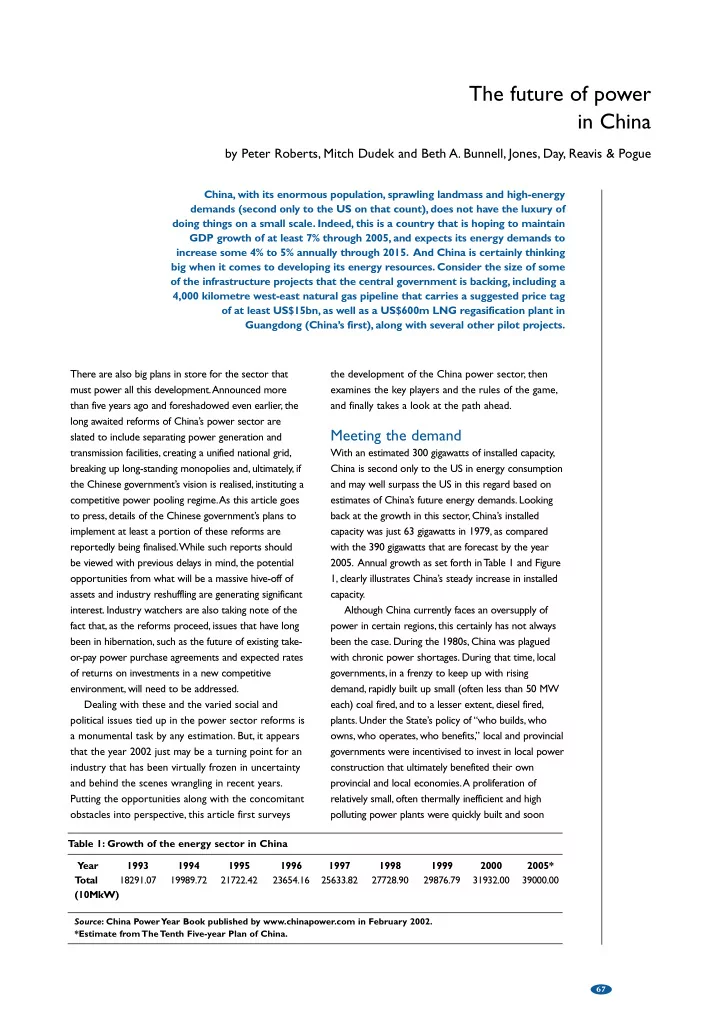
With an estimated 300 gigawatts of installed capacity, China is second only to the US in energy consumption and may well surpass the US in this regard based on estimates of China’s future energy demands. Looking back at the growth in this sector, China’s installed capacity was just 63 gigawatts in 1979, as compared with the 390 gigawatts that are forecast by the year
- 2005. Annual growth as set forth in Table 1 and Figure
1, clearly illustrates China’s steady increase in installed capacity. Although China currently faces an oversupply of power in certain regions, this certainly has not always been the case. During the 1980s, China was plagued with chronic power shortages. During that time, local governments, in a frenzy to keep up with rising demand, rapidly built up small (often less than 50 MW each) coal fired, and to a lesser extent, diesel fired,
- plants. Under the State’s policy of “who builds, who
- wns, who operates, who benefits,” local and provincial
governments were incentivised to invest in local power construction that ultimately benefited their own provincial and local economies.A proliferation of relatively small, often thermally inefficient and high polluting power plants were quickly built and soon Table 1: Growth of the energy sector in China Y ear 1993 1994 1995 1996 1997 1998 1999 2000 2005* T
- tal
18291.07 19989.72 21722.42 23654.16 25633.82 27728.90 29876.79 31932.00 39000.00 (10MkW)
Source: China Power Year Book published by www.chinapower.com in February 2002. *Estimate from The T enth Five-year Plan of China.