The Franklin Expedition UDSL: Nov 13, 2014 Neil Newman What was - - PowerPoint PPT Presentation

the franklin expedition
SMART_READER_LITE
LIVE PREVIEW

The Franklin Expedition UDSL: Nov 13, 2014 Neil Newman What was - - PowerPoint PPT Presentation

The Franklin Expedition UDSL: Nov 13, 2014 Neil Newman What was the Franklin expedition? A British voyage of Arctic exploration led by Captain Sir John Franklin sets off from England on May 19 th , 1845 with 129 men. The ships are Terror


slide-1
SLIDE 1

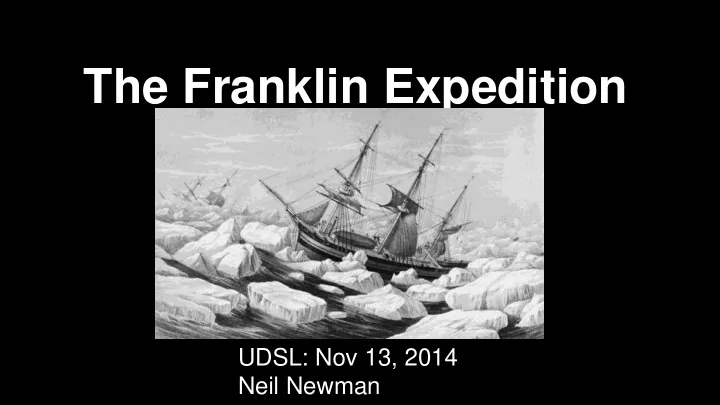
The Franklin Expedition

UDSL: Nov 13, 2014 Neil Newman
slide-2
SLIDE 2

What was the Franklin expedition?

  • A British voyage of Arctic exploration led by Captain Sir

John Franklin sets off from England on May 19th, 1845 with 129 men. The ships are Terror and Erebus.

  • The vessels are seen for the last time by Europeans in

Baffin Bay July 28th, 1845

  • Search missions are carried out starting 1848, involving

13 ships at peak effort

  • There are no survivors. The ships are never found. Only

a few tantalizing clues are discovered over the years.

slide-3
SLIDE 3
slide-4
SLIDE 4

Franklin Expedition in Canadian Culture

“In every culture many stories are told, (but)

  • nly some are told and retold, and these stories

bear examining ... in Canadian literature, one such story is the Franklin expedition”

  • Margaret Atwood
slide-5
SLIDE 5
slide-6
SLIDE 6
slide-7
SLIDE 7

Finding a ship in the arctic is hard

slide-8
SLIDE 8
  • Without survivors, our only clues come from

discovering artifacts and Inuit oral tradition

  • Only one document is ever discovered. The

note is found in 1859 on King William Island

What happened?

slide-9
SLIDE 9
slide-10
SLIDE 10
  • H. M. ships 'Erebus' and 'Terror' wintered in the ice in

28 of May, 1847 lat. 70° 05' N. long. 98° 23' W. Having wintered in 1846–7 at Beechey Island in lat. 74° 43' 28" N.; long. 91° 39' 15" W., after having ascended Wellington Channel to lat. 77° and returned by the west side of Cornwallis Island. Sir John Franklin commanding the expedition. All well. Party consisting of 2 officers and 6 men left the ships

  • n Monday, 24 May 1847.
  • Gm. Gore, Lieut.
  • Chas. F. Des Voeus, Mate.
slide-11
SLIDE 11

April 25, 1848 – H. M. ships 'Terror' and 'Erebus' were deserted on the 22d April, 5 leagues N. N. W. of this, having been beset since 12th September 1846. The

  • fficers and crews, consisting of 105 souls,

under the command of Captain F. R. M. Crozier, landed here in lat. 69° 37' 42" N., long 98° 41' W. Sir John Franklin died on the 11th June, 1847; and the total loss by deaths in the expedition has been to this date 9 officers and 15 men.

slide-12
SLIDE 12

The Graves

slide-13
SLIDE 13

Lead poisoning

  • Bone samples reveal high concentrations of lead in

1981

  • Graves are exhumed for tissue / hair samples in 1984

confirming results

  • Lead poisoning leads to severe mental and physical

problems

  • Badly soldered cans prepared in a hurry for the

voyage?

  • Poorly designed water systems?
slide-14
SLIDE 14

Cannibalism

  • The voyage had food supplies for 5 years
  • "from the mutilated state of many of the bodies and the

contents of the kettles, it is evident that our wretched Countrymen had been driven to the last dread alternative — cannibalism — as a means of prolonging existence"

slide-15
SLIDE 15

Inuit encounters

  • 1850: Inuit board an abandoned ship. Later,

40 men are seen walking south.

  • 1851: Inuit hunters see four men heading

south

  • 1852-1858: Possible sighting of two

survivors heading south

  • 1854: Inuit interviews: items from expedition,

tells that men starved to death after resorting to cannibalism

slide-16
SLIDE 16

HMS Investigator

  • Set out in 1848 to search for Franklin
  • Abandoned in 1853 after becoming trapped

in the ice.

  • Inuit use the ship’s hull for copper and iron.

One year the ship is “Gone without a trace”

  • Discovered in 2010
slide-17
SLIDE 17
slide-18
SLIDE 18

Ship discovery video

slide-19
SLIDE 19

Still being reported on

slide-20
SLIDE 20

Man Proposes, God disposes